
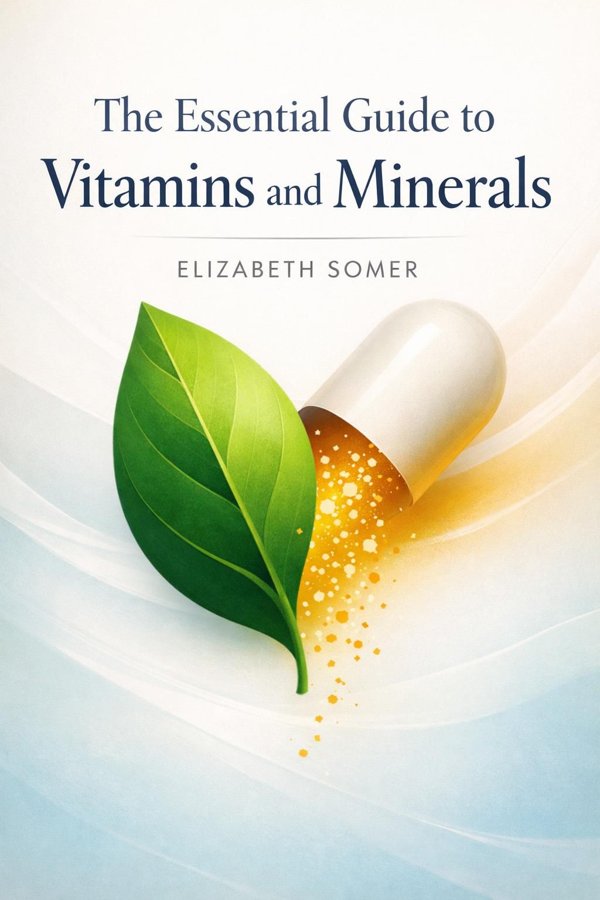
The Essential Guide to Vitamins and Minerals: Practical Evidence-Based Compendium: Summary & Key Insights
 10 min9 chaptersAudio available
Key Takeaways from The Essential Guide to Vitamins and Minerals: Practical Evidence-Based Compendium
The most important forces in health are often the least dramatic.
Numbers on a nutrition chart can look dry, but they represent decades of accumulated knowledge about what the body needs to function well.
Some nutrients are like a paycheck that must keep arriving because there is little savings account to draw from.
Not all nutrients behave the same way, and fat-soluble vitamins remind us that storage can be both an advantage and a risk.
If vitamins are the body’s spark plugs, minerals are often its beams, wiring, and control systems.
What Is The Essential Guide to Vitamins and Minerals: Practical Evidence-Based Compendium About?
The Essential Guide to Vitamins and Minerals: Practical Evidence-Based Compendium by Elizabeth Somer is a nutrition book spanning 7 pages. In a world crowded with nutrition myths, supplement marketing, and conflicting health advice, The Essential Guide to Vitamins and Minerals offers something rare: clear, grounded, evidence-based guidance on the nutrients the body depends on every day. Elizabeth Somer explains what vitamins and minerals do, how much people need, what happens when intake falls short, and when supplements may help—or harm. Rather than treating nutrition as a collection of fads, she presents it as a practical science tied to energy, immunity, bone strength, brain function, metabolism, and healthy aging. What makes this book especially valuable is its balance of accessibility and rigor. Somer translates nutritional research into language ordinary readers can use, while still providing enough precision to be useful for health-conscious professionals, educators, and caregivers. Her background as a registered dietitian and nutrition expert gives the book credibility, but its real strength lies in how actionable it is. This is not a book about chasing perfection. It is a handbook for making better everyday choices, understanding your body’s nutritional needs, and approaching supplements and dietary planning with caution, confidence, and common sense.
This FizzRead summary covers all 9 key chapters of The Essential Guide to Vitamins and Minerals: Practical Evidence-Based Compendium in approximately 10 minutes, distilling the most important ideas, arguments, and takeaways from Elizabeth Somer's work. Also available as an audio summary and Key Quotes Podcast.
The Essential Guide to Vitamins and Minerals: Practical Evidence-Based Compendium
In a world crowded with nutrition myths, supplement marketing, and conflicting health advice, The Essential Guide to Vitamins and Minerals offers something rare: clear, grounded, evidence-based guidance on the nutrients the body depends on every day. Elizabeth Somer explains what vitamins and minerals do, how much people need, what happens when intake falls short, and when supplements may help—or harm. Rather than treating nutrition as a collection of fads, she presents it as a practical science tied to energy, immunity, bone strength, brain function, metabolism, and healthy aging.
What makes this book especially valuable is its balance of accessibility and rigor. Somer translates nutritional research into language ordinary readers can use, while still providing enough precision to be useful for health-conscious professionals, educators, and caregivers. Her background as a registered dietitian and nutrition expert gives the book credibility, but its real strength lies in how actionable it is. This is not a book about chasing perfection. It is a handbook for making better everyday choices, understanding your body’s nutritional needs, and approaching supplements and dietary planning with caution, confidence, and common sense.
Who Should Read The Essential Guide to Vitamins and Minerals: Practical Evidence-Based Compendium?
This book is perfect for anyone interested in nutrition and looking to gain actionable insights in a short read. Whether you're a student, professional, or lifelong learner, the key ideas from The Essential Guide to Vitamins and Minerals: Practical Evidence-Based Compendium by Elizabeth Somer will help you think differently.
- ✓Readers who enjoy nutrition and want practical takeaways
- ✓Professionals looking to apply new ideas to their work and life
- ✓Anyone who wants the core insights of The Essential Guide to Vitamins and Minerals: Practical Evidence-Based Compendium in just 10 minutes
Want the full summary?
Get instant access to this book summary and 100K+ more with Fizz Moment.
Get Free SummaryAvailable on App Store • Free to download
Key Chapters
The most important forces in health are often the least dramatic. Vitamins and minerals do not promise overnight transformation, yet they make nearly every aspect of life possible: converting food into energy, building tissues, supporting nerve signals, maintaining immunity, protecting cells, and helping enzymes do their work. Somer’s central point is that nutrients are not optional extras added to a “healthy lifestyle”; they are the machinery behind the lifestyle itself.
The book begins by clarifying the difference between vitamins and minerals. Vitamins are organic compounds that are generally fragile and can be destroyed by heat, light, or storage conditions. Minerals are inorganic elements that come from soil and water and are more stable, though their absorption can vary. Both are essential because the body cannot manufacture enough of them—or in many cases, any of them at all—to meet its needs. A deficiency may begin subtly, with fatigue, poor concentration, brittle nails, muscle weakness, frequent illness, or low mood, long before serious disease appears.
Somer also emphasizes that nutrients work in teams. Calcium needs vitamin D for efficient absorption. Iron metabolism interacts with vitamin C, copper, and protein status. B vitamins are deeply interconnected in energy metabolism. This means that reducing nutrition to a single “super nutrient” misses the bigger picture. Health is created through patterns, not isolated miracles.
A practical example is someone focused only on calories while ignoring nutrient density. They may eat enough food but still feel exhausted because the diet lacks iron, magnesium, or folate. Another person may chase supplements but neglect balanced meals, missing the synergy whole foods provide.
Actionable takeaway: Stop thinking of nutrients as tiny details and start treating them as core daily inputs—build meals around varied, minimally processed foods so your body gets the full team of compounds it needs.
Numbers on a nutrition chart can look dry, but they represent decades of accumulated knowledge about what the body needs to function well. Somer explains Recommended Dietary Allowances, Adequate Intakes, and other reference values as practical tools rather than rigid rules. Their purpose is not to create anxiety or perfectionism; it is to help individuals and professionals estimate whether intake is likely to be sufficient.
One of the book’s most useful insights is that recommended intakes are designed to cover the needs of nearly all healthy people in a specific age and sex group. They are population-based benchmarks, not flawless prescriptions for every individual. Needs can rise or fall depending on pregnancy, illness, medications, lifestyle, smoking, alcohol intake, athletic training, aging, and absorption issues. This is why two people eating similarly may not have the same nutritional status.
Somer also helps readers avoid a common misunderstanding: more is not automatically better. If the RDA is beneficial, some assume several times that amount must be even better. But nutrients have optimal ranges. Too little causes deficiency, while too much can create toxicity, interfere with other nutrients, or produce false confidence that a poor diet has been “fixed.” Upper intake levels exist for a reason.
For example, a woman of childbearing age should pay special attention to folate and iron, while an older adult may need more focus on vitamin D, calcium, and B12. A strict vegan may need to plan carefully for B12, iron, zinc, iodine, and omega-3s. The reference values help guide those decisions, even if personal adjustment is necessary.
Actionable takeaway: Use nutrient recommendations as informed guardrails—review your age, sex, and life-stage needs, then identify where your diet may need targeted improvement rather than guessing or supplementing blindly.
Some nutrients are like a paycheck that must keep arriving because there is little savings account to draw from. That is the role of water-soluble vitamins, especially the B-complex vitamins and vitamin C. Because the body stores many of them poorly and excess amounts are often excreted, consistent intake matters far more than occasional bursts.
Somer explains that the B vitamins are central to energy metabolism, but not in the simplistic way many advertisements suggest. They do not “give” energy directly like calories do; instead, they help unlock energy from carbohydrates, fats, and proteins. Thiamin, riboflavin, niacin, B6, folate, and B12 all play distinct roles in these pathways. Deficiencies can lead to fatigue, neurological problems, anemia, mood changes, and impaired concentration. Vitamin C, meanwhile, supports collagen formation, immune defense, wound healing, and antioxidant protection, and it also helps improve non-heme iron absorption from plant foods.
This section matters because many modern diets are abundant in calories but sparse in micronutrients. Refined grains can strip away B vitamins unless enriched. Low fruit and vegetable intake can reduce vitamin C. Alcohol misuse, highly restrictive diets, gastrointestinal disorders, and certain medications can also compromise status. Older adults, in particular, may struggle with B12 absorption even if intake appears adequate.
Practical applications are straightforward. Include whole grains, legumes, leafy greens, eggs, dairy, fish, meat, citrus, berries, peppers, potatoes, and beans across the week. Pair lentils or spinach with vitamin C-rich foods like tomatoes or oranges to boost iron uptake. If you are often tired, do not assume caffeine is the answer; nutrient adequacy may be part of the story.
Actionable takeaway: Because water-soluble vitamins need regular replenishment, build daily habits—eat a range of whole grains, produce, and protein foods instead of relying on occasional “healthy” meals to cover the gap.
Not all nutrients behave the same way, and fat-soluble vitamins remind us that storage can be both an advantage and a risk. Vitamins A, D, E, and K are absorbed along with dietary fat and can be stored in body tissues, especially the liver and fat stores. This means the body can draw on reserves over time, but it also means excessive supplementation can become dangerous more easily than with many water-soluble vitamins.
Somer shows how each of these vitamins supports a different dimension of health. Vitamin A is vital for vision, immune defense, and cellular differentiation, though excessive preformed vitamin A can be toxic. Vitamin D supports calcium balance, bone health, muscle function, and broader physiological regulation, yet many people do not get enough because of limited sunlight exposure, skin pigmentation, latitude, sunscreen use, aging, or dietary patterns. Vitamin E acts primarily as an antioxidant protecting cell membranes, while vitamin K is essential for blood clotting and bone metabolism.
The book wisely resists simplistic advice. For example, the solution to poor vitamin D status is not automatically megadosing. Testing, risk factors, diet, and medical guidance all matter. Similarly, people taking anticoagulant medications need to understand vitamin K consistency rather than fearing green vegetables. And because fat absorption is necessary, severe low-fat diets or digestive disorders can impair use of these vitamins even when intake seems sufficient.
A practical eating pattern would include eggs, dairy or fortified alternatives, fatty fish, leafy greens, nuts, seeds, vegetable oils, and colorful produce such as carrots and sweet potatoes. Modest dietary fat can improve absorption of carotenoids and vitamin K from vegetables.
Actionable takeaway: Treat fat-soluble vitamins with respect—aim first for steady intake from foods, understand your personal risk factors, and avoid high-dose supplements unless there is a clear evidence-based reason.
If vitamins are the body’s spark plugs, minerals are often its beams, wiring, and control systems. Somer presents minerals as foundational to both visible structures and invisible regulation. Calcium and phosphorus build bones and teeth, magnesium participates in hundreds of enzymatic reactions, sodium and potassium regulate fluid balance and nerve transmission, iron carries oxygen, zinc supports immunity and wound healing, iodine enables thyroid hormone production, and selenium contributes to antioxidant defense.
A major strength of the book is its explanation that mineral health is never just about intake. Absorption, losses, and balance are equally important. Iron from animal foods is generally absorbed more efficiently than iron from plants, but vitamin C can significantly improve plant iron absorption. Excess sodium can worsen blood pressure and may affect calcium losses. Too much supplemental zinc can interfere with copper. Calcium, iron, and magnesium supplements can compete for absorption depending on timing and dosage.
Somer also highlights how modern eating habits can distort mineral status. Processed foods often deliver abundant sodium but limited potassium and magnesium. People who avoid dairy without careful substitution may fall short on calcium. Heavy menstrual losses can raise iron needs. Endurance athletes may lose substantial electrolytes through sweat, while older adults may eat less overall and reduce mineral intake unintentionally.
Applications are practical and familiar: beans, nuts, seeds, dairy or fortified alternatives, leafy greens, seafood, whole grains, fruits, vegetables, and lean proteins all contribute important minerals. Salt reduction helps, but so does increasing potassium-rich foods like potatoes, bananas, beans, yogurt, and greens. Bone health depends on more than calcium alone; magnesium, phosphorus, vitamin D, activity, and protein all matter.
Actionable takeaway: Think in terms of mineral patterns, not single fixes—reduce processed foods, diversify whole-food sources, and be mindful that the body needs the right mineral balance as much as the right mineral amount.
By the time a full deficiency disease appears, the body has usually been compensating for a long time. One of Somer’s most practical messages is that nutrient shortfalls often begin with vague symptoms that people normalize: tiredness, poor concentration, headaches, weak immunity, low exercise tolerance, mouth sores, numbness, muscle cramps, mood changes, or brittle hair and nails. Because these signs are nonspecific, deficiencies are easy to miss or blame on stress, aging, or lack of sleep.
The book encourages readers to think in terms of risk factors and patterns rather than self-diagnosing from one symptom. Restrictive diets, eating disorders, gastrointestinal conditions, pregnancy, alcohol overuse, food insecurity, medication interactions, and chronic illness all raise the chance of shortfalls. Older adults may have reduced appetite, lower stomach acid, and poorer absorption of nutrients such as B12, calcium, and vitamin D. Vegans can thrive nutritionally, but only if B12 and several other nutrients are intentionally planned.
Somer’s discussion of supplementation is measured and evidence-based. Supplements can be useful for confirmed deficiencies, predictable life-stage needs, medically diagnosed malabsorption, or situations where diet alone is insufficient. But they are not nutritional insurance against consistently poor eating. High doses may create toxicity, mask underlying problems, or interfere with medications and other nutrients. The quality, form, and timing of a supplement also matter.
For example, iron supplements should not be taken casually just because fatigue is present; low iron should be confirmed and the cause investigated. Folate can correct megaloblastic anemia while masking B12-related nerve damage if B12 deficiency goes untreated. Even common supplements deserve careful use.
Actionable takeaway: If you suspect a deficiency, do not guess—review your diet, consider your risk factors, and seek targeted testing or professional guidance before turning supplements into a long-term habit.
A nutrient plan that works at one age may be inadequate at another. Somer emphasizes that nutritional needs evolve across the lifespan because growth, reproduction, hormonal changes, body composition, appetite, absorption, and activity all change. This makes life-stage awareness one of the most practical tools in preventive nutrition.
In infancy and childhood, nutrients support rapid growth, brain development, and immune resilience. Calcium, vitamin D, iron, zinc, and essential fats are especially important. During adolescence, growth spurts and, for girls, menstrual losses can increase needs for calcium and iron. In the reproductive years, folate becomes critical before and during early pregnancy to reduce neural tube defects, while iron demands rise with menstruation and pregnancy. Pregnancy and lactation increase needs for multiple nutrients, not just one or two headline vitamins.
Later in life, the nutritional picture shifts again. Older adults often need fewer calories but equal or greater amounts of several nutrients. This means food quality becomes even more important. Vitamin D, calcium, B12, protein, magnesium, and hydration deserve special attention. Reduced appetite, dental issues, medication use, limited mobility, and social isolation can all make nutrient adequacy harder to maintain.
Somer also notes that lifestyle factors can alter nutrient needs at any age. Smoking can reduce vitamin C status. High alcohol intake impairs absorption and metabolism of several nutrients. Highly active people may need more energy, electrolytes, and certain micronutrients. People under chronic stress may eat poorly or skip meals, indirectly undermining nutrient intake.
A practical application is to reassess nutrition during transitions: starting college, becoming pregnant, entering menopause, recovering from illness, or caring for aging parents. Each stage brings new risks and priorities.
Actionable takeaway: Revisit your nutrient strategy whenever your life stage or routine changes—good nutrition is not static, and your body’s needs deserve periodic recalibration.
The appeal of supplements is easy to understand: they seem precise, convenient, and controllable. But Somer repeatedly makes the case that food should remain the primary source of vitamins and minerals whenever possible. Whole foods provide not only known nutrients but also fiber, water, protein, healthy fats, and thousands of bioactive compounds that work together in ways pills cannot fully replicate.
This is not an anti-supplement argument. It is an argument against magical thinking. A supplement can help fill a real gap—prenatal folic acid, vitamin B12 for vegans, vitamin D in low-sun or high-risk populations, iron for documented deficiency, calcium when food intake is inadequate, and medically guided therapeutic use in specific conditions. But a supplement is most effective when it solves a defined problem, not when it substitutes for a pattern of nutrient-poor eating.
Somer also highlights quality and context. The same nutrient may come in different forms with different bioavailability. Dosage matters. Timing matters. Drug-nutrient interactions matter. A person taking thyroid medication, anticoagulants, acid suppressants, or diuretics should be especially careful. What helps one person may be unnecessary or even harmful for another.
Practical examples include reading labels for dose relative to daily needs, avoiding duplicate ingredients across multivitamins and specialty products, and being skeptical of supplements that promise detoxification, anti-aging miracles, or dramatic energy boosts. A balanced breakfast of yogurt, berries, oats, and nuts often contributes more meaningful nutrition than an expensive “wellness stack.”
Actionable takeaway: Build your foundation with food, use supplements only to address a specific need, and insist on evidence, dosage awareness, and professional guidance before adding anything to your daily routine.
Good nutrition is not just about knowing nutrient names; it is about learning how to interpret health information wisely. One of the book’s lasting contributions is that it teaches readers to become more critical and more confident at the same time. Somer encourages a mindset of nutritional literacy: understand what evidence says, distinguish established need from marketing hype, and evaluate claims in context.
This matters because the public is constantly exposed to exaggerated promises. A headline may celebrate magnesium as the cure for stress, vitamin C as the answer to immunity, or zinc as a universal shield against illness. There may be a kernel of truth, but isolated messages often strip away dosage, limitations, interactions, and the larger dietary picture. Somer’s evidence-based tone pushes back against this fragmented thinking.
Nutrition literacy includes reading food labels, recognizing fortified foods, understanding serving sizes, noticing when “natural” is used as a meaningless selling point, and realizing that anecdote is not proof. It also means asking smarter questions: Is this advice based on deficiency prevention, disease treatment, or marketing? Was the evidence from a large human study or a lab model? Does this recommendation apply to healthy adults, pregnant women, children, athletes, or people with medical conditions?
In practice, this skill changes daily decisions. Instead of buying every new supplement trend, a reader might improve breakfast quality, add more legumes and greens, get a lab test before self-treating fatigue, or ask a clinician whether a medication affects nutrient absorption. These are not glamorous moves, but they are effective.
Actionable takeaway: Develop nutrition literacy as a lifelong skill—question sweeping claims, understand your personal context, and make decisions based on patterns, evidence, and practical usefulness rather than hype.
All Chapters in The Essential Guide to Vitamins and Minerals: Practical Evidence-Based Compendium
About the Author
Elizabeth Somer is a registered dietitian, nutritionist, and health writer known for making complex nutritional science understandable and useful for everyday readers. Her work centers on evidence-based wellness, preventive health, and practical dietary guidance rather than fad-driven advice. Over the course of her career, she has written books and articles on nutrition, women’s health, healthy aging, and lifestyle medicine, earning a reputation for combining scientific credibility with a clear, approachable voice. Somer’s strength lies in translating research into realistic strategies people can apply in daily life, whether they are trying to improve eating habits, prevent deficiencies, or evaluate supplements more wisely. In The Essential Guide to Vitamins and Minerals, she brings that expertise to one of the most commonly misunderstood areas of health, offering readers a reliable framework for understanding what the body truly needs.
Get This Summary in Your Preferred Format
Read or listen to the The Essential Guide to Vitamins and Minerals: Practical Evidence-Based Compendium summary by Elizabeth Somer anytime, anywhere. FizzRead offers multiple formats so you can learn on your terms — all free.
Available formats: App · Audio · PDF · EPUB — All included free with FizzRead
Download The Essential Guide to Vitamins and Minerals: Practical Evidence-Based Compendium PDF and EPUB Summary
Key Quotes from The Essential Guide to Vitamins and Minerals: Practical Evidence-Based Compendium
“The most important forces in health are often the least dramatic.”
“Numbers on a nutrition chart can look dry, but they represent decades of accumulated knowledge about what the body needs to function well.”
“Some nutrients are like a paycheck that must keep arriving because there is little savings account to draw from.”
“Not all nutrients behave the same way, and fat-soluble vitamins remind us that storage can be both an advantage and a risk.”
“If vitamins are the body’s spark plugs, minerals are often its beams, wiring, and control systems.”
Frequently Asked Questions about The Essential Guide to Vitamins and Minerals: Practical Evidence-Based Compendium
The Essential Guide to Vitamins and Minerals: Practical Evidence-Based Compendium by Elizabeth Somer is a nutrition book that explores key ideas across 9 chapters. In a world crowded with nutrition myths, supplement marketing, and conflicting health advice, The Essential Guide to Vitamins and Minerals offers something rare: clear, grounded, evidence-based guidance on the nutrients the body depends on every day. Elizabeth Somer explains what vitamins and minerals do, how much people need, what happens when intake falls short, and when supplements may help—or harm. Rather than treating nutrition as a collection of fads, she presents it as a practical science tied to energy, immunity, bone strength, brain function, metabolism, and healthy aging. What makes this book especially valuable is its balance of accessibility and rigor. Somer translates nutritional research into language ordinary readers can use, while still providing enough precision to be useful for health-conscious professionals, educators, and caregivers. Her background as a registered dietitian and nutrition expert gives the book credibility, but its real strength lies in how actionable it is. This is not a book about chasing perfection. It is a handbook for making better everyday choices, understanding your body’s nutritional needs, and approaching supplements and dietary planning with caution, confidence, and common sense.
More by Elizabeth Somer
You Might Also Like
Eating by the Seasons Cookbook: Seasonal Produce-Focused Recipes
Clare Foster
10 min
From Crook to Cook: Platinum Recipes from Tha Boss Dogg's Kitchen
Snoop Dogg with Ryan Ford
10 min
Juicing for Beginners: The Essential Guide to Juicing Recipes and Juicing for Weight Loss
Rockridge Press
10 min
The Food Therapist: Break Bad Habits, Eat with Intention, and Indulge Without Worry
Shira Lenchewski
10 min
The Mediterranean Diet Meal Plan: A 4-Week Meal Plan for Optimal Health and Weight Loss
Various Contributors
10 min
The Well Plated Cookbook: Simple, Wholesome Recipes for Everyday Meals
Erin Clarke
10 minBrowse by Category
Ready to read The Essential Guide to Vitamins and Minerals: Practical Evidence-Based Compendium?
Get the full summary and 100K+ more books with Fizz Moment.