
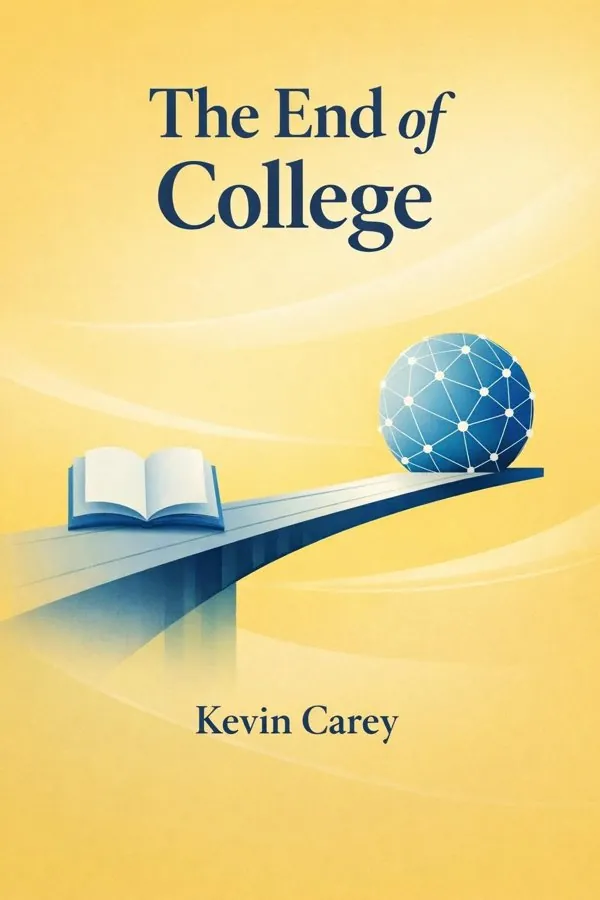
The End of College: Creating the Future of Learning and the University of Everywhere: Summary & Key Insights
by Kevin Carey
 10 min11 chaptersAudio available
What Is The End of College: Creating the Future of Learning and the University of Everywhere About?
The End of College: Creating the Future of Learning and the University of Everywhere by Kevin Carey is a education book spanning 11 pages. A paradigm-shifting examination of the rapidly changing world of higher education, exploring how technology and innovation are transforming traditional universities and creating new models of learning accessible to everyone. Kevin Carey argues that the future of college will be decentralized, personalized, and globally connected, redefining what it means to earn a degree and learn in the digital age.
This FizzRead summary covers all 11 key chapters of The End of College: Creating the Future of Learning and the University of Everywhere in approximately 10 minutes, distilling the most important ideas, arguments, and takeaways from Kevin Carey's work. Also available as an audio summary and Key Quotes Podcast.
The End of College: Creating the Future of Learning and the University of Everywhere
A paradigm-shifting examination of the rapidly changing world of higher education, exploring how technology and innovation are transforming traditional universities and creating new models of learning accessible to everyone. Kevin Carey argues that the future of college will be decentralized, personalized, and globally connected, redefining what it means to earn a degree and learn in the digital age.
Who Should Read The End of College: Creating the Future of Learning and the University of Everywhere?
This book is perfect for anyone interested in education and looking to gain actionable insights in a short read. Whether you're a student, professional, or lifelong learner, the key ideas from The End of College: Creating the Future of Learning and the University of Everywhere by Kevin Carey will help you think differently.
- ✓Readers who enjoy education and want practical takeaways
- ✓Professionals looking to apply new ideas to their work and life
- ✓Anyone who wants the core insights of The End of College: Creating the Future of Learning and the University of Everywhere in just 10 minutes
Want the full summary?
Get instant access to this book summary and 100K+ more with Fizz Moment.
Get Free SummaryAvailable on App Store • Free to download
Key Chapters
To understand what is ending, we must first understand what was built. The modern American university didn’t emerge overnight—it evolved from centuries of European tradition rooted in elitism and exclusivity. In its earliest form, the university was a cloistered institution designed for the ruling class, a physical embodiment of authority over knowledge. Its power rested not only on scholarship but on scarcity: only a select few could enter those gates.
In the nineteenth and early twentieth centuries, as the United States grew, education gradually expanded from elite privilege to mass participation. The Morrill Act of 1862 opened the door to public universities that served the practical needs of a growing industrial nation. Yet even as the mission broadened, the prestige hierarchy remained. Elite schools consolidated their cultural power through branding, physical campuses, and the mystique of old traditions.
Credentialing became the ultimate authority—for employers, governments, and society. Universities claimed the exclusive right to certify knowledge and expertise. The transcript, the diploma, the degree—each became a symbolic gatekeeper, making the institution indispensable. This credentialing monopoly is at the core of what I argue must now change. In a world where knowledge can be accessed freely and demonstrated transparently, authority can no longer rest on the institution alone.
The origins of the modern university show us a system optimized for scarcity; its logic runs counter to today’s digital abundance. The gates that once defined exclusivity are becoming porous, and the walls once protecting academic prestige are giving way to open platforms. What once separated learners—space, class, and privilege—can now be transcended by connection.
As the university system expanded, the financial underpinnings grew increasingly dysfunctional. The prevailing model hinges on ever-rising tuition and the race for prestige. Families are told that college is essential, even as it becomes unaffordable. Institutions chase rankings by building grand facilities and expanding administrative overhead. The result is a market divorced from the actual value of learning.
Student debt, now measured in trillions of dollars nationally, reflects a broken promise. We’ve told generations that a degree guarantees stability, yet many graduates find themselves burdened by debt, underemployed, and uncertain of the return on their investment. Universities justify these costs through reputation, not outcomes—a model that’s beginning to crumble under scrutiny.
The irony is that technology has drastically lowered the real cost of delivering education. It costs far less to stream a world-class lecture than to maintain vast arrays of physical infrastructure. Yet universities cling to physicality—the campus, the ceremony, the exclusivity—because these are what sustain their economic dominance. In this way, higher education has become less about learning and more about brand maintenance.
That imbalance cannot last. Transparency and data are beginning to expose the inefficiencies. As students demand more flexible, affordable alternatives and governments seek accountability, the traditional economic model will face its reckoning. The future will favor organizations that align cost with value and learning with outcomes—something the University of Everywhere naturally embodies. It is not a revolution of destruction, but of redistribution: shifting investment from bricks to minds.
+ 9 more chapters — available in the FizzRead app
All Chapters in The End of College: Creating the Future of Learning and the University of Everywhere
About the Author
Kevin Carey is an American education writer and policy analyst known for his work on higher education reform. He serves as the vice president for education policy and knowledge management at New America, where he focuses on innovation, accountability, and access in education.
Get This Summary in Your Preferred Format
Read or listen to the The End of College: Creating the Future of Learning and the University of Everywhere summary by Kevin Carey anytime, anywhere. FizzRead offers multiple formats so you can learn on your terms — all free.
Available formats: App · Audio · PDF · EPUB — All included free with FizzRead
Download The End of College: Creating the Future of Learning and the University of Everywhere PDF and EPUB Summary
Key Quotes from The End of College: Creating the Future of Learning and the University of Everywhere
“To understand what is ending, we must first understand what was built.”
“As the university system expanded, the financial underpinnings grew increasingly dysfunctional.”
Frequently Asked Questions about The End of College: Creating the Future of Learning and the University of Everywhere
The End of College: Creating the Future of Learning and the University of Everywhere by Kevin Carey is a education book that explores key ideas across 11 chapters. A paradigm-shifting examination of the rapidly changing world of higher education, exploring how technology and innovation are transforming traditional universities and creating new models of learning accessible to everyone. Kevin Carey argues that the future of college will be decentralized, personalized, and globally connected, redefining what it means to earn a degree and learn in the digital age.
You Might Also Like

Bedtime Biography: Florence Nightingale
Isabel Thomas
10 min
Introduction To Museum Studies
Howard H. Hoyt
10 min
A Mind for Numbers: How to Excel at Math and Science (Even If You Flunked Algebra)
Barbara Oakley
10 min
AI for Educators: Learning Strategies, Teacher Empowerment, and the Future of Education
Matt Miller
10 min
Animation For Beginners
Morr Meroz
10 min
Artificial Intelligence for Learning
Donald Clark
10 minBrowse by Category
Ready to read The End of College: Creating the Future of Learning and the University of Everywhere?
Get the full summary and 100K+ more books with Fizz Moment.