
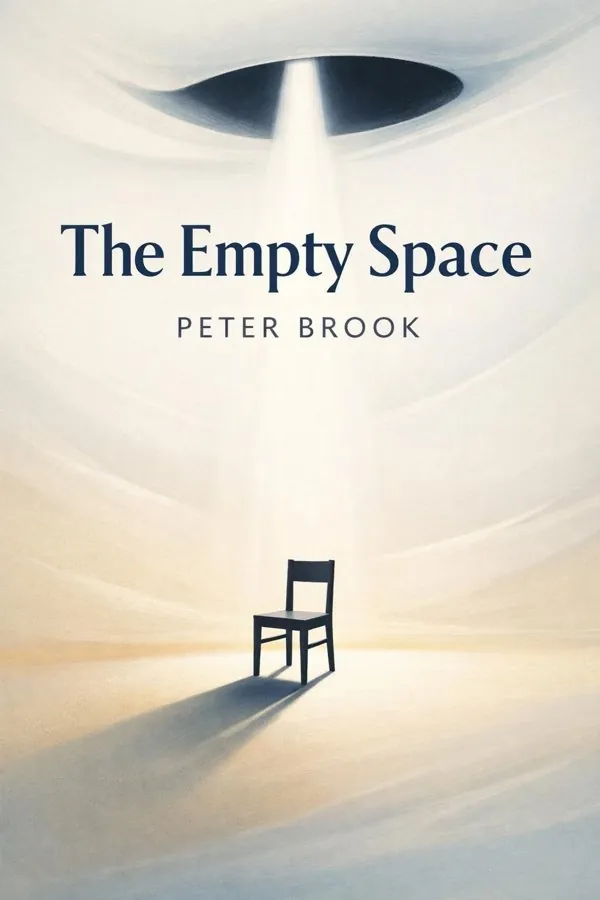
The Empty Space: A Book About the Theatre: Deadly, Holy, Rough, Immediate: Summary & Key Insights
by Peter Brook
 10 min4 chaptersAudio available
What Is The Empty Space: A Book About the Theatre: Deadly, Holy, Rough, Immediate About?
The Empty Space: A Book About the Theatre: Deadly, Holy, Rough, Immediate by Peter Brook is a performing_arts book spanning 4 pages. In this influential work, British theatre director Peter Brook explores four distinct approaches to theatre: the Deadly, the Holy, the Rough, and the Immediate. Drawing from his extensive experience in stage direction, Brook examines the essence of performance, the relationship between actor and audience, and the transformative potential of theatre. The book remains a foundational text in modern theatre theory and practice.
This FizzRead summary covers all 4 key chapters of The Empty Space: A Book About the Theatre: Deadly, Holy, Rough, Immediate in approximately 10 minutes, distilling the most important ideas, arguments, and takeaways from Peter Brook's work. Also available as an audio summary and Key Quotes Podcast.
The Empty Space: A Book About the Theatre: Deadly, Holy, Rough, Immediate
In this influential work, British theatre director Peter Brook explores four distinct approaches to theatre: the Deadly, the Holy, the Rough, and the Immediate. Drawing from his extensive experience in stage direction, Brook examines the essence of performance, the relationship between actor and audience, and the transformative potential of theatre. The book remains a foundational text in modern theatre theory and practice.
Who Should Read The Empty Space: A Book About the Theatre: Deadly, Holy, Rough, Immediate?
This book is perfect for anyone interested in performing_arts and looking to gain actionable insights in a short read. Whether you're a student, professional, or lifelong learner, the key ideas from The Empty Space: A Book About the Theatre: Deadly, Holy, Rough, Immediate by Peter Brook will help you think differently.
- ✓Readers who enjoy performing_arts and want practical takeaways
- ✓Professionals looking to apply new ideas to their work and life
- ✓Anyone who wants the core insights of The Empty Space: A Book About the Theatre: Deadly, Holy, Rough, Immediate in just 10 minutes
Want the full summary?
Get instant access to this book summary and 100K+ more with Fizz Moment.
Get Free SummaryAvailable on App Store • Free to download
Key Chapters
The Deadly Theatre is the first enemy I invite us to confront. It is not bad theatre in the obvious sense; it can often be respectable, even well-reviewed. Its danger lies in its imitation of life, its imitation of art. This is the theatre that repeats forms because they are successful, that reveres tradition without question, that bows to commercial comfort rather than creative truth. It is deadly precisely because it deceives us into believing we are experiencing vitality when we are only consuming a ritual of habit.
The deadly theatre persists in polished productions where directors and actors reproduce interpretations sanctioned by critics and institutions. It feeds on the audience’s laziness and on the critic’s fear of change. Shakespeare, Chekhov, Ibsen—all become embalmed figures, their works recited with reverence rather than discovery. The words may survive, but their spirit dies. What’s lost is the electric spark between actor and spectator, the act of shared creation that makes theatre real.
I have seen it happen everywhere—from the grandest national theatres to the smallest local stages. Institutions, by habit or necessity, protect what they already know how to do. The result is stagnation masked as tradition. The actor obeys the director, the director pleases the management, and the audience applauds politely. In this cycle, no one risks the unknown, and art becomes corporate. Deadly Theatre survives because it is safer than truth.
But even as I condemn it, I recognize how seductive it is. The Deadly Theatre allows comfort; it flatters both performer and viewer. To defeat it, one must first acknowledge how it lives in us all—as laziness, fear, and the temptation to imitate rather than invent. Only through awareness can vitality return.
If the Deadly Theatre is a lie sustained by routine, the Holy Theatre is a search for revelation. It is theatre’s attempt to recover the sacred dimension of experience, to reawaken awe and meaning in a world dulled by habit. In speaking of the Holy, I do not mean religion in a dogmatic sense; I mean the yearning for the invisible truth behind appearances. The Holy Theatre is born from a desire to make the unseen visible—to give form to mystery.
Throughout history, theatre has been tied to ritual. Ancient ceremonies, religious dramas, and even the plays of mystics all sought to connect man with the forces beyond himself. When I speak of the Holy Theatre, I honor this lineage. But in the modern world, where faith has fractured and symbols have lost their potency, the challenge is enormous. How can we make sacred what no longer feels sacred? How can ordinary life be transfigured on stage without retreating into abstraction?
Directors like Grotowski, Artaud, and others have explored this holy impulse. They sought to strip away all falsity until what remains is essence—an actor’s bare humanity, the silence of attention, the vulnerability of spirit exposed. When successful, Holy Theatre can transport us. It transforms the stage into a place of communion, where audience and performer confront their own inner landscapes.
But I warn against its dangers. The pursuit of holiness can easily become self-indulgent, turning into spiritual posturing or aesthetic obscurity. If the connection to real life is lost, the Holy Theatre collapses into mannerism—a sterile temple without worshippers. To remain alive, it must be rooted in the human, the tangible, the here and now. True revelation is not apart from life; it is hidden within it.
+ 2 more chapters — available in the FizzRead app
All Chapters in The Empty Space: A Book About the Theatre: Deadly, Holy, Rough, Immediate
About the Author
Peter Brook (1925–2022) was a British theatre and film director known for his innovative and influential work in modern theatre. He directed numerous acclaimed productions, including adaptations of Shakespeare and experimental works that redefined theatrical performance. Brook’s career spanned over seven decades, during which he became one of the most respected figures in world theatre.
Get This Summary in Your Preferred Format
Read or listen to the The Empty Space: A Book About the Theatre: Deadly, Holy, Rough, Immediate summary by Peter Brook anytime, anywhere. FizzRead offers multiple formats so you can learn on your terms — all free.
Available formats: App · Audio · PDF · EPUB — All included free with FizzRead
Download The Empty Space: A Book About the Theatre: Deadly, Holy, Rough, Immediate PDF and EPUB Summary
Key Quotes from The Empty Space: A Book About the Theatre: Deadly, Holy, Rough, Immediate
“The Deadly Theatre is the first enemy I invite us to confront.”
“If the Deadly Theatre is a lie sustained by routine, the Holy Theatre is a search for revelation.”
Frequently Asked Questions about The Empty Space: A Book About the Theatre: Deadly, Holy, Rough, Immediate
The Empty Space: A Book About the Theatre: Deadly, Holy, Rough, Immediate by Peter Brook is a performing_arts book that explores key ideas across 4 chapters. In this influential work, British theatre director Peter Brook explores four distinct approaches to theatre: the Deadly, the Holy, the Rough, and the Immediate. Drawing from his extensive experience in stage direction, Brook examines the essence of performance, the relationship between actor and audience, and the transformative potential of theatre. The book remains a foundational text in modern theatre theory and practice.
You Might Also Like
Harriet Tubman: Live in Concert
Bob the Drag Queen
10 min
The Art of Stagecraft
Robert Edmond Jones
10 min
The Art of Stop-Motion Animation
Ken A. Priebe
10 min
Thunderstorm
Cao Yu
10 min
Acting In Film: An Actor's Take on Movie Making
Michael Caine
10 min
Character Animation Crash Course!
Eric Goldberg
10 minBrowse by Category
Ready to read The Empty Space: A Book About the Theatre: Deadly, Holy, Rough, Immediate?
Get the full summary and 100K+ more books with Fizz Moment.