
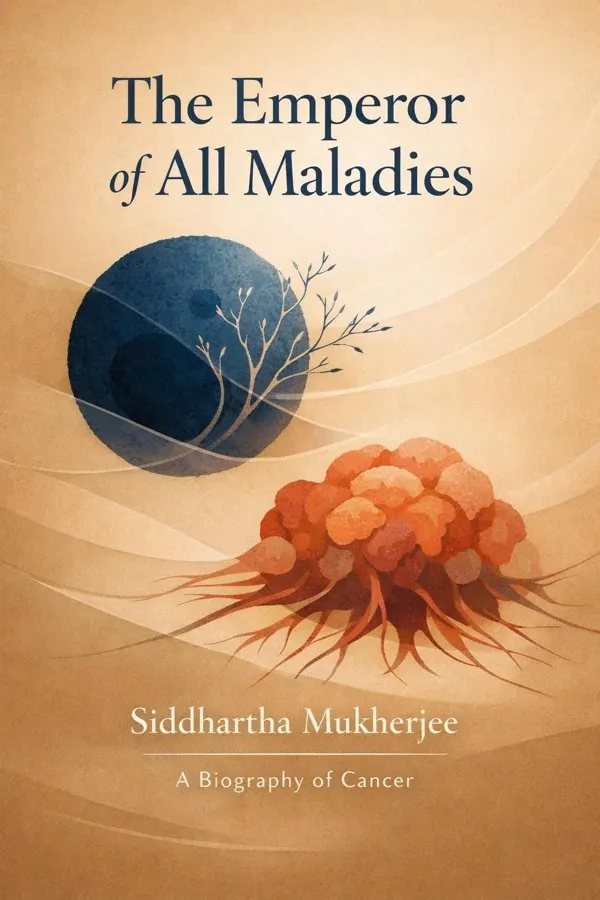
The Emperor of All Maladies: A Biography of Cancer: Summary & Key Insights
 10 min10 chaptersAudio available
Key Takeaways from The Emperor of All Maladies: A Biography of Cancer
One of the book’s most arresting insights is that cancer is not a modern invention but an ancient companion of human life.
A troubling truth runs through cancer’s medical history: when doctors understand little, they often intervene with great force.
Cancer care became truly modern not when medicine found a single cure, but when it built a new language for diagnosis, classification, and coordinated treatment.
Some of medicine’s biggest advances begin in unsettling places.
Big slogans can mobilize resources, but they can also oversimplify reality.
What Is The Emperor of All Maladies: A Biography of Cancer About?
The Emperor of All Maladies: A Biography of Cancer by Siddhartha Mukherjee is a life_science book spanning 10 pages. What if a disease could be written like a life story—complete with childhood, turning points, rebellions, and reinventions? In The Emperor of All Maladies, physician and oncologist Siddhartha Mukherjee does exactly that, tracing cancer from ancient Egyptian records to the age of genomics and precision medicine. This is not just a history of a disease. It is a history of medicine, scientific ambition, public policy, and the patients whose lives have shaped every breakthrough. Mukherjee combines the rigor of a cancer doctor with the clarity of a gifted storyteller. He explains how surgeons, chemists, pathologists, epidemiologists, activists, and patients gradually transformed cancer from a mysterious and often untouchable enemy into a biological process that can be studied, interrupted, and sometimes defeated. Along the way, he shows why progress has been uneven, why “cancer” is not one disease but many, and why every apparent victory reveals new complexity. The book matters because cancer remains one of humanity’s defining medical challenges. Mukherjee gives readers something rare: a deeply humane, scientifically grounded way to understand both the terror of cancer and the hard-won hope of modern oncology.
This FizzRead summary covers all 10 key chapters of The Emperor of All Maladies: A Biography of Cancer in approximately 10 minutes, distilling the most important ideas, arguments, and takeaways from Siddhartha Mukherjee's work. Also available as an audio summary and Key Quotes Podcast.
The Emperor of All Maladies: A Biography of Cancer
What if a disease could be written like a life story—complete with childhood, turning points, rebellions, and reinventions? In The Emperor of All Maladies, physician and oncologist Siddhartha Mukherjee does exactly that, tracing cancer from ancient Egyptian records to the age of genomics and precision medicine. This is not just a history of a disease. It is a history of medicine, scientific ambition, public policy, and the patients whose lives have shaped every breakthrough.
Mukherjee combines the rigor of a cancer doctor with the clarity of a gifted storyteller. He explains how surgeons, chemists, pathologists, epidemiologists, activists, and patients gradually transformed cancer from a mysterious and often untouchable enemy into a biological process that can be studied, interrupted, and sometimes defeated. Along the way, he shows why progress has been uneven, why “cancer” is not one disease but many, and why every apparent victory reveals new complexity.
The book matters because cancer remains one of humanity’s defining medical challenges. Mukherjee gives readers something rare: a deeply humane, scientifically grounded way to understand both the terror of cancer and the hard-won hope of modern oncology.
Who Should Read The Emperor of All Maladies: A Biography of Cancer?
This book is perfect for anyone interested in life_science and looking to gain actionable insights in a short read. Whether you're a student, professional, or lifelong learner, the key ideas from The Emperor of All Maladies: A Biography of Cancer by Siddhartha Mukherjee will help you think differently.
- ✓Readers who enjoy life_science and want practical takeaways
- ✓Professionals looking to apply new ideas to their work and life
- ✓Anyone who wants the core insights of The Emperor of All Maladies: A Biography of Cancer in just 10 minutes
Want the full summary?
Get instant access to this book summary and 100K+ more with Fizz Moment.
Get Free SummaryAvailable on App Store • Free to download
Key Chapters
One of the book’s most arresting insights is that cancer is not a modern invention but an ancient companion of human life. Mukherjee begins with some of the earliest known medical writings, including the Edwin Smith Papyrus, where tumors are described with chilling simplicity as masses for which there is “no treatment.” That small historical detail matters. It shows that long before molecular biology, scans, or chemotherapy, human beings were already confronting abnormal growths that defied explanation and cure.
By tracing cancer across centuries, the book reveals that the disease has always forced medicine to face its limits. Ancient physicians could observe swelling, pain, and wasting, but they lacked a framework for understanding what uncontrolled cell growth really was. Early theories connected cancer to bodily humors or imbalances, which shaped treatments that now seem misguided but were, at the time, rational attempts to bring order to mystery.
This long view changes how we think about progress. Modern readers often imagine medicine moving in a straight line from ignorance to knowledge. Mukherjee shows a more difficult path: observation, false starts, scattered insights, and occasional leaps forward. In practical terms, this perspective can help patients and families understand why cancer treatment is still complex today. A disease with such deep biological roots is unlikely to yield to simple solutions.
The actionable takeaway is this: approach cancer with historical humility. Whether you are a patient, caregiver, clinician, or curious reader, remember that every current therapy sits atop centuries of struggle—and that progress is real precisely because it has been so hard won.
A troubling truth runs through cancer’s medical history: when doctors understand little, they often intervene with great force. In the nineteenth and early twentieth centuries, surgery became the dominant response to solid tumors. Surgeons such as William Halsted developed increasingly aggressive operations, including the radical mastectomy, based on the belief that cancer spread outward in a local, orderly way and could be stopped if enough tissue was removed.
Mukherjee does not present these surgeons as villains. He portrays them as disciplined, ambitious physicians working with the best theories available to them. At a time when anesthesia and antisepsis were making major operations possible, radical surgery offered something patients had rarely possessed—an actual intervention. Yet this hope came at a price. Many procedures were disfiguring, painful, and sometimes ineffective because the underlying model of cancer spread was incomplete.
The larger lesson is that medical treatments are shaped by the concepts behind them. If cancer is seen purely as a local invader, the answer will be a larger knife. If it is understood as a systemic disease, different strategies become necessary. This insight applies broadly beyond oncology. In any field, flawed assumptions can produce technically impressive but poorly targeted solutions.
For readers today, the practical application is to ask not only what a treatment does, but what theory supports it. Whether evaluating surgery, drugs, screening, or lifestyle advice, seek to understand the logic behind the intervention. The actionable takeaway: informed patients make better decisions when they ask how doctors believe a disease behaves, not just how they plan to fight it.
Cancer care became truly modern not when medicine found a single cure, but when it built a new language for diagnosis, classification, and coordinated treatment. Mukherjee shows that oncology developed as physicians began to distinguish between different cancers, stage disease more carefully, and link pathology with treatment decisions. This shift may sound technical, but it transformed everything. Once doctors stopped speaking of cancer as one monolithic entity, they could begin tailoring strategies to leukemia, lymphoma, breast cancer, lung cancer, and countless other forms.
This period also marked the rise of cancer hospitals, research networks, tumor boards, and specialized training. In other words, progress depended not only on scientific discovery but on institutions. A biopsy read accurately, a surgery timed well, a chemotherapy regimen administered correctly, and a radiation plan delivered safely all required systems, not just brilliant individuals.
A practical example of this change can be seen in how patients are treated today. A person diagnosed with breast cancer may receive receptor testing, imaging, surgery, radiation, hormonal therapy, or targeted drugs depending on the exact subtype and stage. That approach descends from the intellectual and organizational revolution Mukherjee describes.
The deeper insight is that medicine advances when classification improves. Naming things precisely is not mere academic fussiness; it changes outcomes. The actionable takeaway is simple: if you or someone you know faces a cancer diagnosis, seek detailed characterization of the disease. Exact subtype, stage, biomarkers, and pathology are not secondary details—they are the foundation of effective treatment.
Some of medicine’s biggest advances begin in unsettling places. Mukherjee recounts how chemotherapy emerged from observations tied to wartime chemical exposures and experimental compounds that damaged rapidly dividing cells. The basic idea was both elegant and brutal: if cancer cells divide uncontrollably, perhaps chemicals that interrupt cell division could destroy them. But because the body also contains healthy fast-dividing cells—in the bone marrow, gut, hair follicles, and elsewhere—these drugs could be lifesaving and toxic at the same time.
Early chemotherapy was especially dramatic in blood cancers such as leukemia and lymphoma, where short-lived remissions hinted that cancer might be pharmacologically controlled. Those early results electrified doctors and families. For the first time, a systemic treatment could shrink widespread disease. Yet remissions often ended, resistance appeared, and the side effects were severe. Progress came through combinations of drugs, careful timing, dose adjustments, and relentless clinical trial work.
Mukherjee’s account offers a practical lesson in how breakthroughs actually happen. Success was not one miracle drug but a process of iteration: test, observe, refine, combine, and try again. That pattern remains central in medicine, business, technology, and public health.
For readers, the application is to understand why cancer treatment can feel paradoxical. A therapy may be harsh because it is targeting biological processes shared by cancer and normal tissues. The actionable takeaway: judge treatment not by whether it sounds gentle or dramatic, but by evidence of benefit, side-effect management, and fit with the specific cancer being treated.
Big slogans can mobilize resources, but they can also oversimplify reality. When the United States launched the “War on Cancer,” it signaled political urgency, funding, and public commitment. Mukherjee shows that this moment mattered immensely: it expanded research infrastructure, raised awareness, and legitimized oncology as a national scientific priority. But the war metaphor also encouraged the illusion that cancer was a single enemy awaiting a decisive military-style victory.
In practice, cancer refused to cooperate with that framing. It was not one disease, not one pathway, and not one target. Some cancers responded dramatically to treatment; others barely budged. Some were best addressed through prevention or early detection rather than aggressive therapy. The war language captured determination but often underplayed complexity.
This lesson extends beyond oncology. Public campaigns often promise fast wins because complexity is hard to communicate. Yet difficult problems—whether climate change, chronic disease, or social inequality—rarely yield to one campaign or one breakthrough. Progress usually comes through long-term investment, better measurement, and adaptive strategy.
Mukherjee also highlights how advocacy and policy can shape science. Funding matters. Institutions matter. Patient voices matter. But so does intellectual honesty about what can and cannot be achieved quickly.
The actionable takeaway is to be wary of simple narratives around complex illnesses. Support ambitious research and policy goals, but expect progress to be incremental, uneven, and multidisciplinary. Real advances often look less like a final victory and more like a growing ability to prevent, manage, subtype, and selectively defeat many different cancers.
The most important turn in cancer research came when scientists stopped seeing tumors only as masses and began seeing them as corrupted cellular programs. Mukherjee explains how the molecular revolution uncovered oncogenes, tumor suppressor genes, signaling pathways, mutations, and the machinery that controls cell division. Cancer was no longer just a clinical phenomenon observed at the bedside or under the microscope. It became a biological narrative written in genes and proteins.
This shift changed treatment philosophy. If a cancer is driven by a specific molecular abnormality, then a drug might be designed to interrupt that pathway rather than indiscriminately kill any fast-dividing cell. The conceptual move is profound: from broad assault to selective interference. Practical examples include therapies aimed at defined mutations or receptors, where identifying the right patient population becomes as important as inventing the drug itself.
Mukherjee is careful not to turn molecular biology into a triumphalist story. Understanding pathways did not eliminate complexity. Tumors evolve. Redundant pathways emerge. Two cancers that look similar under a microscope may behave differently at the molecular level. But the molecular lens gave oncology something it desperately needed: explanatory depth.
This idea has practical implications for how readers think about science. Better tools do not merely improve old answers; they often redefine the question. In cancer care, molecular testing can influence prognosis, drug choice, and eligibility for trials.
The actionable takeaway: whenever possible, favor precision over generalization. Whether in medicine or decision-making more broadly, deeper understanding of the underlying mechanism leads to better-targeted action.
A disease can be studied in laboratories and hospitals, but its moral meaning is shaped by the people who live through it. One of Mukherjee’s great strengths is his insistence that patient stories are not decorative additions to scientific history; they are central to it. The fear, dignity, uncertainty, suffering, and resilience of patients helped transform cancer from a private shame into a public reality that demanded response.
For much of history, cancer was cloaked in silence. Diagnoses were hidden, prognoses softened, and suffering isolated. Over time, patients, families, and advocates disrupted that silence. Their testimony drove changes in consent, palliative care, survivorship, research priorities, and public awareness. They also challenged physicians to balance honesty with hope and treatment with quality of life.
This shift has practical importance today. Modern cancer care is not only about extending survival; it is about shared decision-making, symptom control, fertility, sexuality, work, family roles, and emotional well-being. A treatment plan that ignores the patient’s values may be medically sophisticated but humanly incomplete.
Mukherjee’s patient portraits remind readers that medicine is at its best when it treats persons, not just pathologies. This applies well beyond oncology. In any helping profession, expertise must be joined with listening.
The actionable takeaway is to make values explicit. Patients should ask what a treatment means for daily life, not only for tumor response. Clinicians and caregivers should invite those questions early. Good care begins when the human story is treated as clinically relevant.
One of the most powerful ideas in the book is also one of the least glamorous: some of the greatest victories against cancer come not from dramatic cures but from prevention. Mukherjee’s discussion of smoking, epidemiology, and public health shows how identifying carcinogenic exposures can save vastly more lives than any single new drug. The anti-tobacco struggle illustrates this clearly. Once links between smoking and lung cancer became undeniable, the challenge was no longer only scientific. It became political, cultural, and commercial.
This is a crucial distinction. Knowing what causes cancer does not automatically lead society to act on that knowledge. Industries resist regulation. Habits are hard to change. Risk feels abstract until disease becomes personal. That is why epidemiology matters so much: it turns patterns in populations into evidence strong enough to influence policy, behavior, and prevention campaigns.
The practical lesson is immediate. Lifestyle and environmental factors do not explain every cancer, and prevention should never become a way of blaming patients. But reducing known risks—avoiding tobacco, limiting harmful exposures, improving vaccination rates, and participating in evidence-based screening—can alter outcomes at scale.
Mukherjee shows that prevention lacks the drama of a miracle cure, yet its impact may be greater. A society that only celebrates treatment will always be fighting too late.
The actionable takeaway: take prevention seriously as a form of power. Support public health measures, know major risk factors, follow recommended screenings, and treat early detection and risk reduction as essential parts of cancer care rather than secondary concerns.
The dream of precision medicine rests on a simple but demanding idea: to treat cancer well, we must know exactly what kind of cancer we are dealing with at the genetic level. Mukherjee traces how genomics expanded oncology’s map, allowing researchers to identify mutations, expression patterns, and molecular signatures that distinguish one tumor from another. This transformed cancer from a diagnosis based mainly on location into one increasingly shaped by biological identity.
Targeted therapies emerged from this framework. Instead of using only broad cytotoxic drugs, doctors could in some cases deploy medicines aimed at a receptor, kinase, or mutation critical to a tumor’s survival. These therapies often produced remarkable responses, especially in carefully selected patients. Yet the book also emphasizes the challenge of resistance. Tumors are not static. They mutate, adapt, and find alternative pathways. Precision medicine, therefore, is not a final answer but an ongoing strategy of surveillance and adjustment.
A practical example is the use of biomarker testing before choosing therapy. In contemporary oncology, treatment decisions may depend on whether a tumor expresses a certain receptor or carries a specific mutation. That means diagnostic precision becomes inseparable from therapeutic precision.
The broader lesson is that personalization requires data, humility, and flexibility. Even a highly targeted intervention may stop working as biology changes.
The actionable takeaway: think of cancer treatment as dynamic rather than fixed. Patients should ask about biomarker testing, re-testing when appropriate, and clinical trials. Precision care works best when decisions are revisited as new information emerges.
Perhaps the book’s deepest message is that cancer can be neither romanticized as an invincible emperor nor dismissed as a problem nearly solved. Mukherjee presents a future shaped by real progress—better diagnostics, more refined drugs, improved supportive care, survivorship medicine, immunologic strategies, and genomic insight—but also by the stubborn nature of evolution within the body. Cancer arises from our own cells. That is what makes it so difficult. To defeat it completely, medicine must attack biological capacities that are also central to life itself: growth, repair, adaptation, and replication.
This is why the future of cancer research must be broad. It will require laboratory science, population health, better trial design, equitable access to care, smarter prevention, and deeper understanding of aging, immunity, and cellular ecosystems. A cure is unlikely to come as one universal event. More likely, the future will consist of many partial victories: some cancers prevented, others turned chronic, others cured in subsets, and still others detected early enough to be manageable.
For readers, this outlook is both sobering and empowering. It rejects magical thinking without surrendering to despair. Progress is possible precisely because researchers keep refining questions, not because they claim final answers too soon.
The actionable takeaway is to adopt a long-view mindset. Support science, value evidence, remain open to incremental gains, and resist both cynicism and hype. The future of cancer care belongs to those who can combine urgency with patience.
All Chapters in The Emperor of All Maladies: A Biography of Cancer
About the Author
Siddhartha Mukherjee is an Indian-American physician, oncologist, researcher, and acclaimed author whose work explores the history and meaning of medicine. Trained in medicine and cancer biology, he has served as a cancer physician and academic at Columbia University, where he has cared for patients while conducting research and teaching. Mukherjee is known for combining scientific precision with elegant storytelling, making complex medical ideas accessible to broad audiences. His writing often examines the intersection of biology, ethics, history, and the human condition. The Emperor of All Maladies won the Pulitzer Prize for General Nonfiction and established him as one of the leading public interpreters of modern medicine. His authority comes not only from scholarship but from firsthand experience treating people living with cancer.
Get This Summary in Your Preferred Format
Read or listen to the The Emperor of All Maladies: A Biography of Cancer summary by Siddhartha Mukherjee anytime, anywhere. FizzRead offers multiple formats so you can learn on your terms — all free.
Available formats: App · Audio · PDF · EPUB — All included free with FizzRead
Download The Emperor of All Maladies: A Biography of Cancer PDF and EPUB Summary
Key Quotes from The Emperor of All Maladies: A Biography of Cancer
“One of the book’s most arresting insights is that cancer is not a modern invention but an ancient companion of human life.”
“A troubling truth runs through cancer’s medical history: when doctors understand little, they often intervene with great force.”
“Cancer care became truly modern not when medicine found a single cure, but when it built a new language for diagnosis, classification, and coordinated treatment.”
“Some of medicine’s biggest advances begin in unsettling places.”
“Big slogans can mobilize resources, but they can also oversimplify reality.”
Frequently Asked Questions about The Emperor of All Maladies: A Biography of Cancer
The Emperor of All Maladies: A Biography of Cancer by Siddhartha Mukherjee is a life_science book that explores key ideas across 10 chapters. What if a disease could be written like a life story—complete with childhood, turning points, rebellions, and reinventions? In The Emperor of All Maladies, physician and oncologist Siddhartha Mukherjee does exactly that, tracing cancer from ancient Egyptian records to the age of genomics and precision medicine. This is not just a history of a disease. It is a history of medicine, scientific ambition, public policy, and the patients whose lives have shaped every breakthrough. Mukherjee combines the rigor of a cancer doctor with the clarity of a gifted storyteller. He explains how surgeons, chemists, pathologists, epidemiologists, activists, and patients gradually transformed cancer from a mysterious and often untouchable enemy into a biological process that can be studied, interrupted, and sometimes defeated. Along the way, he shows why progress has been uneven, why “cancer” is not one disease but many, and why every apparent victory reveals new complexity. The book matters because cancer remains one of humanity’s defining medical challenges. Mukherjee gives readers something rare: a deeply humane, scientifically grounded way to understand both the terror of cancer and the hard-won hope of modern oncology.
More by Siddhartha Mukherjee
You Might Also Like
The Selfish Gene
Richard Dawkins
10 min
Awakenings
Oliver Sacks
10 min
Parasite Rex: Inside the Bizarre World of Nature's Most Dangerous Creatures
Carl Zimmer
10 min
The Atlas of Life on Earth
Various
10 min
The Book of Humans: The Story of How We Became Us
Adam Rutherford
10 min
The Horse
Wendy Williams
10 minBrowse by Category
Ready to read The Emperor of All Maladies: A Biography of Cancer?
Get the full summary and 100K+ more books with Fizz Moment.