
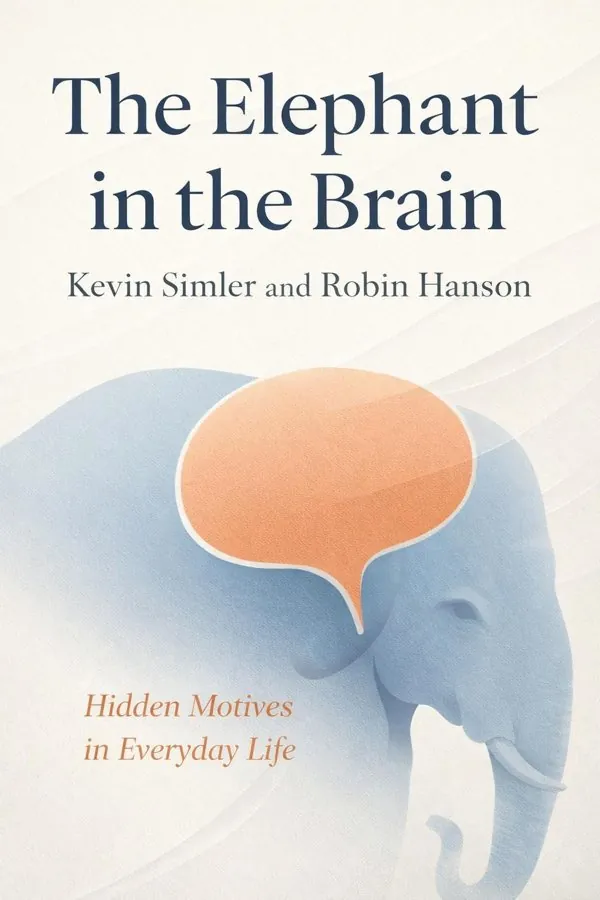
The Elephant in the Brain: Hidden Motives in Everyday Life: Summary & Key Insights
 10 min12 chaptersAudio available
What Is The Elephant in the Brain: Hidden Motives in Everyday Life About?
The Elephant in the Brain: Hidden Motives in Everyday Life by Kevin Simler and Robin Hanson is a cognition book spanning 12 pages. The Elephant in the Brain explores the hidden motives behind human behavior, arguing that much of what we do is driven by self-interest and social signaling rather than the reasons we consciously claim. The authors use insights from evolutionary psychology, economics, and neuroscience to reveal how our brains are wired to deceive ourselves and others, shaping everything from politics and religion to art and charity.
This FizzRead summary covers all 12 key chapters of The Elephant in the Brain: Hidden Motives in Everyday Life in approximately 10 minutes, distilling the most important ideas, arguments, and takeaways from Kevin Simler and Robin Hanson's work. Also available as an audio summary and Key Quotes Podcast.
The Elephant in the Brain: Hidden Motives in Everyday Life
The Elephant in the Brain explores the hidden motives behind human behavior, arguing that much of what we do is driven by self-interest and social signaling rather than the reasons we consciously claim. The authors use insights from evolutionary psychology, economics, and neuroscience to reveal how our brains are wired to deceive ourselves and others, shaping everything from politics and religion to art and charity.
Who Should Read The Elephant in the Brain: Hidden Motives in Everyday Life?
This book is perfect for anyone interested in cognition and looking to gain actionable insights in a short read. Whether you're a student, professional, or lifelong learner, the key ideas from The Elephant in the Brain: Hidden Motives in Everyday Life by Kevin Simler and Robin Hanson will help you think differently.
- ✓Readers who enjoy cognition and want practical takeaways
- ✓Professionals looking to apply new ideas to their work and life
- ✓Anyone who wants the core insights of The Elephant in the Brain: Hidden Motives in Everyday Life in just 10 minutes
Want the full summary?
Get instant access to this book summary and 100K+ more with Fizz Moment.
Get Free SummaryAvailable on App Store • Free to download
Key Chapters
If our actions are shaped by self-interest, why don’t we simply admit it? Because honesty about selfish motives tends to backfire socially. Humans evolved as cooperative yet competitive creatures living in tight groups. To survive, we needed to look generous, loyal, and fair—even when we weren’t. The brain therefore evolved not just to deceive others, but to deceive itself, maintaining a clean self-image while quietly serving its own agenda.
This is the evolutionary genius of self-deception: it allows us to act strategically without appearing so. When we believe our own moral stories, our deceit becomes more convincing. We project sincerity because we feel sincere, even though our deeper drives may be tactical. The mind thus splits itself, with conscious reasoning playing the role of public-relations agent rather than CEO. As we tell the world (and ourselves) that we’re helping others or fighting for justice, another part of the mind is tracking how much status, affection, or influence we stand to gain.
This theory challenges centuries of moral philosophy that assumed people act primarily from principle or reason. But when examined through the lens of behavioral evidence—how we behave under incentives, how we rationalize inconsistency, how we prefer flattering explanations—it becomes clear that the self-deceiving mind is the rule, not the exception. Our moral reasoning is less like a scientist searching for truth and more like a lawyer defending a client. The client is our self-image; the lawyer’s job is to justify it.
To understand hidden motives, we must begin with evolution. Our ancestors lived amid fierce social and environmental competition. Success wasn’t just about staying alive—it was about attracting allies, mates, and followers. Evolution rewarded behaviors that signaled fitness traits: strength, intelligence, generosity, or loyalty. These traits made others want to cooperate with us and trust our leadership.
Out of this crucible of competition emerged signaling: the art of showing one’s value indirectly. A peacock’s tail isn’t practical—it’s an advertisement of health and vitality. Human behaviors evolved in similar ways. Displays of courage, generosity, or even moral conviction served to demonstrate underlying qualities that improved one’s social standing.
But there’s a twist. Our signals work only if they seem genuine. Over-obvious self-promotion invites suspicion. Thus, we needed mechanisms to make our performances appear authentic—and this is where self-deception proved invaluable. By believing we act from noble motives, our signals of virtue appear more credible, reinforcing social cohesion even as competition simmers underneath. Civilized behavior, then, is not the suppression of selfishness but its clever disguise.
+ 10 more chapters — available in the FizzRead app
All Chapters in The Elephant in the Brain: Hidden Motives in Everyday Life
About the Authors
Kevin Simler is a writer and software engineer known for his work on human behavior and social dynamics. Robin Hanson is an associate professor of economics at George Mason University and a researcher at the Oxford Future of Humanity Institute, recognized for his work on prediction markets and social theory.
Get This Summary in Your Preferred Format
Read or listen to the The Elephant in the Brain: Hidden Motives in Everyday Life summary by Kevin Simler and Robin Hanson anytime, anywhere. FizzRead offers multiple formats so you can learn on your terms — all free.
Available formats: App · Audio · PDF · EPUB — All included free with FizzRead
Download The Elephant in the Brain: Hidden Motives in Everyday Life PDF and EPUB Summary
Key Quotes from The Elephant in the Brain: Hidden Motives in Everyday Life
“If our actions are shaped by self-interest, why don’t we simply admit it?”
“To understand hidden motives, we must begin with evolution.”
Frequently Asked Questions about The Elephant in the Brain: Hidden Motives in Everyday Life
The Elephant in the Brain: Hidden Motives in Everyday Life by Kevin Simler and Robin Hanson is a cognition book that explores key ideas across 12 chapters. The Elephant in the Brain explores the hidden motives behind human behavior, arguing that much of what we do is driven by self-interest and social signaling rather than the reasons we consciously claim. The authors use insights from evolutionary psychology, economics, and neuroscience to reveal how our brains are wired to deceive ourselves and others, shaping everything from politics and religion to art and charity.
You Might Also Like

A Field Guide to Lies: Critical Thinking in the Information Age
Daniel J. Levitin
10 min
A Theory of Cognitive Dissonance
Leon Festinger
10 min
Black-And-White Thinking: The Burden of a Binary Brain in a Complex World
Kevin Dutton
10 min
Born Liars: Why We Can’t Live Without Deceit
Ian Leslie
10 min
Collective Illusions: Conformity, Complicity, and the Science of Why We Make Bad Decisions
Todd Rose
10 min
Concrete Mathematics: A Foundation for Computer Science
Ronald L. Graham, Donald E. Knuth, Oren Patashnik
10 minBrowse by Category
Ready to read The Elephant in the Brain: Hidden Motives in Everyday Life?
Get the full summary and 100K+ more books with Fizz Moment.