
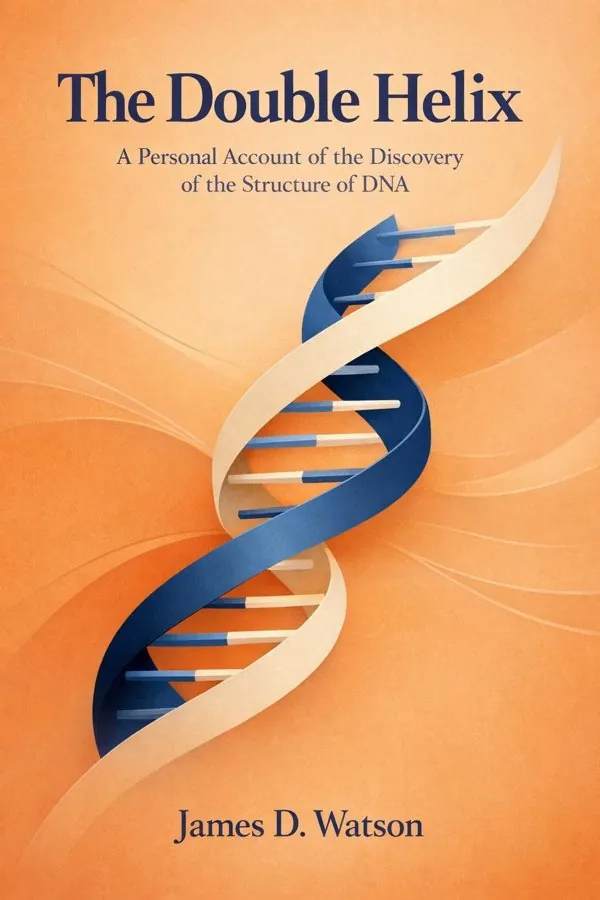
The Double Helix: A Personal Account of the Discovery of the Structure of DNA: Summary & Key Insights
 10 min9 chaptersAudio available
Key Takeaways from The Double Helix: A Personal Account of the Discovery of the Structure of DNA
Great discoveries rarely emerge from isolation; they grow in environments that concentrate talent, urgency, and daring.
A field changes when one question becomes impossible to ignore.
Scientific discovery is often portrayed as cooperative and serene, but Watson shows that competition can be just as influential as collegiality.
Wrong ideas are not merely setbacks; they are often the price of finding the right framework.
Facts do not speak for themselves; they become transformative only when someone sees what they imply.
What Is The Double Helix: A Personal Account of the Discovery of the Structure of DNA About?
The Double Helix: A Personal Account of the Discovery of the Structure of DNA by James D. Watson is a biographies book spanning 9 pages. James D. Watson’s The Double Helix is one of the most famous scientific memoirs ever written because it does something rare: it turns a monumental discovery into a vivid human story. Rather than presenting the structure of DNA as an inevitable triumph of genius, Watson recounts it as a messy, competitive, exhilarating race shaped by ambition, luck, intuition, rivalry, and persistence. At the center of the book is the quest to determine how DNA stores and transmits hereditary information, a puzzle whose solution transformed biology, medicine, and our understanding of life itself. What makes this book matter is not only the importance of the discovery, but the way Watson reveals science from the inside. Laboratories are full of imperfect people, partial data, strong egos, mistaken assumptions, and sudden insights. Watson writes as a participant, not a distant historian: he and Francis Crick were among the scientists who proposed the now-iconic double helix model in 1953. As a result, the book offers both firsthand authority and personal controversy. For readers interested in scientific breakthroughs, creative thinking, or the real dynamics of discovery, The Double Helix remains essential reading.
This FizzRead summary covers all 9 key chapters of The Double Helix: A Personal Account of the Discovery of the Structure of DNA in approximately 10 minutes, distilling the most important ideas, arguments, and takeaways from James D. Watson's work. Also available as an audio summary and Key Quotes Podcast.
The Double Helix: A Personal Account of the Discovery of the Structure of DNA
James D. Watson’s The Double Helix is one of the most famous scientific memoirs ever written because it does something rare: it turns a monumental discovery into a vivid human story. Rather than presenting the structure of DNA as an inevitable triumph of genius, Watson recounts it as a messy, competitive, exhilarating race shaped by ambition, luck, intuition, rivalry, and persistence. At the center of the book is the quest to determine how DNA stores and transmits hereditary information, a puzzle whose solution transformed biology, medicine, and our understanding of life itself.
What makes this book matter is not only the importance of the discovery, but the way Watson reveals science from the inside. Laboratories are full of imperfect people, partial data, strong egos, mistaken assumptions, and sudden insights. Watson writes as a participant, not a distant historian: he and Francis Crick were among the scientists who proposed the now-iconic double helix model in 1953. As a result, the book offers both firsthand authority and personal controversy. For readers interested in scientific breakthroughs, creative thinking, or the real dynamics of discovery, The Double Helix remains essential reading.
Who Should Read The Double Helix: A Personal Account of the Discovery of the Structure of DNA?
This book is perfect for anyone interested in biographies and looking to gain actionable insights in a short read. Whether you're a student, professional, or lifelong learner, the key ideas from The Double Helix: A Personal Account of the Discovery of the Structure of DNA by James D. Watson will help you think differently.
- ✓Readers who enjoy biographies and want practical takeaways
- ✓Professionals looking to apply new ideas to their work and life
- ✓Anyone who wants the core insights of The Double Helix: A Personal Account of the Discovery of the Structure of DNA in just 10 minutes
Want the full summary?
Get instant access to this book summary and 100K+ more with Fizz Moment.
Get Free SummaryAvailable on App Store • Free to download
Key Chapters
Great discoveries rarely emerge from isolation; they grow in environments that concentrate talent, urgency, and daring. When Watson arrived in Cambridge and entered the orbit of the Cavendish Laboratory, he stepped into exactly that kind of setting. The Cavendish was not just a building filled with equipment. It was an intellectual culture shaped by earlier giants such as Rutherford and J. J. Thomson, and it carried an expectation that major questions could be solved by bold thinking.
For Watson, Cambridge provided more than prestige. It brought him together with Francis Crick, whose restless mind, confidence, and appetite for theorizing contrasted with more cautious experimental traditions. The atmosphere rewarded conversation, argument, model-building, and cross-disciplinary curiosity. Physics, chemistry, and biology were beginning to overlap, and this mattered because DNA could not be understood from one angle alone. The structure of heredity required chemical logic, physical evidence, and biological significance.
A practical lesson emerges here: place shapes possibility. People often imagine breakthroughs as products of individual brilliance alone, but Watson’s account shows how much depends on being in the right network, surrounded by people who challenge assumptions and share information quickly. In modern terms, this applies to start-ups, research teams, creative industries, and even personal growth. If you want to solve difficult problems, immerse yourself in an environment where ambitious questions are normal and strong minds collide regularly.
Actionable takeaway: audit your environment and ask whether it stretches your thinking. If not, deliberately seek communities, workplaces, or collaborators that increase the quality of your questions and the speed of your learning.
A field changes when one question becomes impossible to ignore. In the early 1950s, biology was undergoing exactly such a shift. Traditional genetics had shown that traits are inherited, and experiments such as those by Oswald Avery strongly suggested that DNA carried hereditary information. Yet many scientists still gave protein the starring role, assuming DNA was too chemically monotonous to encode life’s complexity.
Watson’s memoir captures this moment of uncertainty. The scientific community had not yet agreed on what DNA really was in functional terms, and that ambiguity created an opening for ambitious researchers. If DNA stored genetic information, then understanding its structure was not a narrow chemical exercise; it was the key to understanding how life reproduces itself. This changed the stakes entirely. The molecule’s architecture had to explain replication, stability, and variation.
The broader importance of this moment is easy to apply beyond science. Progress accelerates when people identify the right question, not just when they work harder on old ones. Many organizations waste energy optimizing surface problems instead of confronting the foundational issue. In Watson’s world, the foundational issue was simple but profound: if DNA is the genetic material, what structure allows it to do that job?
This key idea also explains why molecular biology became such a powerful discipline. Once the right question crystallized, methods, people, and ideas began reorganizing around it. The book demonstrates how intellectual revolutions begin before answers appear; they begin when priorities shift.
Actionable takeaway: when facing a difficult project, ask what the real governing question is. Clarifying the core problem often does more than collecting more effort around the wrong one.
Scientific discovery is often portrayed as cooperative and serene, but Watson shows that competition can be just as influential as collegiality. His encounters with Maurice Wilkins and Rosalind Franklin at King’s College London reveal how personal tensions, institutional boundaries, and uneven communication can either advance or obstruct understanding. Watson did not operate in a vacuum; he and Crick were part of a larger race in which multiple groups were trying to decipher DNA.
What made the situation especially complicated was that rivalry and collaboration were intertwined. Researchers depended on each other’s data, interpretations, and informal exchanges, yet they also feared being beaten to the answer. Franklin’s X-ray diffraction work was crucial, precise, and often underappreciated in Watson’s own telling. Wilkins, meanwhile, occupied an awkward position between colleague and competitor. The relationships were not tidy, and that is precisely the point.
In practical terms, the book offers a sober lesson about team dynamics. Important work often unfolds across overlapping groups with mismatched incentives. Departments may need one another’s expertise while still competing for recognition, funding, or leadership. In these situations, personality matters. Misunderstandings about status, communication style, and credit can distort progress as much as technical obstacles do.
Watson’s account also reminds readers to question simplistic narratives of lone genius. The discovery of the double helix depended on a network of people, some celebrated and some insufficiently credited. Understanding this complexity encourages a more mature view of achievement.
Actionable takeaway: in any collaborative effort, clarify roles, communication channels, and credit early. High-stakes work improves when teams acknowledge both shared goals and competitive pressures instead of pretending those tensions do not exist.
Wrong ideas are not merely setbacks; they are often the price of finding the right framework. One of the most revealing parts of The Double Helix is Watson’s account of false starts, especially the early incorrect models of DNA. These failures were not trivial mistakes but serious attempts built on incomplete evidence, flawed assumptions, and premature confidence.
At one stage, Watson and Crick pursued structural models that did not fit the chemistry or the available X-ray data. Their enthusiasm sometimes ran ahead of rigor. Yet these wrong turns played a crucial role. Each failed model exposed a constraint that any successful model would have to satisfy. In that sense, error became a filtering mechanism. Discovery progressed not because they avoided mistakes, but because they learned which mistakes were informative.
This dynamic applies well outside molecular biology. In product development, strategy, writing, and innovation, first attempts are often oversimplified. The temptation is to treat failure as evidence of incompetence, but Watson’s narrative shows a more useful interpretation: an intelligent failure narrows the search space. The key is to fail in ways that reveal structure rather than simply repeat carelessness.
At the same time, the book warns against romanticizing intuition. Guesswork only becomes productive when tested against hard constraints. Watson and Crick could imagine structures freely, but chemistry and diffraction patterns had the final word. Creativity needed discipline.
Actionable takeaway: when an idea fails, do not only ask whether it was wrong. Ask what boundary condition it revealed. Then use that lesson to design the next attempt with sharper assumptions and stronger tests.
Facts do not speak for themselves; they become transformative only when someone sees what they imply. This is one of the deepest lessons in Watson’s account of Rosalind Franklin’s X-ray diffraction images and the growing recognition that the answer to DNA’s structure lay hidden in patterns many could observe but few could fully integrate. Franklin’s photographs, especially the famous image later known as Photograph 51, offered striking structural clues. Yet data alone was not enough. The challenge was turning visual evidence into a coherent three-dimensional model.
Watson emphasizes the importance of learning from X-ray results even when he did not generate them himself. The key intellectual move was to connect diffraction evidence with physical constraints and model-building. This required humility before evidence and boldness in interpretation. Too much caution could stall progress; too much speculation could produce fantasy.
The practical application is broad. In modern life, people are flooded with data: analytics dashboards, customer feedback, test scores, financial reports, health metrics. Yet abundance of information does not automatically yield insight. What matters is whether someone can recognize the pattern that changes understanding or action. The best analysts, leaders, and researchers do not just collect evidence; they frame it correctly.
Watson’s memoir also raises enduring ethical questions about access, credit, and use of data generated by others. Those issues remain highly relevant in research, business, journalism, and technology.
Actionable takeaway: the next time you face a complex problem, do not ask only what data you have. Ask what interpretation would make the data decisive, and whether you are giving proper credit to those who produced the evidence.
Breakthroughs often happen when a puzzle shifts from vague possibility to exact constraint. In the case of DNA, that happened through chemistry, especially through the recognition of base-pairing rules. Watson’s growing appreciation of Erwin Chargaff’s findings helped transform the search. Chargaff had shown that the amount of adenine matched thymine, and guanine matched cytosine. These ratios suggested a hidden regularity, but the significance was not immediately obvious to everyone.
Once Watson and Crick grasped the chemical implications, the model began to lock into place. Specific pairing between bases explained how two strands could fit together consistently while still encoding variable sequences. This was not just aesthetically satisfying. It answered the central biological question by showing how DNA could be both stable and information-rich.
The larger lesson is that elegant solutions often arise when abstract goals become concrete rules. Teams struggle when they speak only in aspirations such as “be innovative” or “improve quality.” Progress becomes real when constraints become clear: this must pair with that, this ratio must hold, this mechanism must explain replication. Chargaff’s rules narrowed freedom in a productive way.
There is also a cognitive lesson here. Watson’s account shows how important it is to revisit known information with fresh eyes. Chargaff’s results existed before the final model, yet they became revolutionary only when placed in the right conceptual structure. Sometimes the missing ingredient is not more data, but a better question.
Actionable takeaway: identify the non-negotiable rules in your problem. Once the true constraints are visible, many attractive but impossible solutions disappear, and the viable path becomes dramatically clearer.
A truly great idea does more than solve a puzzle; it reveals a new logic for understanding the world. When Watson and Crick arrived at the double helix model, the triumph was not merely geometric. The structure explained how genetic information could be stored, copied, and passed on. Two intertwined strands, held together by complementary base pairs, suggested an elegant mechanism for replication: each strand could serve as a template for the other.
This was the electrifying moment at the center of the book. The beauty of the double helix was that form and function aligned. The model was simple enough to visualize, yet powerful enough to reorganize biology. It connected chemistry with heredity and opened the path toward modern molecular genetics, genomics, and biotechnology.
Watson’s narrative captures the excitement of seeing scattered clues suddenly cohere. Readers can apply this insight in many settings. The best explanations in business, education, and design often share this property: they compress complexity without losing essential truth. A strong model is not just detailed; it is generative. It helps you predict what else must be true.
The double helix also reminds us that elegance in science is not decorative. Simplicity matters when it increases explanatory power. Many people equate sophistication with complication, but the book shows that the deepest solutions may look almost obvious once discovered.
Actionable takeaway: when evaluating ideas, ask whether they merely describe what happened or whether they explain how and why it works. Favor models that make future implications visible, not just past events understandable.
Insight becomes science only after it withstands challenge. In The Double Helix, the moment of discovery is exhilarating, but Watson also shows that proposing a model was only the beginning. The double helix had to be checked against known chemistry, measured against X-ray evidence, and presented to colleagues who could question, refine, or reject it. A brilliant idea without verification is just an attractive story.
Watson and Crick’s confidence grew because their model fit multiple lines of evidence at once. This is a useful standard in any serious field. Good explanations do not merely solve one visible problem; they align with independent constraints. The proposed structure had to satisfy bond lengths, molecular arrangements, and biological plausibility. The stronger the fit across different sources, the more credible the model became.
The book also captures an underappreciated professional skill: presenting insight clearly to skeptical peers. Many people assume that truth wins automatically, but communication matters. Researchers must show why an idea deserves belief, not only why it excites them. In organizations, this is equally true. A new strategy, product concept, or diagnosis gains traction only when decision-makers can test it against reality.
This key idea is especially relevant in an age of rapid claims and instant publication. Speed can be useful, but durability comes from evidence, replication, and criticism.
Actionable takeaway: whenever you think you have found the answer, stress-test it from at least three angles. Ask what evidence supports it, what evidence could disprove it, and how clearly you can explain it to a skeptical but fair-minded audience.
The myth of objective science often hides a more complicated truth: discovery is carried out by ambitious, insecure, competitive, biased, brilliant human beings. One reason The Double Helix remains so memorable is that Watson refuses to portray research as a clean procession of facts. Instead, he shows laboratories full of ego, impatience, fascination, rivalry, attraction, error, and opportunism. The scientific process is rigorous, but the scientists themselves are deeply human.
This human dimension is part of the book’s power and part of its controversy. Watson’s portrayals of colleagues, especially Rosalind Franklin, have been widely debated and criticized. Those debates matter because they reveal how stories of discovery can shape reputations, distort contributions, and reflect the prejudices of their time. The memoir therefore teaches two lessons at once: science advances through human energy, and human bias can influence who gets heard, helped, or remembered.
For modern readers, this is highly practical. Whether in academia, companies, government, or nonprofits, institutions often present decisions as purely rational even when personality and power strongly affect outcomes. Understanding the human layer does not mean abandoning standards; it means becoming more realistic about how progress actually happens.
Watson’s account also makes science more accessible. Readers who might feel excluded by technical complexity can recognize the universal elements: ambition, friendship, fear of failure, and the thrill of insight.
Actionable takeaway: whenever you evaluate a major achievement, look beyond the official result. Ask who shaped it, who was overlooked, what incentives were operating, and how the human story influenced the final outcome.
All Chapters in The Double Helix: A Personal Account of the Discovery of the Structure of DNA
About the Author
James D. Watson is an American molecular biologist, geneticist, and zoologist whose name is inseparable from one of the most important discoveries in modern science: the structure of DNA. Born in 1928 in Chicago, he showed scientific promise early and pursued advanced studies in zoology and genetics before joining the international research community that would shape molecular biology. In 1953, working with Francis Crick at Cambridge, Watson helped propose the double helix model of DNA, a breakthrough that transformed biology and medicine. He later shared the 1962 Nobel Prize in Physiology or Medicine with Crick and Maurice Wilkins. Watson also became a writer, educator, and influential public scientific figure. The Double Helix remains his most famous book, offering a vivid and controversial memoir of scientific discovery from the inside.
Get This Summary in Your Preferred Format
Read or listen to the The Double Helix: A Personal Account of the Discovery of the Structure of DNA summary by James D. Watson anytime, anywhere. FizzRead offers multiple formats so you can learn on your terms — all free.
Available formats: App · Audio · PDF · EPUB — All included free with FizzRead
Download The Double Helix: A Personal Account of the Discovery of the Structure of DNA PDF and EPUB Summary
Key Quotes from The Double Helix: A Personal Account of the Discovery of the Structure of DNA
“Great discoveries rarely emerge from isolation; they grow in environments that concentrate talent, urgency, and daring.”
“A field changes when one question becomes impossible to ignore.”
“Scientific discovery is often portrayed as cooperative and serene, but Watson shows that competition can be just as influential as collegiality.”
“Wrong ideas are not merely setbacks; they are often the price of finding the right framework.”
“Facts do not speak for themselves; they become transformative only when someone sees what they imply.”
Frequently Asked Questions about The Double Helix: A Personal Account of the Discovery of the Structure of DNA
The Double Helix: A Personal Account of the Discovery of the Structure of DNA by James D. Watson is a biographies book that explores key ideas across 9 chapters. James D. Watson’s The Double Helix is one of the most famous scientific memoirs ever written because it does something rare: it turns a monumental discovery into a vivid human story. Rather than presenting the structure of DNA as an inevitable triumph of genius, Watson recounts it as a messy, competitive, exhilarating race shaped by ambition, luck, intuition, rivalry, and persistence. At the center of the book is the quest to determine how DNA stores and transmits hereditary information, a puzzle whose solution transformed biology, medicine, and our understanding of life itself. What makes this book matter is not only the importance of the discovery, but the way Watson reveals science from the inside. Laboratories are full of imperfect people, partial data, strong egos, mistaken assumptions, and sudden insights. Watson writes as a participant, not a distant historian: he and Francis Crick were among the scientists who proposed the now-iconic double helix model in 1953. As a result, the book offers both firsthand authority and personal controversy. For readers interested in scientific breakthroughs, creative thinking, or the real dynamics of discovery, The Double Helix remains essential reading.
You Might Also Like

An American Marriage
Tayari Jones
10 min
Benjamin Franklin: An American Life
Walter Isaacson
10 min
I Know Why The Caged Bird Sings
Maya Angelou
10 min
Long Walk to Freedom
Nelson Mandela
10 min
Persepolis
Marjane Satrapi
10 min
Surely You're Joking, Mr. Feynman!
Richard P. Feynman
10 minBrowse by Category
Ready to read The Double Helix: A Personal Account of the Discovery of the Structure of DNA?
Get the full summary and 100K+ more books with Fizz Moment.