
James D. Watson Books
James Dewey Watson (born 1928) is an American molecular biologist, geneticist, and zoologist, best known as one of the co-discoverers of the structure of DNA. He shared the 1962 Nobel Prize in Physiology or Medicine with Francis Crick and Maurice Wilkins.
Known for: The Double Helix: A Personal Account of the Discovery of the Structure of DNA
Books by James D. Watson
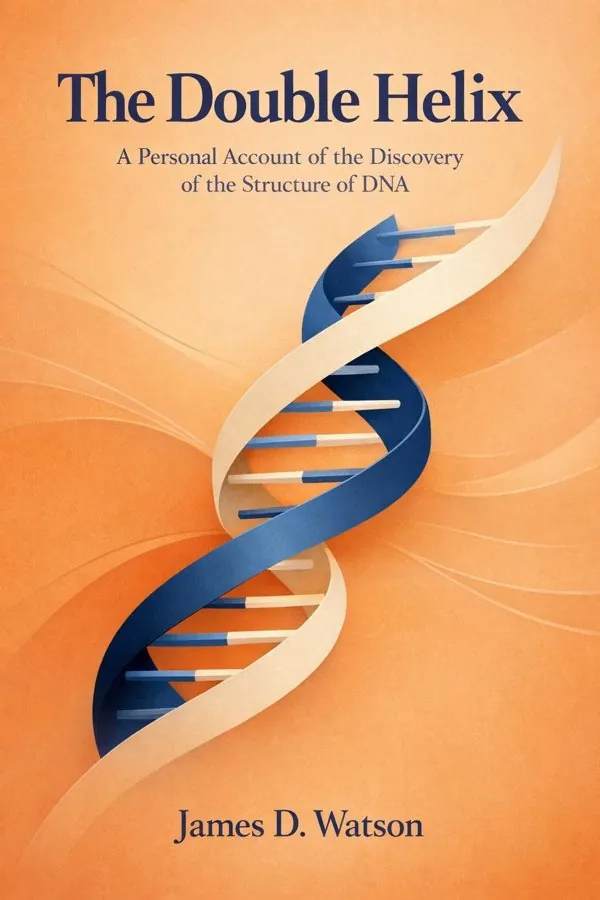
The Double Helix: A Personal Account of the Discovery of the Structure of DNA
James D. Watson’s The Double Helix is one of the most famous scientific memoirs ever written because it does something rare: it turns a monumental discovery into a vivid human story. Rather than presenting the structure of DNA as an inevitable triumph of genius, Watson recounts it as a messy, competitive, exhilarating race shaped by ambition, luck, intuition, rivalry, and persistence. At the center of the book is the quest to determine how DNA stores and transmits hereditary information, a puzzle whose solution transformed biology, medicine, and our understanding of life itself. What makes this book matter is not only the importance of the discovery, but the way Watson reveals science from the inside. Laboratories are full of imperfect people, partial data, strong egos, mistaken assumptions, and sudden insights. Watson writes as a participant, not a distant historian: he and Francis Crick were among the scientists who proposed the now-iconic double helix model in 1953. As a result, the book offers both firsthand authority and personal controversy. For readers interested in scientific breakthroughs, creative thinking, or the real dynamics of discovery, The Double Helix remains essential reading.
Read SummaryKey Insights from James D. Watson
Cambridge as a Crucible for Discovery
Great discoveries rarely emerge from isolation; they grow in environments that concentrate talent, urgency, and daring. When Watson arrived in Cambridge and entered the orbit of the Cavendish Laboratory, he stepped into exactly that kind of setting. The Cavendish was not just a building filled with ...
From The Double Helix: A Personal Account of the Discovery of the Structure of DNA
Biology Needed a New Central Question
A field changes when one question becomes impossible to ignore. In the early 1950s, biology was undergoing exactly such a shift. Traditional genetics had shown that traits are inherited, and experiments such as those by Oswald Avery strongly suggested that DNA carried hereditary information. Yet man...
From The Double Helix: A Personal Account of the Discovery of the Structure of DNA
Rivalry and Collaboration Shape Progress
Scientific discovery is often portrayed as cooperative and serene, but Watson shows that competition can be just as influential as collegiality. His encounters with Maurice Wilkins and Rosalind Franklin at King’s College London reveal how personal tensions, institutional boundaries, and uneven commu...
From The Double Helix: A Personal Account of the Discovery of the Structure of DNA
Failure Can Clarify the Problem
Wrong ideas are not merely setbacks; they are often the price of finding the right framework. One of the most revealing parts of The Double Helix is Watson’s account of false starts, especially the early incorrect models of DNA. These failures were not trivial mistakes but serious attempts built on ...
From The Double Helix: A Personal Account of the Discovery of the Structure of DNA
Data Becomes Powerful Through Interpretation
Facts do not speak for themselves; they become transformative only when someone sees what they imply. This is one of the deepest lessons in Watson’s account of Rosalind Franklin’s X-ray diffraction images and the growing recognition that the answer to DNA’s structure lay hidden in patterns many coul...
From The Double Helix: A Personal Account of the Discovery of the Structure of DNA
Chemistry Solved the Genetic Puzzle
Breakthroughs often happen when a puzzle shifts from vague possibility to exact constraint. In the case of DNA, that happened through chemistry, especially through the recognition of base-pairing rules. Watson’s growing appreciation of Erwin Chargaff’s findings helped transform the search. Chargaff ...
From The Double Helix: A Personal Account of the Discovery of the Structure of DNA
About James D. Watson
James Dewey Watson (born 1928) is an American molecular biologist, geneticist, and zoologist, best known as one of the co-discoverers of the structure of DNA. He shared the 1962 Nobel Prize in Physiology or Medicine with Francis Crick and Maurice Wilkins.


Frequently Asked Questions
James Dewey Watson (born 1928) is an American molecular biologist, geneticist, and zoologist, best known as one of the co-discoverers of the structure of DNA. He shared the 1962 Nobel Prize in Physiology or Medicine with Francis Crick and Maurice Wilkins.
Read James D. Watson's books in 15 minutes
Get AI-powered summaries with key insights from 1 book by James D. Watson.