
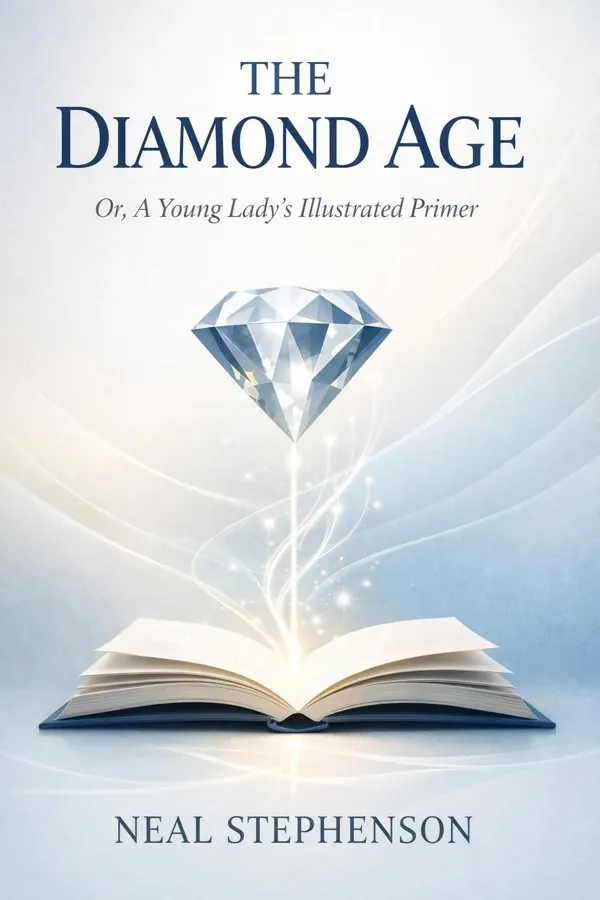
The Diamond Age: Or, A Young Lady’s Illustrated Primer: Summary & Key Insights
 10 min9 chaptersAudio available
Key Takeaways from The Diamond Age: Or, A Young Lady’s Illustrated Primer
The most powerful technologies do not merely solve problems; they quietly redefine who gets to become fully human.
A single act of access can alter the trajectory of a life more than any grand political slogan.
When technology levels material conditions, culture becomes the architecture of power.
True transformation happens when a person stops being defined by systems and starts acting upon them.
Abundance can eliminate scarcity without eliminating struggle.
What Is The Diamond Age: Or, A Young Lady’s Illustrated Primer About?
The Diamond Age: Or, A Young Lady’s Illustrated Primer by Neal Stephenson is a scifi_fantasy book spanning 4 pages. Neal Stephenson’s The Diamond Age: Or, A Young Lady’s Illustrated Primer is a science fiction novel about technology, class, education, and the stories that shape human beings. Set in a future world transformed by nanotechnology, the book imagines a society where material scarcity has largely been conquered, yet inequality remains alive in new and old forms. At the center of the story is Nell, a neglected girl from the social margins who unexpectedly receives an interactive book designed to teach, guide, and empower a privileged child. In Nell’s hands, that book becomes something far more radical: a tool for self-invention. What makes The Diamond Age so enduring is that it is not simply a futuristic adventure. Stephenson uses his dazzling world-building to ask urgent questions: If technology can give everyone abundance, why does power still concentrate? Can education overcome class destiny? And who gets to write the cultural operating system of the future? Stephenson, one of the most respected voices in speculative fiction, is known for blending technical imagination with social insight. Here, he delivers a richly layered novel that feels both visionary and uncannily relevant in an age of AI, personalized media, and widening inequality.
This FizzRead summary covers all 9 key chapters of The Diamond Age: Or, A Young Lady’s Illustrated Primer in approximately 10 minutes, distilling the most important ideas, arguments, and takeaways from Neal Stephenson's work. Also available as an audio summary and Key Quotes Podcast.
The Diamond Age: Or, A Young Lady’s Illustrated Primer
Neal Stephenson’s The Diamond Age: Or, A Young Lady’s Illustrated Primer is a science fiction novel about technology, class, education, and the stories that shape human beings. Set in a future world transformed by nanotechnology, the book imagines a society where material scarcity has largely been conquered, yet inequality remains alive in new and old forms. At the center of the story is Nell, a neglected girl from the social margins who unexpectedly receives an interactive book designed to teach, guide, and empower a privileged child. In Nell’s hands, that book becomes something far more radical: a tool for self-invention.
What makes The Diamond Age so enduring is that it is not simply a futuristic adventure. Stephenson uses his dazzling world-building to ask urgent questions: If technology can give everyone abundance, why does power still concentrate? Can education overcome class destiny? And who gets to write the cultural operating system of the future? Stephenson, one of the most respected voices in speculative fiction, is known for blending technical imagination with social insight. Here, he delivers a richly layered novel that feels both visionary and uncannily relevant in an age of AI, personalized media, and widening inequality.
Who Should Read The Diamond Age: Or, A Young Lady’s Illustrated Primer?
This book is perfect for anyone interested in scifi_fantasy and looking to gain actionable insights in a short read. Whether you're a student, professional, or lifelong learner, the key ideas from The Diamond Age: Or, A Young Lady’s Illustrated Primer by Neal Stephenson will help you think differently.
- ✓Readers who enjoy scifi_fantasy and want practical takeaways
- ✓Professionals looking to apply new ideas to their work and life
- ✓Anyone who wants the core insights of The Diamond Age: Or, A Young Lady’s Illustrated Primer in just 10 minutes
Want the full summary?
Get instant access to this book summary and 100K+ more with Fizz Moment.
Get Free SummaryAvailable on App Store • Free to download
Key Chapters
The most powerful technologies do not merely solve problems; they quietly redefine who gets to become fully human. In The Diamond Age, Stephenson imagines a future where nanotechnology can assemble objects on demand, making material abundance seem almost ordinary. Yet this abundance has not produced equality. Instead, society is divided into tribes, or “phyles,” with the neo-Victorians representing a deliberate revival of discipline, hierarchy, and cultural coherence. The world is rich in technical capability but still structured by inherited status, access, and exclusion.
The Primer is born inside this contradiction. It is commissioned as an elite educational tool for a privileged girl, designed to adapt itself to its reader and shape character as much as intellect. This matters because the novel suggests that education is never neutral. Every learning system encodes values, assumptions, and desired outcomes. The Primer is not just a smart book; it is a machine for producing a certain kind of person.
Stephenson’s larger point is strikingly contemporary. We often assume that better technology automatically leads to a better society, but the book shows that distribution, culture, and governance matter just as much as invention. Today, we can see parallels in AI tutors, personalized learning apps, and platforms that promise empowerment while often reinforcing existing inequalities.
A practical lesson follows: when evaluating any transformative technology, ask not only what it can do, but who it is built for, what values it teaches, and whose future it is meant to secure.
A single act of access can alter the trajectory of a life more than any grand political slogan. Nell begins the novel as a child shaped by neglect, poverty, and danger. She does not enter the story with privilege, support, or institutional protection. What she receives instead is the Primer, an interactive, deeply responsive book originally intended for someone else. Through stories, challenges, and personalized guidance, it becomes tutor, protector, and moral companion.
What makes this relationship so compelling is that the Primer does not simply provide information. It teaches Nell how to interpret the world, make choices under pressure, and imagine herself as someone capable of agency. The book responds to her circumstances, transforming abstract lessons into emotionally resonant experiences. In effect, it does what the best education does: it meets the learner where she is and stretches her toward who she might become.
This idea has obvious relevance beyond fiction. Many people are not held back by lack of intelligence, but by lack of nurturing structures that recognize their potential. A skilled teacher, a meaningful book, a mentoring relationship, or even a thoughtfully designed educational tool can change not only knowledge but identity.
Stephenson reminds us that empowerment is rarely instantaneous. Nell grows through repeated encounters with fear, pain, and uncertainty. The Primer gives her a framework, but she must still do the becoming herself. The actionable takeaway is simple: seek or create learning environments that respond to the individual, build confidence through challenge, and teach judgment rather than rote compliance.
When technology levels material conditions, culture becomes the architecture of power. One of Stephenson’s most fascinating ideas is the organization of society into phyles: cultural groupings that function like nations, classes, and value systems all at once. In this future, identity is less about geography and more about shared norms, rituals, and institutions. The neo-Victorians, for example, do not dominate merely because they possess wealth. They also offer a coherent worldview, with rules about conduct, family, education, and aspiration.
This matters because The Diamond Age argues that social order depends on more than gadgets or markets. Human beings need stories about who they are, what they owe each other, and what kind of lives are admirable. Some groups in the novel provide thick cultural frameworks; others drift in fragmentation. The result is not a clean battle between old and new, but a demonstration that cultures able to reproduce themselves through education and ritual become resilient, even in technologically fluid times.
You can see echoes of this in the present. Institutions, companies, schools, and even online communities thrive or fail partly based on whether they cultivate clear values and durable practices. A group without a cultural operating system struggles to transmit excellence across generations.
Stephenson does not romanticize every tradition, but he insists that culture matters as much as engineering. The practical takeaway is to examine the hidden norms shaping your environment. Ask what behaviors are rewarded, what stories are repeated, and whether your community is building people capable of freedom, responsibility, and continuity.
True transformation happens when a person stops being defined by systems and starts acting upon them. Nell’s journey is not only a coming-of-age story; it is a study in how an individual forged by hardship can become a force in history. The Primer helps her survive, think, and imagine alternatives, but over time she becomes more than its student. She begins to embody the qualities it was designed to cultivate: resilience, intelligence, courage, and strategic awareness.
This evolution is central to the novel’s deeper meaning. Stephenson is not interested in passive uplift, where technology rescues the disadvantaged through benevolent design. Instead, he shows how tools can prepare someone to claim authorship over her own life. Nell’s growth demonstrates that empowerment requires interior development as much as external opportunity. She learns to interpret power, navigate competing worlds, and act decisively when others remain trapped in roles assigned to them.
The idea has broad application. Educational systems, leadership programs, and mentoring structures often focus too heavily on credentials or information transfer. But real development requires training perception, judgment, and moral stamina. The people who shape the future are not always the ones born closest to power; often they are those who learn to translate adversity into capability.
Nell becomes a symbol of a new social possibility: that agency can emerge from the margins and challenge entrenched orders. The actionable takeaway is to treat learning not as consumption but as preparation for action. Ask of every lesson: how does this increase my capacity to choose, build, and influence?
Abundance can eliminate scarcity without eliminating struggle. The world of The Diamond Age is built on nanotechnology so advanced that objects can be fabricated with extraordinary precision. Food, clothing, and everyday goods can be produced through molecular manufacturing systems, radically altering economics and daily life. This is one of Stephenson’s boldest speculative achievements: he imagines a civilization where the control of matter itself has become programmable.
Yet the novel refuses a naive technological utopianism. Even in a world where material production is cheap and widespread, people still compete for status, belonging, influence, and cultural legitimacy. Violence persists. Class remains. Institutions still decide who gets high-quality environments, advanced education, and social protection. In other words, human problems evolve rather than disappear.
This is a useful corrective for modern readers living amid rapid innovation. New tools often generate the illusion that deeper social conflicts will simply dissolve. But technology changes the terrain of human life; it does not automatically settle moral questions. AI, biotech, and automation may transform work and production, yet fairness, purpose, and dignity will still require collective judgment.
Stephenson’s insight is practical: whenever a new technology promises liberation, examine the social systems around it. Who controls access? What dependencies does it create? What parts of human life remain stubbornly unsolved? The takeaway is to resist both blind optimism and reflexive fear. Instead, pair technological imagination with serious thinking about ethics, institutions, and unequal power.
To teach a child is to construct a future society one mind at a time. The Primer dramatizes this idea with unusual force. It is not a textbook in the conventional sense, nor a passive entertainment device. It is adaptive, immersive, and emotionally intelligent, guiding the reader through stories calibrated to her needs and development. In doing so, it reveals education as something broader than skill acquisition. Education is the shaping of perception, values, habits, and possibility.
Stephenson suggests that whoever controls formative narratives holds immense civilizational power. The neo-Victorians understand this, which is why they invest in educational systems that reproduce not just competence but culture. The Primer is effective because it does more than tell Nell what to think; it trains her in how to face complexity, danger, and ambiguity. It gives her a moral grammar for interpreting experience.
This is highly relevant in an era of algorithmic feeds, personalized content, and educational technologies. Children and adults alike are constantly being taught by the systems around them, whether those systems intend to educate or not. Social media teaches attention. Entertainment teaches aspiration. Institutions teach what matters by what they reward.
A practical application is to become more intentional about your own curriculum and that of the people you influence. Ask: what stories are shaping us? What habits of mind are being reinforced? What capabilities are we actually cultivating? The takeaway is clear: treat education as worldbuilding. If you want a wiser future, design learning experiences that form character, not just competence.
Human beings often become the roles they rehearse in imagination before they can perform them in life. The Diamond Age is deeply interested in storytelling as a technology of identity. The Primer does not mold Nell through lectures alone. It uses fairy-tale structures, quests, dangers, and archetypal encounters to help her practice courage, judgment, and self-command. Narrative becomes a training ground where identity is tested and strengthened.
This is one reason the novel feels so rich. Stephenson understands that stories are not decorative additions to life; they are operating systems for meaning. A child who repeatedly encounters narratives of helplessness may internalize passivity. A child who encounters narratives of initiative and resilience may begin to see herself as someone who can act. The same principle applies to adults. The stories we consume about success, love, politics, work, and human nature quietly influence our behavior.
In practical terms, this matters for parenting, leadership, education, and personal growth. Organizational cultures depend on stories about what kind of people belong there. Families pass on identity through repeated narratives. Individuals shape themselves by what they read, watch, and tell themselves in moments of crisis.
Stephenson’s novel invites readers to take stories seriously as formative forces. The actionable takeaway is to audit the narratives governing your life. What scripts are you following? Which ones make you smaller, and which ones call you into greater courage and responsibility? Choose stories that enlarge your sense of agency.
Even the smartest system still depends on hidden human labor, emotion, and sacrifice. One of the novel’s most haunting dimensions lies in the relationship between the Primer and the people who animate parts of its experience. The illusion of seamless technological responsiveness is not purely mechanical; it is supported by human presence, especially through the performance and care embedded in the system. This complicates any simple notion that advanced technology removes the human from the loop.
Stephenson uses this dynamic to expose a recurring truth about modern systems: convenience often conceals labor. Behind frictionless services, elegant interfaces, and personalized experiences are workers, moderators, creators, teachers, and caregivers whose contributions are obscured by design. The book’s emotional power increases because it recognizes that attachment, guidance, and empathy cannot be reduced to code alone.
This insight is especially timely today. AI products and digital platforms are often described as autonomous or fully automated, yet they rely on human training, supervision, content generation, and emotional inference. When we forget this, we risk undervaluing the people whose invisible work makes intelligence seem effortless.
The practical takeaway is twofold. First, whenever a system appears magically smooth, look for the hidden labor sustaining it. Second, remember that genuine care is not a technical feature but a relational act. Whether in education, management, or design, do not let efficiency erase the human beings carrying the emotional and ethical weight of the experience.
A civilization can become more advanced without becoming more mature. That is one of The Diamond Age’s most sobering lessons. Stephenson fills his world with astonishing inventions, intricate political structures, and new forms of social organization. Yet beneath the spectacle lies a persistent question: what actually counts as progress? The novel shows that innovation alone cannot answer it. A society may master manufacturing, communication, and information while still failing to nurture justice, wisdom, or belonging.
This tension runs through the book’s treatment of elites, institutions, and social outsiders. Some groups possess extraordinary technical capabilities yet remain brittle or morally compromised. Others lack resources but exhibit adaptability and vitality. The novel therefore resists equating advancement with gadgets or GDP-style metrics. It asks whether people are becoming more capable of living meaningful, responsible, and humane lives.
This is a valuable framework for readers navigating our own era of rapid change. We often celebrate disruption as inherently good, but many disruptions merely rearrange power or create new dependencies. Real progress should be evaluated by broader criteria: Does it deepen human flourishing? Does it expand agency? Does it strengthen communities without crushing individuality?
Stephenson’s enduring contribution is to insist that the future is not just a technical problem. It is a moral and cultural one. The actionable takeaway is to broaden your definition of progress. When assessing any institution, policy, or technology, ask not only whether it is impressive, but whether it makes people wiser, freer, and better able to build a livable world.
All Chapters in The Diamond Age: Or, A Young Lady’s Illustrated Primer
About the Author
Neal Stephenson is an acclaimed American novelist celebrated for speculative fiction that combines technological imagination with deep cultural and philosophical inquiry. Born in 1959, he has built a reputation for intellectually ambitious novels that explore how science, systems, and ideas reshape human life. He first gained major recognition with Snow Crash, a landmark cyberpunk novel, and went on to write influential works including Cryptonomicon, Anathem, The Baroque Cycle, Reamde, and Seveneves. Stephenson’s fiction is known for dense world-building, sharp social analysis, and a talent for making abstract concepts dramatically vivid. Across his career, he has examined topics such as cryptography, virtual reality, nanotechnology, religion, and political order. The Diamond Age remains one of his most admired novels for its vision of education, class, and technological change.
Get This Summary in Your Preferred Format
Read or listen to the The Diamond Age: Or, A Young Lady’s Illustrated Primer summary by Neal Stephenson anytime, anywhere. FizzRead offers multiple formats so you can learn on your terms — all free.
Available formats: App · Audio · PDF · EPUB — All included free with FizzRead
Download The Diamond Age: Or, A Young Lady’s Illustrated Primer PDF and EPUB Summary
Key Quotes from The Diamond Age: Or, A Young Lady’s Illustrated Primer
“The most powerful technologies do not merely solve problems; they quietly redefine who gets to become fully human.”
“A single act of access can alter the trajectory of a life more than any grand political slogan.”
“When technology levels material conditions, culture becomes the architecture of power.”
“True transformation happens when a person stops being defined by systems and starts acting upon them.”
“Abundance can eliminate scarcity without eliminating struggle.”
Frequently Asked Questions about The Diamond Age: Or, A Young Lady’s Illustrated Primer
The Diamond Age: Or, A Young Lady’s Illustrated Primer by Neal Stephenson is a scifi_fantasy book that explores key ideas across 9 chapters. Neal Stephenson’s The Diamond Age: Or, A Young Lady’s Illustrated Primer is a science fiction novel about technology, class, education, and the stories that shape human beings. Set in a future world transformed by nanotechnology, the book imagines a society where material scarcity has largely been conquered, yet inequality remains alive in new and old forms. At the center of the story is Nell, a neglected girl from the social margins who unexpectedly receives an interactive book designed to teach, guide, and empower a privileged child. In Nell’s hands, that book becomes something far more radical: a tool for self-invention. What makes The Diamond Age so enduring is that it is not simply a futuristic adventure. Stephenson uses his dazzling world-building to ask urgent questions: If technology can give everyone abundance, why does power still concentrate? Can education overcome class destiny? And who gets to write the cultural operating system of the future? Stephenson, one of the most respected voices in speculative fiction, is known for blending technical imagination with social insight. Here, he delivers a richly layered novel that feels both visionary and uncannily relevant in an age of AI, personalized media, and widening inequality.
More by Neal Stephenson


You Might Also Like
Red Rising
Pierce Brown
10 min
Stranger in a Strange Land
Robert A. Heinlein
10 min
AI Valley
Chen Qiufan
10 min
Bloodchild
Octavia E. Butler
10 min
Do Androids Dream of Electric Sheep?
Philip K. Dick
10 min
Jujutsu Kaisen, Vol. 24
Gege Akutami
10 minBrowse by Category
Ready to read The Diamond Age: Or, A Young Lady’s Illustrated Primer?
Get the full summary and 100K+ more books with Fizz Moment.