
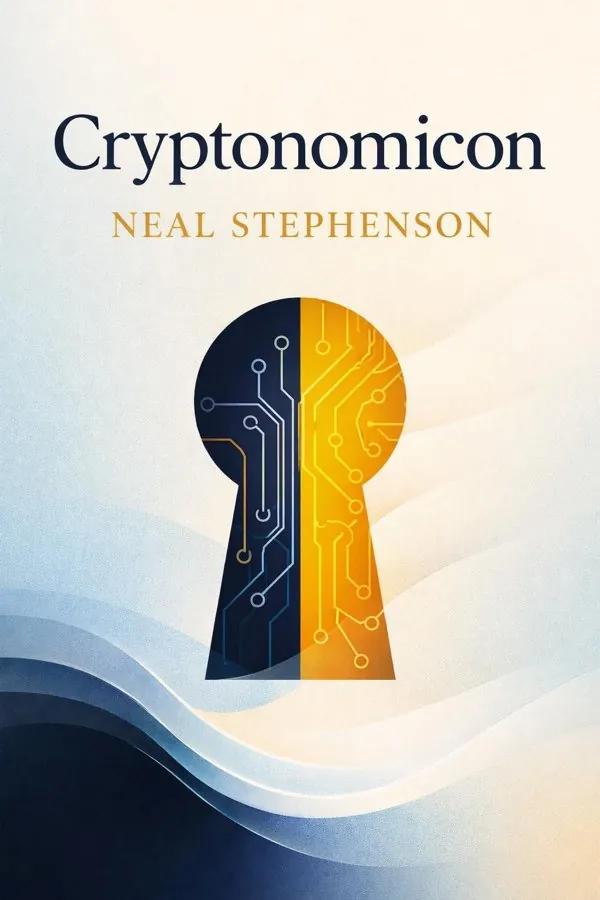
Cryptonomicon: Summary & Key Insights
 10 min8 chaptersAudio available
Key Takeaways from Cryptonomicon
Wars are often remembered through battles, but Cryptonomicon insists that information can be just as decisive as bullets.
The novel suggests that mathematics is not cold abstraction but a way of seeing reality more clearly.
Every era builds its own version of freedom, and in the 1990s timeline of Cryptonomicon that freedom is digital.
Behind the novel’s explosions, jokes, and technical digressions lies a serious philosophical claim: information is one of the fundamental forces shaping human civilization.
A code can protect a message, but it cannot automatically create trust.
What Is Cryptonomicon About?
Cryptonomicon by Neal Stephenson is a bestsellers book spanning 4 pages. What if the secrets that decided World War II also shaped the internet age? In Cryptonomicon, Neal Stephenson builds an ambitious, intellectually dazzling novel that moves between two eras: the codebreaking battlefields of the 1940s and the startup-like, high-risk digital frontier of the 1990s. In the wartime narrative, mathematicians, cryptographers, and soldiers wage a hidden war over information. In the modern timeline, their descendants and ideological heirs try to build a secure data haven beyond the reach of governments and centralized power. The result is part historical thriller, part technological adventure, and part philosophical inquiry into privacy, money, knowledge, and freedom. What makes the book matter is not just its plot, but its foresight. Long before encryption, digital sovereignty, cryptocurrency, and data security became mainstream concerns, Stephenson imagined how they would transform politics and everyday life. He writes with unusual authority because he combines technical literacy, historical curiosity, and a novelist’s flair for character and absurdity. Cryptonomicon is a demanding book, but it rewards readers with a rare experience: a story that makes abstract ideas feel urgent, human, and thrilling.
This FizzRead summary covers all 8 key chapters of Cryptonomicon in approximately 10 minutes, distilling the most important ideas, arguments, and takeaways from Neal Stephenson's work. Also available as an audio summary and Key Quotes Podcast.
Cryptonomicon
What if the secrets that decided World War II also shaped the internet age? In Cryptonomicon, Neal Stephenson builds an ambitious, intellectually dazzling novel that moves between two eras: the codebreaking battlefields of the 1940s and the startup-like, high-risk digital frontier of the 1990s. In the wartime narrative, mathematicians, cryptographers, and soldiers wage a hidden war over information. In the modern timeline, their descendants and ideological heirs try to build a secure data haven beyond the reach of governments and centralized power. The result is part historical thriller, part technological adventure, and part philosophical inquiry into privacy, money, knowledge, and freedom. What makes the book matter is not just its plot, but its foresight. Long before encryption, digital sovereignty, cryptocurrency, and data security became mainstream concerns, Stephenson imagined how they would transform politics and everyday life. He writes with unusual authority because he combines technical literacy, historical curiosity, and a novelist’s flair for character and absurdity. Cryptonomicon is a demanding book, but it rewards readers with a rare experience: a story that makes abstract ideas feel urgent, human, and thrilling.
Who Should Read Cryptonomicon?
This book is perfect for anyone interested in bestsellers and looking to gain actionable insights in a short read. Whether you're a student, professional, or lifelong learner, the key ideas from Cryptonomicon by Neal Stephenson will help you think differently.
- ✓Readers who enjoy bestsellers and want practical takeaways
- ✓Professionals looking to apply new ideas to their work and life
- ✓Anyone who wants the core insights of Cryptonomicon in just 10 minutes
Want the full summary?
Get instant access to this book summary and 100K+ more with Fizz Moment.
Get Free SummaryAvailable on App Store • Free to download
Key Chapters
Wars are often remembered through battles, but Cryptonomicon insists that information can be just as decisive as bullets. One of the novel’s foundational ideas is that World War II was not only fought in trenches, oceans, and skies, but also in hidden rooms where codes were made, broken, and protected. Through Lawrence Waterhouse and the strange, improvisational military unit known as Detachment 2702, Stephenson shows how intelligence work depends on subtlety, deception, and discipline. The unit’s mission is not merely to gather secrets. It must also hide the fact that Allied forces can read enemy signals, which means creating believable cover stories, fake operations, and carefully staged coincidences.
This makes the war feel less like a straightforward contest of force and more like an enormous logic puzzle. A convoy cannot simply avoid an ambush if doing so would reveal that the ambush was predicted from intercepted communications. The moral and strategic complexity is enormous: lives may be risked in the short term to preserve a larger informational advantage. Stephenson uses this setup to dramatize a difficult truth about modern systems: the value of knowledge often depends on how invisibly it is used.
The idea has practical resonance far beyond wartime. In cybersecurity, companies often monitor threats without immediately revealing what they know, because exposing detection methods can help attackers adapt. In business, organizations protect strategic insights by acting carefully rather than dramatically. In daily life, people also manage information asymmetry—deciding what to reveal, when, and why.
Actionable takeaway: Treat information as a strategic asset, not just a fact. When you gain an advantage through knowledge, think not only about how to use it, but how to preserve its long-term value.
The novel suggests that mathematics is not cold abstraction but a way of seeing reality more clearly. Lawrence Waterhouse embodies this perspective. He experiences patterns, anomalies, and systems with almost painful intensity, and that sensibility makes him invaluable in cryptography. In Cryptonomicon, codebreaking is not portrayed as cinematic guesswork or magical genius. It is careful reasoning under pressure, where logic, probability, language, and patience converge. Stephenson turns mathematical thought into drama by showing how small irregularities can reveal vast hidden structures.
What makes this idea powerful is that cryptography becomes a model for thinking itself. To decipher a code, you must assume order beneath apparent noise. You test hypotheses, accept uncertainty, and refine your understanding as evidence accumulates. This mindset applies far beyond encryption. Investors look for patterns in markets without confusing coincidence for signal. Doctors interpret symptoms the same way. Even good managers learn to distinguish one-off problems from systemic failures.
Stephenson also emphasizes that mathematical brilliance alone is insufficient. Codebreaking requires teamwork, tools, context, and operational judgment. A solved cipher means little if decision-makers cannot act on it wisely. That lesson matters in modern data-rich environments. Analytics, artificial intelligence, and dashboards may produce insight, but human interpretation remains essential.
A practical example is personal decision-making. If your finances feel chaotic, a mathematical mindset means tracking expenses, identifying recurring patterns, and testing changes instead of relying on intuition alone. If a team’s productivity is slipping, examine workflows and inputs before blaming individuals.
Actionable takeaway: Practice structured thinking. When faced with confusion, ask what patterns exist, what assumptions you’re making, and what evidence would confirm or challenge your interpretation.
Every era builds its own version of freedom, and in the 1990s timeline of Cryptonomicon that freedom is digital. Randy Waterhouse and his allies pursue an audacious idea: create a data haven, a jurisdictional and technological refuge where encrypted information can be stored and exchanged beyond the easy reach of state control. Stephenson presents this not as a gimmick, but as a serious extension of earlier battles over secrecy, sovereignty, and trust. If wartime cryptographers fought to control information for national survival, the modern characters fight to protect information from centralized power.
The dream matters because Stephenson understands that information is never just information. It carries money, identity, memory, contracts, leverage, and dissent. A data haven is therefore not simply a server farm in an exotic location. It is an experiment in political design. Can code create a zone of liberty? Can technical architecture substitute for legal trust? Can privacy and commerce flourish without becoming tools for criminality or corruption?
These questions have only become more relevant. Today we see versions of the same debate in encrypted messaging, cloud storage, offshore finance, decentralized networks, VPNs, and digital assets. Individuals and organizations want security from surveillance and censorship, but they also rely on institutions for stability and legitimacy. Stephenson refuses easy answers. The dream is visionary, but also messy, opportunistic, and morally ambiguous.
A practical application is thinking carefully about where your data lives and who controls it. Businesses choose between convenience and security when adopting platforms. Individuals make similar choices with passwords, backups, and privacy tools.
Actionable takeaway: Audit your digital dependencies. Know where your information is stored, who can access it, and what protections you need if privacy, autonomy, or resilience matter to you.
Behind the novel’s explosions, jokes, and technical digressions lies a serious philosophical claim: information is one of the fundamental forces shaping human civilization. Cryptonomicon explores this idea by connecting war, commerce, cryptography, religion, language, and computing into one sweeping view. Stephenson argues, implicitly and often playfully, that those who can encode, decode, store, and move information wield a form of power that rivals military might or political office.
The novel’s two timelines eventually feel less like separate stories than like stages in a single evolution. The wartime struggle is about intelligence dominance; the modern struggle is about controlling the infrastructure of the information economy. In both cases, information creates leverage. Secrets affect negotiations, markets, reputations, and geopolitical outcomes. But Stephenson also pushes deeper. He asks what information means philosophically. Is it merely data, or something closer to order itself? Can freedom survive when every action leaves a trace? Does privacy enable liberty, crime, or both?
This concept applies directly to modern life. Social media platforms monetize attention and behavioral data. Governments seek access to communications in the name of security. Companies compete over algorithms, user information, and intellectual property. Individuals, meanwhile, produce more digital exhaust than ever before. The novel helps readers see these issues not as isolated controversies but as expressions of a larger historical shift.
In practical terms, the philosophy of information encourages a more conscious relationship to data. What you share online, how platforms classify you, and who owns the systems you depend on all shape your freedom.
Actionable takeaway: Start treating data choices as life choices. Review your privacy settings, digital habits, and platform dependencies with the same seriousness you would give to financial or legal decisions.
A code can protect a message, but it cannot automatically create trust. One of Cryptonomicon’s most human insights is that secrecy is always double-edged. It shields fragile plans from enemies, but it can also isolate allies, distort motives, and strain relationships. Stephenson fills the novel with people who live inside compartments: military officers who know too much, operatives who know too little, programmers who trust code more than institutions, and entrepreneurs who mix idealism with self-interest. The result is a world where almost everyone depends on hidden knowledge, yet no one can fully escape the need for cooperation.
This tension gives the book emotional and moral depth. During wartime, withholding information may save a mission. In the modern storyline, strong encryption can defend liberty. But total opacity can also create paranoia and fragmentation. Teams fail when members do not know enough to coordinate. Societies fail when distrust becomes the default mode. Stephenson’s point is not that secrecy is bad. Rather, secrecy works only when embedded in trustworthy structures, shared goals, and credible boundaries.
That insight is highly practical. In organizations, leaders sometimes overprotect information in the name of control, then wonder why execution suffers. In personal relationships, privacy is healthy, but chronic concealment corrodes intimacy. In cybersecurity, zero-trust architecture is useful technically, yet human teams still need clarity, role definition, and communication.
A simple application is project management. Sensitive details may need to remain limited, but stakeholders still require enough context to act intelligently. The same is true in family finances, business partnerships, and community leadership.
Actionable takeaway: Distinguish between necessary confidentiality and harmful opacity. Share enough information to build alignment, while protecting what truly needs to remain secure.
We like to imagine that each generation starts fresh, but Cryptonomicon shows how deeply the present is inherited. The novel links grandparents and grandchildren, wartime improvisations and digital-era ambitions, buried treasure and encoded knowledge. This inheritance is not merely biological. It is intellectual, cultural, institutional, and technological. The descendants in the 1990s timeline inherit unfinished projects, moral ambiguities, personal obsessions, and strategic possibilities from the people who lived through World War II.
Stephenson uses this structure to make a larger point: systems remember. A protocol designed for one purpose may shape the next century. A wartime secret may influence peacetime finance. A habit of thought can become a family legacy or a national trait. The past is not over because its patterns are embedded in organizations, stories, laws, archives, and machines. This is why the dual timeline matters so much. It reveals continuity where history often appears fragmented.
Readers can apply this insight in many ways. Families pass down attitudes toward money, risk, education, and authority, often without naming them explicitly. Companies inherit cultures from founders long after those founders are gone. Nations inherit security doctrines and institutional reflexes from earlier crises. Technologists inherit design assumptions from previous generations of software and hardware.
A practical exercise is to identify one system you depend on—your workplace, your finances, your digital stack, or even your family routines—and ask what earlier decisions shaped it. Many recurring frustrations become clearer when traced to inherited structures rather than current personalities.
Actionable takeaway: Investigate your inheritances. Understanding the systems, assumptions, and stories you’ve received is the first step toward deciding which ones to preserve, revise, or escape.
Serious ideas do not have to arrive in solemn packaging, and one reason Cryptonomicon remains memorable is that it is often outrageously funny. Stephenson mixes dense technical discussion with slapstick, eccentric personalities, bizarre digressions, and scenes of logistical absurdity. This is not a distraction from the book’s themes. It is part of the method. By pairing intellectual complexity with comedy and adventure, he makes difficult subjects feel alive, embodied, and unpredictable.
The deeper insight here is that real innovation rarely looks neat from the inside. It is messy, improvisational, and full of personalities who are brilliant in one domain and ridiculous in another. Military operations go sideways. Startups chase grand visions while wrestling with petty constraints. Geniuses misread social cues. Bureaucracies collide with improvisers. The comic energy of the novel captures what polished histories often erase: progress is often built out of confusion, coincidence, and stubbornness.
This matters because many readers approach technical or historically rich books with intimidation. Cryptonomicon argues, through its style, that complexity can be joyful. Curiosity thrives when playfulness is allowed into the room. In workplaces, teams often solve hard problems better when they can experiment, laugh, and tolerate imperfect first attempts. In education, people learn more deeply when ideas are connected to stories and surprise rather than presented as dry doctrine.
A practical application is to bring narrative and humor into your own learning. If you are trying to understand a complex topic like cybersecurity, finance, or machine learning, pair formal study with stories, examples, and conversation.
Actionable takeaway: Approach complexity with curiosity instead of fear. Let humor, narrative, and experimentation become tools for understanding rather than signs that a serious subject is being diluted.
All Chapters in Cryptonomicon
About the Author
Neal Stephenson is an American novelist celebrated for fiction that fuses technology, history, philosophy, and speculative imagination. Born in 1959, he emerged as one of the defining voices of late twentieth-century and early twenty-first-century science fiction and techno-historical fiction. His books, including Snow Crash, The Diamond Age, Cryptonomicon, and the Baroque Cycle, are known for their intellectual ambition, deep research, and expansive treatment of systems such as computing, cryptography, economics, and language. Stephenson has a gift for making highly technical or abstract ideas dramatically engaging without stripping them of complexity. His influence extends beyond literature into technology culture, where many readers admire his foresight on digital networks, virtual worlds, privacy, and information systems. Cryptonomicon remains one of his most widely discussed works because it captures both his historical curiosity and his fascination with the hidden architectures of modern life.
Get This Summary in Your Preferred Format
Read or listen to the Cryptonomicon summary by Neal Stephenson anytime, anywhere. FizzRead offers multiple formats so you can learn on your terms — all free.
Available formats: App · Audio · PDF · EPUB — All included free with FizzRead
Download Cryptonomicon PDF and EPUB Summary
Key Quotes from Cryptonomicon
“Wars are often remembered through battles, but Cryptonomicon insists that information can be just as decisive as bullets.”
“The novel suggests that mathematics is not cold abstraction but a way of seeing reality more clearly.”
“Every era builds its own version of freedom, and in the 1990s timeline of Cryptonomicon that freedom is digital.”
“Behind the novel’s explosions, jokes, and technical digressions lies a serious philosophical claim: information is one of the fundamental forces shaping human civilization.”
“A code can protect a message, but it cannot automatically create trust.”
Frequently Asked Questions about Cryptonomicon
Cryptonomicon by Neal Stephenson is a bestsellers book that explores key ideas across 8 chapters. What if the secrets that decided World War II also shaped the internet age? In Cryptonomicon, Neal Stephenson builds an ambitious, intellectually dazzling novel that moves between two eras: the codebreaking battlefields of the 1940s and the startup-like, high-risk digital frontier of the 1990s. In the wartime narrative, mathematicians, cryptographers, and soldiers wage a hidden war over information. In the modern timeline, their descendants and ideological heirs try to build a secure data haven beyond the reach of governments and centralized power. The result is part historical thriller, part technological adventure, and part philosophical inquiry into privacy, money, knowledge, and freedom. What makes the book matter is not just its plot, but its foresight. Long before encryption, digital sovereignty, cryptocurrency, and data security became mainstream concerns, Stephenson imagined how they would transform politics and everyday life. He writes with unusual authority because he combines technical literacy, historical curiosity, and a novelist’s flair for character and absurdity. Cryptonomicon is a demanding book, but it rewards readers with a rare experience: a story that makes abstract ideas feel urgent, human, and thrilling.
More by Neal Stephenson

You Might Also Like

The Godfather
Mario Puzo
10 min
The Handmaid's Tale
Margaret Atwood
10 min
The Hunger Games
Suzanne Collins
10 min
The Nightingale
Kristin Hannah
10 min
The Seven Husbands of Evelyn Hugo
Taylor Jenkins Reid
10 min
Backwater Justice
Fern Michaels
10 minBrowse by Category
Ready to read Cryptonomicon?
Get the full summary and 100K+ more books with Fizz Moment.