
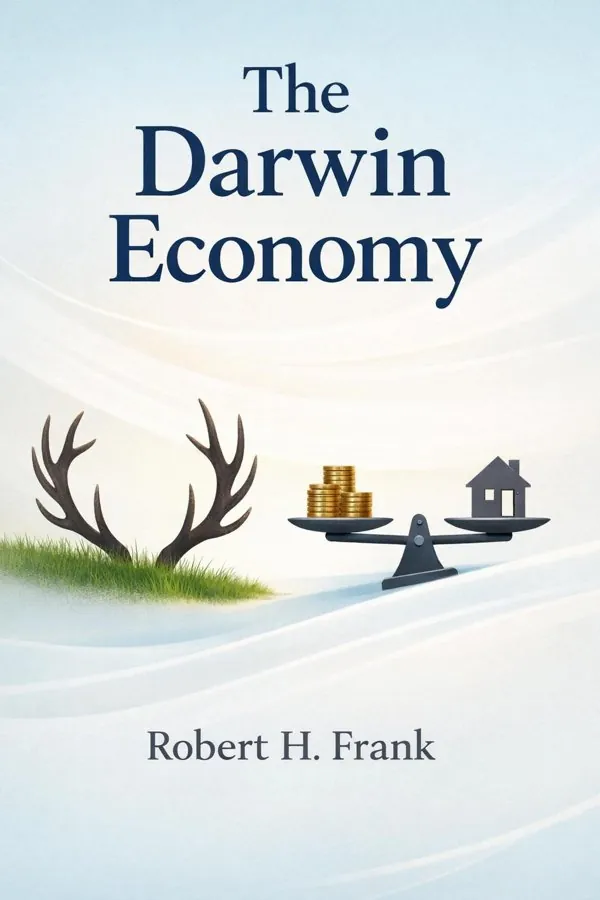
The Darwin Economy: Liberty, Competition, and the Common Good: Summary & Key Insights
 10 min9 chaptersAudio available
What Is The Darwin Economy: Liberty, Competition, and the Common Good About?
The Darwin Economy: Liberty, Competition, and the Common Good by Robert H. Frank is a economics book spanning 9 pages. In The Darwin Economy, economist Robert H. Frank argues that Charles Darwin’s insights into competition provide a more accurate framework for understanding economic behavior than Adam Smith’s invisible hand. Frank contends that individual competition often leads to collective inefficiency, and he proposes policy solutions that align private incentives with the common good. The book explores themes of inequality, taxation, and the role of government in promoting social welfare.
This FizzRead summary covers all 9 key chapters of The Darwin Economy: Liberty, Competition, and the Common Good in approximately 10 minutes, distilling the most important ideas, arguments, and takeaways from Robert H. Frank's work. Also available as an audio summary and Key Quotes Podcast.
The Darwin Economy: Liberty, Competition, and the Common Good
In The Darwin Economy, economist Robert H. Frank argues that Charles Darwin’s insights into competition provide a more accurate framework for understanding economic behavior than Adam Smith’s invisible hand. Frank contends that individual competition often leads to collective inefficiency, and he proposes policy solutions that align private incentives with the common good. The book explores themes of inequality, taxation, and the role of government in promoting social welfare.
Who Should Read The Darwin Economy: Liberty, Competition, and the Common Good?
This book is perfect for anyone interested in economics and looking to gain actionable insights in a short read. Whether you're a student, professional, or lifelong learner, the key ideas from The Darwin Economy: Liberty, Competition, and the Common Good by Robert H. Frank will help you think differently.
- ✓Readers who enjoy economics and want practical takeaways
- ✓Professionals looking to apply new ideas to their work and life
- ✓Anyone who wants the core insights of The Darwin Economy: Liberty, Competition, and the Common Good in just 10 minutes
Want the full summary?
Get instant access to this book summary and 100K+ more with Fizz Moment.
Get Free SummaryAvailable on App Store • Free to download
Key Chapters
Adam Smith envisioned a world where self-interest and competition yield harmony. The baker bakes bread not out of generosity but because it profits him, and consumers benefit as if guided by an invisible hand. But Darwin’s framework tells us something different: competition improves relative standing, not necessarily absolute welfare. In the natural world, traits that confer an edge over rivals—say, larger antlers or brighter plumage—may drain resources or even reduce survival chances for the group.
In economics, similar dynamics emerge. When each firm or individual competes fiercely for relative position—higher salaries, larger market shares—the results may not serve society as a whole. The key is recognizing that what is rational individually can be destructive collectively. Unlike Smith’s model, Darwinian competition has no inherent mechanism guaranteeing social efficiency. Thus, policies based solely on unregulated markets rest on an incomplete understanding of how competition truly functions.
I do not deny Smith’s genius; rather, I argue that his model applies best to small-scale exchange, not large-scale positional contests. In modern economies characterized by highly visible wealth disparities and consumption signals, it is Darwin’s insight that most accurately accounts for the pressures driving behavior. To move beyond Smith, we must see competition as both a creative and corrosive force—a tension that policy must manage rather than simply unleash.
In one of my favorite examples, I describe the bull elk’s antlers. Each elk grows massive antlers to win in mating contests. Having bigger antlers is essential because rivals have big ones; but the trouble is that these antlers make the elk slower and more vulnerable to predators. The outcome is a costly arms race where each individual follows rational incentives yet collectively the species suffers. Their antlers could have been smaller, yielding better survival for all.
Human economic behavior often mirrors this pattern. We build larger houses not because we need the space but to signal status. Families stretch budgets, cities sprawl, energy use climbs—all in pursuit of relative distinction. The tragedy is that when everyone spends more to maintain social rank, no one is better off than before, yet society bears the costs of waste, stress, and environmental damage.
This simple biological analogy exposes the heart of our dilemma: individual rationality does not ensure collective rationality. Recognizing this allows us to imagine interventions that preserve competition’s vitality while curbing its excesses. Just as animal ecologists understand that unchecked sexual selection can imperil a species, economists must understand that unchecked positional competition can imperil an economy.
+ 7 more chapters — available in the FizzRead app
All Chapters in The Darwin Economy: Liberty, Competition, and the Common Good
About the Author
Robert H. Frank is an American economist and professor at Cornell University’s Johnson Graduate School of Management. He is known for his work on behavioral economics, income inequality, and public policy, and has authored several influential books including The Winner-Take-All Society and Luxury Fever.
Get This Summary in Your Preferred Format
Read or listen to the The Darwin Economy: Liberty, Competition, and the Common Good summary by Robert H. Frank anytime, anywhere. FizzRead offers multiple formats so you can learn on your terms — all free.
Available formats: App · Audio · PDF · EPUB — All included free with FizzRead
Download The Darwin Economy: Liberty, Competition, and the Common Good PDF and EPUB Summary
Key Quotes from The Darwin Economy: Liberty, Competition, and the Common Good
“Adam Smith envisioned a world where self-interest and competition yield harmony.”
“In one of my favorite examples, I describe the bull elk’s antlers.”
Frequently Asked Questions about The Darwin Economy: Liberty, Competition, and the Common Good
The Darwin Economy: Liberty, Competition, and the Common Good by Robert H. Frank is a economics book that explores key ideas across 9 chapters. In The Darwin Economy, economist Robert H. Frank argues that Charles Darwin’s insights into competition provide a more accurate framework for understanding economic behavior than Adam Smith’s invisible hand. Frank contends that individual competition often leads to collective inefficiency, and he proposes policy solutions that align private incentives with the common good. The book explores themes of inequality, taxation, and the role of government in promoting social welfare.
More by Robert H. Frank

You Might Also Like

Business Adventures
John Brooks
10 min
Nudge
Richard H. Thaler, Cass R. Sunstein
10 min
The Hitchhiker"s Guide to the Galaxy
Douglas Adams
10 minThe Muqaddimah
Ibn Khaldun
10 minThe Outsiders
William N. Thorndike
10 min
A Little History of Economics
Niall Kishtainy
10 minBrowse by Category
Ready to read The Darwin Economy: Liberty, Competition, and the Common Good?
Get the full summary and 100K+ more books with Fizz Moment.