
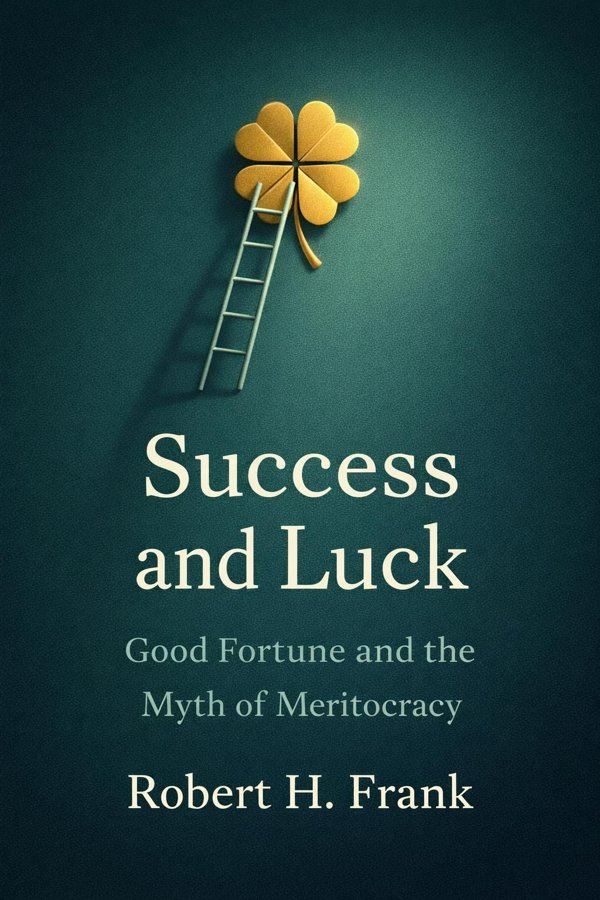
Success and Luck: Good Fortune and the Myth of Meritocracy: Summary & Key Insights
 10 min11 chaptersAudio available
What Is Success and Luck: Good Fortune and the Myth of Meritocracy About?
Success and Luck: Good Fortune and the Myth of Meritocracy by Robert H. Frank is a economics book spanning 11 pages. In this thought-provoking book, economist Robert H. Frank explores the often-overlooked role of luck in success. Drawing on behavioral economics and real-world examples, Frank argues that talent and hard work are important but insufficient explanations for success. He shows how random events and social environments shape outcomes, and he calls for policies that recognize the role of luck in creating fairer societies.
This FizzRead summary covers all 11 key chapters of Success and Luck: Good Fortune and the Myth of Meritocracy in approximately 10 minutes, distilling the most important ideas, arguments, and takeaways from Robert H. Frank's work. Also available as an audio summary and Key Quotes Podcast.
Success and Luck: Good Fortune and the Myth of Meritocracy
In this thought-provoking book, economist Robert H. Frank explores the often-overlooked role of luck in success. Drawing on behavioral economics and real-world examples, Frank argues that talent and hard work are important but insufficient explanations for success. He shows how random events and social environments shape outcomes, and he calls for policies that recognize the role of luck in creating fairer societies.
Who Should Read Success and Luck: Good Fortune and the Myth of Meritocracy?
This book is perfect for anyone interested in economics and looking to gain actionable insights in a short read. Whether you're a student, professional, or lifelong learner, the key ideas from Success and Luck: Good Fortune and the Myth of Meritocracy by Robert H. Frank will help you think differently.
- ✓Readers who enjoy economics and want practical takeaways
- ✓Professionals looking to apply new ideas to their work and life
- ✓Anyone who wants the core insights of Success and Luck: Good Fortune and the Myth of Meritocracy in just 10 minutes
Want the full summary?
Get instant access to this book summary and 100K+ more with Fizz Moment.
Get Free SummaryAvailable on App Store • Free to download
Key Chapters
Before we can talk meaningfully about success, we must clarify what we mean by luck. In everyday conversation, ‘luck’ is a vague concept—a sense that something beyond our control has worked in our favor. In economics, we can define it more precisely as any event that influences outcomes but lies outside a person’s deliberate effort. This could include when and where you are born, the era’s technological stage, the family that supports or hinders you, or even your genetic predispositions.
People often confuse luck with skill because the world rarely provides clean experiments. Two individuals can start with equal intelligence and motivation, yet one happens to meet the right collaborator, receive the right advice, or be present when an opportunity opens. That person’s path diverges, and over time, the difference compounds. To see this vividly, consider the story of Silicon Valley entrepreneurs. Many of them are undoubtedly gifted, but timing and place played decisive roles. Had they been born just ten years earlier or later, in a different neighborhood or without access to certain networks, many would have remained obscure engineers rather than cultural icons.
Recognizing luck’s power doesn’t deny talent—it contextualizes it. Even small advantages at the start, when amplified by the mechanisms of cumulative advantage, can lead to vast outcome disparities. In competition for scarce rewards, the difference between first and second place can be infinitesimal, yet the rewards can differ by millions. This is a mathematical truth of modern markets: when outcomes hinge on small initial differences, chance often dictates the winner. Understanding this truth is the foundation for an honest conversation about fairness.
Several years ago, I experienced an event that seared the reality of chance into my mind. While jogging in Ithaca, I was nearly struck by a car that lost control on an icy road. A few inches, half a second—it was that close. Had I been where I was a moment earlier, I would not be here to write these words. That near-miss led to months of reflection: how easily the trajectory of my career, my family, my research—all of it—could have vanished.
The realization was uncomfortable. As a social scientist, I had always emphasized rational causation, the predictable patterns in human behavior. But this brush with disaster forced me to confront what we all know intuitively yet suppress—the randomness in life. For every person celebrated for perseverance, there are countless others who tried with equal vigor but encountered worse luck: an illness, a setback, a family responsibility, or a market collapse. Their stories vanish into silence, and we mistakenly attribute the silence to a lack of effort rather than misfortune. This personal moment reframed not just my outlook but my entire research trajectory. From then on, my work has aimed to bring luck out of the shadows, to make it visible in the story of human success.
+ 9 more chapters — available in the FizzRead app
All Chapters in Success and Luck: Good Fortune and the Myth of Meritocracy
About the Author
Robert H. Frank is the Henrietta Johnson Louis Professor of Management and Professor of Economics at Cornell University’s Johnson Graduate School of Management. He is known for his work in behavioral economics and has authored several influential books on inequality, competition, and moral sentiments.
Get This Summary in Your Preferred Format
Read or listen to the Success and Luck: Good Fortune and the Myth of Meritocracy summary by Robert H. Frank anytime, anywhere. FizzRead offers multiple formats so you can learn on your terms — all free.
Available formats: App · Audio · PDF · EPUB — All included free with FizzRead
Download Success and Luck: Good Fortune and the Myth of Meritocracy PDF and EPUB Summary
Key Quotes from Success and Luck: Good Fortune and the Myth of Meritocracy
“Before we can talk meaningfully about success, we must clarify what we mean by luck.”
“Several years ago, I experienced an event that seared the reality of chance into my mind.”
Frequently Asked Questions about Success and Luck: Good Fortune and the Myth of Meritocracy
Success and Luck: Good Fortune and the Myth of Meritocracy by Robert H. Frank is a economics book that explores key ideas across 11 chapters. In this thought-provoking book, economist Robert H. Frank explores the often-overlooked role of luck in success. Drawing on behavioral economics and real-world examples, Frank argues that talent and hard work are important but insufficient explanations for success. He shows how random events and social environments shape outcomes, and he calls for policies that recognize the role of luck in creating fairer societies.
More by Robert H. Frank

You Might Also Like

Business Adventures
John Brooks
10 min
Nudge
Richard H. Thaler, Cass R. Sunstein
10 min
The Hitchhiker"s Guide to the Galaxy
Douglas Adams
10 minThe Muqaddimah
Ibn Khaldun
10 minThe Outsiders
William N. Thorndike
10 min
A Little History of Economics
Niall Kishtainy
10 minBrowse by Category
Ready to read Success and Luck: Good Fortune and the Myth of Meritocracy?
Get the full summary and 100K+ more books with Fizz Moment.