
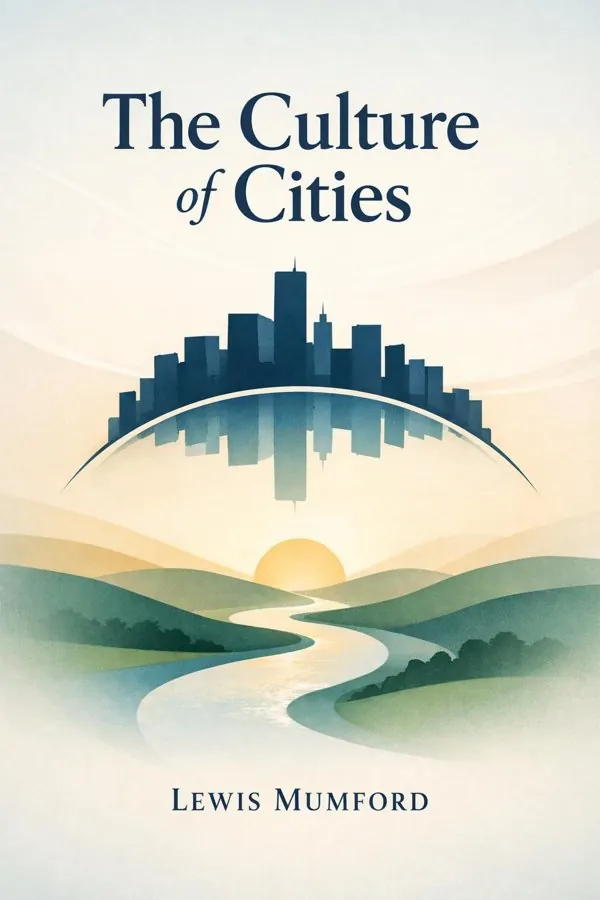
The Culture of Cities: Summary & Key Insights
 10 min9 chaptersAudio available
Key Takeaways from The Culture of Cities
Every great city begins with a modest act of settlement.
A city feels alive when its form grows from life rather than being forced upon it.
When production becomes the supreme value, the city begins to consume the people it was meant to serve.
Technology is not destiny; its value depends on the purposes it serves.
A city does more than house people; it tells them who they are.
What Is The Culture of Cities About?
The Culture of Cities by Lewis Mumford is a civilization book spanning 9 pages. Cities are often judged by their skylines, traffic, and growth rates, but Lewis Mumford asks a deeper question: what kind of human life do they make possible? In The Culture of Cities, he traces the long evolution of urban civilization from sacred ancient centers and medieval towns to the industrial metropolis and the sprawling megalopolis. His central claim is that the city is not merely a machine for production or circulation. It is a social and cultural organism shaped by technology, power, religion, economics, and collective imagination. When cities are designed around human needs, they nurture community, creativity, and civic life; when they are organized around unchecked industry, congestion, and profit, they damage both society and the individual. This book matters because many of Mumford’s concerns—overcrowding, alienation, environmental strain, and the loss of meaningful public space—remain strikingly current. As one of the twentieth century’s most influential historians of cities and technology, Mumford brings unusual authority, range, and moral seriousness to the subject, making this a foundational work for anyone trying to understand urban life.
This FizzRead summary covers all 9 key chapters of The Culture of Cities in approximately 10 minutes, distilling the most important ideas, arguments, and takeaways from Lewis Mumford's work. Also available as an audio summary and Key Quotes Podcast.
The Culture of Cities
Cities are often judged by their skylines, traffic, and growth rates, but Lewis Mumford asks a deeper question: what kind of human life do they make possible? In The Culture of Cities, he traces the long evolution of urban civilization from sacred ancient centers and medieval towns to the industrial metropolis and the sprawling megalopolis. His central claim is that the city is not merely a machine for production or circulation. It is a social and cultural organism shaped by technology, power, religion, economics, and collective imagination. When cities are designed around human needs, they nurture community, creativity, and civic life; when they are organized around unchecked industry, congestion, and profit, they damage both society and the individual. This book matters because many of Mumford’s concerns—overcrowding, alienation, environmental strain, and the loss of meaningful public space—remain strikingly current. As one of the twentieth century’s most influential historians of cities and technology, Mumford brings unusual authority, range, and moral seriousness to the subject, making this a foundational work for anyone trying to understand urban life.
Who Should Read The Culture of Cities?
This book is perfect for anyone interested in civilization and looking to gain actionable insights in a short read. Whether you're a student, professional, or lifelong learner, the key ideas from The Culture of Cities by Lewis Mumford will help you think differently.
- ✓Readers who enjoy civilization and want practical takeaways
- ✓Professionals looking to apply new ideas to their work and life
- ✓Anyone who wants the core insights of The Culture of Cities in just 10 minutes
Want the full summary?
Get instant access to this book summary and 100K+ more with Fizz Moment.
Get Free SummaryAvailable on App Store • Free to download
Key Chapters
Every great city begins with a modest act of settlement. Mumford argues that urban life did not emerge suddenly from trade or political ambition alone; it grew out of the village, where agriculture, ritual, kinship, and shared labor first created stable human communities. Before walls, markets, and monuments, there was a common life organized around the rhythms of soil, season, and worship. The earliest city inherited this structure and magnified it. Temples, granaries, public enclosures, and ceremonial centers gave collective form to values that had already taken root in smaller communities.
This matters because it challenges the idea that cities are purely economic machines. For Mumford, the city is first a container of meaning. Its earliest functions were not just to store goods but to store memory, symbolize order, and organize social cooperation. Ancient cities often united practical needs with spiritual and civic purpose. Their layout reflected beliefs about the cosmos, authority, and communal responsibility.
In modern planning, this insight remains relevant. A successful neighborhood still depends on the village principle: walkable streets, local institutions, social recognition, and places where daily life can unfold without total dependence on distant systems. When urban development ignores these foundations and produces anonymous blocks without community structure, it weakens the social fabric that cities need to thrive.
Actionable takeaway: When evaluating any city or neighborhood, ask whether it supports village-like bonds—shared spaces, local identity, and everyday human connection—not just density or economic activity.
A city feels alive when its form grows from life rather than being forced upon it. Mumford uses the term “eotechnic” to describe the long medieval and early Renaissance period when towns developed in a comparatively organic way. Their streets were often irregular, their buildings closely tied to local materials, and their institutions woven into daily life. Markets, guild halls, churches, workshops, and homes existed in close relation. These cities were not perfect, but they reflected a balance between production, social organization, and the limits of human movement and perception.
The eotechnic city was shaped less by abstract engineering and more by lived use. Because most people moved on foot, urban distances remained understandable. Because work and residence were closely connected, daily existence had a stronger civic and communal dimension. The city was still rough, crowded, and unequal in many places, yet it preserved a direct connection between place and human activity.
Mumford does not romanticize the medieval town as an ideal to be copied exactly. Instead, he sees it as evidence that urban form can remain intelligible and socially rooted. Modern planners can learn from this by designing districts that encourage mixed use, short travel distances, and buildings suited to local climate and materials. Historic centers that remain attractive today often retain precisely these qualities.
Actionable takeaway: Favor urban environments built at a human scale—walkable, mixed, locally distinctive, and easy to understand—rather than places organized entirely for speed, abstraction, or spectacle.
When production becomes the supreme value, the city begins to consume the people it was meant to serve. Mumford calls the harsh urban order of early industrialization the “paleotechnic” phase. Fueled by coal, factories, mechanized labor, and profit-driven expansion, the industrial city reorganized space around extraction and output rather than health, beauty, or community. Smoke, overcrowded housing, polluted water, noise, and exhausting labor became normal features of the new metropolis.
In this phase, the city’s earlier civic and symbolic roles were pushed aside. Workers were packed into slums near mills and rail lines. Public life deteriorated as private wealth accumulated beside public misery. Industrial efficiency was celebrated, but the social cost was immense: disease, class segregation, alienation, and environmental ruin. The city no longer integrated functions harmoniously; it fragmented them under economic pressure.
Mumford’s critique is still recognizable in places where urban policy prioritizes logistics, real-estate speculation, or industrial throughput over human well-being. Neighborhoods cut off by highways, communities exposed to toxic infrastructure, and long commutes from affordable housing to distant employment all repeat paleotechnic patterns in updated form.
The lesson is not that industry has no place in civilization, but that productive systems must be subordinated to humane aims. A city that measures success only by growth, output, or land value may appear dynamic while becoming less livable.
Actionable takeaway: Judge urban progress by health, dignity, and social integration as much as by productivity or expansion.
Technology is not destiny; its value depends on the purposes it serves. Mumford introduces the “neotechnic” phase as a more promising technological order, associated with electricity, cleaner energy, improved communication, lighter materials, and more flexible forms of production. Unlike the dirty concentration demanded by coal and heavy industry, newer technologies made it possible to decentralize certain activities, reduce pollution, and rethink the rigid patterns of the industrial metropolis.
This shift opened a major possibility: cities no longer had to be built as giant machines of congestion. If power could be transmitted efficiently, if transportation could be reorganized intelligently, and if communication could reduce unnecessary centralization, then urban life could be dispersed without becoming chaotic. The neotechnic city could, in principle, combine technological sophistication with cleaner environments, healthier housing, and more balanced regional development.
But Mumford warns that better tools do not automatically produce better cities. New systems can also intensify control, expand sprawl, or reinforce inequality if guided by the wrong values. That warning feels especially modern. Digital infrastructure, remote work, smart systems, and renewable energy all offer opportunities to improve urban life, yet they can still produce exclusion, surveillance, or ecological waste if used carelessly.
The challenge is moral and social, not merely technical. The question is always whether technology enlarges human freedom, community, and well-being, or whether it simply accelerates existing dysfunction.
Actionable takeaway: Embrace innovation only when it clearly improves health, access, community life, and environmental quality—not just convenience or profit.
Beyond a certain scale, urban expansion can stop enriching life and begin hollowing it out. Mumford uses the term “megalopolis” to describe the overgrown metropolitan region in which cities spread, merge, and intensify beyond healthy limits. In this condition, size itself becomes a problem. Administration grows remote, daily movement becomes exhausting, open land disappears, and citizens lose a clear sense of local belonging. The metropolis no longer acts as an integrated civic organism; it becomes an agglomeration of disconnected functions and populations.
Megalopolis promises opportunity, but often produces strain. Congestion, anonymity, speculative land use, excessive commuting, environmental degradation, and social fragmentation become ordinary. People may live physically close yet remain socially isolated. Economic and cultural concentration can generate wealth and innovation, but it can also erode democratic participation when institutions become too vast and impersonal for ordinary citizens to influence.
Mumford’s diagnosis seems prophetic in the age of endless suburban belts, mega-regions, and infrastructure stretched across enormous territories. The issue is not population alone but uncontrolled scale without corresponding social design. A region may be large and still livable if organized as a network of coherent communities. It becomes megalopolitan when growth outruns civic form.
Mumford therefore pushes readers to think regionally. The answer is not simply to stop cities from growing, but to distribute functions intelligently, preserve green belts, protect local centers, and prevent concentration from becoming domination.
Actionable takeaway: Support regional planning that limits destructive sprawl, strengthens local communities, and preserves open land instead of treating unlimited expansion as inevitable progress.
A city succeeds not when it gets bigger, but when it helps people become more fully human. For Mumford, the city’s greatest function is social and cultural before it is economic. It gathers people, institutions, and traditions into a setting where conversation, education, art, memory, political life, and moral growth can flourish. The true city enlarges personality through association. It brings diverse groups into contact, supports shared rituals and responsibilities, and provides the institutions that help individuals move beyond private survival into civic participation.
This view sharply contrasts with narrow definitions of the city as a labor market, transport hub, or consumer platform. Those functions matter, but they are secondary. A city worthy of the name should cultivate public life. Libraries, schools, parks, theaters, neighborhood associations, and accessible gathering places are not luxuries in Mumford’s framework; they are part of the city’s essential work.
This idea has practical implications for policy. If urban life is judged mainly by tax base, tourism, or property values, governments may underinvest in the very institutions that make citizenship meaningful. Yet cities become resilient when residents have places to meet, learn, deliberate, and create. Even small interventions—a well-designed square, an active public school, a community arts center—can strengthen civic culture.
Mumford reminds us that urban design should not merely manage populations. It should support the development of character, intelligence, and fellowship.
Actionable takeaway: Measure your city by the quality of its public life—its schools, parks, libraries, meeting places, and cultural institutions—not only by wealth or infrastructure.
Bad planning can be as destructive as no planning at all. Mumford strongly supports urban planning, but only when it is guided by human needs rather than mechanical formulas. He rejects both laissez-faire chaos and rigid technocratic schemes that treat cities as diagrams instead of living communities. Real planning must balance housing, work, transportation, recreation, nature, and civic institutions in ways that respect both regional structure and local experience.
For Mumford, reconstruction means more than replacing obsolete buildings. It requires rethinking the relationships between city and countryside, center and neighborhood, movement and settlement. Housing should not be isolated from schools and services. Roads should not dominate public space. Industry should not poison residential districts. Regional plans should preserve farmland and open land while supporting multiple centers of activity instead of funneling everything into one congested core.
This balanced approach is strikingly contemporary. Current debates about transit-oriented development, 15-minute cities, mixed-income housing, and climate adaptation all reflect questions Mumford helped frame. His point is that planning succeeds when it coordinates systems without crushing spontaneity. Citizens need order, but they also need complexity, local identity, and room for informal social life.
Urban redevelopment often fails when it erases neighborhoods in the name of efficiency or imposes uniform solutions on different communities. Mumford calls for intelligence with sympathy—technical competence shaped by social understanding.
Actionable takeaway: Support planning that integrates housing, mobility, green space, and local institutions while preserving the lived texture of neighborhoods.
The healthiest city behaves less like a machine and more like an organism. Mumford’s organic ideal is his answer to both industrial chaos and overcentralized planning. An organic city is not disorderly; it is ordered in a living way. Its parts relate to one another as functions within a whole. Neighborhoods have identity but remain connected to the larger city. The city itself belongs to a wider region that includes farms, watersheds, forests, and smaller settlements. Growth is guided by limits, proportion, and reciprocal support.
The organic ideal resists two temptations at once: uncontrolled metropolitan expansion and sterile uniformity. It favors decentralization without isolation, density without congestion, and technology without domination. In practical terms, this means designing settlements where work, residence, recreation, and culture are linked intelligently; where natural systems are protected; and where public institutions are distributed in ways that sustain everyday access and civic equality.
Today this idea resonates with ecological urbanism, biophilic design, and regional sustainability. Cities increasingly recognize that floodplains, tree cover, local food systems, walkability, and social infrastructure are not optional extras. They are part of a city’s life-support system. Mumford anticipated this broad ecological understanding decades before it became common.
His organic vision is ultimately ethical. It assumes that cities should help human beings live richly within natural and social limits, rather than seeking endless expansion or mechanical control.
Actionable takeaway: Favor urban choices that strengthen relationships—between neighborhoods, institutions, and the natural environment—rather than projects that maximize short-term growth at long-term human cost.
All Chapters in The Culture of Cities
About the Author
Lewis Mumford (1895–1990) was an American historian, sociologist, literary critic, and philosopher of technology whose work profoundly shaped modern thinking about cities and civilization. Largely self-educated, he brought together history, architecture, urban planning, biology, and cultural criticism in a way few twentieth-century writers matched. Mumford became known for examining how technological systems and built environments influence human values, community life, and political power. His major books include Technics and Civilization, The Culture of Cities, and The City in History, the last of which won the National Book Award. Across his career, he criticized both unrestrained industrialism and mechanized social thinking, while advocating for human-scaled communities, regional planning, and a more organic relationship between society, technology, and nature.
Get This Summary in Your Preferred Format
Read or listen to the The Culture of Cities summary by Lewis Mumford anytime, anywhere. FizzRead offers multiple formats so you can learn on your terms — all free.
Available formats: App · Audio · PDF · EPUB — All included free with FizzRead
Download The Culture of Cities PDF and EPUB Summary
Key Quotes from The Culture of Cities
“Every great city begins with a modest act of settlement.”
“A city feels alive when its form grows from life rather than being forced upon it.”
“When production becomes the supreme value, the city begins to consume the people it was meant to serve.”
“Technology is not destiny; its value depends on the purposes it serves.”
“A city does more than house people; it tells them who they are.”
Frequently Asked Questions about The Culture of Cities
The Culture of Cities by Lewis Mumford is a civilization book that explores key ideas across 9 chapters. Cities are often judged by their skylines, traffic, and growth rates, but Lewis Mumford asks a deeper question: what kind of human life do they make possible? In The Culture of Cities, he traces the long evolution of urban civilization from sacred ancient centers and medieval towns to the industrial metropolis and the sprawling megalopolis. His central claim is that the city is not merely a machine for production or circulation. It is a social and cultural organism shaped by technology, power, religion, economics, and collective imagination. When cities are designed around human needs, they nurture community, creativity, and civic life; when they are organized around unchecked industry, congestion, and profit, they damage both society and the individual. This book matters because many of Mumford’s concerns—overcrowding, alienation, environmental strain, and the loss of meaningful public space—remain strikingly current. As one of the twentieth century’s most influential historians of cities and technology, Mumford brings unusual authority, range, and moral seriousness to the subject, making this a foundational work for anyone trying to understand urban life.
More by Lewis Mumford
You Might Also Like
The Structure of Scientific Revolutions
Thomas S. Kuhn
10 min
Genius
Harold Bloom
10 min
A Cultural History of the Medieval Age
Various Editors
10 min
A History of God: The 4,000-Year Quest of Judaism, Christianity and Islam
Karen Armstrong
10 min
A History of the World in 10½ Chapters
Julian Barnes
10 min
A Short History of Progress
Ronald Wright
10 minBrowse by Category
Ready to read The Culture of Cities?
Get the full summary and 100K+ more books with Fizz Moment.