
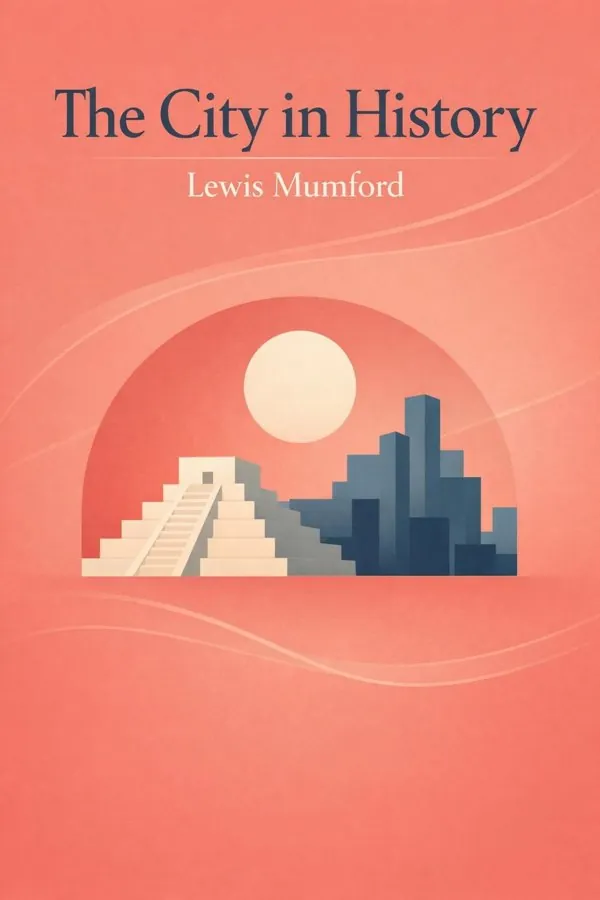
The City in History: Its Origins, Its Transformations, and Its Prospects: Summary & Key Insights
 10 min9 chaptersAudio available
What Is The City in History: Its Origins, Its Transformations, and Its Prospects About?
The City in History: Its Origins, Its Transformations, and Its Prospects by Lewis Mumford is a civilization book spanning 9 pages. A comprehensive exploration of the development of cities from ancient times to the modern era, examining how urban environments have shaped and reflected human civilization. Mumford traces the evolution of urban life, architecture, and social organization, offering a critical perspective on the cultural and technological forces that have influenced city growth and decline.
This FizzRead summary covers all 9 key chapters of The City in History: Its Origins, Its Transformations, and Its Prospects in approximately 10 minutes, distilling the most important ideas, arguments, and takeaways from Lewis Mumford's work. Also available as an audio summary and Key Quotes Podcast.
The City in History: Its Origins, Its Transformations, and Its Prospects
A comprehensive exploration of the development of cities from ancient times to the modern era, examining how urban environments have shaped and reflected human civilization. Mumford traces the evolution of urban life, architecture, and social organization, offering a critical perspective on the cultural and technological forces that have influenced city growth and decline.
Who Should Read The City in History: Its Origins, Its Transformations, and Its Prospects?
This book is perfect for anyone interested in civilization and looking to gain actionable insights in a short read. Whether you're a student, professional, or lifelong learner, the key ideas from The City in History: Its Origins, Its Transformations, and Its Prospects by Lewis Mumford will help you think differently.
- ✓Readers who enjoy civilization and want practical takeaways
- ✓Professionals looking to apply new ideas to their work and life
- ✓Anyone who wants the core insights of The City in History: Its Origins, Its Transformations, and Its Prospects in just 10 minutes
Want the full summary?
Get instant access to this book summary and 100K+ more with Fizz Moment.
Get Free SummaryAvailable on App Store • Free to download
Key Chapters
Before the city, there was the village—the first sustained human experiment in settled life. In the Neolithic era, humanity turned from nomadic gathering to agriculture, and that transition established the social and spatial fabric that would later give rise to urban civilization. The village was modest: homes arranged around communal centers, life sustained by the rhythms of sowing and harvest. Yet embedded in those rhythms was a profound innovation—continuity.
The Neolithic village exemplified cooperation. It was here that humans learned to share the daily burdens of food production, craftwork, and ritual; to domesticate not only plants and animals, but their own behavior. The hearth became the nucleus of cultural integration: each dwelling represented both independence and interdependence. Religion emerged as the binding force, personifying fertility and cycles of nature, expressed in shared festivals and symbols. Thus the village did not simply serve material needs—it crystallized the moral idea that human life could be collectively sustained.
From this humble beginning arose the notion of spatial enclosure. The village’s boundary delineated what was human from what was wild, giving structure to our very sense of belonging. Though later civilizations would build grand monuments and complex bureaucracies, their social order still rested upon the community pattern first established here: the mutual recognition of identity and responsibility within a shared domain.
What I emphasize is that the Neolithic world gave birth to the organic principle that should continue to guide urban development—the city as a living extension of biological and psychological order. Its earliest form still carried the sense of wholeness that industrial and mechanical cities would later betray.
The transition from village to city in Mesopotamia and Egypt transformed civilization’s scale and intention. Here urban life first became conscious of itself as an institution—a coordinated structure of economic, religious, and political forces. In Sumer, the city was simultaneously a temple and a market, combining spiritual order with material exchange. Its walls demarcated not only protection but identity; the citizen was one who participated in ritual and regulation alike.
Cities such as Ur and Babylon represented a decisive leap: the concentration of surplus wealth and labor under centralized authority. The temple served as both treasury and administrative headquarters; religion, now embodied in architecture, sanctified the city’s power. This dual integration—of divine symbolism and social organization—defined the classical urban archetype.
Egypt followed a similar course, though its cities were extensions of cosmic order rather than mercantile engines. The axis of the Nile mirrored the axis of creation; every urban plan echoed mythological symbolism. In both civilizations, urbanism arose as a means to sustain collective stability and to ritualize the relationship between heaven and earth.
Yet I caution that this unity carried a hidden cost. The first cities turned human cooperation into hierarchy. As division of labor multiplied, citizenship became stratified, and the built environment reflected domination instead of organic community. The seeds of future alienation were thus sown even as the urban mind awakened.
+ 7 more chapters — available in the FizzRead app
All Chapters in The City in History: Its Origins, Its Transformations, and Its Prospects
About the Author
Lewis Mumford (1895–1990) was an American historian, sociologist, philosopher of technology, and literary critic. He is best known for his studies on cities and urban architecture, as well as his influential works on the relationship between technology and culture.
Get This Summary in Your Preferred Format
Read or listen to the The City in History: Its Origins, Its Transformations, and Its Prospects summary by Lewis Mumford anytime, anywhere. FizzRead offers multiple formats so you can learn on your terms — all free.
Available formats: App · Audio · PDF · EPUB — All included free with FizzRead
Download The City in History: Its Origins, Its Transformations, and Its Prospects PDF and EPUB Summary
Key Quotes from The City in History: Its Origins, Its Transformations, and Its Prospects
“Before the city, there was the village—the first sustained human experiment in settled life.”
“The transition from village to city in Mesopotamia and Egypt transformed civilization’s scale and intention.”
Frequently Asked Questions about The City in History: Its Origins, Its Transformations, and Its Prospects
The City in History: Its Origins, Its Transformations, and Its Prospects by Lewis Mumford is a civilization book that explores key ideas across 9 chapters. A comprehensive exploration of the development of cities from ancient times to the modern era, examining how urban environments have shaped and reflected human civilization. Mumford traces the evolution of urban life, architecture, and social organization, offering a critical perspective on the cultural and technological forces that have influenced city growth and decline.
More by Lewis Mumford
You Might Also Like
The Structure of Scientific Revolutions
Thomas S. Kuhn
10 min
Genius
Harold Bloom
10 min
A Cultural History of the Medieval Age
Various Editors
10 min
A History of God: The 4,000-Year Quest of Judaism, Christianity and Islam
Karen Armstrong
10 min
A History of the World in 10½ Chapters
Julian Barnes
10 min
A Short History of Progress
Ronald Wright
10 minBrowse by Category
Ready to read The City in History: Its Origins, Its Transformations, and Its Prospects?
Get the full summary and 100K+ more books with Fizz Moment.