
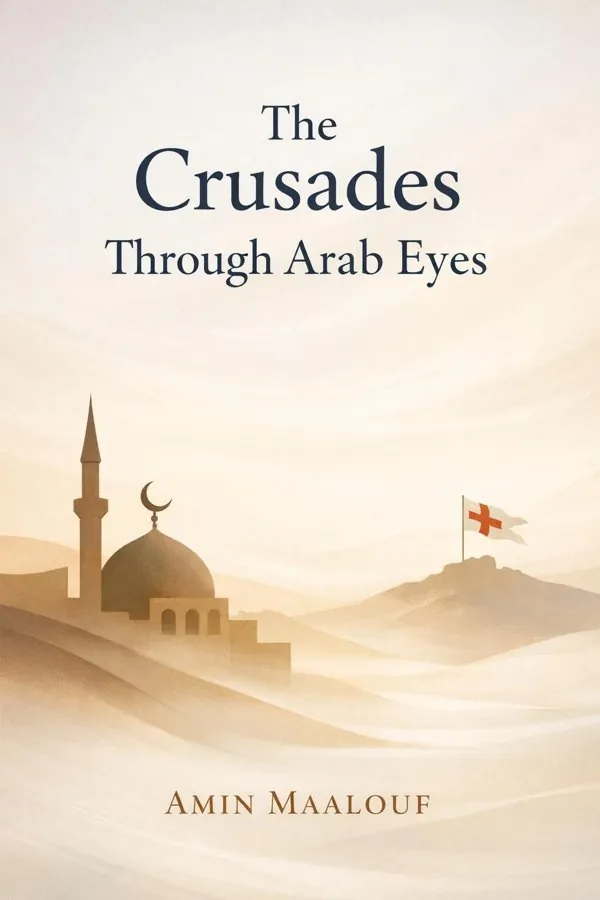
The Crusades Through Arab Eyes: Summary & Key Insights
by Amin Maalouf
 10 min10 chaptersAudio available
What Is The Crusades Through Arab Eyes About?
The Crusades Through Arab Eyes by Amin Maalouf is a world_history book spanning 10 pages. In this acclaimed historical work, Amin Maalouf recounts the Crusades from the perspective of Arab chroniclers of the time. Drawing on their accounts, he reconstructs how the peoples of the Middle East perceived the invasions from the West, revealing a world shaken by foreign incursions. The book illuminates cultural misunderstandings, religious conflicts, and the lasting consequences of these wars on relations between East and West.
This FizzRead summary covers all 10 key chapters of The Crusades Through Arab Eyes in approximately 10 minutes, distilling the most important ideas, arguments, and takeaways from Amin Maalouf's work. Also available as an audio summary and Key Quotes Podcast.
The Crusades Through Arab Eyes
In this acclaimed historical work, Amin Maalouf recounts the Crusades from the perspective of Arab chroniclers of the time. Drawing on their accounts, he reconstructs how the peoples of the Middle East perceived the invasions from the West, revealing a world shaken by foreign incursions. The book illuminates cultural misunderstandings, religious conflicts, and the lasting consequences of these wars on relations between East and West.
Who Should Read The Crusades Through Arab Eyes?
This book is perfect for anyone interested in world_history and looking to gain actionable insights in a short read. Whether you're a student, professional, or lifelong learner, the key ideas from The Crusades Through Arab Eyes by Amin Maalouf will help you think differently.
- ✓Readers who enjoy world_history and want practical takeaways
- ✓Professionals looking to apply new ideas to their work and life
- ✓Anyone who wants the core insights of The Crusades Through Arab Eyes in just 10 minutes
Want the full summary?
Get instant access to this book summary and 100K+ more with Fizz Moment.
Get Free SummaryAvailable on App Store • Free to download
Key Chapters
The First Crusade stands in Arab chronicles as a calamity unleashed without warning. From the distant shores of France, Germany, and Italy came multitudes whose purpose was obscured even to the Arabs—they appeared as barbaric hordes, driven by faith but behaving with cruelty. Chroniclers like Ibn al-Qalanisi recount their approach with horror: these men marched eastward with crosses and swords, burning villages, slaughtering inhabitants, and desecrating mosques. The fall of Jerusalem in 1099 is described in words that still sear the imagination. Blood flowed in the streets; corpses piled in the sacred sites; and the city, for centuries the spiritual heart of Islam, Christianity, and Judaism alike, was rendered a place of massacre.
For Muslim witnesses, this event was incomprehensible. They saw no geopolitical logic, only an eruption of sacrilege. The chroniclers tried to make sense of the invaders' motives—were they seeking wealth, revenge, or divine favor? Many thought of the Crusaders as desperate refugees driven by famine and greed rather than holiness. They called them 'Franks,' a collective term that included diverse Europeans, and described their manners as crude, their faith fanatical, and their discipline poor but ferocity overwhelming.
This first invasion exposed not just military vulnerability but cultural fragility. The Muslim world, then fragmented into numerous powers—Seljuks, Fatimids, and local emirs—failed to act in concert. Each ruler viewed the calamity as another region’s concern. Thus, Jerusalem fell not only to European swords but to the paralysis of Islamic disunity. In the eyes of the Arab chroniclers, the catastrophe was divine punishment for internal divisions, moral decay, and neglect of faith. Yet underlying the laments was a flicker of recognition: this disaster would force reflection and renewal. The Crusaders had awakened the East from complacency. The chronicles echo both despair and the beginning of awareness—a lesson that humiliation could ignite revival.
Following the loss of Jerusalem, the Islamic heartlands found themselves incapable of united action. From Cairo to Damascus and Baghdad, the great cities of Islam were ruled by separate dynasties whose rivalries consumed their energies. Each prince sought his own glory. Ibn al-Athir described how rulers watched the Crusaders devour Syrian territories while continuing their internal feuds, each hoping that the invaders would weaken his rivals. The chroniclers’ tone is bitter: the Crusaders succeeded less because of their power, more because of Muslim disunity.
I recount the voices of those who saw devastation but could not convince their leaders. The Arab historians depict envoys traveling between courts, pleading for unity, imploring sultans to set aside vanity. Yet politics and personal ambition prevailed. The Fatimids of Egypt even attempted alliances with the Crusaders against the Seljuks, hoping to maintain control over parts of the Levant. Such bargains, made out of expedience, deepened despair among the faithful.
This period of fragmentation also exposed a loss of spiritual confidence. Islam had once radiated a sense of universal mission, but now its leaders seemed confined to local interests. For ordinary people, the Crusades were more than foreign invasions; they were proof that faith itself had been fractured. Chroniclers wrote of crowds praying, fasting, seeking divine intervention, yet seeing little change. The bitterness of helplessness fills their pages. Through their lamentations, one perceives how deeply politics shaped faith and how the yearning for unity set the foundation for future redemption.
In this chaos, small pockets of resistance began to form—city by city, clan by clan. These early defenders were not organized armies but local fighters driven by rage and the defense of home. Their bravery foretold the spirit that would, in time, awaken under new guidance. Unity would become the watchword of salvation, but the road to it was long and paved with lessons learned from defeat.
+ 8 more chapters — available in the FizzRead app
All Chapters in The Crusades Through Arab Eyes
About the Author
Amin Maalouf is a Franco-Lebanese writer and essayist born in 1949 in Beirut. Winner of the Prix Goncourt in 1993 for 'The Rock of Tanios', he is a member of the Académie Française. His work explores themes of identity, exile, and dialogue between civilizations.
Get This Summary in Your Preferred Format
Read or listen to the The Crusades Through Arab Eyes summary by Amin Maalouf anytime, anywhere. FizzRead offers multiple formats so you can learn on your terms — all free.
Available formats: App · Audio · PDF · EPUB — All included free with FizzRead
Download The Crusades Through Arab Eyes PDF and EPUB Summary
Key Quotes from The Crusades Through Arab Eyes
“The First Crusade stands in Arab chronicles as a calamity unleashed without warning.”
“Following the loss of Jerusalem, the Islamic heartlands found themselves incapable of united action.”
Frequently Asked Questions about The Crusades Through Arab Eyes
The Crusades Through Arab Eyes by Amin Maalouf is a world_history book that explores key ideas across 10 chapters. In this acclaimed historical work, Amin Maalouf recounts the Crusades from the perspective of Arab chroniclers of the time. Drawing on their accounts, he reconstructs how the peoples of the Middle East perceived the invasions from the West, revealing a world shaken by foreign incursions. The book illuminates cultural misunderstandings, religious conflicts, and the lasting consequences of these wars on relations between East and West.
More by Amin Maalouf
You Might Also Like

The Age of Capital
Eric Hobsbawm
10 min
The Gulag Archipelago
Aleksandr Solzhenitsyn
10 min
Jerusalem: The Biography
Simon Sebag Montefiore
10 min
The Anglo-Saxons
James Campbell
10 min
The Boer War
Thomas Pakenham
10 min
The Industrial Revolutionaries: The Making of the Modern World 1776–1914
Gavin Weightman
10 minBrowse by Category
Ready to read The Crusades Through Arab Eyes?
Get the full summary and 100K+ more books with Fizz Moment.