
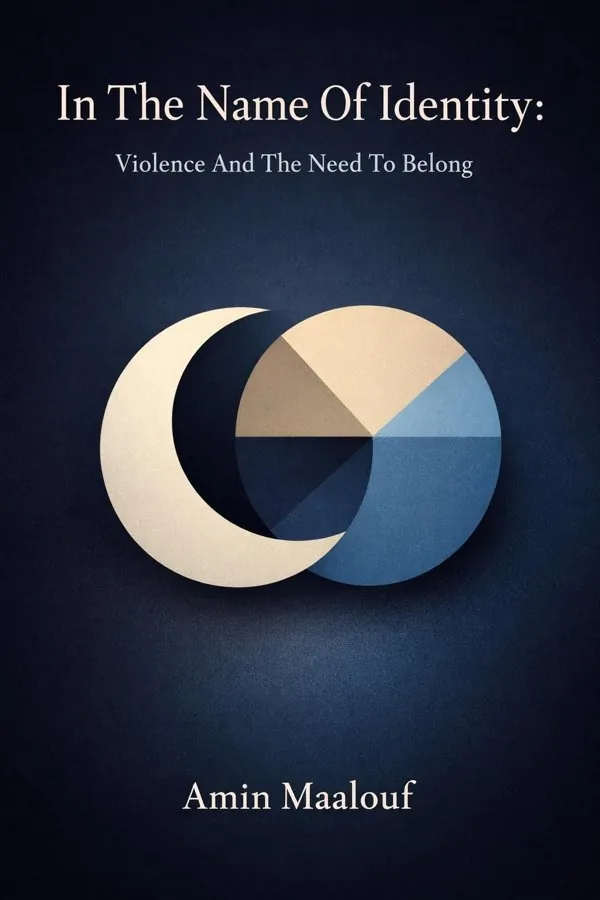
In The Name Of Identity: Violence And The Need To Belong: Summary & Key Insights
by Amin Maalouf
 10 min9 chaptersAudio available
What Is In The Name Of Identity: Violence And The Need To Belong About?
In The Name Of Identity: Violence And The Need To Belong by Amin Maalouf is a civilization book spanning 9 pages. In this thought-provoking essay, Amin Maalouf explores the complex nature of identity in the modern world. He examines how cultural, religious, and national affiliations can become sources of conflict when perceived in exclusive terms. Through a humanistic lens, Maalouf advocates for an open and pluralistic understanding of identity, emphasizing coexistence and mutual recognition as essential to overcoming divisions and violence.
This FizzRead summary covers all 9 key chapters of In The Name Of Identity: Violence And The Need To Belong in approximately 10 minutes, distilling the most important ideas, arguments, and takeaways from Amin Maalouf's work. Also available as an audio summary and Key Quotes Podcast.
In The Name Of Identity: Violence And The Need To Belong
In this thought-provoking essay, Amin Maalouf explores the complex nature of identity in the modern world. He examines how cultural, religious, and national affiliations can become sources of conflict when perceived in exclusive terms. Through a humanistic lens, Maalouf advocates for an open and pluralistic understanding of identity, emphasizing coexistence and mutual recognition as essential to overcoming divisions and violence.
Who Should Read In The Name Of Identity: Violence And The Need To Belong?
This book is perfect for anyone interested in civilization and looking to gain actionable insights in a short read. Whether you're a student, professional, or lifelong learner, the key ideas from In The Name Of Identity: Violence And The Need To Belong by Amin Maalouf will help you think differently.
- ✓Readers who enjoy civilization and want practical takeaways
- ✓Professionals looking to apply new ideas to their work and life
- ✓Anyone who wants the core insights of In The Name Of Identity: Violence And The Need To Belong in just 10 minutes
Want the full summary?
Get instant access to this book summary and 100K+ more with Fizz Moment.
Get Free SummaryAvailable on App Store • Free to download
Key Chapters
Each of us carries within us a multitude of affiliations. To pretend that any human being can be reduced to a single belonging is to deny our very experience of life. I am Lebanese by birth, French by adoption, Arab by culture, and yet also a writer whose language and imagination are shaped by a universal human heritage. These layers do not cancel each other out—they enrich one another.
In ‘The Multiplicity of Identity,’ I argue that every person’s identity is formed at the intersection of several elements: our religion, our nationality, our family traditions, our language, our gender, our social environment, and even our choices. Think of identity as a living organism constantly evolving. It is never complete, and it changes with each encounter, each migration, each historical transformation. When we insist on defining ourselves by a single thread, we impoverish our humanity.
People often ask me, “How can we know who we are if we belong to many places?” My answer is simple: we know who we are precisely because we belong to many. Identity is not a hierarchy of loyalties; it is an ecology of influences. When diversity is recognized, we thrive. When it is denied, we shrink into defensive tribes. The multiplicity of identity is both our inheritance and our hope—it allows us to survive change without fear, to integrate difference without losing coherence.
The tragedy of our age lies in our fascination with simplified identities. All too often, religion or nationality becomes the supreme label, erasing every other dimension of the person. In Lebanon, I witnessed how such labels tore families apart; Christians and Muslims who once lived side by side began to see each other as foreigners. This illusion of singular identity poisons coexistence. When someone says, “I am only this,” what they truly mean is, “I am against all that.”
Authorities and movements exploit this illusion to consolidate power. Politicians invoke ‘the people,’ clerics invoke ‘the faithful,’ nationalists invoke ‘the homeland.’ Behind each invocation hides a fear of complexity—a fear that difference might undermine control. But complexity, though uncomfortable, is the lifeblood of civilization. Every great cultural achievement arises from crossings and mixtures, never from isolation.
Throughout history, singular identities have justified persecution: religious wars, ethnic cleansings, ideological purges. By dissecting individuals into monolithic categories, societies lose sight of human nuance and compassion. To dismantle this illusion, we must return to individual experience: the person who prays in one language and dreams in another; the migrant who loves two countries; the child who feels both rooted and uprooted. Recognizing this human richness dispels the myth that purity equals authenticity.
+ 7 more chapters — available in the FizzRead app
All Chapters in In The Name Of Identity: Violence And The Need To Belong
About the Author
Amin Maalouf is a Franco-Lebanese writer born in Beirut in 1949. He won the Prix Goncourt in 1993 for 'The Rock of Tanios' and has been a member of the Académie Française since 2011. His works, written in French, often address themes of exile, identity, and intercultural dialogue.
Get This Summary in Your Preferred Format
Read or listen to the In The Name Of Identity: Violence And The Need To Belong summary by Amin Maalouf anytime, anywhere. FizzRead offers multiple formats so you can learn on your terms — all free.
Available formats: App · Audio · PDF · EPUB — All included free with FizzRead
Download In The Name Of Identity: Violence And The Need To Belong PDF and EPUB Summary
Key Quotes from In The Name Of Identity: Violence And The Need To Belong
“Each of us carries within us a multitude of affiliations.”
“The tragedy of our age lies in our fascination with simplified identities.”
Frequently Asked Questions about In The Name Of Identity: Violence And The Need To Belong
In The Name Of Identity: Violence And The Need To Belong by Amin Maalouf is a civilization book that explores key ideas across 9 chapters. In this thought-provoking essay, Amin Maalouf explores the complex nature of identity in the modern world. He examines how cultural, religious, and national affiliations can become sources of conflict when perceived in exclusive terms. Through a humanistic lens, Maalouf advocates for an open and pluralistic understanding of identity, emphasizing coexistence and mutual recognition as essential to overcoming divisions and violence.
More by Amin Maalouf

You Might Also Like

The Structure of Scientific Revolutions
Thomas S. Kuhn
10 min
Genius
Harold Bloom
10 min
A Cultural History of the Medieval Age
Various Editors
10 min
A History of God: The 4,000-Year Quest of Judaism, Christianity and Islam
Karen Armstrong
10 min
A History of the World in 10½ Chapters
Julian Barnes
10 min
A Short History of Progress
Ronald Wright
10 minBrowse by Category
Ready to read In The Name Of Identity: Violence And The Need To Belong?
Get the full summary and 100K+ more books with Fizz Moment.