
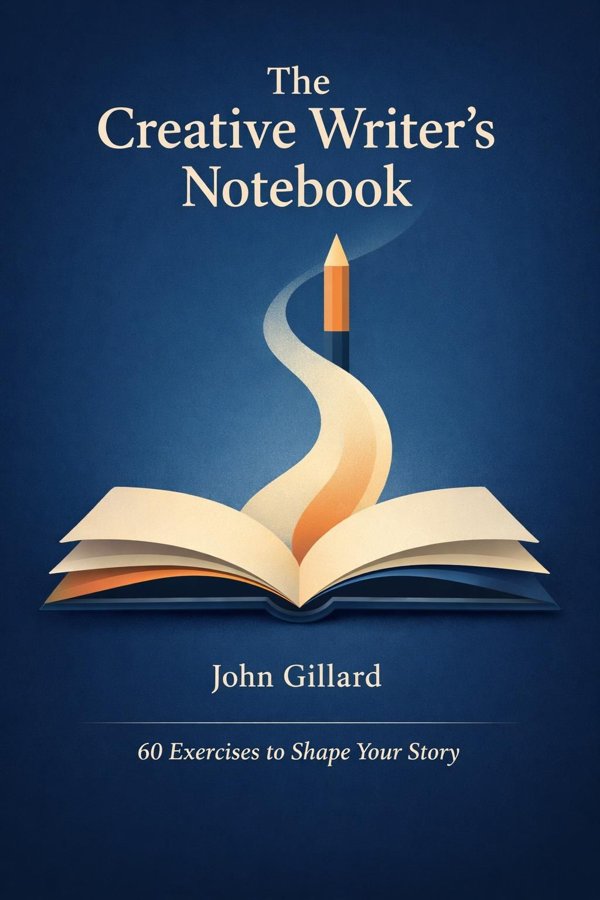
The Creative Writer's Notebook: 60 Exercises to Shape Your Story: Summary & Key Insights
by John Gillard
 10 min9 chaptersAudio available
Key Takeaways from The Creative Writer's Notebook: 60 Exercises to Shape Your Story
A blank page is rarely empty; it is crowded with hesitation, expectations, and the fear of failing before a sentence even begins.
Readers do not fall in love with descriptions; they connect with desire, contradiction, and vulnerability.
Real conversation is messy, but effective fictional dialogue is purposeful.
Place is never just background.
Stories stall when nothing resists desire.
What Is The Creative Writer's Notebook: 60 Exercises to Shape Your Story About?
The Creative Writer's Notebook: 60 Exercises to Shape Your Story by John Gillard is a writing book spanning 6 pages. The Creative Writer's Notebook: 60 Exercises to Shape Your Story is a hands-on guide for writers who want to move beyond theory and actually build stronger fiction on the page. Rather than offering abstract rules, John Gillard structures the book around practical exercises that help writers generate ideas, deepen characters, sharpen dialogue, strengthen plots, and refine style through repeated practice. Its central promise is simple but powerful: writing improves when you write deliberately, experiment often, and reflect on what works. What makes this book valuable is its workshop-like approach. Gillard treats creativity not as a mysterious gift bestowed on a lucky few, but as a craft that can be trained. Each exercise pushes the reader to observe more closely, imagine more boldly, and revise more intelligently. That makes the book especially useful for writers who feel stuck, overwhelmed, or unsure how to develop raw inspiration into a finished story. As a British author and creative writing instructor, Gillard brings clarity, encouragement, and practicality to the process. His guidance is accessible to beginners yet rich enough to benefit experienced writers who want fresh prompts and a disciplined way to sharpen their storytelling instincts.
This FizzRead summary covers all 9 key chapters of The Creative Writer's Notebook: 60 Exercises to Shape Your Story in approximately 10 minutes, distilling the most important ideas, arguments, and takeaways from John Gillard's work. Also available as an audio summary and Key Quotes Podcast.
The Creative Writer's Notebook: 60 Exercises to Shape Your Story
The Creative Writer's Notebook: 60 Exercises to Shape Your Story is a hands-on guide for writers who want to move beyond theory and actually build stronger fiction on the page. Rather than offering abstract rules, John Gillard structures the book around practical exercises that help writers generate ideas, deepen characters, sharpen dialogue, strengthen plots, and refine style through repeated practice. Its central promise is simple but powerful: writing improves when you write deliberately, experiment often, and reflect on what works.
What makes this book valuable is its workshop-like approach. Gillard treats creativity not as a mysterious gift bestowed on a lucky few, but as a craft that can be trained. Each exercise pushes the reader to observe more closely, imagine more boldly, and revise more intelligently. That makes the book especially useful for writers who feel stuck, overwhelmed, or unsure how to develop raw inspiration into a finished story.
As a British author and creative writing instructor, Gillard brings clarity, encouragement, and practicality to the process. His guidance is accessible to beginners yet rich enough to benefit experienced writers who want fresh prompts and a disciplined way to sharpen their storytelling instincts.
Who Should Read The Creative Writer's Notebook: 60 Exercises to Shape Your Story?
This book is perfect for anyone interested in writing and looking to gain actionable insights in a short read. Whether you're a student, professional, or lifelong learner, the key ideas from The Creative Writer's Notebook: 60 Exercises to Shape Your Story by John Gillard will help you think differently.
- ✓Readers who enjoy writing and want practical takeaways
- ✓Professionals looking to apply new ideas to their work and life
- ✓Anyone who wants the core insights of The Creative Writer's Notebook: 60 Exercises to Shape Your Story in just 10 minutes
Want the full summary?
Get instant access to this book summary and 100K+ more with Fizz Moment.
Get Free SummaryAvailable on App Store • Free to download
Key Chapters
A blank page is rarely empty; it is crowded with hesitation, expectations, and the fear of failing before a sentence even begins. One of the book’s most useful lessons is that writer’s block is often less a lack of ideas than a lack of permission. John Gillard encourages writers to stop waiting for perfect inspiration and instead use structured prompts to generate movement. Creativity, in his view, is not summoned by mood alone but activated through action.
This section focuses on practical ways to loosen the mind. Exercises may ask you to begin with a stray memory, a found object, a line of overheard dialogue, or a “what if” question. Instead of judging ideas too quickly, you are invited to follow them, however odd or incomplete they seem. A story about a woman missing a train can become a story about regret, escape, or reinvention depending on which detail you choose to pursue. Gillard shows that ideas become richer when they are handled, not merely admired from afar.
He also reframes creative drought as part of the process. When you freewrite for ten minutes, list possible conflicts, or rewrite a mundane event from three different emotional angles, you train yourself to create on demand. The goal is momentum rather than brilliance. Even weak ideas can lead to surprising discoveries when explored honestly.
Actionable takeaway: when you feel blocked, set a timer for ten minutes and write from a concrete prompt without stopping or editing. Treat generation and evaluation as separate stages.
Readers do not fall in love with descriptions; they connect with desire, contradiction, and vulnerability. Gillard emphasizes that memorable characters are not assembled from surface traits alone but from tensions within them. A believable character wants something, fears something, hides something, and behaves in ways that reveal all three. The notebook’s exercises are designed to move writers beyond generic profiles into emotional specificity.
Rather than simply listing eye color, age, or occupation, the book invites writers to ask sharper questions. What does your character regret? What lie do they tell themselves? What do they do when no one is watching? A disciplined character exercise might begin with a simple premise—a schoolteacher, a mechanic, a teenager—and then deepen through motivation and conflict. A mechanic who secretly collects poetry feels more human than a mechanic described only by greasy hands and overalls.
Gillard also links characterization to action. People reveal themselves most clearly under pressure. Put a polite man in a humiliating situation, or a confident woman in front of someone she cannot impress, and real character begins to emerge. Dialogue, gesture, silence, and choice all become tools for revelation. This approach helps writers avoid flat characters who exist only to serve the plot.
The exercises train you to create a cast whose desires clash naturally. Once each character wants something specific, scenes gain energy without feeling forced. Motivation becomes the engine of story.
Actionable takeaway: write a one-page scene in which your character wants something simple but urgent, and reveal their personality only through what they say, do, and avoid saying.
Real conversation is messy, but effective fictional dialogue is purposeful. One of Gillard’s key insights is that dialogue should not merely imitate life; it should distill it. People in stories speak to persuade, hide, flirt, defend, evade, or control. If characters only exchange information, the scene may be clear but it will not feel alive. The notebook pushes writers to hear the tension beneath speech.
Many beginning writers use dialogue as exposition, forcing characters to say things no real person would say just to help the reader understand the plot. Gillard counters this with exercises that focus on subtext. Two characters discussing the weather may actually be negotiating a breakup. A parent asking whether a teenager has finished homework may really be expressing fear, disappointment, or helplessness. Meaning often lives in what is implied rather than stated.
The book also encourages attention to rhythm and individuality. Each character should have a slightly different verbal fingerprint: one may speak in short clipped responses, another in sprawling anecdotes, another in careful formal phrasing. These differences do not need to be exaggerated; subtle variation is often enough. Interruptions, pauses, and omissions can create more realism than dialect-heavy spelling or ornamental wit.
By practicing dialogue in isolation, writers learn to trim redundancy and sharpen conflict. A useful exercise might involve writing a scene where neither character says what they actually want. This produces friction, and friction produces interest.
Actionable takeaway: draft a conversation between two characters with opposing goals, then revise it to remove every line of obvious exposition and replace direct statements with implication or resistance.
Place is never just background. Gillard argues that setting becomes powerful when it influences mood, behavior, and meaning. A story set in a narrow apartment, a fogbound harbor, or a fluorescent hospital corridor does more than provide visual context; it creates emotional pressure. Writers often think of setting as description, but in strong fiction it operates as an active force.
The exercises in this section encourage close observation and sensory precision. Instead of describing a city as “busy” or a forest as “dark,” you are pushed to notice texture, sound, smell, temperature, and movement. A train station can be defined by the metallic shriek of brakes, the smell of wet newspapers, and the shuffle of impatient shoes. These details ground the reader in a world that feels inhabited rather than sketched.
Gillard also shows how setting can mirror or counterpoint character. A grieving person in a cheerful seaside town may feel even more isolated because the environment clashes with their inner state. Conversely, a threatening alley described through the eyes of someone exhilarated by danger will feel different from the same alley seen by a frightened child. Setting is filtered through perspective, and that perspective creates tone.
Most importantly, the book suggests using place dynamically. Weather can interrupt plans. Architecture can trap, conceal, or expose. Social setting—classroom, courtroom, church, nightclub—creates invisible rules that shape what characters can do.
Actionable takeaway: choose a scene you have written and rewrite the setting so it actively increases the emotional stakes, rather than simply decorating the action.
Stories stall when nothing resists desire. Gillard treats conflict as the heartbeat of narrative structure: not merely explosions, arguments, or dramatic villains, but any meaningful obstacle between a character and what they want. Once desire meets resistance, scenes begin to matter. The book’s exercises help writers understand that plot is not a list of events but a chain of pressures, decisions, and consequences.
A useful distinction in this section is between incident and movement. Many drafts contain things happening, but not enough change. A character goes to a café, receives a call, walks home, and remembers childhood. That may be atmospheric, but unless each beat alters the character’s options or understanding, the story drifts. Gillard pushes writers to ask after every scene: what has changed? Has tension increased, information shifted, a relationship worsened, or a choice become unavoidable?
He also breaks structure into manageable parts. Beginnings create curiosity and establish a disturbance. Middles complicate matters through escalation, reversal, and deepening stakes. Endings do not simply stop; they resolve, transform, or deliberately unsettle. Exercises might involve mapping a story through turning points or rewriting the same premise with a stronger central conflict. A woman preparing dinner becomes far more compelling if she must conceal that her estranged brother is about to arrive, or that tonight she plans to leave.
The notebook demystifies structure by making it practical. You do not need a rigid formula, but you do need cause and effect. Tension is what pulls readers forward.
Actionable takeaway: outline your story in five major turning points and make sure each one increases pressure, raises stakes, or forces a more difficult choice.
A writer’s voice is not something you discover once and keep forever; it emerges through repeated choices on the page. Gillard treats voice as a combination of diction, rhythm, perspective, tone, and attention. It is the feeling the reader gets from the way a story is told. The book reassures writers that voice grows through practice, imitation, experimentation, and, above all, revision.
Early drafts often contain the raw energy of discovery but not the clarity of intention. Gillard’s exercises show how revision is where style becomes deliberate. You may write a scene quickly to capture instinct, then return to tighten verbs, remove clichés, vary sentence length, and sharpen imagery. A flat sentence like “He walked into the room and was nervous” can become “He hovered in the doorway, fingers worrying the seam of his sleeve.” Revision converts explanation into evocation.
The notebook also encourages stylistic range. Try telling the same event in a lyrical voice, then in spare minimal prose, then in comic exaggeration. These experiments teach you what feels natural and what expands your expressive control. Rather than copying admired writers blindly, you learn from their methods while shaping a voice rooted in your own perceptions.
Crucially, Gillard frames revision not as punishment for getting it wrong, but as the real craft of writing. Cutting, reordering, condensing, and clarifying are not signs of failure. They are signs that you are taking the work seriously.
Actionable takeaway: take one page of your draft and revise it three times—once for stronger verbs, once for more precise sensory detail, and once for sentence rhythm—then compare the results.
Imagination does not operate in isolation; it feeds on what the writer notices, remembers, and transforms. Gillard places strong emphasis on observation as a creative resource. Everyday life is full of story material, but most of it passes unnoticed because we do not train ourselves to attend to detail. The notebook encourages writers to gather fragments from the world and use them as seeds for fiction.
This means paying attention not only to dramatic events but to small, telling moments: the way someone folds a receipt before bad news, the smell of old carpeting in a waiting room, the awkward silence after a joke that fails. Such details lend credibility to invented scenes because they come from lived experience. A fictional grandmother feels more convincing when she insists on saving rubber bands in a biscuit tin than when she is described only as “strict but loving.”
Memory is equally valuable, though Gillard treats it as material rather than sacred truth. Personal recollections can provide emotional authenticity even when facts are altered. A childhood afternoon, an argument on a bus, or the feeling of entering a new school can all be reshaped into scenes that belong to a different plot and cast. The point is not confession; it is conversion.
Exercises in this area help writers build notebooks of sensory and emotional data. Over time, these observations become a personal archive that can rescue a story from vagueness.
Actionable takeaway: spend fifteen minutes observing a public place, write down ten precise details, then use at least five of them to build the opening paragraph of a fictional scene.
Many writers become trapped not because they lack talent, but because they repeat the same safe moves. Gillard’s notebook resists that habit by treating exercises as experiments. The purpose is not always to produce polished work; sometimes it is to discover what happens when you break pattern. Creative growth often begins where certainty ends.
The book invites writers to shift perspective, tense, genre, scale, and form. A scene told in first person may feel intimate but narrow; rewritten in third person, it may gain irony or distance. A realistic domestic conflict recast as speculative fiction may expose its core themes more clearly. A long descriptive paragraph cut down to a handful of stark images may become more powerful than the original. Through these changes, writers learn that storytelling choices are flexible, not fixed.
Experimentation also reduces fear. If every exercise must result in publishable prose, the stakes become paralyzing. But if an exercise is allowed to fail, surprise becomes possible. You may discover that your comic voice is stronger than you thought, or that a secondary character deserves the story’s center. Even abandoned attempts teach you something about your instincts and limitations.
What makes Gillard effective here is his emphasis on play with purpose. These are not random tricks; they are methods for stretching technique. By trying unfamiliar approaches, you build adaptability, and adaptable writers are better equipped to solve narrative problems.
Actionable takeaway: take an existing scene and rewrite it in a different point of view or genre, then note what new tensions, themes, or character insights emerge.
Talent matters less than many writers hope and practice matters more. One of the book’s quiet but enduring messages is that writing becomes sustainable when it is treated as an ongoing discipline rather than a sporadic burst of emotion. Gillard acknowledges that enthusiasm rises and falls, but a workable creative life depends on habits, reflection, and patience.
The notebook format itself supports this mindset. By moving from exercise to exercise, writers experience progress in manageable units. You do not need to complete a novel in one heroic effort; you need to return regularly, test ideas, review what you have learned, and keep building. This is especially encouraging for beginners who feel intimidated by large projects. It is equally useful for experienced writers who need to reset their process.
Reflection plays a major role. After finishing an exercise, Gillard implicitly asks: what surprised you? What came easily? Where did the writing feel false? These questions turn practice into self-knowledge. Over time, patterns emerge. You may notice that your scenes come alive when anchored in physical setting, or that your endings weaken because conflict resolves too quickly. Reflection helps convert repetition into improvement.
Discipline in this book is not harshness. It is consistency paired with curiosity. Writers are urged to protect time, accept imperfect drafts, and keep going through uncertainty. Creative confidence grows from evidence, and evidence comes from pages written.
Actionable takeaway: create a weekly writing routine built around two or three short exercises, and keep a brief log of what each session taught you about your strengths and recurring challenges.
All Chapters in The Creative Writer's Notebook: 60 Exercises to Shape Your Story
About the Author
John Gillard is a British author and creative writing instructor known for producing practical, approachable guides for developing writers. His work focuses on making the craft of storytelling accessible through structured exercises, clear explanations, and encouraging advice rather than dense theory. Gillard’s teaching style emphasizes that creativity can be strengthened through observation, experimentation, and regular practice, making his books especially helpful for beginners and intermediate writers looking for direction. In The Creative Writer's Notebook, he brings an instructor’s clarity and a workshop leader’s sense of momentum, guiding readers through the building blocks of fiction one exercise at a time. His reputation rests on helping aspiring authors turn uncertainty into action and inspiration into usable writing habits.
Get This Summary in Your Preferred Format
Read or listen to the The Creative Writer's Notebook: 60 Exercises to Shape Your Story summary by John Gillard anytime, anywhere. FizzRead offers multiple formats so you can learn on your terms — all free.
Available formats: App · Audio · PDF · EPUB — All included free with FizzRead
Download The Creative Writer's Notebook: 60 Exercises to Shape Your Story PDF and EPUB Summary
Key Quotes from The Creative Writer's Notebook: 60 Exercises to Shape Your Story
“A blank page is rarely empty; it is crowded with hesitation, expectations, and the fear of failing before a sentence even begins.”
“Readers do not fall in love with descriptions; they connect with desire, contradiction, and vulnerability.”
“Real conversation is messy, but effective fictional dialogue is purposeful.”
“Gillard argues that setting becomes powerful when it influences mood, behavior, and meaning.”
“Stories stall when nothing resists desire.”
Frequently Asked Questions about The Creative Writer's Notebook: 60 Exercises to Shape Your Story
The Creative Writer's Notebook: 60 Exercises to Shape Your Story by John Gillard is a writing book that explores key ideas across 9 chapters. The Creative Writer's Notebook: 60 Exercises to Shape Your Story is a hands-on guide for writers who want to move beyond theory and actually build stronger fiction on the page. Rather than offering abstract rules, John Gillard structures the book around practical exercises that help writers generate ideas, deepen characters, sharpen dialogue, strengthen plots, and refine style through repeated practice. Its central promise is simple but powerful: writing improves when you write deliberately, experiment often, and reflect on what works. What makes this book valuable is its workshop-like approach. Gillard treats creativity not as a mysterious gift bestowed on a lucky few, but as a craft that can be trained. Each exercise pushes the reader to observe more closely, imagine more boldly, and revise more intelligently. That makes the book especially useful for writers who feel stuck, overwhelmed, or unsure how to develop raw inspiration into a finished story. As a British author and creative writing instructor, Gillard brings clarity, encouragement, and practicality to the process. His guidance is accessible to beginners yet rich enough to benefit experienced writers who want fresh prompts and a disciplined way to sharpen their storytelling instincts.
You Might Also Like
The Art of Perspective
Christopher Castellani
10 min
Making a Point: The Persnickety Story of English Punctuation
David Crystal
10 min
The Elements Of Eloquence: How To Turn The Perfect English Phrase
Mark Forsyth
10 min
The Pocket Muse: Ideas and Inspirations for Writing
Monica Wood
10 min
A Little Book on Form: An Exploration into the Formal Imagination of Poetry
Robert Hass
10 min
Adventures In The Screen Trade: A Personal View Of Hollywood And Screenwriting
William Goldman
10 minBrowse by Category
Ready to read The Creative Writer's Notebook: 60 Exercises to Shape Your Story?
Get the full summary and 100K+ more books with Fizz Moment.