
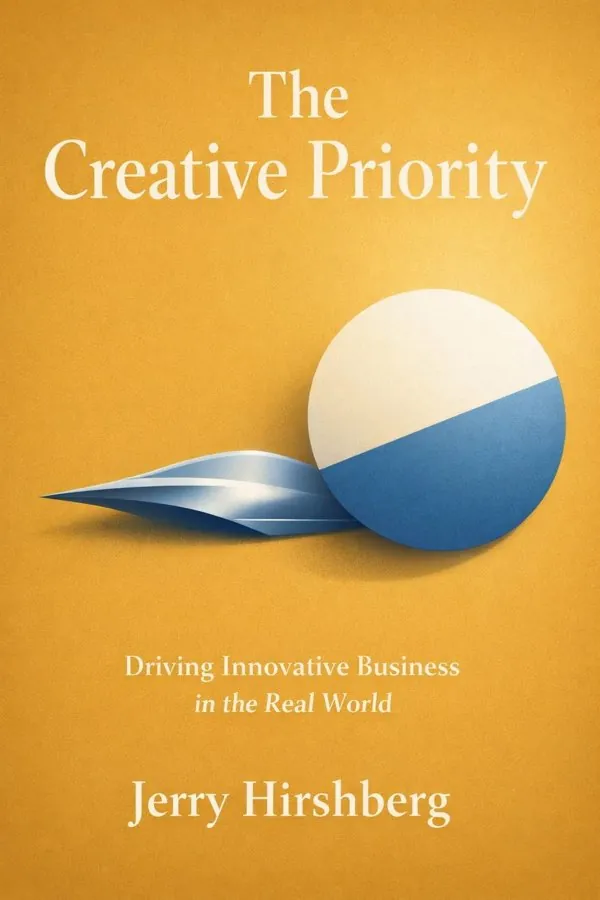
The Creative Priority: Driving Innovative Business in the Real World: Putting Innovation to Work in Your Business: Summary & Key Insights
 10 min3 chaptersAudio available
What Is The Creative Priority: Driving Innovative Business in the Real World: Putting Innovation to Work in Your Business About?
The Creative Priority: Driving Innovative Business in the Real World: Putting Innovation to Work in Your Business by Jerry Hirshberg is a creativity book spanning 3 pages. In this insightful work, Jerry Hirshberg, founder and president of Nissan Design International (NDI), shares his experiences leading one of the most innovative design organizations in the automotive industry. The book explores how creativity can be cultivated and integrated into business practices, offering practical lessons on fostering innovation, collaboration, and design thinking within corporate environments.
This FizzRead summary covers all 3 key chapters of The Creative Priority: Driving Innovative Business in the Real World: Putting Innovation to Work in Your Business in approximately 10 minutes, distilling the most important ideas, arguments, and takeaways from Jerry Hirshberg's work. Also available as an audio summary and Key Quotes Podcast.
The Creative Priority: Driving Innovative Business in the Real World: Putting Innovation to Work in Your Business
In this insightful work, Jerry Hirshberg, founder and president of Nissan Design International (NDI), shares his experiences leading one of the most innovative design organizations in the automotive industry. The book explores how creativity can be cultivated and integrated into business practices, offering practical lessons on fostering innovation, collaboration, and design thinking within corporate environments.
Who Should Read The Creative Priority: Driving Innovative Business in the Real World: Putting Innovation to Work in Your Business?
This book is perfect for anyone interested in creativity and looking to gain actionable insights in a short read. Whether you're a student, professional, or lifelong learner, the key ideas from The Creative Priority: Driving Innovative Business in the Real World: Putting Innovation to Work in Your Business by Jerry Hirshberg will help you think differently.
- ✓Readers who enjoy creativity and want practical takeaways
- ✓Professionals looking to apply new ideas to their work and life
- ✓Anyone who wants the core insights of The Creative Priority: Driving Innovative Business in the Real World: Putting Innovation to Work in Your Business in just 10 minutes
Want the full summary?
Get instant access to this book summary and 100K+ more with Fizz Moment.
Get Free SummaryAvailable on App Store • Free to download
Key Chapters
NDI began as both a bold experiment and a leap of faith. When Nissan approached me to establish a design studio in Southern California, the idea itself was radical. Car design at that time was deeply tied to corporate headquarters and centralized hierarchies. The Japanese design culture prized harmony, refinement, and meticulous attention to tradition—qualities I respected deeply—but it often left little room for the messy, unpredictable nature of creativity. My challenge was to build a bridge between those worlds: to create a studio that honored Nissan’s precision and discipline while infusing it with an American spirit of questioning and exploration.
From day one, I wanted NDI to be more than a place where cars were designed. I saw it as a crucible—a living model of how creativity could thrive within the constraints of international business. We were, in essence, a startup with a multinational backbone. Our team was multicultural, interdisciplinary, and at times volatile. But that volatility, I realized, was the signal of real creative chemistry. Conflict, when handled with respect, is a powerful driver of insight.
The early years were filled with contradictions. We had freedom to innovate yet constant scrutiny from Tokyo. We were encouraged to break molds but required to meet engineering benchmarks. I learned quickly that creative leadership was not about choosing one side of the equation—it was about embracing the tension and turning it into fuel. For NDI, that meant designing an internal culture that could absorb difference and thrive on dialogue instead of dogma.
The building itself reflected our philosophy: open spaces, shared studios, places where ideas could cross-pollinate without hierarchy. Every wall, every piece of furniture had meaning because environment shapes behavior. When you walk into a place designed to encourage movement and conversation, you begin to think differently. That’s how we wanted NDI to operate—not as a silo of designers but as an ecosystem of thinkers.
We soon discovered that creativity is not something you can mandate. What I could do as leader was create conditions for curiosity, allow risk, and make it acceptable to ask naïve questions. These principles guided NDI’s evolution from a small experiment to one of the world’s most respected design studios. Our mission wasn’t just to design cars; it was to demonstrate that creativity and corporate responsibility could not only coexist but thrive together.
Before I could teach creativity, I had to redefine it. Too often, creativity is misunderstood as spontaneous inspiration—a sudden spark granted to gifted individuals. In business, this misconception is lethal because it suggests that innovation depends on luck rather than discipline. My experience taught me that creativity is, above all, a process: a way of seeing problems differently, asking questions the system doesn’t usually ask, and bringing disparate insights together into something useful.
At NDI, we treated creativity like a practice—a craft that demanded attention and structure. The creative act always began with observation. We studied users not as market data but as people with behaviors, emotions, and contradictions. Design, after all, is an applied form of empathy. When our team brainstormed ideas for new vehicle concepts, we didn’t start with the question “What will sell?” We began with “What do people need, and how do they feel when they use what’s available now?” That inversion of priorities changed everything. It freed us from routine and pushed us to invent from understanding rather than prediction.
Creativity in business also requires collaboration between intuition and logic. When creative people trust both sides of their mind—the analytical and the imaginative—they can navigate between inspiration and practicality. I learned to respect intuition as data, a form of intelligence that precedes conscious reasoning. Some of the best design breakthroughs at NDI were born from gut feelings that later proved technically or commercially sound.
What distinguished creative organizations from reactive ones was not the quality of their ideas but the way they treated those ideas. At NDI, no concept was too raw or too strange to be explored. Every proposal received its moment of consideration, because premature judgment kills originality. Our process was disciplined but inclusive, a geometry of freedom within form. Through it, we demonstrated that creativity could be harnessed methodically without losing its soul.
Understanding creativity as a disciplined, repeatable process changed how we worked with Nissan globally. We were no longer contestants in a design competition; we became partners in reshaping how the company thought about innovation. Creativity became central to planning, production, and leadership—not an afterthought. It became the company’s way of thinking.
+ 1 more chapters — available in the FizzRead app
All Chapters in The Creative Priority: Driving Innovative Business in the Real World: Putting Innovation to Work in Your Business
About the Author
Jerry Hirshberg is an American designer and entrepreneur best known as the founding president of Nissan Design International (NDI). Before joining Nissan, he worked as a design manager at General Motors. His career has been marked by a commitment to integrating creativity and business strategy, making him a respected voice in design leadership.
Get This Summary in Your Preferred Format
Read or listen to the The Creative Priority: Driving Innovative Business in the Real World: Putting Innovation to Work in Your Business summary by Jerry Hirshberg anytime, anywhere. FizzRead offers multiple formats so you can learn on your terms — all free.
Available formats: App · Audio · PDF · EPUB — All included free with FizzRead
Download The Creative Priority: Driving Innovative Business in the Real World: Putting Innovation to Work in Your Business PDF and EPUB Summary
Key Quotes from The Creative Priority: Driving Innovative Business in the Real World: Putting Innovation to Work in Your Business
“NDI began as both a bold experiment and a leap of faith.”
“Before I could teach creativity, I had to redefine it.”
Frequently Asked Questions about The Creative Priority: Driving Innovative Business in the Real World: Putting Innovation to Work in Your Business
The Creative Priority: Driving Innovative Business in the Real World: Putting Innovation to Work in Your Business by Jerry Hirshberg is a creativity book that explores key ideas across 3 chapters. In this insightful work, Jerry Hirshberg, founder and president of Nissan Design International (NDI), shares his experiences leading one of the most innovative design organizations in the automotive industry. The book explores how creativity can be cultivated and integrated into business practices, offering practical lessons on fostering innovation, collaboration, and design thinking within corporate environments.
You Might Also Like

Dimensions Of Creativity
Margaret A. Boden
10 min
How to Fly a Horse: The Secret History of Creation, Invention, and Discovery
Kevin Ashton
10 min
Imagine: How Creativity Works
Jonah Lehrer
10 min
The Accidental Creative: How to Be Brilliant at a Moment's Notice
Todd Henry
10 min
The Origins of Creativity
Edward O. Wilson
10 min
Wired to Create: Unraveling the Mysteries of the Creative Mind
Scott Barry Kaufman, Carolyn Gregoire
10 minBrowse by Category
Ready to read The Creative Priority: Driving Innovative Business in the Real World: Putting Innovation to Work in Your Business?
Get the full summary and 100K+ more books with Fizz Moment.