
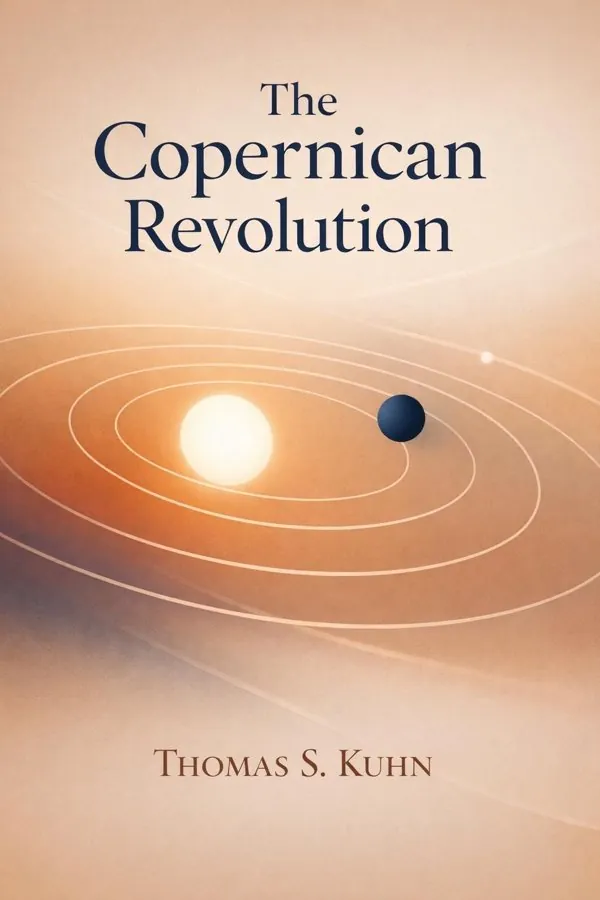
The Copernican Revolution: Planetary Astronomy in the Development of Western Thought: Summary & Key Insights
 10 min10 chaptersAudio available
Key Takeaways from The Copernican Revolution: Planetary Astronomy in the Development of Western Thought
A revolutionary idea is only impressive when we understand the strength of what it replaced.
Ideas become powerful when they are woven into an entire civilization.
Most revolutions begin as inconveniences, not declarations.
Sometimes the boldest move is not solving every problem, but changing the question.
New ideas rarely face opposition because people hate truth.
What Is The Copernican Revolution: Planetary Astronomy in the Development of Western Thought About?
The Copernican Revolution: Planetary Astronomy in the Development of Western Thought by Thomas S. Kuhn is a civilization book spanning 10 pages. Thomas S. Kuhn’s The Copernican Revolution is far more than a history of astronomy. It is an account of how one change in cosmic theory helped reorder philosophy, religion, science, and humanity’s self-understanding. Kuhn traces the long arc from the ancient geocentric universe of Aristotle and Ptolemy to the heliocentric vision of Copernicus, and then onward through Kepler, Galileo, and Newton, showing that scientific ideas never move in isolation. They rise within inherited traditions, clash with established authorities, and eventually reshape the intellectual world around them. What makes this book endure is Kuhn’s ability to connect technical astronomy with broader cultural meaning. He explains why the old worldview was persuasive, why the new one was so difficult to accept, and how the eventual shift transformed Western thought. Written before his famous The Structure of Scientific Revolutions, this book already displays Kuhn’s distinctive talent for explaining major scientific change as a historical process. It matters because it reveals that revolutions in knowledge are also revolutions in imagination.
This FizzRead summary covers all 10 key chapters of The Copernican Revolution: Planetary Astronomy in the Development of Western Thought in approximately 10 minutes, distilling the most important ideas, arguments, and takeaways from Thomas S. Kuhn's work. Also available as an audio summary and Key Quotes Podcast.
The Copernican Revolution: Planetary Astronomy in the Development of Western Thought
Thomas S. Kuhn’s The Copernican Revolution is far more than a history of astronomy. It is an account of how one change in cosmic theory helped reorder philosophy, religion, science, and humanity’s self-understanding. Kuhn traces the long arc from the ancient geocentric universe of Aristotle and Ptolemy to the heliocentric vision of Copernicus, and then onward through Kepler, Galileo, and Newton, showing that scientific ideas never move in isolation. They rise within inherited traditions, clash with established authorities, and eventually reshape the intellectual world around them. What makes this book endure is Kuhn’s ability to connect technical astronomy with broader cultural meaning. He explains why the old worldview was persuasive, why the new one was so difficult to accept, and how the eventual shift transformed Western thought. Written before his famous The Structure of Scientific Revolutions, this book already displays Kuhn’s distinctive talent for explaining major scientific change as a historical process. It matters because it reveals that revolutions in knowledge are also revolutions in imagination.
Who Should Read The Copernican Revolution: Planetary Astronomy in the Development of Western Thought?
This book is perfect for anyone interested in civilization and looking to gain actionable insights in a short read. Whether you're a student, professional, or lifelong learner, the key ideas from The Copernican Revolution: Planetary Astronomy in the Development of Western Thought by Thomas S. Kuhn will help you think differently.
- ✓Readers who enjoy civilization and want practical takeaways
- ✓Professionals looking to apply new ideas to their work and life
- ✓Anyone who wants the core insights of The Copernican Revolution: Planetary Astronomy in the Development of Western Thought in just 10 minutes
Want the full summary?
Get instant access to this book summary and 100K+ more with Fizz Moment.
Get Free SummaryAvailable on App Store • Free to download
Key Chapters
A revolutionary idea is only impressive when we understand the strength of what it replaced. Kuhn begins by showing that the Ptolemaic system was not a foolish mistake waiting to be discarded, but a sophisticated and deeply persuasive model of the universe. Built on Greek geometry, Aristotelian physics, and careful astronomical observation, it placed Earth at the center while explaining planetary motion through deferents, epicycles, and equants. For centuries, this framework did real intellectual work: it predicted celestial positions, supported calendar making, and aligned with accepted ideas about motion and matter.
Its durability came from more than mathematical convenience. The geocentric cosmos fit common sense. The Earth seemed still, heavy bodies appeared to move naturally toward the center, and the heavens seemed orderly and unchanging. The model also resonated with philosophy and religion by giving humanity a clear place in a structured universe. In that sense, the Ptolemaic system was not merely astronomy; it was a worldview.
Kuhn’s crucial point is that scientific systems survive because they solve problems, not because people are blind. Even when the Ptolemaic model grew cumbersome, its complexity reflected attempts to preserve predictive accuracy, not irrational stubbornness. This is a useful lesson far beyond astronomy. In business, politics, or education, old systems often persist because they meet real needs, even if imperfectly.
The practical application is simple: before criticizing an established model, ask what problems it solves and why intelligent people trust it. Actionable takeaway: whenever you encounter a “better” new idea, first understand the hidden strengths of the old one.
Ideas become powerful when they are woven into an entire civilization. Kuhn explains that during the Middle Ages, European thinkers did not merely preserve ancient astronomy; they integrated it into a grand synthesis of philosophy, theology, and education. Aristotle’s physics and Ptolemy’s astronomy were absorbed into Christian intellectual life through scholars such as Thomas Aquinas and Albertus Magnus. The result was a world in which reason and revelation appeared mutually reinforcing.
In this synthesis, the cosmos was morally and spiritually meaningful. Earth’s central position was not necessarily a privilege, but it made symbolic sense within a universe ordered by divine purpose. The heavens were seen as perfect and incorruptible, while the sublunary world was marked by change, decay, and generation. Universities taught this structure as part of a coherent vision of reality, so challenging astronomy eventually meant challenging linked assumptions in natural philosophy and theology.
That explains why heliocentrism met such intense resistance. It was not simply proposing a new diagram of planetary motion; it threatened an interconnected worldview. Kuhn helps readers see that intellectual change is hardest when ideas are institutionally embedded. The same pattern appears today when organizations resist new evidence because it disrupts procedures, identities, or power structures.
A practical example can be seen in modern workplaces adopting artificial intelligence or remote work systems. Resistance often comes not from ignorance but from the fact that new tools unsettle an entire established order. Actionable takeaway: if you want to change minds, address the larger web of beliefs and institutions surrounding an idea, not just the idea itself.
Most revolutions begin as inconveniences, not declarations. Kuhn shows that the crisis of the Ptolemaic model emerged gradually from within the system itself. Astronomers faced persistent difficulties in producing accurate predictions, especially for planetary positions. Over time, attempts to repair the model required increasing mathematical complexity. New epicycles and adjustments made the framework more intricate, but not necessarily more satisfying.
The problem was not simply that the system failed. It often worked reasonably well. The deeper issue was that it became less elegant, less coherent, and less aligned with the ideal of a rationally ordered cosmos. Astronomers were committed not only to prediction but also to intelligibility. As discrepancies accumulated, confidence in the inherited framework weakened. Yet Kuhn stresses that crisis does not automatically produce consensus around a replacement. It creates a period of instability in which alternatives become thinkable.
This is one of Kuhn’s most valuable historical insights. People usually imagine scientific revolutions as moments when truth suddenly crushes error. In reality, old theories often survive many anomalies, and their defenders can propose legitimate fixes. What changes is the balance between patching and reimagining. At some point, complexity begins to feel like a sign that the underlying assumptions may be wrong.
In practical terms, this applies to any system under strain: a company with declining processes, a government with mounting policy exceptions, or a personal schedule full of workarounds. If you find yourself constantly compensating for flaws, the issue may no longer be execution but design. Actionable takeaway: treat recurring patches as a signal to reconsider first principles, not just improve maintenance.
Sometimes the boldest move is not solving every problem, but changing the question. Kuhn presents Copernicus as a thinker who reorganized astronomy by relocating the center of planetary motion from Earth to the Sun. In De revolutionibus, Copernicus argued that many apparent irregularities of the planets could be explained more simply if Earth itself moved. Daily motion came from Earth’s rotation, and annual changes from its revolution around the Sun.
This proposal did not immediately outperform the Ptolemaic system in raw predictive accuracy. In fact, Copernicus still relied on circles and epicycles, because the ideal of uniform circular motion remained intact. What made heliocentrism revolutionary was not immediate technical superiority but conceptual transformation. It offered a new ordering principle that made retrograde motion, planetary brightness, and the sequence of planets easier to understand as consequences of Earth’s changing position.
Kuhn emphasizes that Copernicus did not merely offer a better calculation; he changed perspective. That is why his work matters beyond astronomy. Many breakthroughs happen when a field stops asking how to refine appearances and starts asking what hidden assumption is distorting the entire picture. In medicine, for example, a shift from treating symptoms to identifying systemic causes often produces similar clarity.
Copernicus also reminds us that transformative ideas may begin as intellectually attractive before they become empirically decisive. They win partly because they reorganize experience into a more meaningful whole. Actionable takeaway: when a problem seems unsolvable, experiment with changing the frame rather than perfecting the old answer.
New ideas rarely face opposition because people hate truth. Kuhn is especially good at explaining why resistance to Copernicus was understandable. Heliocentrism contradicted ordinary experience: if Earth moved, why did objects fall straight down, why was there no obvious stellar parallax, and why did people not feel motion? It also challenged Aristotelian physics, which treated natural motion and the structure of the cosmos very differently from what heliocentrism implied. In addition, scriptural interpretations seemed to support Earth’s stability.
For many scholars, then, rejecting Copernicus was not anti-scientific. It was a reasonable response to a theory that raised as many problems as it solved. Kuhn’s account makes scientific controversy more human and more intellectually serious. Competing sides usually operate with different standards of plausibility, different background commitments, and different ideas about what counts as a satisfactory explanation.
This perspective is useful in modern debates over public policy, technology, or institutional reform. People may reject a proposal not because they are irrational, but because it conflicts with evidence they trust, assumptions they rely on, or frameworks that have served them well. Productive persuasion requires understanding those frameworks.
A practical example: when teams resist a new software system, they often fear hidden costs, workflow disruption, and loss of reliability. The resistance may be prudent. Instead of dismissing objections, leaders should identify what the old system protects. Actionable takeaway: when your idea meets resistance, ask not “Why don’t they get it?” but “What valid concerns make the old view seem safer or stronger?”
A revolutionary theory becomes durable when someone makes it work better than its rival. Kuhn shows that Johannes Kepler played this crucial role by refining heliocentrism into a mathematically superior astronomy. Drawing on Tycho Brahe’s exceptionally accurate observations, Kepler abandoned the ancient requirement of uniform circular motion and concluded that planets move in ellipses with the Sun at one focus. He also discovered lawful relations connecting orbital speed and distance.
This was a monumental break. The circle had long been treated as the perfect celestial form, and giving it up meant sacrificing a deeply rooted metaphysical ideal. Yet Kepler was willing to let the heavens be mathematically intelligible without being geometrically perfect in the traditional sense. In doing so, he made the Copernican system more accurate and conceptually fruitful.
Kuhn presents Kepler as a bridge figure. He retained older ambitions for cosmic harmony, but his willingness to revise cherished assumptions pushed astronomy toward modern science. His achievement illustrates an important truth: revolutions often require a second generation that is less loyal to inherited elegance and more willing to follow evidence where it leads.
The practical lesson applies in innovation, research, and strategy. A promising new model may remain fragile until someone improves its precision and operational value. For example, an inspiring business vision becomes credible only when tied to measurable systems and repeatable outcomes. Actionable takeaway: if you believe in a transformative idea, do the hard work of refinement; inspiration changes minds, but precision changes history.
Evidence matters most when it changes what people believe they can see. Kuhn highlights Galileo as the figure who gave the Copernican revolution dramatic empirical force. Using the telescope, Galileo observed mountains on the Moon, sunspots, the phases of Venus, and the moons of Jupiter. These discoveries undermined the old picture of perfect, unchanging heavens and demonstrated that not everything revolved around Earth.
But Galileo’s importance was not limited to observation. He was also a master of interpretation, argument, and public persuasion. Telescopic data did not speak for themselves. They had to be defended against skeptical readers who questioned the reliability of the instrument and the meaning of what it revealed. Galileo connected new observations to a broader physical understanding of motion, helping make heliocentrism thinkable not just mathematically but physically.
Kuhn’s treatment reminds us that science advances through instruments, theory, and rhetoric together. A new tool can open unprecedented possibilities, but communities still need arguments, demonstrations, and educational efforts before they accept what the tool reveals. This is highly relevant today in fields shaped by data analytics, imaging technologies, and artificial intelligence.
For practical application, consider how leaders introduce analytics in an organization. Raw dashboards rarely persuade by themselves; they need context, explanation, and trust-building. Galileo’s example shows that evidence becomes transformative only when framed convincingly. Actionable takeaway: when presenting new evidence, do not assume the facts are enough; help others learn how to interpret, trust, and use what they see.
A true intellectual revolution is complete only when separate worlds become one. Kuhn argues that Isaac Newton provided the final synthesis that made the Copernican revolution intellectually irresistible. Before Newton, astronomy and terrestrial physics were still partly distinct domains. Planetary motion could be described, but why the heavens moved as they did remained uncertain. Newton’s laws of motion and universal gravitation changed that by explaining both falling apples and orbiting planets through the same principles.
This unification was profound. The old Aristotelian division between the corrupt Earth and the perfect heavens collapsed. The same mathematical laws governed all bodies everywhere. Newton thus accomplished more than a technical advance; he transformed the idea of nature itself. The universe became a lawful, intelligible system open to mathematical investigation. This was the foundation of modern physics and a major turning point in Western thought.
Kuhn shows that revolutions often need an integrative stage. Copernicus displaced Earth from the center, Kepler improved the mathematics, Galileo expanded the evidence, but Newton made the new universe coherent as a whole. In modern terms, innovation matures when scattered breakthroughs become a unified framework.
A practical example appears in interdisciplinary work. A company may have strong insights in engineering, design, and customer behavior, but real transformation occurs when those insights are integrated into one operating model. Actionable takeaway: if you want lasting change, do not stop at isolated improvements; build a unified framework that connects them into a compelling whole.
When the universe changes, the human self changes with it. Kuhn emphasizes that the Copernican revolution had consequences far beyond astronomy. Removing Earth from the cosmic center altered philosophical anthropology, theology, and cultural imagination. Humanity no longer occupied the obvious physical focal point of creation. The universe grew larger, less intimate, and more governed by impersonal law. This shift helped prepare the modern sense that nature could be studied objectively, even if that meant surrendering older forms of symbolic comfort.
Theological responses varied. Some thinkers saw heliocentrism as a threat to scriptural authority or to inherited doctrines about cosmic order. Others gradually reinterpreted religious texts and integrated the new astronomy into a broader conception of divine creation. Kuhn’s point is not that science simply defeated religion, but that major intellectual revolutions force traditions to adapt, reinterpret, and renegotiate their claims.
This dynamic remains familiar. New discoveries in genetics, neuroscience, and artificial intelligence continue to raise questions about free will, identity, and moral responsibility. Scientific change often becomes culturally explosive when it unsettles stories people use to locate meaning in the world.
The practical lesson is to recognize that debates over facts are often also debates over significance. If someone feels threatened by a new idea, the issue may be existential as much as intellectual. Actionable takeaway: whenever knowledge shifts your understanding of reality, take time to ask not only “Is it true?” but also “How does this change the way I understand human purpose and responsibility?”
The deepest lesson of Kuhn’s book is that revolutions in science are also revolutions in perception. The Copernican revolution was not just the replacement of one astronomical model with another. It changed standards of explanation, altered relations between observation and theory, and redefined what counted as a satisfying picture of the world. Kuhn uses this episode to show that scientific development is historical, contested, and discontinuous in crucial moments.
This idea anticipates themes later made famous in The Structure of Scientific Revolutions. People working within different frameworks do not simply disagree over isolated facts; they often inhabit different conceptual worlds. A geocentric and a heliocentric astronomer may look at the same sky, yet organize its meaning differently. That is why evidence alone may not end a debate quickly. Competing systems are judged partly by coherence, fruitfulness, simplicity, and compatibility with broader beliefs.
For readers today, this is an invitation to intellectual humility. Our own most trusted frameworks may one day look partial, limited, or strangely constrained. Progress depends not only on accumulating data but on retaining the courage to rethink basic assumptions. At the same time, Kuhn does not suggest that change is arbitrary. Revolutions succeed when they open richer, more powerful ways of understanding the world.
In practical life, this applies to career transitions, organizational redesign, and personal growth. Sometimes improvement requires more than adding skills; it requires seeing the situation through a different lens. Actionable takeaway: regularly examine the assumptions that make your world seem obvious, because the next breakthrough may begin by questioning what currently feels unquestionable.
All Chapters in The Copernican Revolution: Planetary Astronomy in the Development of Western Thought
About the Author
Thomas S. Kuhn (1922–1996) was an American historian and philosopher of science whose work reshaped the study of scientific knowledge. Trained in physics at Harvard, he later turned to the history of science, where he developed a groundbreaking approach that emphasized the role of conceptual frameworks, historical context, and intellectual discontinuity in scientific change. His early book The Copernican Revolution revealed his gift for combining technical explanation with broad cultural interpretation. He later became world-famous for The Structure of Scientific Revolutions, which introduced the influential idea of paradigm shifts. Kuhn taught at Harvard, Berkeley, Princeton, and MIT, and his work remains central to debates about how science develops, why old theories persist, and how new ways of seeing the world emerge.
Get This Summary in Your Preferred Format
Read or listen to the The Copernican Revolution: Planetary Astronomy in the Development of Western Thought summary by Thomas S. Kuhn anytime, anywhere. FizzRead offers multiple formats so you can learn on your terms — all free.
Available formats: App · Audio · PDF · EPUB — All included free with FizzRead
Download The Copernican Revolution: Planetary Astronomy in the Development of Western Thought PDF and EPUB Summary
Key Quotes from The Copernican Revolution: Planetary Astronomy in the Development of Western Thought
“A revolutionary idea is only impressive when we understand the strength of what it replaced.”
“Ideas become powerful when they are woven into an entire civilization.”
“Most revolutions begin as inconveniences, not declarations.”
“Sometimes the boldest move is not solving every problem, but changing the question.”
“New ideas rarely face opposition because people hate truth.”
Frequently Asked Questions about The Copernican Revolution: Planetary Astronomy in the Development of Western Thought
The Copernican Revolution: Planetary Astronomy in the Development of Western Thought by Thomas S. Kuhn is a civilization book that explores key ideas across 10 chapters. Thomas S. Kuhn’s The Copernican Revolution is far more than a history of astronomy. It is an account of how one change in cosmic theory helped reorder philosophy, religion, science, and humanity’s self-understanding. Kuhn traces the long arc from the ancient geocentric universe of Aristotle and Ptolemy to the heliocentric vision of Copernicus, and then onward through Kepler, Galileo, and Newton, showing that scientific ideas never move in isolation. They rise within inherited traditions, clash with established authorities, and eventually reshape the intellectual world around them. What makes this book endure is Kuhn’s ability to connect technical astronomy with broader cultural meaning. He explains why the old worldview was persuasive, why the new one was so difficult to accept, and how the eventual shift transformed Western thought. Written before his famous The Structure of Scientific Revolutions, this book already displays Kuhn’s distinctive talent for explaining major scientific change as a historical process. It matters because it reveals that revolutions in knowledge are also revolutions in imagination.
More by Thomas S. Kuhn
You Might Also Like
The Structure of Scientific Revolutions
Thomas S. Kuhn
10 min
Genius
Harold Bloom
10 min
A Cultural History of the Medieval Age
Various Editors
10 min
A History of God: The 4,000-Year Quest of Judaism, Christianity and Islam
Karen Armstrong
10 min
A History of the World in 10½ Chapters
Julian Barnes
10 min
A Short History of Progress
Ronald Wright
10 minBrowse by Category
Ready to read The Copernican Revolution: Planetary Astronomy in the Development of Western Thought?
Get the full summary and 100K+ more books with Fizz Moment.