
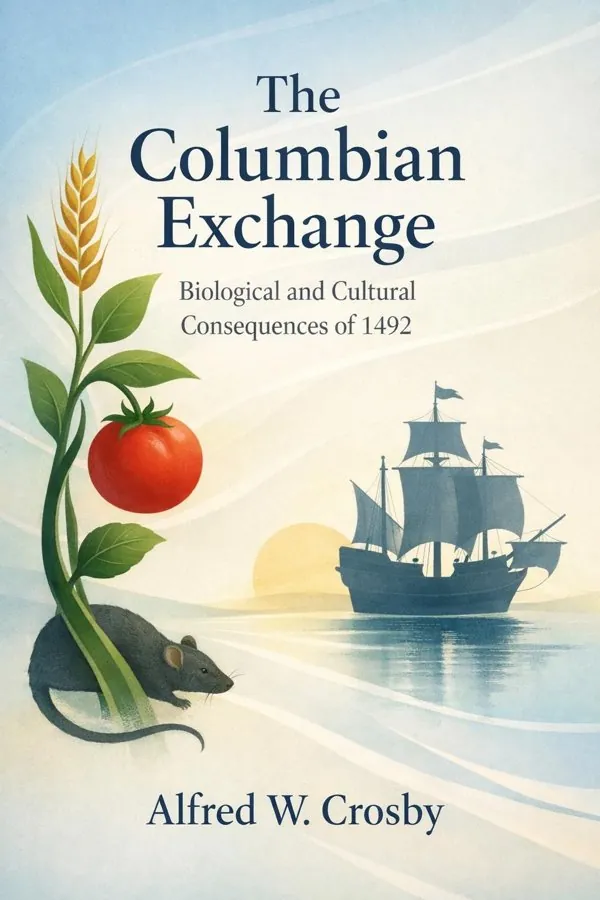
The Columbian Exchange: Biological and Cultural Consequences of 1492: Summary & Key Insights
 10 min10 chaptersAudio available
Key Takeaways from The Columbian Exchange: Biological and Cultural Consequences of 1492
One of Crosby’s most powerful insights is that before 1492, the Old World and the New World had evolved largely in isolation, creating two distinct biological systems.
Crosby asks us to see European arrival in the Americas as more than an episode of exploration or conquest.
Perhaps Crosby’s most famous and unsettling contribution is his explanation of how Old World diseases devastated Indigenous populations in the Americas.
If disease was the darkest side of the Columbian Exchange, the transfer of American crops was one of its most transformative and enduring developments.
Crosby demonstrates that the Old World’s biological gifts to the Americas were not limited to disease.
What Is The Columbian Exchange: Biological and Cultural Consequences of 1492 About?
The Columbian Exchange: Biological and Cultural Consequences of 1492 by Alfred W. Crosby is a world_history book spanning 10 pages. History often treats 1492 as a political turning point, but Alfred W. Crosby shows that it was also a biological revolution. In The Columbian Exchange, Crosby argues that Columbus’s voyages did far more than connect continents through trade and conquest: they unleashed a vast transfer of plants, animals, microbes, and people between the Old World and the New. That exchange transformed diets, landscapes, labor systems, economies, and population patterns across the globe. Potatoes and maize helped feed growing populations in Europe, Africa, and Asia; horses and cattle reshaped life in the Americas; and diseases such as smallpox devastated Indigenous communities with catastrophic speed. What makes this book so important is its shift in perspective. Crosby moves beyond kings, battles, and treaties to reveal how ecological forces can shape world history just as powerfully as armies and empires. In doing so, he helped found the modern field of environmental history. Clear, provocative, and enduringly influential, this book remains essential for understanding colonialism, globalization, and the deep biological interdependence of human societies. Crosby’s authority comes from his pioneering scholarship and his ability to make environmental change central to historical explanation.
This FizzRead summary covers all 10 key chapters of The Columbian Exchange: Biological and Cultural Consequences of 1492 in approximately 10 minutes, distilling the most important ideas, arguments, and takeaways from Alfred W. Crosby's work. Also available as an audio summary and Key Quotes Podcast.
The Columbian Exchange: Biological and Cultural Consequences of 1492
History often treats 1492 as a political turning point, but Alfred W. Crosby shows that it was also a biological revolution. In The Columbian Exchange, Crosby argues that Columbus’s voyages did far more than connect continents through trade and conquest: they unleashed a vast transfer of plants, animals, microbes, and people between the Old World and the New. That exchange transformed diets, landscapes, labor systems, economies, and population patterns across the globe. Potatoes and maize helped feed growing populations in Europe, Africa, and Asia; horses and cattle reshaped life in the Americas; and diseases such as smallpox devastated Indigenous communities with catastrophic speed.
What makes this book so important is its shift in perspective. Crosby moves beyond kings, battles, and treaties to reveal how ecological forces can shape world history just as powerfully as armies and empires. In doing so, he helped found the modern field of environmental history. Clear, provocative, and enduringly influential, this book remains essential for understanding colonialism, globalization, and the deep biological interdependence of human societies. Crosby’s authority comes from his pioneering scholarship and his ability to make environmental change central to historical explanation.
Who Should Read The Columbian Exchange: Biological and Cultural Consequences of 1492?
This book is perfect for anyone interested in world_history and looking to gain actionable insights in a short read. Whether you're a student, professional, or lifelong learner, the key ideas from The Columbian Exchange: Biological and Cultural Consequences of 1492 by Alfred W. Crosby will help you think differently.
- ✓Readers who enjoy world_history and want practical takeaways
- ✓Professionals looking to apply new ideas to their work and life
- ✓Anyone who wants the core insights of The Columbian Exchange: Biological and Cultural Consequences of 1492 in just 10 minutes
Want the full summary?
Get instant access to this book summary and 100K+ more with Fizz Moment.
Get Free SummaryAvailable on App Store • Free to download
Key Chapters
One of Crosby’s most powerful insights is that before 1492, the Old World and the New World had evolved largely in isolation, creating two distinct biological systems. Eurasia and Africa shared crops, animals, diseases, and technologies across broad interconnected networks. The Americas, by contrast, developed with different domesticated species, different staple foods, and different disease environments. This separation meant that when contact finally came, it was not a simple meeting of cultures but a collision of ecosystems.
Crosby emphasizes that this long isolation explains why the consequences of contact were so dramatic. Wheat, sugarcane, cattle, horses, pigs, and Old World pathogens entered environments where they had never existed. Meanwhile, maize, potatoes, tomatoes, cacao, and tobacco traveled eastward to societies that had never seen them. Because both hemispheres had developed independently for thousands of years, each possessed biological resources and vulnerabilities the other lacked.
A practical way to understand this is to look at modern food. Italian cuisine without tomatoes, Irish history without potatoes, or Plains Indigenous cultures without horses would be almost unimaginable today. Yet all of these were products of post-1492 exchange. What feels ancient and natural is often historically recent.
Crosby’s framework invites readers to think historically about everyday life. The foods we eat, the animals around us, and even the diseases societies have faced are shaped by long ecological histories. Actionable takeaway: when studying any major historical event, ask not only who fought or ruled, but what biological worlds were brought into contact.
Crosby asks us to see European arrival in the Americas as more than an episode of exploration or conquest. Ships crossing the Atlantic carried entire ecological packages. Europeans brought seeds in cargo, animals in holds, microbes in bodies, and habits of land use in their minds. Conquest succeeded not only through weapons and institutions but through biological companions that transformed American environments in Europe’s favor.
This helps explain why European settlement spread so quickly in certain regions. Colonists did not merely occupy land; they remade it. Forests were cleared for pasture, European weeds spread along roads and settlements, and livestock multiplied in places where native ecosystems had no precedent for such grazing pressure. These changes altered soils, waterways, and patterns of subsistence. The encounter was environmental before it was cultural and cultural because it was environmental.
Crosby’s argument also complicates heroic or purely moral narratives. It shows that history can be driven by unintended consequences. A settler might transport pigs for food, but those pigs could devastate local agriculture. A sailor carrying no hostile intent could still bring infection. The result was a form of transformation that often outpaced deliberate human planning.
In today’s terms, this resembles how invasive species or accidental disease transmission can reshape entire regions. Ecological effects often travel with human mobility. Actionable takeaway: understand migration, colonization, and trade as biological processes as well as political ones, because people never move alone—they carry living systems with them.
Perhaps Crosby’s most famous and unsettling contribution is his explanation of how Old World diseases devastated Indigenous populations in the Americas. Smallpox, measles, influenza, typhus, and other pathogens crossed the Atlantic with Europeans and Africans. Because Native American populations had not previously been exposed to these diseases, they lacked the inherited and acquired immunological defenses common in the Old World. The result was demographic catastrophe on an extraordinary scale.
Crosby does not reduce conquest to germs alone, but he makes clear that epidemic disease was often the decisive precondition for European expansion. Societies were shattered before they could effectively resist. Communities lost leaders, farmers, warriors, and healers in waves of mortality. Agriculture faltered, political authority weakened, and social confidence broke down. In many places, disease reached populations before Europeans themselves did, spreading through trade and contact networks faster than armies could travel.
This idea has practical importance because it changes how we interpret power. Military superiority mattered, but epidemics radically tilted the balance. A tiny invading force could appear unbeatable when disease had already undermined resistance.
Modern readers can connect this argument to pandemic history more broadly. Disease is not a side note to human affairs; it is a historical force that can rearrange labor markets, political structures, and social memory. Actionable takeaway: when evaluating historical rise and fall, always consider epidemiology alongside economics and warfare, because microbes can be among the most powerful actors in history.
If disease was the darkest side of the Columbian Exchange, the transfer of American crops was one of its most transformative and enduring developments. Crosby shows that plants from the Americas reshaped diets and demographics across Europe, Africa, and Asia. Maize, potatoes, sweet potatoes, cassava, tomatoes, peanuts, beans, chili peppers, cacao, and tobacco all moved eastward, with enormous consequences.
The potato is a classic example. Highly productive and nutritious, it could support dense populations on relatively small plots of land, especially in parts of Europe with cooler climates. Maize spread widely in southern Europe, Africa, and China. Cassava became especially important in Africa because it tolerated poor soils and variable conditions. These crops did not merely diversify cuisine; they increased caloric availability, reduced famine risk in some regions, and supported population growth.
Crosby’s insight reminds us that globalization is often rooted in agriculture. A single crop can alter settlement patterns, labor systems, and political power by changing how many people a region can feed. Even modern national cuisines owe much to these transfers. Indian food without chili peppers or European cooking without tomatoes would look radically different.
This is a useful lesson for understanding development today. Food systems are global, historically contingent, and often built on past exchanges that became normalized over time. Actionable takeaway: pay close attention to staple crops in any society, because what people can grow and eat often shapes demography, trade, resilience, and cultural identity more deeply than ideology alone.
Crosby demonstrates that the Old World’s biological gifts to the Americas were not limited to disease. Animals and plants introduced by Europeans transformed landscapes, labor, and daily life. Horses, cattle, pigs, sheep, goats, wheat, barley, sugarcane, coffee, and countless weeds crossed the Atlantic and often flourished with remarkable speed. Their success changed ecosystems and social relations alike.
The horse is one of the most striking examples. Though initially brought by Europeans, it was adopted by many Indigenous peoples, especially on the North American plains, where it revolutionized mobility, hunting, warfare, trade, and status. Cattle and sheep reshaped land use through grazing, often displacing native plants. Pigs reproduced quickly and could become feral, damaging fields and forests. Sugarcane, meanwhile, encouraged plantation systems tied to slavery, linking ecology to labor exploitation and imperial wealth.
Crosby’s point is that biological introductions can have cascading effects. An animal is never just an animal; it is a source of meat, traction, transport, manure, property, conflict, and environmental pressure. A crop is never just food; it can reorder labor and trade.
This remains highly relevant in the modern world, where introduced species continue to disrupt ecosystems. Whether rabbits in Australia or zebra mussels in North America, ecological history repeats its patterns. Actionable takeaway: treat introduced species as agents of historical change, and when examining a society’s transformation, ask how animals and plants altered both the environment and human institutions.
A central achievement of Crosby’s book is showing that imperial expansion cannot be understood apart from ecological change. European empires did not simply conquer territory and extract wealth; they often established conditions in which familiar Old World organisms could thrive. Settlers, livestock, crops, weeds, and microbes collectively created environments more hospitable to European ways of life and less stable for Indigenous ones.
This idea helps explain why colonization often involved environmental replacement as much as political domination. Colonists fenced land, imposed private property systems, introduced grazing animals, and planted European crops. In many cases, these changes undermined Indigenous land management practices, from controlled burning to mixed subsistence patterns. Ecological disruption weakened local autonomy while making colonial economies more viable.
Crosby’s analysis also illuminates how economic systems grew out of biological realities. Plantation zones emerged where sugar or other imported crops could flourish. Ranching societies expanded where livestock adapted well. The environment was not a passive backdrop to empire; it was an active participant in determining what imperial systems could become.
Readers can apply this insight far beyond the Atlantic world. Modern infrastructure projects, resource frontiers, and export agriculture still show how political power and ecological transformation reinforce one another. Actionable takeaway: whenever studying empire or development, look for the environmental foundations beneath the institutions, because land use, species transfer, and disease environments often make political dominance materially possible.
Crosby’s great strength is that he never treats biology as separate from culture. The transfer of crops, animals, and diseases reshaped belief systems, habits, tastes, work patterns, and social identities. Food is a clear example. Once American crops entered Afro-Eurasian societies, they were absorbed into local cuisines and became symbols of regional tradition. At the same time, Old World species altered social practices in the Americas, from mounted warfare to ranching economies.
This means the Columbian Exchange was not only a movement of things but a reorganization of meaning. Tobacco became embedded in global commerce and social ritual. Sugar changed consumption habits and class distinctions in Europe. Horses transformed ideas of prestige and power among Indigenous peoples who adopted them. Even catastrophic epidemics affected religion and worldview, as communities struggled to interpret suffering on an unprecedented scale.
Crosby thus encourages a broader definition of culture. Culture is not just literature, religion, or law; it includes diet, domestication, health, and environmental adaptation. Biological shifts can become cultural revolutions once societies absorb them into everyday life.
This perspective helps modern readers recognize that cultural authenticity is often historically layered. Many traditions that feel timeless are products of exchange, adaptation, and survival. Actionable takeaway: when thinking about culture, examine its ecological roots—what people eat, raise, cultivate, and endure often reveals as much about identity as language or ideology.
Behind Crosby’s discussion of crops and microbes lies an even larger theme: the Columbian Exchange radically redistributed human populations and possibilities. In the Americas, Indigenous mortality from disease and conquest created demographic collapse. In Europe, new food resources helped sustain long-term population growth. In Africa, Atlantic slave trading intensified as colonial labor demands rose, especially in plantation zones producing sugar and other commodities.
These population changes were interconnected. Labor shortages in the Americas, partly caused by epidemic devastation, contributed to the expansion of African slavery. New crops such as maize and cassava later affected African population patterns as well, even as the slave trade inflicted deep social violence. Europe benefited from new wealth, new foods, and enlarged commercial networks. The exchange was therefore not balanced; it created winners and losers through uneven biological and economic consequences.
Crosby’s demographic perspective is essential because it links environmental history to human suffering and structural change. Population numbers are not abstract statistics. They affect military power, tax capacity, urbanization, family life, and cultural continuity. Entire civilizations can be destabilized when mortality rises suddenly or fertility patterns change.
This key idea also sharpens our understanding of modern globalization. Movements of goods, organisms, and labor are always tied to population effects. Actionable takeaway: when analyzing any major global system, trace its demographic consequences—who grew, who declined, who was displaced, and who supplied the labor that made the system work.
Crosby presents 1492 as the start of a new phase in world history: the irreversible knitting together of previously separated ecological zones. After Columbus, no major region of the world remained biologically isolated in the same way. Species, diseases, commodities, and people moved across oceans with increasing speed and regularity. The Atlantic became a corridor of exchange that eventually fed into a genuinely global system.
This matters because it shifts the meaning of globalization. We often think of globalization in terms of finance, media, or modern technology, but Crosby shows that its foundations are much older and more biological. Long before the internet, the world was being integrated through food staples, epidemic pathways, plantation crops, and migration routes. The results were durable and often irreversible.
Examples are everywhere. American silver connected with Asian trade; American crops altered African and European agriculture; Old World livestock changed American frontiers. Over time, these exchanges blended into a world where local life depended on distant ecologies. A famine, epidemic, or commodity boom in one region could now be linked to species and markets from another.
Crosby’s framework remains especially useful in the age of climate change and global supply chains. It reminds us that interdependence is not new, and that biological exchange has long produced both abundance and vulnerability. Actionable takeaway: see globalization not as a recent invention but as a centuries-long ecological process, and evaluate modern interconnection with that deeper historical perspective.
The lasting power of Crosby’s book lies in its final implication: the Columbian Exchange is not just a past event but an ongoing condition of modern life. Our diets, economies, landscapes, and health systems still bear its imprint. Everyday meals combine ingredients from multiple continents. National economies rely on crops and animals introduced centuries ago. Public health systems continue to grapple with the movement of pathogens across connected populations.
Crosby encourages readers to see environmental history as a living framework. The same patterns that emerged after 1492—rapid movement, ecological disruption, species transfer, unequal consequences—remain visible today. Invasive species spread through trade. Industrial agriculture depends on globally circulated crops. Pandemics reveal how mobility links distant populations. Climate change intensifies the consequences of ecological interdependence that began in earlier global exchanges.
The book also leaves readers with a moral challenge. Biological exchange created wealth and innovation, but it also produced dispossession, enslavement, and demographic disaster. To understand the modern world honestly, we must hold both truths together: connection can generate abundance, and it can also magnify inequality and vulnerability.
For students, policymakers, and general readers, Crosby’s lesson is strikingly practical. Historical literacy about ecology improves how we think about food security, migration, disease, and sustainability. Actionable takeaway: use the Columbian Exchange as a lens for the present—whenever a species, product, or pathogen moves across borders, ask what long-term ecological and human consequences may follow.
All Chapters in The Columbian Exchange: Biological and Cultural Consequences of 1492
About the Author
Alfred W. Crosby (1931–2018) was an American historian whose work helped establish environmental history as a major field of study. He taught at several universities, most notably the University of Texas at Austin, and became known for asking how biology, ecology, and disease shape the course of human events. Rather than focusing only on political leaders or military conflicts, Crosby examined the movement of plants, animals, microbes, and people across regions and empires. His landmark books, including The Columbian Exchange and Ecological Imperialism, transformed the way historians understand colonialism and globalization. Crosby’s scholarship was admired for being both intellectually original and accessible to general readers. His legacy endures in the many historians, environmental scholars, and students influenced by his ecological approach to world history.
Get This Summary in Your Preferred Format
Read or listen to the The Columbian Exchange: Biological and Cultural Consequences of 1492 summary by Alfred W. Crosby anytime, anywhere. FizzRead offers multiple formats so you can learn on your terms — all free.
Available formats: App · Audio · PDF · EPUB — All included free with FizzRead
Download The Columbian Exchange: Biological and Cultural Consequences of 1492 PDF and EPUB Summary
Key Quotes from The Columbian Exchange: Biological and Cultural Consequences of 1492
“One of Crosby’s most powerful insights is that before 1492, the Old World and the New World had evolved largely in isolation, creating two distinct biological systems.”
“Crosby asks us to see European arrival in the Americas as more than an episode of exploration or conquest.”
“Perhaps Crosby’s most famous and unsettling contribution is his explanation of how Old World diseases devastated Indigenous populations in the Americas.”
“If disease was the darkest side of the Columbian Exchange, the transfer of American crops was one of its most transformative and enduring developments.”
“Crosby demonstrates that the Old World’s biological gifts to the Americas were not limited to disease.”
Frequently Asked Questions about The Columbian Exchange: Biological and Cultural Consequences of 1492
The Columbian Exchange: Biological and Cultural Consequences of 1492 by Alfred W. Crosby is a world_history book that explores key ideas across 10 chapters. History often treats 1492 as a political turning point, but Alfred W. Crosby shows that it was also a biological revolution. In The Columbian Exchange, Crosby argues that Columbus’s voyages did far more than connect continents through trade and conquest: they unleashed a vast transfer of plants, animals, microbes, and people between the Old World and the New. That exchange transformed diets, landscapes, labor systems, economies, and population patterns across the globe. Potatoes and maize helped feed growing populations in Europe, Africa, and Asia; horses and cattle reshaped life in the Americas; and diseases such as smallpox devastated Indigenous communities with catastrophic speed. What makes this book so important is its shift in perspective. Crosby moves beyond kings, battles, and treaties to reveal how ecological forces can shape world history just as powerfully as armies and empires. In doing so, he helped found the modern field of environmental history. Clear, provocative, and enduringly influential, this book remains essential for understanding colonialism, globalization, and the deep biological interdependence of human societies. Crosby’s authority comes from his pioneering scholarship and his ability to make environmental change central to historical explanation.
You Might Also Like
The Age of Capital
Eric Hobsbawm
10 min
The Gulag Archipelago
Aleksandr Solzhenitsyn
10 min
Jerusalem: The Biography
Simon Sebag Montefiore
10 min
The Anglo-Saxons
James Campbell
10 min
The Boer War
Thomas Pakenham
10 min
The Industrial Revolutionaries: The Making of the Modern World 1776–1914
Gavin Weightman
10 minBrowse by Category
Ready to read The Columbian Exchange: Biological and Cultural Consequences of 1492?
Get the full summary and 100K+ more books with Fizz Moment.