
Alfred W. Crosby Books
Alfred W. Crosby (1931–2018) was an American historian and professor known for pioneering the field of environmental history.
Known for: The Columbian Exchange: Biological and Cultural Consequences of 1492
Books by Alfred W. Crosby
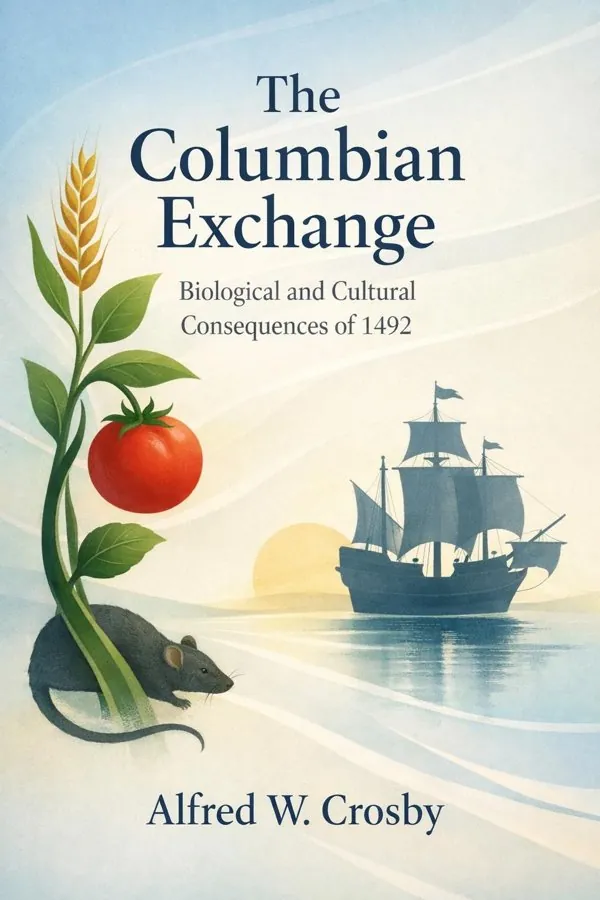
The Columbian Exchange: Biological and Cultural Consequences of 1492
History often treats 1492 as a political turning point, but Alfred W. Crosby shows that it was also a biological revolution. In The Columbian Exchange, Crosby argues that Columbus’s voyages did far more than connect continents through trade and conquest: they unleashed a vast transfer of plants, animals, microbes, and people between the Old World and the New. That exchange transformed diets, landscapes, labor systems, economies, and population patterns across the globe. Potatoes and maize helped feed growing populations in Europe, Africa, and Asia; horses and cattle reshaped life in the Americas; and diseases such as smallpox devastated Indigenous communities with catastrophic speed. What makes this book so important is its shift in perspective. Crosby moves beyond kings, battles, and treaties to reveal how ecological forces can shape world history just as powerfully as armies and empires. In doing so, he helped found the modern field of environmental history. Clear, provocative, and enduringly influential, this book remains essential for understanding colonialism, globalization, and the deep biological interdependence of human societies. Crosby’s authority comes from his pioneering scholarship and his ability to make environmental change central to historical explanation.
Read SummaryKey Insights from Alfred W. Crosby
Two Worlds Long Kept Apart
One of Crosby’s most powerful insights is that before 1492, the Old World and the New World had evolved largely in isolation, creating two distinct biological systems. Eurasia and Africa shared crops, animals, diseases, and technologies across broad interconnected networks. The Americas, by contrast...
From The Columbian Exchange: Biological and Cultural Consequences of 1492
European Arrival Changed More Than Politics
Crosby asks us to see European arrival in the Americas as more than an episode of exploration or conquest. Ships crossing the Atlantic carried entire ecological packages. Europeans brought seeds in cargo, animals in holds, microbes in bodies, and habits of land use in their minds. Conquest succeeded...
From The Columbian Exchange: Biological and Cultural Consequences of 1492
Disease Was the Deadliest Invader
Perhaps Crosby’s most famous and unsettling contribution is his explanation of how Old World diseases devastated Indigenous populations in the Americas. Smallpox, measles, influenza, typhus, and other pathogens crossed the Atlantic with Europeans and Africans. Because Native American populations had...
From The Columbian Exchange: Biological and Cultural Consequences of 1492
American Crops Fed the Old World
If disease was the darkest side of the Columbian Exchange, the transfer of American crops was one of its most transformative and enduring developments. Crosby shows that plants from the Americas reshaped diets and demographics across Europe, Africa, and Asia. Maize, potatoes, sweet potatoes, cassava...
From The Columbian Exchange: Biological and Cultural Consequences of 1492
Old World Species Remade American Landscapes
Crosby demonstrates that the Old World’s biological gifts to the Americas were not limited to disease. Animals and plants introduced by Europeans transformed landscapes, labor, and daily life. Horses, cattle, pigs, sheep, goats, wheat, barley, sugarcane, coffee, and countless weeds crossed the Atlan...
From The Columbian Exchange: Biological and Cultural Consequences of 1492
Ecology and Empire Worked Together
A central achievement of Crosby’s book is showing that imperial expansion cannot be understood apart from ecological change. European empires did not simply conquer territory and extract wealth; they often established conditions in which familiar Old World organisms could thrive. Settlers, livestock...
From The Columbian Exchange: Biological and Cultural Consequences of 1492
About Alfred W. Crosby
Alfred W. Crosby (1931–2018) was an American historian and professor known for pioneering the field of environmental history. His research focused on the ecological and biological factors that shaped human societies, and his works, including 'The Columbian Exchange' and 'Ecological Imperialism,' hav...
Read more
Alfred W. Crosby (1931–2018) was an American historian and professor known for pioneering the field of environmental history. His research focused on the ecological and biological factors that shaped human societies, and his works, including 'The Columbian Exchange' and 'Ecological Imperialism,' hav...
Alfred W. Crosby (1931–2018) was an American historian and professor known for pioneering the field of environmental history. His research focused on the ecological and biological factors that shaped human societies, and his works, including 'The Columbian Exchange' and 'Ecological Imperialism,' have had a lasting influence on global historical scholarship.


Frequently Asked Questions
Alfred W. Crosby (1931–2018) was an American historian and professor known for pioneering the field of environmental history.
Read Alfred W. Crosby's books in 15 minutes
Get AI-powered summaries with key insights from 1 book by Alfred W. Crosby.