
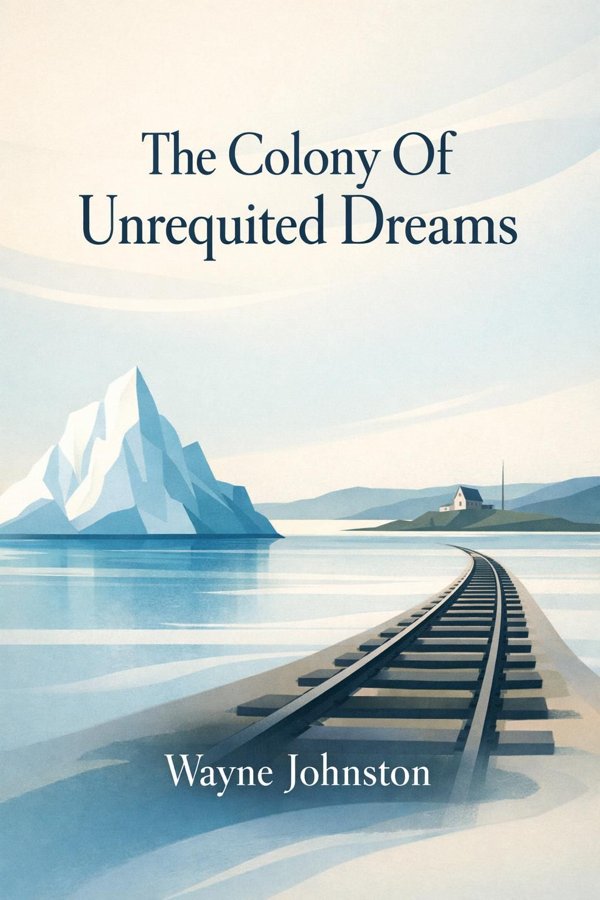
The Colony Of Unrequited Dreams: Summary & Key Insights
 10 min9 chaptersAudio available
Key Takeaways from The Colony Of Unrequited Dreams
A place can become a personality, and in this novel Newfoundland is not just a setting but a force that molds every decision.
Words often become the first ladder out of obscurity, and Joey Smallwood climbs that ladder through journalism.
Every ambitious public figure needs a countervoice, and Sheilagh Fielding is the novel’s most brilliant one.
Political change is often described in terms of elections and speeches, but Johnston shows that it begins much earlier in private obsessions, grudges, and emotional needs.
The promise of a better future can unite people, but it can also expose deep anxieties about who they are.
What Is The Colony Of Unrequited Dreams About?
The Colony Of Unrequited Dreams by Wayne Johnston is a world_history book spanning 5 pages. The Colony Of Unrequited Dreams is a sweeping historical novel that turns the political life of Newfoundland into a deeply human story about ambition, belonging, and the cost of trying to reshape a nation. Centered on Joey Smallwood, the controversial figure who would eventually lead Newfoundland into confederation with Canada, Wayne Johnston traces one man’s rise alongside the fate of a place long defined by distance, hardship, and fierce local pride. But this is far more than a fictionalized biography. It is also a meditation on memory, myth, and the uneasy relationship between personal dreams and collective history. Johnston’s authority comes not only from his gifts as a novelist, but from his deep roots in Newfoundland and his remarkable ability to capture the island’s speech, politics, weather, and contradictions. He understands Newfoundland from the inside, and that intimacy gives the novel unusual force. For readers interested in world history, national identity, or the hidden dramas behind political change, this book offers an unforgettable portrait of how a marginalized place struggles to imagine its future.
This FizzRead summary covers all 9 key chapters of The Colony Of Unrequited Dreams in approximately 10 minutes, distilling the most important ideas, arguments, and takeaways from Wayne Johnston's work. Also available as an audio summary and Key Quotes Podcast.
The Colony Of Unrequited Dreams
The Colony Of Unrequited Dreams is a sweeping historical novel that turns the political life of Newfoundland into a deeply human story about ambition, belonging, and the cost of trying to reshape a nation. Centered on Joey Smallwood, the controversial figure who would eventually lead Newfoundland into confederation with Canada, Wayne Johnston traces one man’s rise alongside the fate of a place long defined by distance, hardship, and fierce local pride. But this is far more than a fictionalized biography. It is also a meditation on memory, myth, and the uneasy relationship between personal dreams and collective history. Johnston’s authority comes not only from his gifts as a novelist, but from his deep roots in Newfoundland and his remarkable ability to capture the island’s speech, politics, weather, and contradictions. He understands Newfoundland from the inside, and that intimacy gives the novel unusual force. For readers interested in world history, national identity, or the hidden dramas behind political change, this book offers an unforgettable portrait of how a marginalized place struggles to imagine its future.
Who Should Read The Colony Of Unrequited Dreams?
This book is perfect for anyone interested in world_history and looking to gain actionable insights in a short read. Whether you're a student, professional, or lifelong learner, the key ideas from The Colony Of Unrequited Dreams by Wayne Johnston will help you think differently.
- ✓Readers who enjoy world_history and want practical takeaways
- ✓Professionals looking to apply new ideas to their work and life
- ✓Anyone who wants the core insights of The Colony Of Unrequited Dreams in just 10 minutes
Want the full summary?
Get instant access to this book summary and 100K+ more with Fizz Moment.
Get Free SummaryAvailable on App Store • Free to download
Key Chapters
A place can become a personality, and in this novel Newfoundland is not just a setting but a force that molds every decision. At the turn of the twentieth century, the island exists in a state of uncertainty: geographically isolated, economically fragile, and politically suspended between imperial dependence and the dream of self-determination. Wayne Johnston shows how the cold coastline, scattered outports, and harsh routines of survival produce a people who are resilient yet deeply vulnerable to disappointment. That atmosphere of difficulty is essential to understanding Joey Smallwood. His ambition does not emerge in a vacuum; it is born from a landscape that teaches scarcity, exclusion, and the need to imagine escape.
The novel suggests that historical actors are often products of local conditions long before they become public figures. Newfoundland’s culture prizes endurance, wit, and self-invention, but it also carries a burden of inferiority, as though it has been overlooked by larger powers. Joey grows up absorbing both impulses: pride in his homeland and impatience with its limitations. Johnston uses this tension to explain why grand political dreams can feel both necessary and dangerous.
Readers can apply this insight beyond the novel. Whether in politics, business, or family life, people often mistake ambition for pure individual will when it is really shaped by background, geography, and collective memory. A person raised on the margins may hunger for recognition more fiercely than someone born at the center.
Actionable takeaway: when evaluating any leader or any dream, first ask what environment made that dream seem urgent, possible, or necessary.
Words often become the first ladder out of obscurity, and Joey Smallwood climbs that ladder through journalism. As a young man in St. John’s, he is restless, hungry for significance, and convinced that language can move him closer to power. Reporting gives him more than employment. It teaches him how stories shape public life, how rhetoric can frame events, and how confidence can sometimes outrun competence. Johnston presents Joey’s early newspaper work as a training ground where ego, curiosity, and political instinct begin to merge.
This part of the novel is especially compelling because it captures journalism as both democratic craft and self-making performance. Joey learns to observe, persuade, exaggerate, and adapt. He also learns that public life rewards those who can turn private conviction into a shared narrative. His talent lies not merely in reporting facts but in sensing what version of reality people are ready to believe. That skill later becomes central to his political career.
Johnston does not romanticize this transformation. Journalism sharpens Joey’s intelligence, but it also feeds his vanity and appetite for influence. The same tools that help him understand the public also allow him to manipulate it. In that sense, the novel offers a timeless lesson about media: language can illuminate reality, but it can also manufacture consent.
This idea remains highly practical today. Anyone working in media, leadership, education, or advocacy can see how storytelling determines attention and legitimacy. The question is never just whether a message is powerful, but whether it is ethically used.
Actionable takeaway: pay close attention to the stories leaders tell, because the path to power often begins with mastery over language rather than mastery over truth.
Every ambitious public figure needs a countervoice, and Sheilagh Fielding is the novel’s most brilliant one. Sharp, wounded, fiercely intelligent, and defiantly unconventional, she stands apart from the respectable social world that Joey wishes to enter and eventually dominate. Through Fielding, Johnston gives the novel a moral and emotional depth it would otherwise lack. She is not merely a supporting character or love interest. She is the book’s conscience, skeptic, witness, and alternative historian.
Fielding’s importance lies in her refusal to believe easy myths. Where Joey sees destiny, she sees vanity. Where public life demands slogans, she offers irony. Where history tends to celebrate winners, she notices the lonely, the humiliated, and the erased. Her newspaper columns and private observations expose the distance between political theater and human truth. In doing so, she reminds readers that official narratives are never complete.
She also embodies one of the novel’s most moving themes: the cost of intelligence in a society that rewards conformity. Fielding is too original to fit neatly into the roles available to women of her time, and her exclusion becomes part of the novel’s critique of social respectability. Johnston uses her character to show that nations are not built only by their loudest architects, but also by those whose insight goes unrecognized.
In practical terms, Fielding teaches readers to look for the dissenting voice in any public story. In workplaces, governments, and communities, there is often someone who sees what the celebrated leader cannot or will not see.
Actionable takeaway: whenever a grand vision is presented as unquestionable, seek out the person brave enough to question it.
Political change is often described in terms of elections and speeches, but Johnston shows that it begins much earlier in private obsessions, grudges, and emotional needs. Joey Smallwood’s rise is not simply a sequence of public achievements. It is also the story of a man who needs validation, fears insignificance, and turns those feelings into relentless political momentum. The novel insists that ideology alone cannot explain leadership. Personality matters, insecurity matters, and longing matters.
This is one of the book’s most sophisticated contributions. It avoids treating history as a clean procession of ideas and instead presents politics as deeply entangled with temperament. Joey’s capacity for endurance, persuasion, and reinvention makes him formidable. Yet the same qualities also reveal his instability. He can be inspired and opportunistic, visionary and self-serving, resilient and emotionally needy. Johnston refuses the comfort of a simple hero or villain.
That complexity helps readers understand why political movements can become so attached to a single figure. Leaders often succeed because they convert private hunger into public narrative. Their personal dramas become national dramas. In Joey’s case, the need to matter fuses with Newfoundland’s need to define itself. The result is charisma powered by historical opportunity.
This idea applies far beyond Newfoundland. Citizens today still evaluate leaders as if their public positions were separate from their psychological patterns. Yet repeated behavior, emotional style, and response to criticism often reveal as much as policy statements do.
Actionable takeaway: when assessing a political leader, examine not just what they promise, but what personal need seems to drive their ambition.
The promise of a better future can unite people, but it can also expose deep anxieties about who they are. In The Colony Of Unrequited Dreams, confederation with Canada is not presented as a simple policy debate. It becomes the central symbolic struggle over Newfoundland’s identity, dignity, and survival. For Joey Smallwood, confederation represents modernization, economic hope, and a route out of stagnation. For many others, it threatens the loss of sovereignty, tradition, and a hard-won sense of distinctiveness.
Johnston’s great achievement here is his refusal to flatten either side. He understands why confederation could appear both practical and humiliating. Newfoundland is poor, vulnerable, and politically unstable, yet it is also culturally singular and emotionally attached to its difference. This makes the debate tragic rather than merely procedural. People are not simply choosing between two constitutional arrangements; they are deciding whether joining a larger nation is progress or surrender.
The novel therefore becomes a study in how historical decisions are made under pressure, with incomplete information and competing versions of hope. Joey champions confederation with near-messianic energy, but Johnston invites readers to ask what gets sacrificed when a future is gained. Material improvement may come at the cost of symbolic independence, and historical necessity may still feel like emotional defeat.
Modern readers can recognize this pattern in debates about globalization, union, regional autonomy, or institutional reform. Progress is often measured economically, while identity resists those calculations.
Actionable takeaway: when judging major political change, consider both the material benefits it promises and the deeper identities it may unsettle or erase.
Nations are built as much through storytelling as through legislation, and Johnston’s novel constantly asks who gets to tell the story. By fictionalizing Joey Smallwood while weaving in recognizable historical events, the book lives in the tension between documented fact and imaginative truth. This is not a flaw but a central insight. Historical memory is never neutral. It is arranged, repeated, contested, and revised depending on who speaks and who is silenced.
The novel’s structure highlights that public history tends to elevate official achievement while overlooking ambiguity and contradiction. Joey is remembered as a nation-builder, but the book probes the costs, distortions, and emotional wreckage beneath that title. Sheilagh Fielding, in contrast, preserves a more skeptical record, one that resists patriotic simplification. Together they dramatize two competing forms of memory: the triumphant and the unsettling.
This theme matters because readers often approach historical fiction looking for a definitive version of the past. Johnston offers something more valuable: an education in uncertainty. He shows that understanding history requires attention not only to what happened, but to how events are remembered and why some interpretations prevail.
This is practical in everyday life. Families, companies, and countries all create flattering myths about their origins. Those myths can inspire loyalty, but they can also conceal harm or exclusion. Learning to read multiple versions of a story is an essential civic skill.
Actionable takeaway: whenever you encounter a polished historical narrative, ask whose memory it preserves, whose memory it excludes, and what emotional purpose the story serves.
Isolation can preserve character, but it can also magnify fantasy. Newfoundland in this novel is shaped by its apartness: from continental centers of power, from economic security, and from the easy movement of ideas and people. That apartness generates a strong local identity, rich language, and communal solidarity. Yet Johnston also shows how isolation fosters exaggeration, grievance, and dreamlike forms of self-understanding. A community cut off from the center often becomes intensely conscious of how it is seen, or not seen, by others.
Joey Smallwood embodies this double condition. He loves Newfoundland, but he is also embarrassed by its backwardness and desperate to drag it into modernity. His ambitions are inflated by the island’s remoteness; when the world ignores your home, transforming it can feel like a heroic calling. But that same isolation distorts judgment. Grand projects can appear more salvational than they are, and political opponents can be cast as enemies of destiny rather than fellow citizens with different fears.
Johnston’s portrayal remains relevant because many communities today feel culturally peripheral, economically neglected, or symbolically invisible. In such places, leaders often arise who promise recognition, renewal, and a return to dignity. Sometimes these promises lead to renewal; sometimes they deepen resentment and mythmaking.
Readers can use this idea to better understand regional politics, organizational silos, and even personal identity. Feeling unseen can strengthen resilience, but it can also encourage overcompensation and unrealistic expectations.
Actionable takeaway: if you come from a neglected place or group, honor the pride that isolation creates without letting that pride turn every political dream into a rescue fantasy.
The tragedy of great ambition is not only that it may fail, but that even success leaves damage behind. By the later movement of the novel, Johnston turns from aspiration to aftermath. Joey Smallwood achieves historical consequence, yet the emotional and moral cost of that achievement lingers. Relationships fray, illusions harden, and the meaning of victory becomes increasingly unstable. The title itself points to this tension: dreams animate history, but many remain unfulfilled, misdirected, or only partly realized.
Johnston does not deny Joey’s accomplishment. Instead, he complicates it by asking whether public success can compensate for private loss or historical ambiguity. What does it mean to win politically while still inhabiting a world of disappointment? What happens when the future one fought for arrives, yet fails to cure loneliness, division, or doubt? These questions give the novel its melancholy force.
This is one reason the book resonates beyond its historical setting. Many readers have pursued careers, causes, or identities with near-total commitment, only to discover that achievement does not erase vulnerability. Institutions change more slowly than slogans promise. Personal wounds remain. Legacy is never fully under one’s control.
The novel therefore offers a mature understanding of aspiration. Dreams matter because they move people and nations forward. But they should not be worshipped as complete solutions. Every victory creates new debts, exclusions, and unfinished business.
Actionable takeaway: pursue large goals with conviction, but regularly ask what your dream is costing you and whether success will truly deliver what you imagine.
Before people vote for change, they must be able to imagine it. One of the novel’s deepest insights is that political transformation depends on narrative imagination. Joey Smallwood succeeds in part because he gives Newfoundland a story about itself: not as a forgotten colony trapped by its past, but as a community capable of entering a larger national future. Whether readers agree with his vision or not, Johnston makes clear that history moves when someone persuades people to reinterpret their circumstances.
This is why the novel is so valuable for readers of world history. It shows that nation-building is not merely administrative or constitutional. It is psychological and literary. People need metaphors, heroes, enemies, promises, and emotional coherence. They need to feel that a coming arrangement belongs to them. Joey understands this instinctively. He does not just campaign for confederation; he narrates it as destiny.
At the same time, Johnston warns that narrative power is morally ambiguous. The same storytelling force that helps a society move forward can also simplify complexity, suppress dissent, and convert uncertainty into certainty. Public stories mobilize, but they also edit. The novel asks readers to admire that power without surrendering to it.
This lesson applies everywhere from national politics to social movements to organizational change. If people cannot imagine a future, they rarely build it. But if the story is too neat, they may overlook hidden costs.
Actionable takeaway: whenever you encounter a persuasive vision of collective change, examine not only its goals but the story structure that makes those goals feel inevitable.
All Chapters in The Colony Of Unrequited Dreams
About the Author
Wayne Johnston is a Canadian novelist born in 1958 in Goulds, Newfoundland. He is one of the most acclaimed literary voices to emerge from the province, known for fiction that explores Newfoundland’s history, politics, mythology, and emotional landscape with unusual depth. His work often blends intimate personal storytelling with larger historical themes, making regional experience feel universal. Johnston gained wide recognition for The Colony Of Unrequited Dreams, a landmark novel that reimagines the life of Joey Smallwood and Newfoundland’s path into confederation with Canada. He has also written celebrated books such as The Custodian of Paradise and First Snow, Last Light. Admired for his lyrical prose and strong sense of place, Johnston remains an essential writer for readers interested in Canadian literature and identity.
Get This Summary in Your Preferred Format
Read or listen to the The Colony Of Unrequited Dreams summary by Wayne Johnston anytime, anywhere. FizzRead offers multiple formats so you can learn on your terms — all free.
Available formats: App · Audio · PDF · EPUB — All included free with FizzRead
Download The Colony Of Unrequited Dreams PDF and EPUB Summary
Key Quotes from The Colony Of Unrequited Dreams
“A place can become a personality, and in this novel Newfoundland is not just a setting but a force that molds every decision.”
“Words often become the first ladder out of obscurity, and Joey Smallwood climbs that ladder through journalism.”
“Every ambitious public figure needs a countervoice, and Sheilagh Fielding is the novel’s most brilliant one.”
“Political change is often described in terms of elections and speeches, but Johnston shows that it begins much earlier in private obsessions, grudges, and emotional needs.”
“The promise of a better future can unite people, but it can also expose deep anxieties about who they are.”
Frequently Asked Questions about The Colony Of Unrequited Dreams
The Colony Of Unrequited Dreams by Wayne Johnston is a world_history book that explores key ideas across 9 chapters. The Colony Of Unrequited Dreams is a sweeping historical novel that turns the political life of Newfoundland into a deeply human story about ambition, belonging, and the cost of trying to reshape a nation. Centered on Joey Smallwood, the controversial figure who would eventually lead Newfoundland into confederation with Canada, Wayne Johnston traces one man’s rise alongside the fate of a place long defined by distance, hardship, and fierce local pride. But this is far more than a fictionalized biography. It is also a meditation on memory, myth, and the uneasy relationship between personal dreams and collective history. Johnston’s authority comes not only from his gifts as a novelist, but from his deep roots in Newfoundland and his remarkable ability to capture the island’s speech, politics, weather, and contradictions. He understands Newfoundland from the inside, and that intimacy gives the novel unusual force. For readers interested in world history, national identity, or the hidden dramas behind political change, this book offers an unforgettable portrait of how a marginalized place struggles to imagine its future.
More by Wayne Johnston

You Might Also Like
The Age of Capital
Eric Hobsbawm
10 min
The Gulag Archipelago
Aleksandr Solzhenitsyn
10 min
Jerusalem: The Biography
Simon Sebag Montefiore
10 min
The Anglo-Saxons
James Campbell
10 min
The Boer War
Thomas Pakenham
10 min
The Industrial Revolutionaries: The Making of the Modern World 1776–1914
Gavin Weightman
10 minBrowse by Category
Ready to read The Colony Of Unrequited Dreams?
Get the full summary and 100K+ more books with Fizz Moment.