
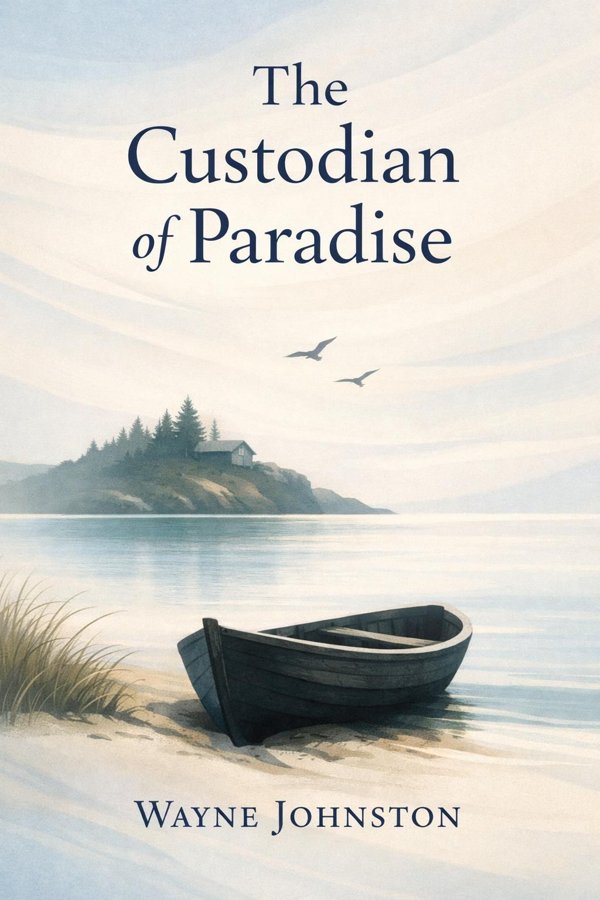
The Custodian of Paradise: Summary & Key Insights
 10 min8 chaptersAudio available
Key Takeaways from The Custodian of Paradise
Exile is rarely just a change of place; more often, it is a structure built from memory, shame, and the desperate need for distance.
A reputation can outlive truth, and a city never forgets the stories it enjoys telling about its outcasts.
Solitude becomes most revealing when it is interrupted.
The body keeps a stricter record than memory.
Redemption rarely arrives as innocence regained; more often, it begins when a person becomes willing to guard what remains.
What Is The Custodian of Paradise About?
The Custodian of Paradise by Wayne Johnston is a bestsellers book spanning 5 pages. What happens when a person withdraws from the world not to disappear, but to face everything that once made life unbearable? In The Custodian of Paradise, Wayne Johnston returns to one of his most unforgettable characters, Sheilagh Fielding, and places her on a remote island off Newfoundland, where solitude becomes both punishment and possibility. Living in physical isolation and marked by illness, age, addiction, and memory, Sheilagh looks backward over a turbulent life shaped by scandal, love, political history, and deep emotional damage. What unfolds is not simply a survival story, but a fierce reckoning with identity. The novel matters because it transforms isolation into a searching meditation on how people narrate themselves after loss. It asks whether exile can become a kind of freedom, whether memory is a burden or a final refuge, and whether redemption is still possible for someone who has spent a lifetime resisting comfort. Johnston is uniquely suited to tell this story. One of Canada’s most accomplished novelists, he has built a body of work deeply rooted in Newfoundland’s history, language, weather, and contradictions. Here, those strengths converge in a haunting, intimate novel about the cost of self-invention and the endurance of the human spirit.
This FizzRead summary covers all 8 key chapters of The Custodian of Paradise in approximately 10 minutes, distilling the most important ideas, arguments, and takeaways from Wayne Johnston's work. Also available as an audio summary and Key Quotes Podcast.
The Custodian of Paradise
What happens when a person withdraws from the world not to disappear, but to face everything that once made life unbearable? In The Custodian of Paradise, Wayne Johnston returns to one of his most unforgettable characters, Sheilagh Fielding, and places her on a remote island off Newfoundland, where solitude becomes both punishment and possibility. Living in physical isolation and marked by illness, age, addiction, and memory, Sheilagh looks backward over a turbulent life shaped by scandal, love, political history, and deep emotional damage. What unfolds is not simply a survival story, but a fierce reckoning with identity.
The novel matters because it transforms isolation into a searching meditation on how people narrate themselves after loss. It asks whether exile can become a kind of freedom, whether memory is a burden or a final refuge, and whether redemption is still possible for someone who has spent a lifetime resisting comfort. Johnston is uniquely suited to tell this story. One of Canada’s most accomplished novelists, he has built a body of work deeply rooted in Newfoundland’s history, language, weather, and contradictions. Here, those strengths converge in a haunting, intimate novel about the cost of self-invention and the endurance of the human spirit.
Who Should Read The Custodian of Paradise?
This book is perfect for anyone interested in bestsellers and looking to gain actionable insights in a short read. Whether you're a student, professional, or lifelong learner, the key ideas from The Custodian of Paradise by Wayne Johnston will help you think differently.
- ✓Readers who enjoy bestsellers and want practical takeaways
- ✓Professionals looking to apply new ideas to their work and life
- ✓Anyone who wants the core insights of The Custodian of Paradise in just 10 minutes
Want the full summary?
Get instant access to this book summary and 100K+ more with Fizz Moment.
Get Free SummaryAvailable on App Store • Free to download
Key Chapters
Exile is rarely just a change of place; more often, it is a structure built from memory, shame, and the desperate need for distance. In The Custodian of Paradise, Sheilagh Fielding’s move to a remote Newfoundland island is not merely geographical. It is a deliberate rearrangement of her life, an attempt to control what can still be controlled after years of scandal, emotional injury, and bodily decline. The island is harsh, beautiful, and indifferent, which makes it the perfect setting for a woman who has stopped expecting mercy from the world.
Johnston uses Fielding’s retreat to show that isolation can hold opposite meanings at once. It can be self-protection, self-punishment, and self-discovery. On the island, Sheilagh is cut off from the demands and humiliations of society, but she is also trapped with the past she hoped distance might soften. Her daily routines, her observations of the weather, and her management of limited resources reveal exile as something practical as well as psychological. To live apart, one must construct new habits strong enough to hold back despair.
This idea has wide relevance beyond the novel. People often withdraw after grief, burnout, or public failure, hoping a new environment will heal them. The book reminds us that changing location may create clarity, but it does not erase inner conflict. Solitude can be restorative only when it becomes reflective rather than avoidant.
Actionable takeaway: When you feel the urge to retreat, ask yourself whether you are creating space to understand your life or simply building a more elegant hiding place.
A reputation can outlive truth, and a city never forgets the stories it enjoys telling about its outcasts. Sheilagh Fielding’s memories of St. John’s form one of the novel’s emotional backbones, revealing how a strong-willed woman becomes both legend and target. Johnston does not present her past as a neat chain of events. Instead, memory arrives in flashes, arguments, humiliations, and unresolved attachments. This fragmented method mirrors how people actually revisit formative experience: not as orderly history, but as recurring pressure points.
Through these recollections, we see the making of Fielding’s public and private self. She is brilliant, unruly, self-destructive, and resistant to convention. The very qualities that make her vivid also make her scandalous in the eyes of a judgmental society. Johnston uses her story to explore the gendered cost of nonconformity. Men are often forgiven eccentricity or excess; women are more likely to be reduced to cautionary tales.
The novel also demonstrates how place shapes identity. St. John’s is not a passive backdrop but a social machine of gossip, class expectations, political loyalties, and inherited grievances. Fielding’s memories show how deeply communities can wound those who fail to fit their preferred narrative.
In ordinary life, many readers will recognize this tension between self-definition and social labeling. Families, workplaces, and communities create simplified versions of people, often clinging to old judgments long after circumstances change.
Actionable takeaway: Notice where your identity is being written by other people’s stories, and begin reclaiming it by naming the version of yourself that feels truest.
Solitude becomes most revealing when it is interrupted. One of the novel’s most compelling tensions comes from the appearance, or possibility, of a visitor in Sheilagh’s isolated world. On a remote island, even the smallest intrusion carries enormous weight. A knock, a sighting, a rumor, or an unexplained presence can alter the emotional climate as dramatically as a storm. Johnston uses this disturbance to examine how fragile our private fortresses really are.
The visitor matters not only as plot but as symbol. For someone who has chosen or accepted isolation, another person represents danger and rescue at once. Human contact threatens the stories we have told ourselves about independence. It can force old loyalties, unresolved grief, or hidden guilt back into consciousness. Sheilagh’s responses to intrusion reveal how deeply ambivalent she is about being known. She resists dependence, yet she is not beyond longing.
This idea speaks to a broader truth: people who insist they need no one are often the most shaped by abandonment, betrayal, or disappointment. The novel refuses to romanticize total self-sufficiency. Instead, it suggests that even the fiercest autonomy exists in relation to others, whether those others are present, absent, or imagined.
In practical terms, the “visitor” can be understood as any event that disrupts emotional isolation: a message from the past, an illness, an unexpected act of kindness, or a demand for accountability. Such moments can feel invasive, but they may also open a path toward honesty.
Actionable takeaway: When something or someone unsettles the distance you have built, pause before rejecting it; disruption sometimes reveals the healing your routines have been designed to avoid.
The body keeps a stricter record than memory. In The Custodian of Paradise, Sheilagh’s physical decline is not a secondary detail but a central reality. Age, illness, addiction, and fatigue shape her experience of the island as much as weather or terrain do. Johnston grounds the novel in the undeniable material facts of embodiment: the body weakens, habits take their toll, and even a formidable mind cannot negotiate forever with physical limits.
This makes the novel unusually powerful. Rather than treating suffering as abstract tragedy, it shows how decline affects ordinary tasks, perception, and self-respect. The island becomes a testing ground where bodily vulnerability cannot be disguised. Every movement costs something. Every decision about food, shelter, effort, and rest carries consequence. Sheilagh’s survival depends not on romantic resilience but on adapting to weakness without surrendering dignity.
Johnston also links bodily decline to emotional reckoning. The failing body strips away illusion. It reduces the space for performance and compels a more direct encounter with what remains unresolved. In this sense, physical hardship becomes a severe teacher. It reveals what matters, what can no longer be postponed, and what forms of pride have become destructive.
Readers can apply this insight in less extreme settings. Modern life often encourages denial of limitation, as if discipline alone could overpower exhaustion, grief, or aging. The novel argues for a harder but healthier wisdom: acceptance of frailty can deepen seriousness and compassion.
Actionable takeaway: Instead of treating your limits as personal failures, treat them as information that can help you live more honestly, choose more carefully, and value what still sustains you.
Redemption rarely arrives as innocence regained; more often, it begins when a person becomes willing to guard what remains. The title The Custodian of Paradise points to one of the novel’s deepest ideas: paradise is not a perfect place but a fragile condition of attention, responsibility, and meaning. Sheilagh does not stumble into peace through escape alone. She moves toward something like redemption by becoming a custodian, someone who witnesses, preserves, and tends to a world she once may have approached with more defiance than care.
Johnston’s version of redemption is unsentimental. There is no easy absolution for the past, no neat undoing of damage. Instead, reflection becomes active. Sheilagh reconsiders her life not to excuse herself but to understand its shape. That understanding allows a quieter transformation. She cannot become another person, but she can inhabit her remaining life with greater lucidity.
The concept of custodianship expands beyond the island. It includes stewardship of memory, language, and moral truth. To become a custodian is to stop treating life as something to conquer or flee and start treating it as something entrusted to you, however briefly. This has practical relevance for anyone recovering from a period of self-destruction, estrangement, or regret. Repair often begins not with grand gestures but with attentive care for one place, one relationship, or one task.
Actionable takeaway: If you are seeking redemption, begin by asking what in your life now needs tending rather than escaping, and commit to caring for it with steadier attention.
Memory can preserve us, but it can also imprison us in rooms we keep rebuilding. Johnston makes memory the true landscape of the novel. The island may be remote, but Sheilagh is never far from the people, scenes, humiliations, and passions that shaped her. Her recollections are not passive flashbacks. They are acts of interpretation, self-defense, revision, and confession. Through them, the novel asks a difficult question: when we remember our lives, are we discovering truth, or arranging a version we can bear?
Sheilagh’s voice gives this theme unusual force. She is intelligent enough to detect the unreliability of her own narrative, yet proud enough to resist full surrender to anyone else’s. This tension makes memory both intimate and unstable. The past offers continuity, but it also threatens to become a closed circuit in which the same injuries are replayed without release.
The novel’s insight applies directly to everyday life. People often return mentally to defining moments, especially those involving shame, loss, or missed chances. Such reflection can produce understanding, but it can also deepen fixation. The difference lies in whether memory opens perspective or merely reinforces a grievance.
Johnston suggests that mature reflection requires holding competing truths at once: what happened, what it felt like, and what we may still be refusing to see. That kind of remembering is painful, but it is less distorting than nostalgia or bitterness.
Actionable takeaway: The next time you revisit a painful memory, ask not only what others did to you, but also what story you have been repeating about yourself and whether it is time to revise it.
Some novels use setting as scenery; this one uses it as judgment, witness, and companion. Newfoundland in The Custodian of Paradise is not merely where events occur. Its fog, salt air, isolation, rough coastlines, and historical weight shape the consciousness of the novel. Johnston’s great gift is to make landscape feel inseparable from identity. The environment is never decorative. It presses on every choice, every mood, every act of endurance.
This is especially important for understanding Sheilagh. Her personality matches the place in crucial ways: severe, unsentimental, resilient, and difficult to possess. The island she inhabits sharpens the novel’s moral atmosphere. Beauty exists, but never without exposure. Survival requires alertness. Comfort is temporary. The land and sea do not care whether one deserves mercy, which gives the story its bracing honesty.
Johnston also draws on Newfoundland’s cultural specificity to deepen universal themes. Questions of belonging, historical burden, local memory, and marginal identity gain texture because they are rooted in a place with a distinct social and political history. Readers need not know Newfoundland intimately to feel the force of its presence; indeed, the novel invites them to see how place itself can become a repository of grief and meaning.
Practically, this idea encourages readers to think about how their own environments shape them. Cities, coastlines, neighborhoods, and homes carry emotional scripts. They influence what we notice, fear, remember, and aspire to.
Actionable takeaway: Reflect on one place that has most shaped you, and identify which parts of your character are genuinely yours and which were formed in response to that place’s demands.
Strength becomes dangerous when it hardens into refusal. Sheilagh Fielding is memorable partly because she is so fiercely independent. She resists pity, convention, and control with uncommon intensity. Johnston admires this toughness, but he also examines its cost. The novel asks whether defiance, once necessary for survival, can become a habit that prevents tenderness, help, or change.
Sheilagh’s pride is not vanity in a shallow sense. It is a disciplined refusal to be diminished by a world that has misread and judged her. Yet the same pride contributes to her isolation. It keeps her from easy reconciliation and may even distort the way she understands care. If dependence feels humiliating, then human connection itself becomes risky. Johnston’s portrait is compassionate because it recognizes that difficult traits often begin as forms of protection.
This theme resonates strongly beyond literature. Many capable people build identities around self-sufficiency, especially after betrayal or disappointment. They become the person who needs nothing, asks for nothing, and reveals little. Such strength is admired, but it can quietly produce loneliness and emotional rigidity. The novel does not argue for sentimentality. It argues for discernment: knowing when pride preserves dignity and when it obstructs life.
Readers can apply this by examining where resistance has become automatic. Are you declining support because it is unhelpful, or because accepting it would challenge the version of yourself you have learned to defend?
Actionable takeaway: Identify one area where your pride may be costing you connection, and experiment with a small act of honest vulnerability rather than another performance of total control.
All Chapters in The Custodian of Paradise
About the Author
Wayne Johnston is a celebrated Canadian novelist born in Goulds, Newfoundland, in 1958. He is best known for fiction that explores Newfoundland’s history, politics, geography, and emotional life with unusual intensity and precision. His major works include The Story of Bobby O’Malley, Baltimore’s Mansion, The Colony of Unrequited Dreams, and The Navigator of New York. Johnston’s writing is marked by richly realized settings, psychologically complex characters, and a deep interest in how identity is shaped by place, memory, and public history. He has earned a wide readership in Canada and internationally for his ability to combine literary depth with strong narrative voice. In The Custodian of Paradise, he returns to Sheilagh Fielding, one of his most compelling creations, and confirms his reputation as one of Newfoundland’s essential literary interpreters.
Get This Summary in Your Preferred Format
Read or listen to the The Custodian of Paradise summary by Wayne Johnston anytime, anywhere. FizzRead offers multiple formats so you can learn on your terms — all free.
Available formats: App · Audio · PDF · EPUB — All included free with FizzRead
Download The Custodian of Paradise PDF and EPUB Summary
Key Quotes from The Custodian of Paradise
“Exile is rarely just a change of place; more often, it is a structure built from memory, shame, and the desperate need for distance.”
“A reputation can outlive truth, and a city never forgets the stories it enjoys telling about its outcasts.”
“Solitude becomes most revealing when it is interrupted.”
“The body keeps a stricter record than memory.”
“Redemption rarely arrives as innocence regained; more often, it begins when a person becomes willing to guard what remains.”
Frequently Asked Questions about The Custodian of Paradise
The Custodian of Paradise by Wayne Johnston is a bestsellers book that explores key ideas across 8 chapters. What happens when a person withdraws from the world not to disappear, but to face everything that once made life unbearable? In The Custodian of Paradise, Wayne Johnston returns to one of his most unforgettable characters, Sheilagh Fielding, and places her on a remote island off Newfoundland, where solitude becomes both punishment and possibility. Living in physical isolation and marked by illness, age, addiction, and memory, Sheilagh looks backward over a turbulent life shaped by scandal, love, political history, and deep emotional damage. What unfolds is not simply a survival story, but a fierce reckoning with identity. The novel matters because it transforms isolation into a searching meditation on how people narrate themselves after loss. It asks whether exile can become a kind of freedom, whether memory is a burden or a final refuge, and whether redemption is still possible for someone who has spent a lifetime resisting comfort. Johnston is uniquely suited to tell this story. One of Canada’s most accomplished novelists, he has built a body of work deeply rooted in Newfoundland’s history, language, weather, and contradictions. Here, those strengths converge in a haunting, intimate novel about the cost of self-invention and the endurance of the human spirit.
More by Wayne Johnston
You Might Also Like

The Godfather
Mario Puzo
10 min
The Handmaid's Tale
Margaret Atwood
10 min
The Hunger Games
Suzanne Collins
10 min
The Nightingale
Kristin Hannah
10 min
The Seven Husbands of Evelyn Hugo
Taylor Jenkins Reid
10 min
Backwater Justice
Fern Michaels
10 minBrowse by Category
Ready to read The Custodian of Paradise?
Get the full summary and 100K+ more books with Fizz Moment.