
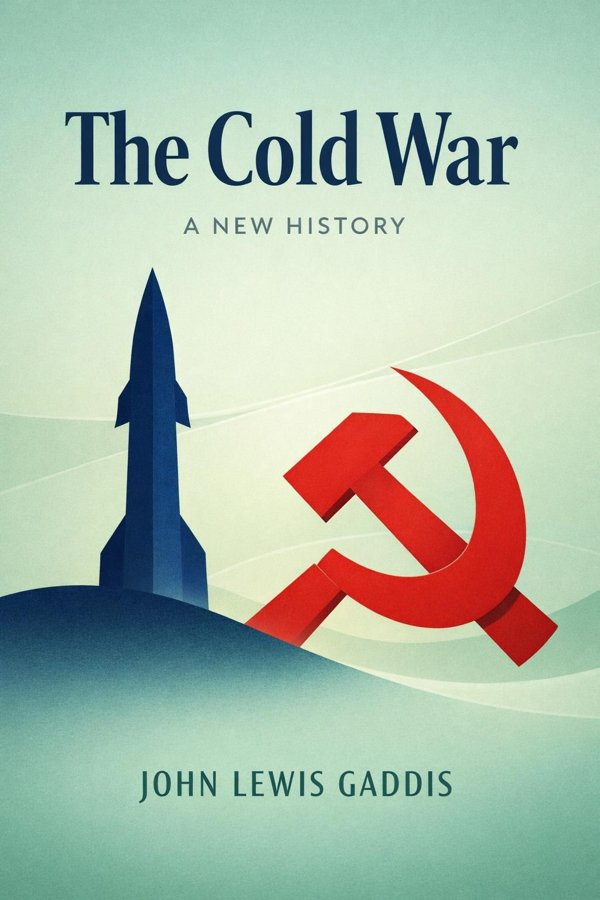
The Cold War: A New History: Summary & Key Insights
 10 min10 chaptersAudio available
Key Takeaways from The Cold War: A New History
Great conflicts often begin before anyone admits that they have started.
History is driven by systems, but sometimes a single leader hardens those systems into confrontation.
Sometimes the most influential strategy is not a blueprint for victory but a disciplined way of avoiding disaster.
The most dangerous feature of the Cold War was also what helped keep it cold.
What began as a struggle over Europe quickly spread across the world.
What Is The Cold War: A New History About?
The Cold War: A New History by John Lewis Gaddis is a world_history book spanning 11 pages. The Cold War: A New History is John Lewis Gaddis’s concise but powerful interpretation of one of the most consequential conflicts in modern history. Rather than treating the Cold War as a simple sequence of diplomatic standoffs, Gaddis presents it as a global struggle between rival political systems, strategic visions, and ideas about human freedom, order, and power. The book follows the story from the uneasy aftermath of World War II to the collapse of the Soviet Union, showing how fear, ideology, leadership, nuclear weapons, and miscalculation shaped nearly half a century of international politics. What makes this book especially valuable is its clarity. Gaddis distills a vast and complicated period into a readable narrative without flattening its complexity. He explains why the Cold War began, why it spread far beyond Europe, why it so often threatened catastrophe, and why it ended without the superpower war many had feared. As one of the world’s foremost Cold War historians and a longtime Yale professor, Gaddis brings deep scholarly authority to the subject. This is an essential book for readers who want to understand how the twentieth century was transformed—and why the Cold War still shapes the world today.
This FizzRead summary covers all 10 key chapters of The Cold War: A New History in approximately 10 minutes, distilling the most important ideas, arguments, and takeaways from John Lewis Gaddis's work. Also available as an audio summary and Key Quotes Podcast.
The Cold War: A New History
The Cold War: A New History is John Lewis Gaddis’s concise but powerful interpretation of one of the most consequential conflicts in modern history. Rather than treating the Cold War as a simple sequence of diplomatic standoffs, Gaddis presents it as a global struggle between rival political systems, strategic visions, and ideas about human freedom, order, and power. The book follows the story from the uneasy aftermath of World War II to the collapse of the Soviet Union, showing how fear, ideology, leadership, nuclear weapons, and miscalculation shaped nearly half a century of international politics.
What makes this book especially valuable is its clarity. Gaddis distills a vast and complicated period into a readable narrative without flattening its complexity. He explains why the Cold War began, why it spread far beyond Europe, why it so often threatened catastrophe, and why it ended without the superpower war many had feared. As one of the world’s foremost Cold War historians and a longtime Yale professor, Gaddis brings deep scholarly authority to the subject. This is an essential book for readers who want to understand how the twentieth century was transformed—and why the Cold War still shapes the world today.
Who Should Read The Cold War: A New History?
This book is perfect for anyone interested in world_history and looking to gain actionable insights in a short read. Whether you're a student, professional, or lifelong learner, the key ideas from The Cold War: A New History by John Lewis Gaddis will help you think differently.
- ✓Readers who enjoy world_history and want practical takeaways
- ✓Professionals looking to apply new ideas to their work and life
- ✓Anyone who wants the core insights of The Cold War: A New History in just 10 minutes
Want the full summary?
Get instant access to this book summary and 100K+ more with Fizz Moment.
Get Free SummaryAvailable on App Store • Free to download
Key Chapters
Great conflicts often begin before anyone admits that they have started. Gaddis shows that the Cold War did not emerge from a single event but from the collapse of the wartime alliance after 1945. The United States, Britain, and the Soviet Union had cooperated to defeat Nazi Germany, but their partnership was built on necessity, not trust. Once that common enemy disappeared, deeper tensions surfaced. The Western powers favored pluralism, open markets, and political self-determination, while the Soviet Union pursued centralized control, one-party rule, and strategic domination of its borderlands.
Gaddis emphasizes that the roots of the conflict lay in both ideology and insecurity. Each side believed its system was morally superior, but each also feared encirclement and betrayal. The Soviet Union had been invaded repeatedly from the West and wanted a buffer zone in Eastern Europe. The United States, meanwhile, saw Soviet expansion as a threat to balance, liberty, and postwar reconstruction. Mutual suspicion turned disagreement into confrontation.
This framework helps explain why the Cold War became so durable. It was not merely a contest over territory; it was a clash over how societies should be organized and how international order should work. In practical terms, readers can use this lens to understand why modern rivalries also combine security fears with competing political values. Nations rarely act from one motive alone.
Actionable takeaway: When analyzing any geopolitical conflict, look for the interaction between ideas, fear, and power—not just the trigger event.
History is driven by systems, but sometimes a single leader hardens those systems into confrontation. One of Gaddis’s central arguments is that Joseph Stalin was indispensable to the origins of the Cold War. Stalin was not simply protecting Soviet security in a cautious, defensive way. He governed through suspicion, coercion, secrecy, and ideological rigidity, and these traits shaped Soviet behavior across Eastern Europe and beyond.
Gaddis argues that Stalin’s worldview made compromise extraordinarily difficult. He did not trust independent centers of power, whether in neighboring states or within his own alliance. As a result, countries liberated from Nazi rule were not allowed to evolve politically on their own terms. Instead, the Soviet Union imposed compliant regimes, suppressed opposition, and treated Eastern Europe as a controlled strategic zone. To Western observers, this looked less like defense and more like expansion.
The significance of this argument is that it restores agency to individuals without ignoring larger forces. Not every Soviet leader would have acted exactly as Stalin did. His methods deepened the divide and helped persuade American policymakers that accommodation was unlikely to succeed. A practical lesson here extends beyond history: institutions matter, but leaders can intensify danger through paranoia, absolutism, and refusal to tolerate ambiguity.
For contemporary readers, this idea can be applied when evaluating states today. Ask not only what a regime wants, but how its leader perceives risk, opposition, and legitimacy. Personality can alter the trajectory of entire systems.
Actionable takeaway: In assessing major political conflicts, examine leadership psychology alongside ideology and national interests.
Sometimes the most influential strategy is not a blueprint for victory but a disciplined way of avoiding disaster. Gaddis explains how the United States gradually moved from wartime cooperation with the Soviet Union to a long-term policy of containment. Associated above all with George Kennan, containment rested on the belief that Soviet power was real but limited, and that patient resistance to expansion would eventually expose the weaknesses of the communist system.
This was a crucial shift. Instead of seeking immediate rollback everywhere, American strategy aimed to prevent further Soviet gains in key areas. The Truman Doctrine, Marshall Plan, and formation of NATO reflected this logic. Economic aid mattered as much as military power. Rebuilding Western Europe was not only a humanitarian project; it was a strategic effort to strengthen societies against communist influence and political collapse.
Gaddis also shows that containment evolved over time. It was never a perfectly consistent doctrine. Some policymakers applied it selectively; others expanded it globally. At its best, it balanced firmness with restraint. At its worst, it justified overreach in regions where local conflicts were poorly understood. That ambiguity remains relevant today. Grand strategy often sounds clear in theory but becomes messy in practice.
Readers can apply this lesson in decision-making beyond foreign policy. Strong strategies often require patience, prioritization, and realistic limits. Trying to solve every problem at once usually weakens effectiveness.
Actionable takeaway: Build strategy around long-term endurance and clear priorities, rather than reactive attempts to confront every threat everywhere.
The most dangerous feature of the Cold War was also what helped keep it cold. Gaddis explains that nuclear weapons transformed international politics by making total war between the superpowers potentially suicidal. Unlike previous eras, military superiority could no longer guarantee usable victory. Once both the United States and the Soviet Union possessed secure second-strike capabilities, deterrence became central to survival.
This nuclear dimension created a paradox. The arms race intensified fear, consumed enormous resources, and brought the world repeatedly to the brink of catastrophe. Yet the same destructive power imposed caution on leaders who understood that escalation could become irreversible. Strategy was no longer only about winning battles; it was about signaling resolve, managing perception, and preventing miscalculation.
Gaddis presents the Cold War as a period in which stability depended on irrationally destructive weapons being handled with rational restraint. This is one reason crises like Berlin and Cuba mattered so much: both sides were constantly testing limits without knowing exactly where those limits were. Practical examples include arms control talks, hotlines, and confidence-building measures, all designed to reduce the risk of accidental war.
For modern readers, this chapter offers a broader insight into high-stakes systems. When consequences are extreme, communication and risk management become as important as force. Whether in diplomacy, finance, or technology, systems with catastrophic downside demand humility and safeguards.
Actionable takeaway: In any high-risk environment, prioritize clear communication, redundancy, and escalation control over short-term displays of strength.
What began as a struggle over Europe quickly spread across the world. Gaddis shows that the Cold War cannot be understood as a narrow U.S.-Soviet rivalry confined to Berlin, Moscow, and Washington. It became global because decolonization, revolution, civil war, and state-building opened political space across Asia, Africa, Latin America, and the Middle East. Local actors pursued their own goals, but the superpowers often interpreted those conflicts through ideological lenses.
This expansion changed the nature of the confrontation. The Korean War, the Vietnam conflict, the Middle East crises, Cuba, Afghanistan, and numerous African struggles revealed that the Cold War was never only about direct superpower competition. It was also about influence in newly independent or unstable regions. Yet Gaddis is careful to show that local leaders were not merely pawns. Many exploited superpower rivalry to secure aid, weapons, legitimacy, or strategic protection.
This matters because it complicates simplistic narratives. Not every anti-colonial movement was Soviet-controlled, and not every alliance with the United States represented democracy. The global Cold War mixed idealism, opportunism, fear, and local grievance. Readers can use this framework to better understand how major powers still project their rivalries into regional conflicts today.
A practical application is to resist viewing international events only from the perspective of great powers. Regional history, domestic politics, and local ambitions often determine outcomes more than superpower plans do.
Actionable takeaway: Whenever a major power intervenes abroad, analyze the local conflict on its own terms before accepting the global narrative built around it.
The Cold War was sustained tension, but its defining moments were sudden crises when misjudgment could have destroyed everything. Gaddis highlights flashpoints such as Berlin and especially the Cuban Missile Crisis to show how close the superpowers came to catastrophe. These crises were not just tests of military capacity; they were tests of perception, communication, and emotional control.
The Cuban Missile Crisis is particularly important in Gaddis’s account because it revealed both the recklessness and restraint built into Cold War politics. Nikita Khrushchev’s decision to place missiles in Cuba was a bold attempt to alter the strategic balance and political psychology of the rivalry. John F. Kennedy’s response had to combine firmness with caution. Too weak a reaction would damage credibility; too aggressive a reaction might trigger nuclear war.
What emerges is a lesson in leadership under pressure. Successful crisis management did not mean avoiding danger altogether. It meant creating off-ramps, maintaining communication, and recognizing the other side’s need to save face. This remains relevant in every domain where escalation can outrun intentions. In organizations, markets, or international disputes, crises often worsen when leaders become trapped by pride, public posturing, or false certainty.
Gaddis reminds readers that peaceful outcomes can depend less on perfect planning than on the ability to adapt quickly, absorb ambiguity, and accept compromise when stakes are existential.
Actionable takeaway: In moments of confrontation, focus on preserving options and de-escalation channels rather than forcing immediate total victory.
The Cold War was fought not only with armies and treaties but with promises about how ordinary people should live. Gaddis shows that ideological competition penetrated domestic politics, culture, education, economics, and even consumer life. The United States portrayed itself as the defender of freedom, prosperity, and individual opportunity. The Soviet Union presented itself as the champion of equality, anti-imperialism, and historical progress. Each side tried to prove the superiority of its system not just abroad, but at home.
This produced intense internal consequences. In the United States, anti-communism shaped elections, loyalty programs, military spending, and public culture, at times generating fear-driven excesses such as McCarthyism. In the Soviet bloc, the need to preserve ideological purity justified censorship, surveillance, repression, and the suppression of dissent. Scientific achievement, space exploration, sports, and industrial output all became symbolic battlegrounds.
Gaddis helps readers see that geopolitical rivalries often reshape domestic institutions. Foreign threats can consolidate political authority, justify exceptional policies, and redefine national identity. We still see similar patterns when governments invoke external dangers to strengthen internal control or rally public unity.
A practical application is to examine how national narratives are built. Citizens should ask how international competition influences what they are told about security, sacrifice, and belonging. The Cold War demonstrates that propaganda works best when it merges external conflict with personal meaning.
Actionable takeaway: Pay attention to how governments use foreign rivalry to shape domestic priorities, fears, and ideas about citizenship.
Periods of reduced tension can be mistaken for lasting settlement. Gaddis argues that détente in the 1960s and 1970s was important, but limited. After repeated crises and mounting costs, both superpowers had strong reasons to stabilize their relationship. Arms control agreements, summit diplomacy, and more predictable communication reflected a shared interest in reducing immediate danger. Détente acknowledged that coexistence was preferable to confrontation.
Yet Gaddis also shows why détente never fully solved the deeper conflict. The ideological rivalry persisted, regional competition continued, and both sides interpreted restraint differently. For some Americans, détente looked like realism and prudence. For others, it appeared to legitimize Soviet gains without changing Soviet behavior. Meanwhile, the Soviet leadership often saw strategic parity as confirmation that their system remained globally competitive.
This tension matters because it reveals the limits of diplomacy when underlying political assumptions remain unreconciled. Agreements can manage rivalry without ending it. That is often still the best available outcome, but it should not be confused with trust. The same pattern appears in business negotiations, labor disputes, and long-running political conflicts: reduced friction is valuable, but unresolved fundamentals can reemerge.
Gaddis treats détente as a necessary pause, not a final answer. It bought time, reduced some risks, and created useful habits of communication, but it could not compensate for stagnation within the Soviet system or for ongoing geopolitical competition.
Actionable takeaway: Value temporary cooperation, but always distinguish between managing conflict and actually resolving its root causes.
One of the most striking facts about the Cold War is that it ended not with the superpower war many feared, but with the internal unraveling of one side. Gaddis explains that the final phase of the Cold War cannot be understood without considering both renewed Western pressure and transformative Soviet leadership. Ronald Reagan initially intensified confrontation through military buildup and strong anti-Soviet rhetoric, but he also became more flexible when genuine openings appeared. Mikhail Gorbachev, in turn, sought to reform a stagnant Soviet system through glasnost and perestroika, only to discover that meaningful reform would weaken the foundations of Soviet power itself.
Gaddis presents Gorbachev as the pivotal figure in the Cold War’s peaceful end. Unlike earlier Soviet leaders, he was willing to loosen coercive control in Eastern Europe and reconsider the assumptions that had sustained the rivalry. Once Moscow stopped enforcing empire by force, communist regimes across Eastern Europe collapsed with astonishing speed. The Soviet Union itself soon followed.
The broader lesson is that systems often look strongest shortly before they fail. External pressure mattered, but internal legitimacy mattered more. A regime can survive hardship for a long time; it struggles to survive when its elites lose confidence and its citizens stop believing in its purpose.
This insight applies widely. Organizations, governments, and institutions rarely collapse only because of outside attack. They collapse when internal reform becomes unavoidable but incompatible with existing structures.
Actionable takeaway: To understand whether a powerful system can endure, examine its capacity for self-correction, not just its visible strength.
The Cold War did not end in 1991 so much as it changed form. Gaddis concludes by showing that its legacy lives on in alliances, military doctrines, political memories, and global institutions. NATO survived and expanded. Nuclear deterrence remains central to international security. Regional conflicts once shaped by Cold War alignments left behind unstable states, militarized politics, and contested historical narratives. Even the language of freedom, containment, spheres of influence, and credibility continues to influence policy debates.
Just as important is the moral and intellectual legacy. The Cold War forced generations to think about how free societies defend themselves without abandoning their principles, how ideological certainty distorts judgment, and how fear can both discipline and damage democracies. It also raised enduring questions about intervention: when should powerful states resist aggression, and when do they worsen conflicts they only partially understand?
For readers today, Gaddis offers more than a historical account. He provides a framework for recognizing recurring patterns in international life: rival systems, arms races, proxy struggles, propaganda, and the tension between realism and moral purpose. The Cold War remains a usable past because its dilemmas have not disappeared.
A practical example is current debate about major-power rivalry in the twenty-first century. While circumstances differ, the need for strategic patience, alliance management, institutional resilience, and clear-eyed understanding remains familiar.
Actionable takeaway: Study the Cold War not as a closed chapter, but as a guide to managing long-term rivalry without surrendering judgment or principle.
All Chapters in The Cold War: A New History
About the Author
John Lewis Gaddis is an American historian, author, and professor widely regarded as one of the foremost scholars of the Cold War. He taught for many years at Yale University, where he became known for his influential work on international history, grand strategy, and U.S. foreign policy. Gaddis has written several major books on the origins, conduct, and end of the Cold War, earning a reputation for combining deep archival research with clear, elegant prose. His scholarship has shaped both academic debate and public understanding of twentieth-century geopolitics. In addition to his work on the Cold War, he has written on strategic thinking and statesmanship, including a notable biography of George F. Kennan. Gaddis is admired for making complex historical questions accessible without losing intellectual rigor.
Get This Summary in Your Preferred Format
Read or listen to the The Cold War: A New History summary by John Lewis Gaddis anytime, anywhere. FizzRead offers multiple formats so you can learn on your terms — all free.
Available formats: App · Audio · PDF · EPUB — All included free with FizzRead
Download The Cold War: A New History PDF and EPUB Summary
Key Quotes from The Cold War: A New History
“Great conflicts often begin before anyone admits that they have started.”
“History is driven by systems, but sometimes a single leader hardens those systems into confrontation.”
“Sometimes the most influential strategy is not a blueprint for victory but a disciplined way of avoiding disaster.”
“The most dangerous feature of the Cold War was also what helped keep it cold.”
“What began as a struggle over Europe quickly spread across the world.”
Frequently Asked Questions about The Cold War: A New History
The Cold War: A New History by John Lewis Gaddis is a world_history book that explores key ideas across 10 chapters. The Cold War: A New History is John Lewis Gaddis’s concise but powerful interpretation of one of the most consequential conflicts in modern history. Rather than treating the Cold War as a simple sequence of diplomatic standoffs, Gaddis presents it as a global struggle between rival political systems, strategic visions, and ideas about human freedom, order, and power. The book follows the story from the uneasy aftermath of World War II to the collapse of the Soviet Union, showing how fear, ideology, leadership, nuclear weapons, and miscalculation shaped nearly half a century of international politics. What makes this book especially valuable is its clarity. Gaddis distills a vast and complicated period into a readable narrative without flattening its complexity. He explains why the Cold War began, why it spread far beyond Europe, why it so often threatened catastrophe, and why it ended without the superpower war many had feared. As one of the world’s foremost Cold War historians and a longtime Yale professor, Gaddis brings deep scholarly authority to the subject. This is an essential book for readers who want to understand how the twentieth century was transformed—and why the Cold War still shapes the world today.
More by John Lewis Gaddis
You Might Also Like
The Age of Capital
Eric Hobsbawm
10 min
The Gulag Archipelago
Aleksandr Solzhenitsyn
10 min
Jerusalem: The Biography
Simon Sebag Montefiore
10 min
The Anglo-Saxons
James Campbell
10 min
The Boer War
Thomas Pakenham
10 min
The Industrial Revolutionaries: The Making of the Modern World 1776–1914
Gavin Weightman
10 minBrowse by Category
Ready to read The Cold War: A New History?
Get the full summary and 100K+ more books with Fizz Moment.