
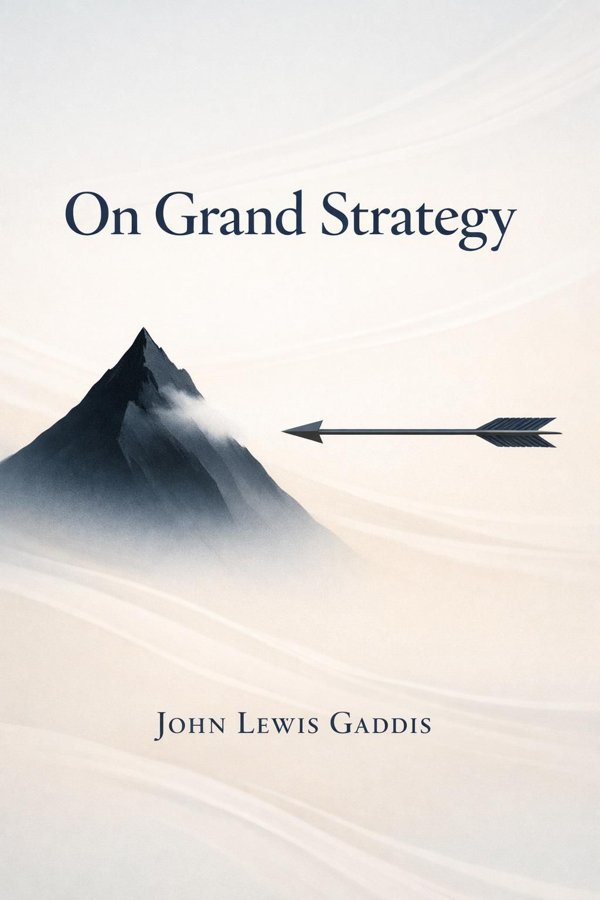
On Grand Strategy: Summary & Key Insights
 10 min8 chaptersAudio available
Key Takeaways from On Grand Strategy
Great failures often begin with a mismatch between what people want and what they can actually do.
Strategy collapses when it is built on illusions.
Some of the most decisive battles in strategy are fought within the strategist.
The paradox of strategy is that the more complex the world becomes, the less useful inflexible plans are.
Without perspective, leaders confuse the urgent with the important.
What Is On Grand Strategy About?
On Grand Strategy by John Lewis Gaddis is a strategy book. What separates people who shape events from those who are overwhelmed by them? In On Grand Strategy, historian John Lewis Gaddis explores that question through a rich blend of history, philosophy, literature, and statecraft. Rather than offering a rigid formula, Gaddis examines how leaders align large ambitions with limited resources, uncertain information, and changing circumstances. Drawing on thinkers and figures ranging from Sun Tzu, Augustine, and Machiavelli to Lincoln, Xerxes, and Isaiah Berlin, he shows that strategy is not just for generals or presidents. It is a way of thinking about life, leadership, conflict, and decision-making. The book matters because it treats strategy as a timeless human challenge: balancing ends and means without losing sight of either. Gaddis, one of America’s most respected historians and a leading scholar of international relations, brings exceptional authority to the subject. His teaching at Yale’s famous grand strategy program informs the book’s accessible yet profound style. The result is a thoughtful guide to judgment under pressure, revealing how successful strategists combine vision, restraint, adaptability, and self-awareness in a world that rarely cooperates with our plans.
This FizzRead summary covers all 8 key chapters of On Grand Strategy in approximately 10 minutes, distilling the most important ideas, arguments, and takeaways from John Lewis Gaddis's work. Also available as an audio summary and Key Quotes Podcast.
On Grand Strategy
What separates people who shape events from those who are overwhelmed by them? In On Grand Strategy, historian John Lewis Gaddis explores that question through a rich blend of history, philosophy, literature, and statecraft. Rather than offering a rigid formula, Gaddis examines how leaders align large ambitions with limited resources, uncertain information, and changing circumstances. Drawing on thinkers and figures ranging from Sun Tzu, Augustine, and Machiavelli to Lincoln, Xerxes, and Isaiah Berlin, he shows that strategy is not just for generals or presidents. It is a way of thinking about life, leadership, conflict, and decision-making.
The book matters because it treats strategy as a timeless human challenge: balancing ends and means without losing sight of either. Gaddis, one of America’s most respected historians and a leading scholar of international relations, brings exceptional authority to the subject. His teaching at Yale’s famous grand strategy program informs the book’s accessible yet profound style. The result is a thoughtful guide to judgment under pressure, revealing how successful strategists combine vision, restraint, adaptability, and self-awareness in a world that rarely cooperates with our plans.
Who Should Read On Grand Strategy?
This book is perfect for anyone interested in strategy and looking to gain actionable insights in a short read. Whether you're a student, professional, or lifelong learner, the key ideas from On Grand Strategy by John Lewis Gaddis will help you think differently.
- ✓Readers who enjoy strategy and want practical takeaways
- ✓Professionals looking to apply new ideas to their work and life
- ✓Anyone who wants the core insights of On Grand Strategy in just 10 minutes
Want the full summary?
Get instant access to this book summary and 100K+ more with Fizz Moment.
Get Free SummaryAvailable on App Store • Free to download
Key Chapters
Great failures often begin with a mismatch between what people want and what they can actually do. One of Gaddis’s central insights is that grand strategy depends on aligning ends with means. Ambition alone is not strategy. Resources, time, political support, geography, information, and human limits all shape what is possible. When leaders ignore those constraints, they drift into fantasy, overreach, or ruin.
Gaddis illustrates this through historical contrasts. Some leaders pursued objectives so expansive that they exhausted their states and lost everything. Others understood that a durable victory requires proportion. This is why grand strategy is not simply about boldness. It is about disciplined ambition. Leaders must ask not only, “What do I want?” but also, “What can I sustain?” and “What trade-offs will this require?”
This principle applies far beyond war and diplomacy. A company that expands into too many markets at once can strain talent and capital. A manager who promises every stakeholder everything may end up delivering little to anyone. Even in personal life, people fail when their goals exceed their time, energy, or emotional capacity. Strategic success requires choosing priorities and accepting limits.
Gaddis’s treatment is powerful because it reframes restraint as strength, not weakness. The best strategists do not confuse scale with seriousness. They know that selective focus can achieve more than scattered exertion. The question is never whether to have grand goals, but whether those goals can be matched by coherent action.
Actionable takeaway: Before committing to any major objective, list your desired ends, available means, and likely constraints. If they do not align, adjust the goal, gather more resources, or narrow the mission before moving forward.
Strategy collapses when it is built on illusions. Gaddis repeatedly emphasizes that effective grand strategists must perceive reality clearly, even when reality is inconvenient, disappointing, or politically costly. Wishful thinking is comforting in the short term, but it is destructive over time. Leaders who succeed are those who resist the urge to force facts to fit a preferred narrative.
This is where Gaddis draws on Isaiah Berlin’s famous contrast between the fox and the hedgehog. Hedgehogs interpret the world through one big idea; foxes absorb many details and adapt to complexity. Grand strategy, in Gaddis’s account, often requires a fox-like awareness of context. While overarching purpose matters, rigid ideological certainty can blind leaders to changing conditions.
In practical terms, this means constantly testing assumptions. Are competitors behaving as expected? Are incentives producing unintended consequences? Are allies still aligned? In business, a product team may become attached to a vision despite poor user adoption. In politics, governments may persist with failing policies because reversing course seems embarrassing. In personal decisions, people stay with dead-end plans simply because they have invested heavily in them.
Gaddis reminds us that reality does not reward sincerity; it rewards accuracy. Good strategists create systems for feedback, tolerate dissent, and revise their judgments when evidence changes. They distinguish between what they hope will happen and what is actually happening.
This does not mean abandoning conviction. It means grounding conviction in observation. Strategic clarity depends on seeing the terrain, the actors, and oneself without distortion. The strongest plans emerge when purpose is tempered by honest appraisal.
Actionable takeaway: Build a habit of reality checks. For any important plan, identify your top three assumptions and actively seek evidence that could disprove them before you proceed too far.
Some of the most decisive battles in strategy are fought within the strategist. Gaddis shows that judgment, patience, and emotional discipline are not soft virtues; they are core strategic assets. Leaders often fail not because they lack intelligence, but because they cannot master impulse, vanity, fear, or anger. A person who cannot govern himself will struggle to govern events.
This theme echoes through the thinkers and statesmen Gaddis discusses. Strategic wisdom requires the ability to pause, to distinguish provocation from necessity, and to delay gratification in service of larger goals. Impulsive reactions may feel strong, but they can lock leaders into conflicts they did not need, escalate costs unnecessarily, or destroy coalitions they depend upon.
In modern settings, emotional self-command matters everywhere. A CEO confronted by criticism can lash out publicly and worsen a crisis, or respond calmly and preserve trust. A team leader facing internal disagreement can punish dissent and silence useful information, or manage ego and invite better ideas. In personal life, reacting defensively in relationships often sacrifices long-term health for short-term emotional release.
Gaddis’s broader point is that strategic discipline creates freedom. When you are not controlled by immediate emotion, you can choose among options. You preserve room to maneuver. Self-restraint keeps objectives in view when circumstances try to drag attention elsewhere.
This kind of discipline is difficult because uncertainty creates anxiety, and anxiety invites rash action. Yet grand strategy depends on distinguishing urgent feelings from important priorities. To remain effective, leaders need routines, trusted advisors, and reflective habits that reduce the risk of impulsive decision-making.
Actionable takeaway: When facing a high-stakes decision, create a pause between stimulus and response. Delay major reactions long enough to ask: What outcome do I want in six months, and does my immediate impulse help or hurt that objective?
The paradox of strategy is that the more complex the world becomes, the less useful inflexible plans are. Gaddis argues that grand strategy is not a blueprint to be followed mechanically. It is a way of navigating uncertainty while keeping long-term purpose intact. Because circumstances change, effective strategists combine direction with adaptability.
History is full of elegant plans undone by unexpected events. Weather shifts, alliances fracture, technology evolves, public opinion changes, and adversaries behave creatively. Leaders who cling to a plan simply because it was once reasonable can turn manageable problems into disasters. Gaddis therefore favors strategic designs that preserve options, absorb shocks, and evolve through experience.
This has immediate relevance today. A startup may begin with a compelling business model only to discover that customer needs differ from expectations. The strategic response is not stubborn repetition but disciplined adaptation. A public institution rolling out reform may find that frontline realities differ from what headquarters imagined. In personal career planning, a long-term goal may remain valid while the route to it changes multiple times.
Gaddis does not advocate drifting without purpose. Flexibility is not indecision. It is the capacity to adjust methods without losing sight of ends. The strategist knows what must remain constant and what can change. That distinction is crucial. If everything is fixed, you become brittle. If everything is fluid, you lose coherence.
The best leaders therefore prepare for surprise. They create reserve capacity, encourage scenario thinking, and avoid commitments that eliminate alternatives too early. They understand that adaptation is not a concession to failure; it is often the essence of success.
Actionable takeaway: Define your non-negotiable objective, then identify at least three possible paths to reach it. Review those options regularly so you can adapt quickly when reality changes.
Without perspective, leaders confuse the urgent with the important. Gaddis highlights the strategist’s need to rise above immediate noise and see patterns across time, scale, and consequence. Grand strategy requires not only action but interpretation: the ability to place present decisions within a larger frame.
This is one reason Gaddis turns to history and literature rather than only military theory. Stories, biographies, and long historical arcs help us recognize recurring dilemmas. They reveal how short-term wins can produce long-term losses, how symbolic gestures can alter political realities, and how neglecting secondary effects can unravel apparent success. Perspective enables leaders to anticipate that every move echoes beyond the moment.
In practical settings, perspective helps people avoid reactive cycles. A company under quarterly pressure may cut investment in innovation and improve short-term numbers while undermining future competitiveness. A policymaker may adopt a dramatic measure that satisfies public anger but weakens institutions over time. An individual may chase prestige or busyness while neglecting the relationships and health that sustain long-term performance.
Gaddis’s strategic lesson is that distance improves judgment. This does not require detachment from reality. It requires the discipline to zoom in and zoom out. Strategic thinkers ask how today’s decision fits within a larger sequence, what second-order consequences might emerge, and whether immediate sacrifices support enduring aims.
Perspective also helps with proportion. Not every setback deserves escalation. Not every opportunity deserves pursuit. Some events matter because they signal structural change; others matter only because we let them dominate our attention.
Actionable takeaway: For any major decision, ask three framing questions: How will this look in one year, in five years, and from the viewpoint of those affected beyond my immediate circle? Let those answers shape your next move.
Power is rarely sustained by force alone. Gaddis shows that grand strategy depends on legitimacy, persuasion, and the stories leaders tell about their actions. People follow, endure, and sacrifice more willingly when they believe a cause is just, coherent, and meaningful. Strategy therefore includes moral and psychological dimensions, not just material ones.
This insight explains why some leaders achieve influence far beyond their raw capabilities, while others squander superior resources. If your allies do not trust your intentions, if your own people do not understand the purpose of sacrifice, or if your adversaries successfully define the narrative, then even strong material positions can erode. Strategic communication is not decoration after the fact; it is part of the strategy itself.
In contemporary life, this appears everywhere. Organizations that communicate change as a shared mission often gain buy-in that command-and-control directives cannot achieve. Political leaders who explain trade-offs honestly can maintain credibility even during hardship. Managers who connect daily tasks to broader purpose increase commitment and resilience in their teams.
Gaddis does not suggest that rhetoric can replace substance. Empty slogans fail quickly. But when actions and narrative reinforce each other, legitimacy compounds strength. Moral authority can attract allies, reduce resistance, and widen strategic room for maneuver. Conversely, hypocrisy narrows options and invites backlash.
The deeper lesson is that strategy involves human interpretation. People respond not only to what leaders do, but to what they believe those actions mean. The strategist must therefore think carefully about fairness, trust, symbolism, and explanation.
Actionable takeaway: When pursuing a difficult objective, define the story behind the strategy. Explain the purpose, the sacrifices required, and the values guiding your decisions so others can understand and support the path forward.
A strategy that tries to do everything is not a strategy at all. Gaddis makes clear that grand strategy requires selection. Because resources are finite and circumstances uncertain, leaders must rank priorities, reject distractions, and accept that every meaningful commitment carries opportunity costs.
This sounds obvious, yet it is one of the hardest disciplines to practice. Leaders are rewarded for confidence, responsiveness, and ambition, which often encourages them to expand goals rather than narrow them. The result is dilution: too many fronts, too many promises, too many initiatives competing for the same resources. Once focus disappears, execution weakens.
Historical examples in Gaddis’s account show that successful strategists understand what matters most and protect it. They know which risks are worth taking and which can be deferred. They resist being pulled into peripheral contests that consume attention without advancing core aims. This discipline is especially difficult in environments filled with political pressure or emotional urgency.
In business, strategic prioritization might mean declining lucrative but distracting opportunities to protect a core product. In public leadership, it may require concentrating on a few reforms rather than announcing a dozen. In personal life, it means recognizing that saying yes to one major goal often means saying no to many lesser ones.
Trade-offs are painful because they expose limits, and limits challenge ego. But Gaddis shows that seriousness begins where fantasy ends. The willingness to choose is what turns aspiration into strategy. Once priorities are clear, actions become more coherent, communication becomes easier, and results become more measurable.
Actionable takeaway: Write down your top two strategic priorities for the next year, then identify three activities currently consuming time or resources that do not directly support them. Reduce or eliminate those activities to create real alignment.
History is one of strategy’s greatest teachers, but only if used wisely. Gaddis draws broadly from ancient and modern examples to show that historical study can sharpen judgment, broaden imagination, and reveal recurring patterns. At the same time, he warns against simplistic analogies. The point of history is not to hand us ready-made answers; it is to improve how we think.
This distinction matters because leaders often misuse the past. They seize on a familiar precedent, declare the current situation equivalent, and force decisions into an inherited script. Yet contexts differ. The personalities, institutions, technologies, and constraints surrounding one event may not resemble those of another. A bad analogy can be as dangerous as historical ignorance.
Gaddis’s method is more subtle. He mines history for questions rather than formulas. What caused overreach? How did certain leaders maintain legitimacy? Why did some adapt better than others? Which assumptions proved fatal? This approach turns history into a laboratory of judgment rather than a catalogue of clichés.
In practical terms, teams and leaders can use case studies to challenge blind spots. A business executive considering rapid expansion might study previous overextensions to identify warning signs. A public leader facing crisis can compare different models of coalition-building rather than assuming one precedent dictates the answer. Individuals can examine biographies to understand how accomplished people handled uncertainty, ambition, and failure.
The strategic value of history lies in pattern recognition paired with humility. It widens perspective while reminding us that no situation is identical. That balance helps leaders stay informed without becoming trapped by analogies.
Actionable takeaway: When using a historical example to guide a decision, list both the similarities and the differences between past and present. Let the differences discipline your conclusions before you act.
All Chapters in On Grand Strategy
About the Author
John Lewis Gaddis is an American historian widely regarded as one of the foremost scholars of the Cold War and U.S. foreign policy. Born in 1941, he built a distinguished academic career through influential books on containment, international strategy, and twentieth-century diplomacy. Gaddis taught at Yale University, where he became closely associated with the university’s celebrated Grand Strategy program, helping students and leaders think across history, politics, and statecraft. His work is known for combining rigorous scholarship with unusual clarity and accessibility. In addition to writing for academic audiences, he has reached broad general readership through books that explain complex geopolitical ideas in vivid, memorable ways. His expertise, range, and teaching experience make him a uniquely authoritative guide to the timeless principles explored in On Grand Strategy.
Get This Summary in Your Preferred Format
Read or listen to the On Grand Strategy summary by John Lewis Gaddis anytime, anywhere. FizzRead offers multiple formats so you can learn on your terms — all free.
Available formats: App · Audio · PDF · EPUB — All included free with FizzRead
Download On Grand Strategy PDF and EPUB Summary
Key Quotes from On Grand Strategy
“Great failures often begin with a mismatch between what people want and what they can actually do.”
“Strategy collapses when it is built on illusions.”
“Some of the most decisive battles in strategy are fought within the strategist.”
“The paradox of strategy is that the more complex the world becomes, the less useful inflexible plans are.”
“Without perspective, leaders confuse the urgent with the important.”
Frequently Asked Questions about On Grand Strategy
On Grand Strategy by John Lewis Gaddis is a strategy book that explores key ideas across 8 chapters. What separates people who shape events from those who are overwhelmed by them? In On Grand Strategy, historian John Lewis Gaddis explores that question through a rich blend of history, philosophy, literature, and statecraft. Rather than offering a rigid formula, Gaddis examines how leaders align large ambitions with limited resources, uncertain information, and changing circumstances. Drawing on thinkers and figures ranging from Sun Tzu, Augustine, and Machiavelli to Lincoln, Xerxes, and Isaiah Berlin, he shows that strategy is not just for generals or presidents. It is a way of thinking about life, leadership, conflict, and decision-making. The book matters because it treats strategy as a timeless human challenge: balancing ends and means without losing sight of either. Gaddis, one of America’s most respected historians and a leading scholar of international relations, brings exceptional authority to the subject. His teaching at Yale’s famous grand strategy program informs the book’s accessible yet profound style. The result is a thoughtful guide to judgment under pressure, revealing how successful strategists combine vision, restraint, adaptability, and self-awareness in a world that rarely cooperates with our plans.
More by John Lewis Gaddis
You Might Also Like

Mastery
Robert Greene
10 min
Cut Costs Not Corners: A Practical Guide to Staying Competitive and Improving Profits
Colin Barrow
10 min
Good Strategy/Bad Strategy: The Difference and Why It Matters
Richard P. Rumelt
10 min
The Six Disciplines of Digital Transformation
George Westerman
10 min
7 Powers: The Foundations of Business Strategy
Hamilton Helmer
10 min
Analysis Without Paralysis: 12 Tools to Make Better Strategic Decisions
Babette E. Bensoussan, Craig S. Fleisher
10 minBrowse by Category
Ready to read On Grand Strategy?
Get the full summary and 100K+ more books with Fizz Moment.