
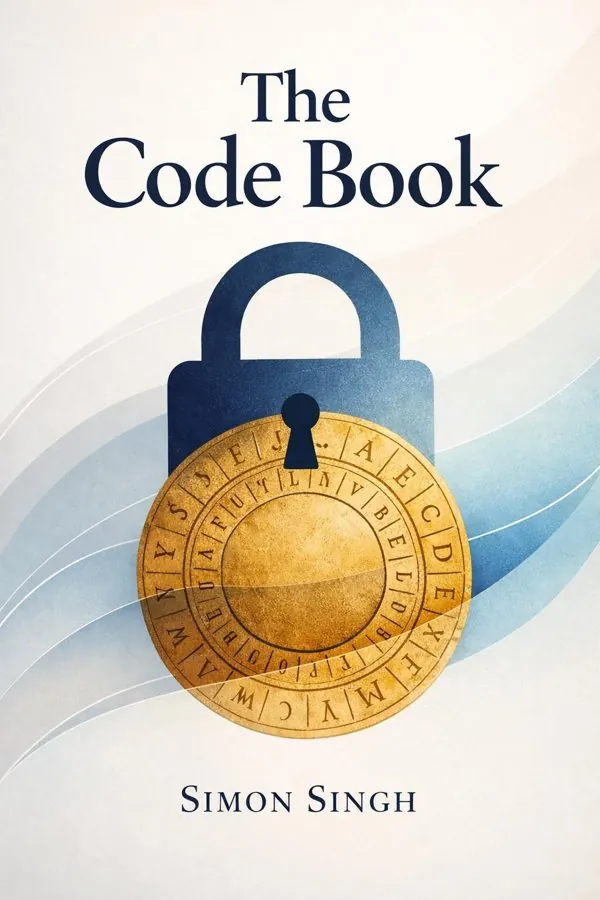
The Code Book: The Science of Secrecy from Ancient Egypt to Quantum Cryptography: Summary & Key Insights
by Simon Singh
 10 min6 chaptersAudio available
What Is The Code Book: The Science of Secrecy from Ancient Egypt to Quantum Cryptography About?
The Code Book: The Science of Secrecy from Ancient Egypt to Quantum Cryptography by Simon Singh is a popular_sci book spanning 6 pages. The Code Book explores the history and science of cryptography, tracing the evolution of secret writing from ancient ciphers to modern encryption. Simon Singh reveals how codes have shaped wars, politics, and technology, and how the ongoing battle between codemakers and codebreakers continues to influence our digital world.
This FizzRead summary covers all 6 key chapters of The Code Book: The Science of Secrecy from Ancient Egypt to Quantum Cryptography in approximately 10 minutes, distilling the most important ideas, arguments, and takeaways from Simon Singh's work. Also available as an audio summary and Key Quotes Podcast.
The Code Book: The Science of Secrecy from Ancient Egypt to Quantum Cryptography
The Code Book explores the history and science of cryptography, tracing the evolution of secret writing from ancient ciphers to modern encryption. Simon Singh reveals how codes have shaped wars, politics, and technology, and how the ongoing battle between codemakers and codebreakers continues to influence our digital world.
Who Should Read The Code Book: The Science of Secrecy from Ancient Egypt to Quantum Cryptography?
This book is perfect for anyone interested in popular_sci and looking to gain actionable insights in a short read. Whether you're a student, professional, or lifelong learner, the key ideas from The Code Book: The Science of Secrecy from Ancient Egypt to Quantum Cryptography by Simon Singh will help you think differently.
- ✓Readers who enjoy popular_sci and want practical takeaways
- ✓Professionals looking to apply new ideas to their work and life
- ✓Anyone who wants the core insights of The Code Book: The Science of Secrecy from Ancient Egypt to Quantum Cryptography in just 10 minutes
Want the full summary?
Get instant access to this book summary and 100K+ more with Fizz Moment.
Get Free SummaryAvailable on App Store • Free to download
Key Chapters
The story begins in ancient Egypt, where the power of hidden knowledge was sacred. Scribes would alter hieroglyphic inscriptions not to obscure meaning completely, but to create a veil of exclusivity. Those who could decipher the symbols possessed both religious authority and mystique. This early flirtation with cryptography illustrates that secrecy was never purely practical — it was psychological and spiritual.
Centuries later, the practical utility of secrecy emerged among military and diplomatic circles. Early substitution ciphers appeared when scribes replaced letters or symbols systematically to disguise sensitive information. The most famous among these early methods is the Caesar cipher, named after Julius Caesar, who used it to communicate with his generals. By shifting each letter in the Roman alphabet by a fixed number, Caesar could mask his intentions from enemies. Simple by modern standards, this cipher embodied a vital truth: codes succeed not just by complexity, but by the ignorance of those outside the circle of trust.
These elementary systems hint at something profound about human communication — that secrecy is freedom. To encode is to control meaning. To decode is to reclaim it. The earliest cryptographers might not have used mathematical formulae, but their impulses laid the foundation for centuries of intellectual warfare over information.
As secrecy evolved, so too did the brilliance of those who sought to undo it. The Islamic scholars of the ninth century transformed codebreaking from guesswork into a science. At the heart of this revolution was Al-Kindi, an Arab polymath who wrote a treatise on cryptanalysis that introduced the concept of frequency analysis. By recognizing that written languages have predictable letter patterns, Al-Kindi turned intuition into algorithm: by analyzing how often letters appeared in a ciphertext, one could infer the structure of the underlying message.
This was a turning point. For the first time, encryption met its nemesis in the rational mind. Every cipher henceforth had to consider not just secrecy by obscurity, but the empirical tendencies of language itself. During the Renaissance, this method matured further as scholars across Europe applied it to diplomatic ciphers. Cryptology became a craft of state, its practitioners serving the power of kings while being constrained by the tools of mathematics.
To study frequency analysis is to see how cryptography bridges art and science. When the cryptographer designs a cipher, they appeal to creativity and pattern-making; when the cryptanalyst attacks it, they apply logic and rigor. This duality became the rhythm of cryptographic history — each new code inspiring a counterforce determined to expose it.
+ 4 more chapters — available in the FizzRead app
All Chapters in The Code Book: The Science of Secrecy from Ancient Egypt to Quantum Cryptography
About the Author
Simon Singh is a British author and science journalist known for making complex scientific and mathematical ideas accessible to general readers. He holds a PhD in particle physics from the University of Cambridge and has written several bestselling books on mathematics, cryptography, and science communication.
Get This Summary in Your Preferred Format
Read or listen to the The Code Book: The Science of Secrecy from Ancient Egypt to Quantum Cryptography summary by Simon Singh anytime, anywhere. FizzRead offers multiple formats so you can learn on your terms — all free.
Available formats: App · Audio · PDF · EPUB — All included free with FizzRead
Download The Code Book: The Science of Secrecy from Ancient Egypt to Quantum Cryptography PDF and EPUB Summary
Key Quotes from The Code Book: The Science of Secrecy from Ancient Egypt to Quantum Cryptography
“The story begins in ancient Egypt, where the power of hidden knowledge was sacred.”
“As secrecy evolved, so too did the brilliance of those who sought to undo it.”
Frequently Asked Questions about The Code Book: The Science of Secrecy from Ancient Egypt to Quantum Cryptography
The Code Book: The Science of Secrecy from Ancient Egypt to Quantum Cryptography by Simon Singh is a popular_sci book that explores key ideas across 6 chapters. The Code Book explores the history and science of cryptography, tracing the evolution of secret writing from ancient ciphers to modern encryption. Simon Singh reveals how codes have shaped wars, politics, and technology, and how the ongoing battle between codemakers and codebreakers continues to influence our digital world.
More by Simon Singh
You Might Also Like

Structures: Or Why Things Don"t Fall Down
J.E. Gordon
10 min
The Road to Wigan Pier
George Orwell
10 min
Bonk: The Curious Coupling of Science and Sex
Mary Roach
10 min
First Bite: How We Learn to Eat
Bee Wilson
10 min
In Pursuit Of The Unknown: 17 Equations That Changed The World
Ian Stewart
10 min
Napoleon's Buttons: 17 Molecules That Changed History
Penny Le Couteur and Jay Burreson
10 minBrowse by Category
Ready to read The Code Book: The Science of Secrecy from Ancient Egypt to Quantum Cryptography?
Get the full summary and 100K+ more books with Fizz Moment.