
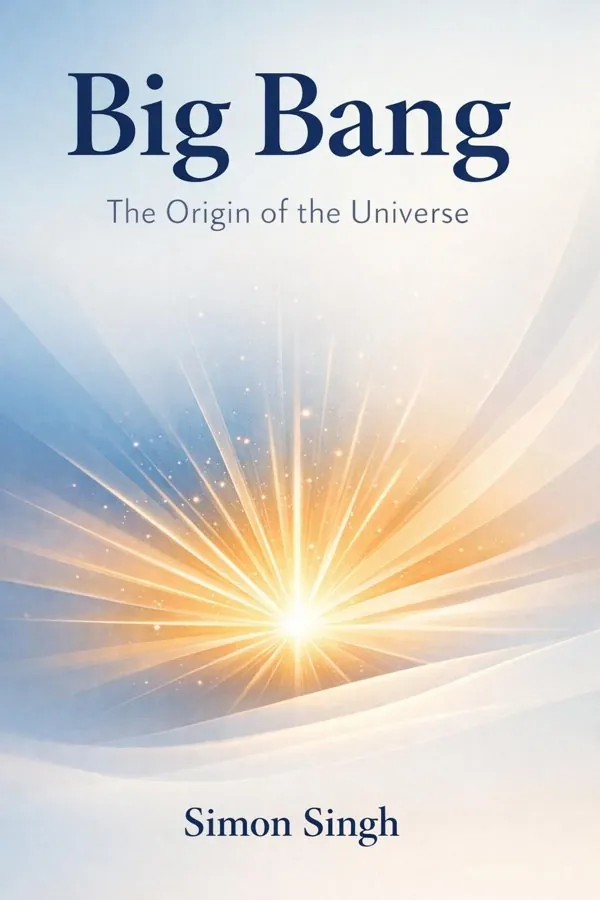
Big Bang: The Origin of the Universe: Summary & Key Insights
by Simon Singh
 10 min11 chaptersAudio available
What Is Big Bang: The Origin of the Universe About?
Big Bang: The Origin of the Universe by Simon Singh is a popular_sci book spanning 11 pages. Big Bang is a comprehensive exploration of the history and science behind cosmology, tracing humanity’s quest to understand the origins of the universe. Simon Singh presents the development of the Big Bang theory, from early philosophical ideas to modern astrophysics, explaining complex scientific concepts in accessible language and highlighting the contributions of key figures such as Einstein, Hubble, and Gamow.
This FizzRead summary covers all 11 key chapters of Big Bang: The Origin of the Universe in approximately 10 minutes, distilling the most important ideas, arguments, and takeaways from Simon Singh's work. Also available as an audio summary and Key Quotes Podcast.
Big Bang: The Origin of the Universe
Big Bang is a comprehensive exploration of the history and science behind cosmology, tracing humanity’s quest to understand the origins of the universe. Simon Singh presents the development of the Big Bang theory, from early philosophical ideas to modern astrophysics, explaining complex scientific concepts in accessible language and highlighting the contributions of key figures such as Einstein, Hubble, and Gamow.
Who Should Read Big Bang: The Origin of the Universe?
This book is perfect for anyone interested in popular_sci and looking to gain actionable insights in a short read. Whether you're a student, professional, or lifelong learner, the key ideas from Big Bang: The Origin of the Universe by Simon Singh will help you think differently.
- ✓Readers who enjoy popular_sci and want practical takeaways
- ✓Professionals looking to apply new ideas to their work and life
- ✓Anyone who wants the core insights of Big Bang: The Origin of the Universe in just 10 minutes
Want the full summary?
Get instant access to this book summary and 100K+ more with Fizz Moment.
Get Free SummaryAvailable on App Store • Free to download
Key Chapters
The first chapter of our journey takes us to the ancients—those who watched the night sky long before telescopes or theories. The Greeks, in particular, were keen observers and deep thinkers. They conceived of a universe that was harmonious, fixed, and Earth-centered. Aristotle’s cosmos placed our planet at the center of concentric celestial spheres, each carrying stars or planets in perfect circular motion. To them, eternity and immutability reflected divine perfection. Change was reserved for the imperfect realm of Earth below.
This geocentric view endured for nearly two millennia. It was reinforced by philosophical reasoning and empirical observation that seemed to confirm its symmetry. The notion of a finite, orderly universe appealed to both mind and faith—it merged rational structure with spiritual comfort. The heavens couldn’t possibly change, after all, because perfection doesn’t evolve.
Yet even amid this confidence, seeds of doubt appeared. Aristarchus of Samos suggested that the Sun, not Earth, might be the center. His ideas were brushed aside, too radical for their time. But they mattered—they whispered through history as reminders that truth isn’t determined by consensus but by evidence awaiting discovery.
When Copernicus published *De revolutionibus orbium coelestium* in 1543, the world wasn’t ready. His proposal that Earth rotated around the Sun shattered the old cosmological order. Even so, his model was the first solid step toward understanding the universe dynamically rather than hierarchically. Galileo’s observations with his telescope—moons orbiting Jupiter, phases of Venus, sunspots—proved that celestial bodies were not immutable. These discoveries were revelations that broke chains of theological constraint.
Newton’s *Principia* completed the revolution. It transformed motion into mathematics. For the first time, the cosmos could be described by universal laws, the same gravity that drew apples to Earth kept planets in orbit. Newton unified the heavens and the Earth under one physical rule—a triumph of intellect that emerged from centuries of gradual realization.
This era marked humanity’s awakening from philosophical speculation to scientific inquiry. The shift from geocentrism to heliocentrism wasn’t merely technical—it signified a profound philosophical change. The universe was no longer structured for human convenience but for the elegance of nature’s own laws.
+ 9 more chapters — available in the FizzRead app
All Chapters in Big Bang: The Origin of the Universe
About the Author
Simon Singh is a British author and science journalist known for making complex scientific ideas accessible to general readers. He holds a PhD in particle physics from the University of Cambridge and has written several bestselling books on mathematics and physics, including Fermat’s Last Theorem and The Code Book.
Get This Summary in Your Preferred Format
Read or listen to the Big Bang: The Origin of the Universe summary by Simon Singh anytime, anywhere. FizzRead offers multiple formats so you can learn on your terms — all free.
Available formats: App · Audio · PDF · EPUB — All included free with FizzRead
Download Big Bang: The Origin of the Universe PDF and EPUB Summary
Key Quotes from Big Bang: The Origin of the Universe
“The first chapter of our journey takes us to the ancients—those who watched the night sky long before telescopes or theories.”
“When Copernicus published *De revolutionibus orbium coelestium* in 1543, the world wasn’t ready.”
Frequently Asked Questions about Big Bang: The Origin of the Universe
Big Bang: The Origin of the Universe by Simon Singh is a popular_sci book that explores key ideas across 11 chapters. Big Bang is a comprehensive exploration of the history and science behind cosmology, tracing humanity’s quest to understand the origins of the universe. Simon Singh presents the development of the Big Bang theory, from early philosophical ideas to modern astrophysics, explaining complex scientific concepts in accessible language and highlighting the contributions of key figures such as Einstein, Hubble, and Gamow.
More by Simon Singh
You Might Also Like

Structures: Or Why Things Don"t Fall Down
J.E. Gordon
10 min
The Road to Wigan Pier
George Orwell
10 min
Bonk: The Curious Coupling of Science and Sex
Mary Roach
10 min
First Bite: How We Learn to Eat
Bee Wilson
10 min
In Pursuit Of The Unknown: 17 Equations That Changed The World
Ian Stewart
10 min
Napoleon's Buttons: 17 Molecules That Changed History
Penny Le Couteur and Jay Burreson
10 minBrowse by Category
Ready to read Big Bang: The Origin of the Universe?
Get the full summary and 100K+ more books with Fizz Moment.