
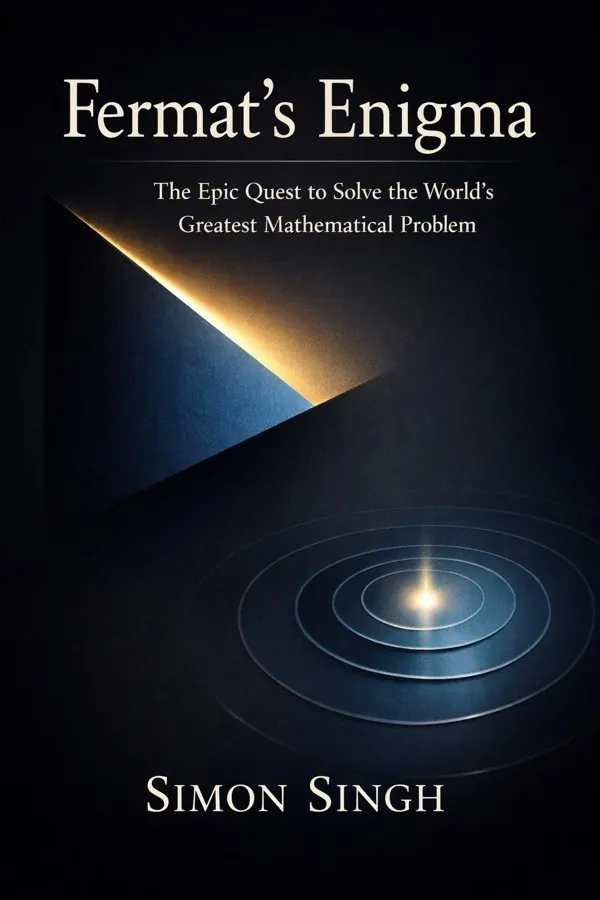
Fermat’s Enigma: The Epic Quest to Solve the World’s Greatest Mathematical Problem: Summary & Key Insights
by Simon Singh
 10 min5 chaptersAudio available
What Is Fermat’s Enigma: The Epic Quest to Solve the World’s Greatest Mathematical Problem About?
Fermat’s Enigma: The Epic Quest to Solve the World’s Greatest Mathematical Problem by Simon Singh is a popular_sci book spanning 5 pages. Fermat’s Enigma recounts the centuries-long pursuit to prove Fermat’s Last Theorem, a mathematical riddle that baffled generations of mathematicians. Simon Singh traces the story from Pierre de Fermat’s 17th-century note to Andrew Wiles’s groundbreaking proof in 1994, weaving together history, biography, and the beauty of mathematics in an accessible narrative.
This FizzRead summary covers all 5 key chapters of Fermat’s Enigma: The Epic Quest to Solve the World’s Greatest Mathematical Problem in approximately 10 minutes, distilling the most important ideas, arguments, and takeaways from Simon Singh's work. Also available as an audio summary and Key Quotes Podcast.
Fermat’s Enigma: The Epic Quest to Solve the World’s Greatest Mathematical Problem
Fermat’s Enigma recounts the centuries-long pursuit to prove Fermat’s Last Theorem, a mathematical riddle that baffled generations of mathematicians. Simon Singh traces the story from Pierre de Fermat’s 17th-century note to Andrew Wiles’s groundbreaking proof in 1994, weaving together history, biography, and the beauty of mathematics in an accessible narrative.
Who Should Read Fermat’s Enigma: The Epic Quest to Solve the World’s Greatest Mathematical Problem?
This book is perfect for anyone interested in popular_sci and looking to gain actionable insights in a short read. Whether you're a student, professional, or lifelong learner, the key ideas from Fermat’s Enigma: The Epic Quest to Solve the World’s Greatest Mathematical Problem by Simon Singh will help you think differently.
- ✓Readers who enjoy popular_sci and want practical takeaways
- ✓Professionals looking to apply new ideas to their work and life
- ✓Anyone who wants the core insights of Fermat’s Enigma: The Epic Quest to Solve the World’s Greatest Mathematical Problem in just 10 minutes
Want the full summary?
Get instant access to this book summary and 100K+ more with Fizz Moment.
Get Free SummaryAvailable on App Store • Free to download
Key Chapters
In the beginning stands Pierre de Fermat, a provincial magistrate in Toulouse who treated mathematics as a pastime yet changed its course forever. He and his contemporary René Descartes were shaping what we now call analytical geometry, yet Fermat’s joy lay in pure numbers. His note—claiming an impossible proof—was written beside a theorem that worked perfectly well for squares but allegedly failed for higher powers. To us, this is the origin of Fermat’s Last Theorem.
Fermat's silent confidence captured what makes mathematics uniquely human. He wrote as someone who saw patterns dancing beyond ordinary algebra, convinced of a deep harmony in numbers. But in his day, mathematical communication was constrained by handwritten letters and printed treatises. Many of Fermat’s claims remained cryptic, unverified, often rediscovered later. The note’s survival itself was an accident—a chance that the margin of a book would carry forward an intellectual spark.
What makes this episode fascinating is not just the theorem, but the psychology hidden inside that small claim. Fermat felt the exuberance of discovery yet was careless with transmission. His legacy became less a proof than a challenge—an invitation to posterity. In retelling this, I ask readers to notice how the endeavor of mathematics often begins as a whisper between generations. Out of that marginal whisper blossomed an entire field of mathematics: number theory.
The first centuries after Fermat transformed his playful conjecture into a collective obsession. Leonhard Euler, one of the towering figures of the Enlightenment, attacked the problem with characteristic ingenuity. He proved special cases, moving the theorem forward for certain exponents, but the full proof eluded even him. Euler’s success lay not in solving Fermat’s puzzle completely, but in establishing new methods—laying foundations for number theory itself.
Later came Sophie Germain, a brilliant French thinker who corresponded secretly with Gauss to mask her gender. Her work was revolutionary not only mathematically but socially. She proved crucial cases, introducing novel reasoning in modular arithmetic and properties of primes. Germain’s perseverance against institutional prejudice mirrored the stubbornness required to chase such an elusive theorem. The equation was no longer just a puzzle—it became a measure of human resilience.
Ernst Kummer in the 19th century brought a decisive turn. He invented “ideal numbers,” abstract constructs that allowed mathematicians to repair failures in unique factorization—a flaw revealed when older methods stumbled against Fermat’s challenge. Though Kummer never completed the theorem entirely, his ideas seeded modern algebraic number theory. Each of these scholars may have failed to prove Fermat’s statement outright, but collectively, they transformed mathematics into a richer, more abstract landscape. Their century-long struggle proves that the destination may be unreachable, but the journey itself yields a new world.
+ 3 more chapters — available in the FizzRead app
All Chapters in Fermat’s Enigma: The Epic Quest to Solve the World’s Greatest Mathematical Problem
About the Author
Simon Singh is a British science writer and television producer known for making complex scientific and mathematical ideas accessible to the public. He holds a PhD in particle physics from the University of Cambridge and has authored several bestselling popular science books, including 'The Code Book' and 'Big Bang'.
Get This Summary in Your Preferred Format
Read or listen to the Fermat’s Enigma: The Epic Quest to Solve the World’s Greatest Mathematical Problem summary by Simon Singh anytime, anywhere. FizzRead offers multiple formats so you can learn on your terms — all free.
Available formats: App · Audio · PDF · EPUB — All included free with FizzRead
Download Fermat’s Enigma: The Epic Quest to Solve the World’s Greatest Mathematical Problem PDF and EPUB Summary
Key Quotes from Fermat’s Enigma: The Epic Quest to Solve the World’s Greatest Mathematical Problem
“In the beginning stands Pierre de Fermat, a provincial magistrate in Toulouse who treated mathematics as a pastime yet changed its course forever.”
“The first centuries after Fermat transformed his playful conjecture into a collective obsession.”
Frequently Asked Questions about Fermat’s Enigma: The Epic Quest to Solve the World’s Greatest Mathematical Problem
Fermat’s Enigma: The Epic Quest to Solve the World’s Greatest Mathematical Problem by Simon Singh is a popular_sci book that explores key ideas across 5 chapters. Fermat’s Enigma recounts the centuries-long pursuit to prove Fermat’s Last Theorem, a mathematical riddle that baffled generations of mathematicians. Simon Singh traces the story from Pierre de Fermat’s 17th-century note to Andrew Wiles’s groundbreaking proof in 1994, weaving together history, biography, and the beauty of mathematics in an accessible narrative.
More by Simon Singh
You Might Also Like

Structures: Or Why Things Don"t Fall Down
J.E. Gordon
10 min
The Road to Wigan Pier
George Orwell
10 min
Bonk: The Curious Coupling of Science and Sex
Mary Roach
10 min
First Bite: How We Learn to Eat
Bee Wilson
10 min
In Pursuit Of The Unknown: 17 Equations That Changed The World
Ian Stewart
10 min
Napoleon's Buttons: 17 Molecules That Changed History
Penny Le Couteur and Jay Burreson
10 minBrowse by Category
Ready to read Fermat’s Enigma: The Epic Quest to Solve the World’s Greatest Mathematical Problem?
Get the full summary and 100K+ more books with Fizz Moment.