
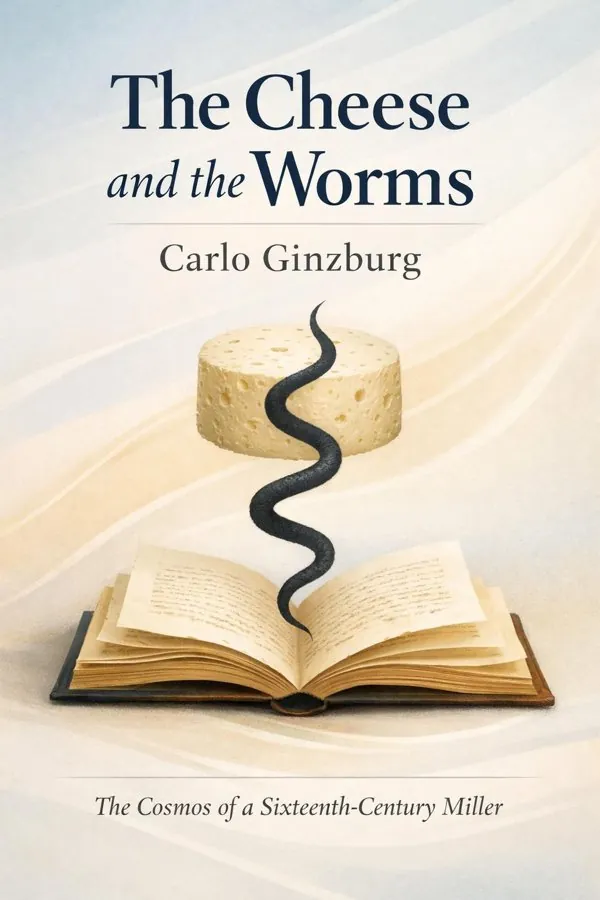
The Cheese and the Worms: The Cosmos of a Sixteenth-Century Miller: Summary & Key Insights
 10 min9 chaptersAudio available
Key Takeaways from The Cheese and the Worms: The Cosmos of a Sixteenth-Century Miller
Sometimes the fastest way to understand an age is not to study its rulers, but to study one ordinary person caught in its machinery.
Historical evidence is rarely neutral; some of the richest archives survive because institutions wanted to control, punish, or silence people.
One of the book’s most unsettling insights is that “ordinary” people are often far more intellectually active than stereotypes allow.
A single metaphor can reveal an entire worldview.
Institutions often label as heresy what, at the individual level, begins as interpretation.
What Is The Cheese and the Worms: The Cosmos of a Sixteenth-Century Miller About?
The Cheese and the Worms: The Cosmos of a Sixteenth-Century Miller by Carlo Ginzburg is a world_history book spanning 8 pages. What happens when a historian stops looking at kings, popes, and generals and instead listens closely to a village miller? In The Cheese and the Worms, Carlo Ginzburg reconstructs the startling inner world of Domenico Scandella, called Menocchio, a sixteenth-century miller from Friuli whose unconventional religious ideas brought him before the Roman Inquisition. Drawing on trial records, depositions, and fragments of Menocchio’s reading life, Ginzburg uncovers a mind that blended biblical stories, popular folklore, oral culture, and stray printed texts into a deeply original vision of the cosmos. The book matters because it transforms one obscure heresy trial into a profound meditation on culture, power, literacy, and historical method. Rather than treating ordinary people as passive recipients of elite ideas, Ginzburg shows how they interpreted, reshaped, and resisted them. The result is one of the foundational works of microhistory: a study small in scale but enormous in implication. As one of the most influential historians of the twentieth century, Ginzburg brings both archival rigor and interpretive boldness, making this book essential for anyone interested in early modern Europe, religion, or the hidden complexity of everyday lives.
This FizzRead summary covers all 9 key chapters of The Cheese and the Worms: The Cosmos of a Sixteenth-Century Miller in approximately 10 minutes, distilling the most important ideas, arguments, and takeaways from Carlo Ginzburg's work. Also available as an audio summary and Key Quotes Podcast.
The Cheese and the Worms: The Cosmos of a Sixteenth-Century Miller
What happens when a historian stops looking at kings, popes, and generals and instead listens closely to a village miller? In The Cheese and the Worms, Carlo Ginzburg reconstructs the startling inner world of Domenico Scandella, called Menocchio, a sixteenth-century miller from Friuli whose unconventional religious ideas brought him before the Roman Inquisition. Drawing on trial records, depositions, and fragments of Menocchio’s reading life, Ginzburg uncovers a mind that blended biblical stories, popular folklore, oral culture, and stray printed texts into a deeply original vision of the cosmos.
The book matters because it transforms one obscure heresy trial into a profound meditation on culture, power, literacy, and historical method. Rather than treating ordinary people as passive recipients of elite ideas, Ginzburg shows how they interpreted, reshaped, and resisted them. The result is one of the foundational works of microhistory: a study small in scale but enormous in implication. As one of the most influential historians of the twentieth century, Ginzburg brings both archival rigor and interpretive boldness, making this book essential for anyone interested in early modern Europe, religion, or the hidden complexity of everyday lives.
Who Should Read The Cheese and the Worms: The Cosmos of a Sixteenth-Century Miller?
This book is perfect for anyone interested in world_history and looking to gain actionable insights in a short read. Whether you're a student, professional, or lifelong learner, the key ideas from The Cheese and the Worms: The Cosmos of a Sixteenth-Century Miller by Carlo Ginzburg will help you think differently.
- ✓Readers who enjoy world_history and want practical takeaways
- ✓Professionals looking to apply new ideas to their work and life
- ✓Anyone who wants the core insights of The Cheese and the Worms: The Cosmos of a Sixteenth-Century Miller in just 10 minutes
Want the full summary?
Get instant access to this book summary and 100K+ more with Fizz Moment.
Get Free SummaryAvailable on App Store • Free to download
Key Chapters
Sometimes the fastest way to understand an age is not to study its rulers, but to study one ordinary person caught in its machinery. Ginzburg places Menocchio within sixteenth-century Italy, a world shaped by rigid hierarchy, intense religious authority, and the expanding pressures of the Counter-Reformation. The Catholic Church was not simply a spiritual institution; it regulated knowledge, morality, and public speech. At the same time, the spread of print, the lingering influence of oral culture, and the upheavals of Protestant reform created cracks in the intellectual order.
Menocchio lived in Friuli, a peripheral region rather than a major urban center, which matters because frontier zones often preserve cultural mixtures more vividly than capitals do. In his world, local traditions, biblical teachings, rumors, songs, and printed books coexisted uneasily. This setting helps explain why his ideas were neither purely learned nor purely folk. They emerged from a society in transition, where old communal beliefs and newer textual influences met under the suspicious gaze of church authorities.
A practical way to think about this is to compare social media today with village gossip, sermons, and cheap printed books then. People do not absorb ideas in neat categories; they combine what they hear from institutions with what circulates informally. Menocchio’s case shows that intellectual life is never confined to elites alone.
The takeaway: to understand any historical period, look beyond official doctrines and ask how ordinary people actually mixed, used, and contested the ideas around them.
Historical evidence is rarely neutral; some of the richest archives survive because institutions wanted to control, punish, or silence people. Menocchio is known to us because inquisitors questioned him in detail and recorded his answers in order to identify heresy. Ginzburg’s methodological brilliance lies in reading these documents against their original purpose. Rather than accepting the records as transparent fact, he treats them as mediated encounters shaped by fear, translation, formulaic legal language, and unequal power.
This means the book is not just about Menocchio’s beliefs; it is also about how historians recover partial voices from hostile sources. The inquisitors asked leading questions. Scribes summarized or regularized speech. Menocchio may have tailored some answers strategically. Yet within those distortions, patterns still appear: recurring metaphors, repeated arguments, references to books, and stubbornly held convictions. Ginzburg pieces together these fragments with extraordinary care.
The method has broad application. Historians of enslaved people, colonized communities, workers, or dissidents often depend on documents created by authorities. A police file, missionary report, or court transcript may preserve traces of lives otherwise lost. The challenge is to hear the subject without forgetting the filter.
For modern readers, this offers a valuable lesson in source criticism. Whether reading archival records, journalism, or online testimony, we should ask: who created this document, for what purpose, and what voices are amplified or suppressed?
The takeaway: valuable truths often survive inside biased records, but only if we read them critically, patiently, and with attention to power.
One of the book’s most unsettling insights is that “ordinary” people are often far more intellectually active than stereotypes allow. Menocchio was a miller, a local figure with modest status but unusual exposure to ideas. He was literate to a meaningful degree, held village offices, and occupied a social position that gave him access to conversation, conflict, and books. Ginzburg does not romanticize him as a hidden philosopher, but he does show that Menocchio was far from passive.
His trade matters. Millers often stood at points of exchange: they interacted with villagers, travelers, and local markets. Such occupations could make people intermediaries between worlds. Menocchio’s reading was eclectic rather than scholarly. He encountered texts in fragments, often through adaptation, retelling, or selective memory. That mixed intellectual diet helped produce his distinctive worldview.
This chapter of the story pushes against the old assumption that culture flows only downward from elite thinkers to the masses. Menocchio interpreted what he read in light of his own experiences and communal traditions. He did not simply repeat doctrine incorrectly; he generated meaning independently. That is why he was so troubling to authorities. He was not ignorant in the way they expected. He was creatively heterodox.
A modern parallel would be someone without formal academic training who reads widely across religion, politics, and science, then constructs a personal worldview outside institutional boundaries. Such thinking can be original, confused, insightful, and dangerous all at once.
The takeaway: never underestimate the intellectual agency of people outside official centers of learning; insight often emerges from unexpected social positions.
A single metaphor can reveal an entire worldview. Menocchio’s most famous idea was his account of creation: he imagined the universe emerging like cheese from milk, with angels appearing within it as worms form in cheese. This startling cosmology has become iconic because it is so vivid, so earthy, and so far from orthodox Christian doctrine. Yet Ginzburg shows that it was not random absurdity. It was a serious attempt to make sense of origins using analogies drawn from everyday life, available reading, and inherited oral imagery.
Menocchio’s cosmology matters because it demonstrates how people reason with the materials closest to them. He did not think in abstract scholastic categories. He thought through fermentation, matter, growth, and transformation. His explanation of creation came from a tactile world of food, labor, and observation. That does not make it primitive. It makes it grounded in lived experience.
Ginzburg traces possible influences from popular books, biblical stories, and broader currents of heterodox thought, but he avoids reducing Menocchio’s ideas to a single source. The originality lies in the combination. Menocchio fused fragments into a coherent mental picture that felt true to him.
This has practical relevance beyond history. People still build beliefs by linking expert knowledge, folk wisdom, personal experience, and metaphor. Public understanding of science, politics, and religion often works this way. If we want to understand how ideas spread, we must pay attention to the images and analogies people use.
The takeaway: beliefs become powerful when they are tied to everyday experience, so understanding someone’s metaphors is often the key to understanding their world.
Institutions often label as heresy what, at the individual level, begins as interpretation. Menocchio challenged core teachings on creation, the Church, Christ, the sacraments, and religious authority. He questioned whether priests truly possessed spiritual superiority, criticized ecclesiastical wealth, and expressed ideas that blurred distinctions between religions and undermined the monopoly of Christian truth. For the Inquisition, these views were not isolated errors; they represented a broader refusal to submit to doctrinal order.
What makes his case especially compelling is that his beliefs were not systematically Protestant, atheist, or modern in any simple sense. Menocchio did not fit neat categories. He absorbed some reformist themes, such as criticism of clerical corruption and emphasis on direct access to religious truth, but he also retained many assumptions rooted in older communal religion. His thought was hybrid, unstable, and deeply personal.
That complexity is one of Ginzburg’s major contributions. He shows that historical belief does not always align with the tidy labels later historians prefer. Real people are inconsistent. They improvise. They carry contradictory ideas at once. Menocchio’s “heresy” therefore reveals not only doctrinal conflict but the larger human habit of building meaning from fragments.
In practical terms, this idea can sharpen how we understand dissent today. People who oppose official narratives rarely do so from a single ideology. Their views often emerge from mixed influences, local experiences, and moral intuitions that institutions struggle to categorize.
The takeaway: when encountering dissent, look beyond labels and ask how people assemble their beliefs; complexity is often more revealing than classification.
Cultural change rarely replaces one medium with another; instead, old and new forms overlap, collide, and reshape each other. One of the book’s most influential arguments is that Menocchio’s worldview emerged from the interaction between oral tradition and print culture. He read books, but he did not read them as a trained theologian would. He folded what he read into a world already structured by memory, spoken exchange, proverbs, local stories, and collective habits of interpretation.
This point is crucial because historians once tended to separate “popular” and “elite” culture too sharply. Ginzburg shows a more dynamic relationship. Cheap printed books could circulate ideas beyond elite circles, but once they entered village life, they were reinterpreted through oral frameworks. Texts were discussed aloud, remembered imperfectly, combined with rumor, and transformed in the process. Reading was not a solitary, silent, modern activity; it was social and unstable.
Menocchio’s references to the Bible and other texts therefore do not indicate pure textual dependence. They show appropriation. He made books answer questions that mattered in his own environment. This explains why the same text could produce wildly different meanings in different social settings.
The insight applies strongly today. Digital culture does not eliminate older ways of meaning-making; it intensifies remixing. Articles, videos, religious teachings, memes, and personal anecdotes merge into new narratives. Menocchio’s world was not ours, but the logic of cultural blending is surprisingly familiar.
The takeaway: ideas do not simply travel; they are transformed by the communities that receive them, so always study interpretation as closely as transmission.
Authority is strongest when it appears total, but Ginzburg shows that even powerful institutions struggle to control what people inwardly believe. Menocchio was tried by the Inquisition, pressured to recant, and at one stage appeared to submit. Yet his beliefs persisted, resurfaced, and ultimately led to renewed prosecution and execution. This pattern reveals an uncomfortable truth for systems of power: coercion can produce outward conformity without securing inward conviction.
The Inquisition’s response was not only punitive but diagnostic. Officials tried to classify Menocchio, identify his influences, and restore doctrinal order. Their concern tells us how threatening unsanctioned interpretation had become in the age of religious conflict. If a miller could publicly debate the foundations of Christianity, then the boundaries between learned truth and popular error were less stable than authorities wanted to admit.
Ginzburg also captures the tragedy of the encounter. Menocchio was stubborn, outspoken, and repeatedly unwilling to stay silent. The Church, shaped by post-Reformation anxieties, became less tolerant of ambiguity. The result was not dialogue but elimination.
This dynamic remains relevant. Modern institutions may not use inquisitorial courts, but organizations still respond to unapproved thinking through surveillance, discipline, and reputational control. Whether in politics, workplaces, or media systems, the gap between compliance and belief remains significant.
The takeaway: do not confuse visible obedience with genuine agreement; where institutions demand uniformity, hidden independence of thought often survives longer than expected.
A tiny case can illuminate a civilization when examined with enough depth. That is the promise of microhistory, and The Cheese and the Worms is one of its defining achievements. Rather than summarizing broad structures from a distance, Ginzburg zooms in on a single individual and uses that close focus to raise large questions about literacy, religion, social exchange, intellectual authority, and historical evidence.
Microhistory is not antiquarian curiosity. It is a method based on the belief that anomalies are revealing. Menocchio matters precisely because he does not fit standard categories. By following his peculiar beliefs closely, Ginzburg exposes fractures in the relationship between elite and popular culture that a broad survey might miss. The unusual case becomes a diagnostic tool.
This approach has influenced many fields. Historians now use village disputes, court cases, family letters, and local rituals to uncover larger structures through fine-grained analysis. In business or policy terms, it resembles studying one customer complaint, one medical case, or one community conflict in enough detail to reveal system-wide assumptions.
The method also demands humility. A microhistorian must resist overgeneralizing from a single example while still showing why the example matters. Ginzburg does this by balancing careful contextualization with bold interpretation.
For readers, the book demonstrates that scale is a choice in analysis. You do not always need more data to understand a world; sometimes you need closer attention to one richly documented life.
The takeaway: when a case seems unusually detailed or strange, treat it as an opportunity; close analysis of the particular can expose truths that broad generalization hides.
The deepest achievement of this book is ethical as much as intellectual: it restores complexity to someone whom official history wanted to reduce to a heretic. Menocchio emerges not as a symbol alone but as a person—argumentative, imaginative, contradictory, brave, imprudent, and deeply engaged with the biggest questions of existence. Ginzburg does not turn him into a modern hero, yet he refuses to let institutional judgment have the final word.
This restoration matters because historical narratives often flatten people, especially those on the margins. Official records classify them as deviant, criminal, ignorant, or insignificant. Microhistory counters that flattening by reconstructing texture: what someone read, how they spoke, what metaphors they trusted, what social world they inhabited, and why their ideas felt meaningful.
That practice has implications beyond historical scholarship. In contemporary life, people are constantly compressed into labels: extremist, uninformed, elite, traditional, progressive. Ginzburg’s work reminds us that individuals are usually more layered than the categories assigned to them. Understanding does not require agreement, but it does require attention.
The book therefore invites a disciplined form of empathy. Not sentimental identification, but the effort to see how a worldview is built from circumstances, exchanges, and lived experience. Such empathy improves both scholarship and citizenship.
The takeaway: when confronting any person reduced to a label, pause and reconstruct the world from their point of view; complexity is often the beginning of real understanding.
All Chapters in The Cheese and the Worms: The Cosmos of a Sixteenth-Century Miller
About the Author
Carlo Ginzburg, born in Turin in 1939, is an Italian historian widely recognized as one of the founders of microhistory. His work focuses on the relationship between popular culture and elite culture, especially in early modern Europe, and on the methods historians use to recover marginalized voices from difficult archives. He became internationally known through books such as The Cheese and the Worms and The Night Battles, both of which helped reshape the study of religion, belief, and everyday life. Ginzburg is admired for combining meticulous archival research with imaginative interpretation, often showing how a single case can illuminate wider historical structures. Over the course of his career, he has taught at major institutions in Italy and abroad, including UCLA and the Scuola Normale Superiore in Pisa.
Get This Summary in Your Preferred Format
Read or listen to the The Cheese and the Worms: The Cosmos of a Sixteenth-Century Miller summary by Carlo Ginzburg anytime, anywhere. FizzRead offers multiple formats so you can learn on your terms — all free.
Available formats: App · Audio · PDF · EPUB — All included free with FizzRead
Download The Cheese and the Worms: The Cosmos of a Sixteenth-Century Miller PDF and EPUB Summary
Key Quotes from The Cheese and the Worms: The Cosmos of a Sixteenth-Century Miller
“Sometimes the fastest way to understand an age is not to study its rulers, but to study one ordinary person caught in its machinery.”
“Historical evidence is rarely neutral; some of the richest archives survive because institutions wanted to control, punish, or silence people.”
“One of the book’s most unsettling insights is that “ordinary” people are often far more intellectually active than stereotypes allow.”
“A single metaphor can reveal an entire worldview.”
“Institutions often label as heresy what, at the individual level, begins as interpretation.”
Frequently Asked Questions about The Cheese and the Worms: The Cosmos of a Sixteenth-Century Miller
The Cheese and the Worms: The Cosmos of a Sixteenth-Century Miller by Carlo Ginzburg is a world_history book that explores key ideas across 9 chapters. What happens when a historian stops looking at kings, popes, and generals and instead listens closely to a village miller? In The Cheese and the Worms, Carlo Ginzburg reconstructs the startling inner world of Domenico Scandella, called Menocchio, a sixteenth-century miller from Friuli whose unconventional religious ideas brought him before the Roman Inquisition. Drawing on trial records, depositions, and fragments of Menocchio’s reading life, Ginzburg uncovers a mind that blended biblical stories, popular folklore, oral culture, and stray printed texts into a deeply original vision of the cosmos. The book matters because it transforms one obscure heresy trial into a profound meditation on culture, power, literacy, and historical method. Rather than treating ordinary people as passive recipients of elite ideas, Ginzburg shows how they interpreted, reshaped, and resisted them. The result is one of the foundational works of microhistory: a study small in scale but enormous in implication. As one of the most influential historians of the twentieth century, Ginzburg brings both archival rigor and interpretive boldness, making this book essential for anyone interested in early modern Europe, religion, or the hidden complexity of everyday lives.
You Might Also Like
The Age of Capital
Eric Hobsbawm
10 min
The Gulag Archipelago
Aleksandr Solzhenitsyn
10 min
Jerusalem: The Biography
Simon Sebag Montefiore
10 min
The Anglo-Saxons
James Campbell
10 min
The Boer War
Thomas Pakenham
10 min
The Industrial Revolutionaries: The Making of the Modern World 1776–1914
Gavin Weightman
10 minBrowse by Category
Ready to read The Cheese and the Worms: The Cosmos of a Sixteenth-Century Miller?
Get the full summary and 100K+ more books with Fizz Moment.