
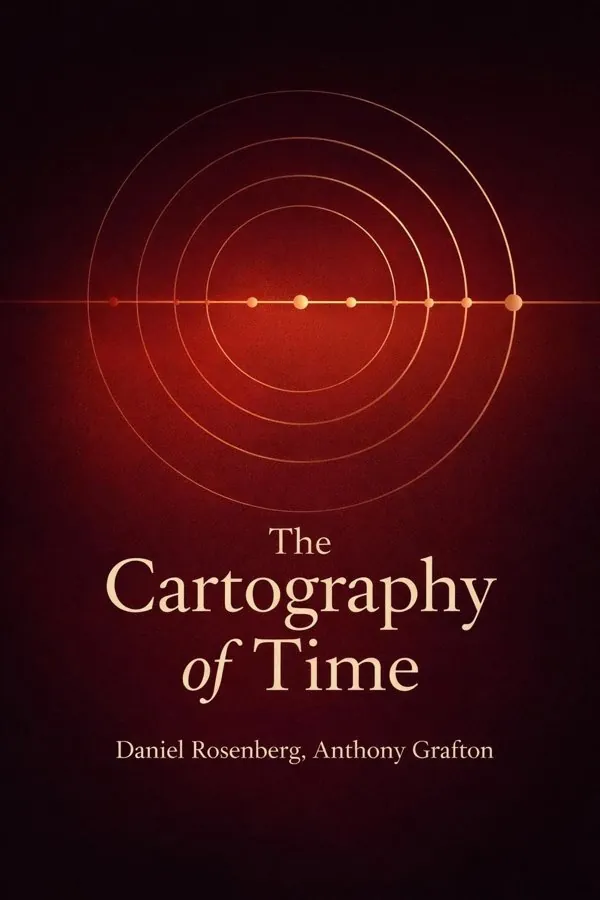
The Cartography of Time: Summary & Key Insights
by Daniel Rosenberg, Anthony Grafton
 10 min9 chaptersAudio available
Key Takeaways from The Cartography of Time
Before time became a line, it was often experienced as a rhythm.
A civilization changes when it starts to believe that history moves somewhere.
Dates are never just decorations; they are the scaffolding of historical thought.
The timeline seems so natural today that it is easy to forget it had to be invented.
How information looks changes what people are able to think.
What Is The Cartography of Time About?
The Cartography of Time by Daniel Rosenberg, Anthony Grafton is a civilization book spanning 9 pages. Time feels invisible until someone draws it. That is the central fascination of The Cartography of Time, a richly illuminating study of how human beings have tried to picture history, chronology, and temporal order across centuries. Rather than treating dates as neutral facts, Daniel Rosenberg and Anthony Grafton show that every timeline, chart, table, and diagram carries assumptions about how the world works: whether history repeats, progresses, fractures, or converges. The book moves from ancient and medieval worldviews to Renaissance chronologies, Enlightenment timelines, modern scientific graphics, and contemporary digital forms, revealing that the visualization of time has shaped not just scholarship but politics, religion, identity, and memory. What makes this work especially valuable is the authority of its authors. Rosenberg, a historian of intellectual life and information systems, and Grafton, one of the foremost historians of Renaissance learning, combine visual analysis with deep historical scholarship. Together, they demonstrate that chronology is never merely technical. It is cultural imagination made visible. For readers interested in civilization, media, history, or the design of knowledge, this book offers a powerful new way to understand how societies organize the past in order to guide the future.
This FizzRead summary covers all 9 key chapters of The Cartography of Time in approximately 10 minutes, distilling the most important ideas, arguments, and takeaways from Daniel Rosenberg, Anthony Grafton's work. Also available as an audio summary and Key Quotes Podcast.
The Cartography of Time
Time feels invisible until someone draws it. That is the central fascination of The Cartography of Time, a richly illuminating study of how human beings have tried to picture history, chronology, and temporal order across centuries. Rather than treating dates as neutral facts, Daniel Rosenberg and Anthony Grafton show that every timeline, chart, table, and diagram carries assumptions about how the world works: whether history repeats, progresses, fractures, or converges. The book moves from ancient and medieval worldviews to Renaissance chronologies, Enlightenment timelines, modern scientific graphics, and contemporary digital forms, revealing that the visualization of time has shaped not just scholarship but politics, religion, identity, and memory.
What makes this work especially valuable is the authority of its authors. Rosenberg, a historian of intellectual life and information systems, and Grafton, one of the foremost historians of Renaissance learning, combine visual analysis with deep historical scholarship. Together, they demonstrate that chronology is never merely technical. It is cultural imagination made visible. For readers interested in civilization, media, history, or the design of knowledge, this book offers a powerful new way to understand how societies organize the past in order to guide the future.
Who Should Read The Cartography of Time?
This book is perfect for anyone interested in civilization and looking to gain actionable insights in a short read. Whether you're a student, professional, or lifelong learner, the key ideas from The Cartography of Time by Daniel Rosenberg, Anthony Grafton will help you think differently.
- ✓Readers who enjoy civilization and want practical takeaways
- ✓Professionals looking to apply new ideas to their work and life
- ✓Anyone who wants the core insights of The Cartography of Time in just 10 minutes
Want the full summary?
Get instant access to this book summary and 100K+ more with Fizz Moment.
Get Free SummaryAvailable on App Store • Free to download
Key Chapters
Before time became a line, it was often experienced as a rhythm. One of the book’s most important insights is that ancient and medieval societies did not usually imagine time as a single, universal continuum stretching evenly from past to future. Instead, time was embedded in ritual, agriculture, cosmology, and sacred narrative. In Greek and Roman thought, recurring cycles of seasons, festivals, dynasties, and celestial motions shaped the sense that time returned as much as it advanced. In the medieval Christian world, chronology was often ordered not by abstract numerical sequence alone but by salvation history: Creation, Incarnation, Judgment.
This does not mean earlier cultures lacked historical awareness. Rather, they organized the past differently. Medieval chronicles frequently listed rulers, saints, and biblical events side by side, creating structures that fused sacred and secular order. Time was not yet pictured as a neutral grid; it was a moral and theological framework. Genealogies, annals, and liturgical calendars were visual tools, but they did not imply the modern idea of history as a continuous, measurable flow.
A practical lesson follows from this. Whenever we look at an old chart, calendar, or chronicle, we should not ask only whether it is accurate by modern standards. We should ask what kind of world it assumes. Does it privilege divine intervention, political legitimacy, or cosmic repetition? The answer reveals a civilization’s deepest values.
Actionable takeaway: When studying any historical period, begin by identifying how that culture structured time—cyclical, sacred, dynastic, seasonal, or linear—before interpreting its events.
A civilization changes when it starts to believe that history moves somewhere. Rosenberg and Grafton show that the Renaissance helped accelerate a major shift from cyclical and sacred temporal frameworks toward a more linear conception of time. Humanist scholars became increasingly concerned with sequence, periodization, dating, and the recovery of historical distance. Antiquity was no longer simply a source of authority; it became a past era that could be compared, reconstructed, and placed on a timeline leading toward the present.
This transformation was tied to philology, archival work, and the comparison of sources. Scholars sought to reconcile conflicting records, establish accurate dates, and distinguish between ancient, medieval, and modern periods. The idea of an ordered historical progression gave rise to new questions: When did institutions begin? How do eras differ? Can decline be separated from renewal? Time gradually became something that could be measured and mapped rather than only narrated.
The practical effect was enormous. Once time is understood as linear, reform becomes thinkable. If history is directional, then societies can imagine progress, regression, innovation, or revolution. The modern habit of thinking in terms like “before,” “after,” “transition,” and “development” depends on this intellectual shift.
Today, we use linear time constantly in project planning, education, and public memory. School curricula, museum galleries, and business roadmaps all rely on temporal sequencing as a form of explanation.
Actionable takeaway: Whenever you evaluate a modern claim about progress or decline, ask what model of linear history it assumes and whether that model clarifies reality or oversimplifies it.
Dates are never just decorations; they are the scaffolding of historical thought. In the early modern period, chronology became a serious scholarly enterprise aimed at creating coherent temporal frameworks from scattered and often contradictory evidence. Rosenberg and Grafton show how scholars worked across biblical records, classical texts, king lists, astronomical observations, and local histories to establish synchronized systems of dating. Their work was painstaking, technical, and surprisingly consequential.
Chronologists faced a difficult challenge: different cultures counted years differently, and many events had uncertain or disputed dates. To compare Egyptian, Roman, Hebrew, and Christian histories, scholars had to devise correspondences between calendars and eras. This led to chronological tables that aligned rulers, events, and civilizations across parallel columns. Such tables were not only reference tools; they changed how readers thought. By seeing simultaneous developments laid out visually, people could grasp history comparatively rather than as isolated narratives.
This was an important step toward modern historical consciousness. Chronology turned time into a shared field where diverse traditions could be positioned relative to one another. It also carried ideological power. Systems that began from biblical chronology, for instance, made theological assumptions central to global history.
In practical terms, early modern chronology resembles modern data integration. Historians were building interoperable systems for incompatible records. Their work anticipates spreadsheets, databases, and synchronized dashboards.
Actionable takeaway: When comparing information from different systems—historical sources, organizations, or cultures—first create a common frame of reference, because insight depends on alignment before interpretation.
The timeline seems so natural today that it is easy to forget it had to be invented. One of the book’s most memorable contributions is showing that the timeline is not an eternal or obvious form but a relatively modern graphic solution to a complex intellectual problem: how to make temporal sequence visible at a glance. Earlier chronologies often used lists, tables, or narrative structures. The modern timeline condensed duration, simultaneity, and succession into spatial form.
This invention mattered because it transformed reading into seeing. A reader no longer had to reconstruct chronology mentally from prose alone. A line, scale, or chart could display long stretches of time and reveal patterns instantly: overlaps between empires, gaps in records, clusters of events, and comparative duration. Once adopted, the timeline became a powerful educational device, helping students and general readers grasp history as an organized panorama.
But the timeline also imposes order. It privileges sequence over ambiguity and continuity over rupture. What does not fit the line—mythic time, recurring ritual time, emotional time, or fragmented memory—can become harder to represent. In that sense, every timeline is both a revelation and a simplification.
You can see this today in news explainers, product roadmaps, family histories, and medical charts. Timelines help people process complexity, but they also shape what counts as relevant. A startup timeline emphasizes milestones; a personal timeline may foreground trauma or achievement; a national timeline may conceal marginalized experiences.
Actionable takeaway: Use timelines as tools for orientation, but always ask what stories, voices, and forms of experience their linear structure leaves out.
How information looks changes what people are able to think. Rosenberg and Grafton argue that graphic innovations in historical representation did far more than beautify scholarship; they expanded cognitive possibilities. Charts, trees, scrolls, tables, bands, and synchronized columns allowed readers to compare events across space and time in ways that prose alone could not. Visual design became a method of argument.
Consider the difference between a written narrative of dynastic succession and a diagram that shows branching lineages, overlapping reigns, and contested inheritance. The visual format reveals patterns, compression, and relational structure instantly. Similarly, a comparative chart of civilizations can suggest parallel development, competition, or divergence before a single sentence is read. In this sense, graphics do not merely illustrate conclusions. They participate in producing them.
The book encourages readers to see historical diagrams as intellectual technologies. Their choices—scale, alignment, color, direction, spacing—carry interpretive consequences. A wide chart can imply continuity; a segmented display can imply breaks. A centered Europe can imply civilizational centrality. Graphic form shapes historical imagination.
This insight has practical application beyond historiography. Modern dashboards, infographics, and slide decks also encode arguments visually. A graph can make a trend look dramatic or negligible depending on scale. A process map can imply inevitability where there is actually uncertainty.
Actionable takeaway: Whenever you create or consume a visual representation of history or data, examine the design choices as part of the message, not as neutral packaging around the facts.
Once time is drawn as a line, it often becomes a ladder. A major theme in The Cartography of Time is the close relationship between modern temporal visualization and the idea of progress. Enlightenment and post-Enlightenment thinkers increasingly represented history as developmental: societies advanced from primitive to civilized, ignorance gave way to reason, and the future promised improvement. Timelines, evolutionary charts, and universal histories gave this belief persuasive visual form.
These representations were powerful because they transformed a philosophical claim into something that looked self-evident. If the past is arranged in ascending stages, progress appears natural. Yet Rosenberg and Grafton invite readers to question this confidence. Visual histories of progress often reflected the prejudices of their makers. They could justify colonialism, rank civilizations hierarchically, and treat Western modernity as history’s destination. In other words, a chart of time could become a map of power.
At the same time, the idea of progress also energized reform movements, scientific inquiry, and educational expansion. Belief in historical development encouraged people to imagine that institutions could improve and that inherited structures were not final. The challenge is to retain the motivating energy of progress without accepting crude or triumphalist narratives.
In contemporary life, progress rhetoric appears in technology, economics, and politics. Product releases are framed as inevitable evolution; social change is presented as a straight line toward justice, even when reality is uneven and reversible.
Actionable takeaway: Treat every narrative of progress as a hypothesis rather than a certainty, and test who benefits, who is excluded, and what setbacks the picture ignores.
Bringing different civilizations onto one temporal chart is both enlightening and dangerous. The book shows how efforts to build global and comparative chronologies expanded historical vision beyond local or confessional frameworks. Scholars increasingly sought to place Chinese dynasties, Islamic empires, biblical history, classical antiquity, and modern Europe into a single comparative system. This was a bold intellectual ambition: to imagine world history as a shared temporal field.
The value of such work is obvious. Comparative chronology helps readers see simultaneity, connection, and asymmetry. It reveals that while one empire was rising, another was declining; while one religious tradition was codifying doctrine, another was expanding commercially or artistically. These juxtapositions challenge parochial history by showing that no civilization develops in isolation.
Yet comparison can distort as easily as it clarifies. Forcing diverse cultures into one temporal framework may erase local categories of time, flatten differences in periodization, or privilege one civilization’s calendar as universal. A chart that aligns world histories can subtly install a hierarchy, especially when one region appears as the reference standard and others as supplements.
This issue remains urgent today in global education, museum curation, and media storytelling. World history textbooks, interactive maps, and comparative datasets still wrestle with how to show interconnection without homogenization.
Actionable takeaway: When comparing civilizations, use shared chronology to enable dialogue, but preserve each culture’s own temporal logic instead of reducing everything to a single master timeline.
Modernity did not simply make time more precise; it made time stranger. As scientific knowledge expanded, especially in geology, evolutionary biology, and physics, familiar historical scales became inadequate. Rosenberg and Grafton trace how modernist and scientific temporalities disrupted inherited understandings by introducing deep time, nonhuman time, standardized time, and abstract temporal systems beyond everyday perception.
Geology revealed an earth far older than traditional chronologies allowed. Evolution stretched human existence across immense biological durations. Industrial society imposed clock discipline, timetables, and synchronization, making time more standardized and impersonal. Later, scientific and artistic modernism experimented with fragmented, subjective, and multilayered temporal experience. Time was no longer only historical sequence; it was also measurable precision, cosmic depth, and psychological distortion.
Visual representation had to evolve accordingly. Stratigraphic diagrams, evolutionary trees, railway schedules, and scientific charts each gave form to kinds of time that prose struggled to capture. These new graphics changed consciousness. People began to think of themselves simultaneously as workers on the clock, citizens in national history, and tiny actors in planetary or evolutionary time.
The practical relevance is clear. Today, climate change, genomics, and digital networks all require us to understand overlapping timescales: immediate, historical, and geological. Decisions that feel local may have effects extending generations.
Actionable takeaway: When confronting complex modern problems, deliberately ask which timescale you are using—minutes, years, centuries, or millennia—because the right response often depends on seeing more than one temporal frame at once.
In the digital age, time is no longer just drawn; it is navigated. The final arc of the book points toward contemporary representations of temporality shaped by databases, interactive interfaces, searchable archives, and networked media. Unlike static timelines of earlier centuries, digital forms allow users to zoom, filter, reorder, and personalize historical information. Time becomes dynamic, layered, and responsive.
This shift changes both access and authority. In a printed chronology, the author determines the path. In digital environments, users can jump between centuries, compare regions instantly, or trace thematic rather than strictly sequential histories. The result is empowering but also disorienting. Without a clear narrative spine, chronology can become an endless field of fragments. We gain flexibility, yet risk losing coherence.
Digital temporal tools are now everywhere: project management platforms, social media feeds, historical archives, health trackers, and AI-driven visualizations. Each offers a model of time. Social media privileges immediacy and recency. Productivity apps convert time into milestones and metrics. Digital archives enable deep historical comparison. The question is not whether these systems represent time, but what habits of attention they cultivate.
Rosenberg and Grafton’s broader lesson is that new media do not free us from the politics of temporal representation. They simply relocate them. Interface design, metadata, search logic, and default sorting all influence how the past appears.
Actionable takeaway: Use digital timelines and archives actively rather than passively—adjust filters, compare scales, and question defaults so that convenience does not become your unexamined philosophy of time.
All Chapters in The Cartography of Time
About the Authors
Daniel Rosenberg is a historian of intellectual life, visual knowledge, and the history of information. His work often focuses on how systems of organization, representation, and media shape the way people understand ideas across time. Anthony Grafton is one of the most respected historians of Renaissance Europe and the history of scholarship. He is especially known for his research on humanism, chronology, reading practices, annotation, and the culture of learned books. Together, Rosenberg and Grafton bring complementary strengths to The Cartography of Time: Rosenberg’s attention to visual and informational form, and Grafton’s deep mastery of early modern historical scholarship. Their collaboration makes the book both visually attentive and intellectually authoritative, combining design history, historiography, and cultural analysis into a compelling study of how civilizations have imagined time.
Get This Summary in Your Preferred Format
Read or listen to the The Cartography of Time summary by Daniel Rosenberg, Anthony Grafton anytime, anywhere. FizzRead offers multiple formats so you can learn on your terms — all free.
Available formats: App · Audio · PDF · EPUB — All included free with FizzRead
Download The Cartography of Time PDF and EPUB Summary
Key Quotes from The Cartography of Time
“Before time became a line, it was often experienced as a rhythm.”
“A civilization changes when it starts to believe that history moves somewhere.”
“Dates are never just decorations; they are the scaffolding of historical thought.”
“The timeline seems so natural today that it is easy to forget it had to be invented.”
“How information looks changes what people are able to think.”
Frequently Asked Questions about The Cartography of Time
The Cartography of Time by Daniel Rosenberg, Anthony Grafton is a civilization book that explores key ideas across 9 chapters. Time feels invisible until someone draws it. That is the central fascination of The Cartography of Time, a richly illuminating study of how human beings have tried to picture history, chronology, and temporal order across centuries. Rather than treating dates as neutral facts, Daniel Rosenberg and Anthony Grafton show that every timeline, chart, table, and diagram carries assumptions about how the world works: whether history repeats, progresses, fractures, or converges. The book moves from ancient and medieval worldviews to Renaissance chronologies, Enlightenment timelines, modern scientific graphics, and contemporary digital forms, revealing that the visualization of time has shaped not just scholarship but politics, religion, identity, and memory. What makes this work especially valuable is the authority of its authors. Rosenberg, a historian of intellectual life and information systems, and Grafton, one of the foremost historians of Renaissance learning, combine visual analysis with deep historical scholarship. Together, they demonstrate that chronology is never merely technical. It is cultural imagination made visible. For readers interested in civilization, media, history, or the design of knowledge, this book offers a powerful new way to understand how societies organize the past in order to guide the future.
You Might Also Like
The Structure of Scientific Revolutions
Thomas S. Kuhn
10 min
Genius
Harold Bloom
10 min
A Cultural History of the Medieval Age
Various Editors
10 min
A History of God: The 4,000-Year Quest of Judaism, Christianity and Islam
Karen Armstrong
10 min
A History of the World in 10½ Chapters
Julian Barnes
10 min
A Short History of Progress
Ronald Wright
10 minBrowse by Category
Ready to read The Cartography of Time?
Get the full summary and 100K+ more books with Fizz Moment.