
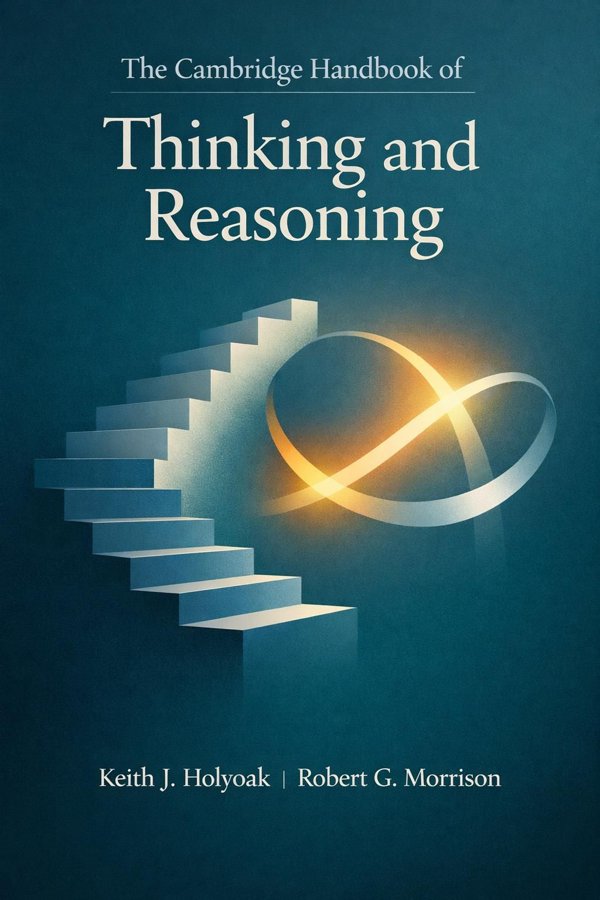
The Cambridge Handbook of Thinking and Reasoning: Summary & Key Insights
by Keith J. Holyoak, Robert G. Morrison
 10 min6 chaptersAudio available
What Is The Cambridge Handbook of Thinking and Reasoning About?
The Cambridge Handbook of Thinking and Reasoning by Keith J. Holyoak, Robert G. Morrison is a cognition book spanning 6 pages. This comprehensive handbook, edited by Keith J. Holyoak and Robert G. Morrison, brings together leading scholars in cognitive psychology, cognitive science, and neuroscience to explore the fundamental processes of human thought. It covers key topics such as reasoning, judgment, decision making, problem solving, and conceptual understanding, providing an authoritative overview of the field of thinking and reasoning.
This FizzRead summary covers all 6 key chapters of The Cambridge Handbook of Thinking and Reasoning in approximately 10 minutes, distilling the most important ideas, arguments, and takeaways from Keith J. Holyoak, Robert G. Morrison's work. Also available as an audio summary and Key Quotes Podcast.
The Cambridge Handbook of Thinking and Reasoning
This comprehensive handbook, edited by Keith J. Holyoak and Robert G. Morrison, brings together leading scholars in cognitive psychology, cognitive science, and neuroscience to explore the fundamental processes of human thought. It covers key topics such as reasoning, judgment, decision making, problem solving, and conceptual understanding, providing an authoritative overview of the field of thinking and reasoning.
Who Should Read The Cambridge Handbook of Thinking and Reasoning?
This book is perfect for anyone interested in cognition and looking to gain actionable insights in a short read. Whether you're a student, professional, or lifelong learner, the key ideas from The Cambridge Handbook of Thinking and Reasoning by Keith J. Holyoak, Robert G. Morrison will help you think differently.
- ✓Readers who enjoy cognition and want practical takeaways
- ✓Professionals looking to apply new ideas to their work and life
- ✓Anyone who wants the core insights of The Cambridge Handbook of Thinking and Reasoning in just 10 minutes
Want the full summary?
Get instant access to this book summary and 100K+ more with Fizz Moment.
Get Free SummaryAvailable on App Store • Free to download
Key Chapters
The study of reasoning has its origins not in laboratories but in philosophy. Our intellectual ancestors — from Aristotle to Descartes and Kant — sought to understand what makes human thought distinct, and how it could approach truth. These classical questions provided the metaphysical and logical frameworks that would later be recast as experimental inquiries. Aristotle’s syllogisms laid the groundwork for formal logic; Descartes’ rationalism elevated the mind’s capacity for structured reason; empiricists like Hume and Mill illuminated the limits of induction.
It was only in the twentieth century that reasoning became a subject of empirical psychology. Cognitive scientists such as Jean Piaget reframed reasoning as a developmental process, while Karl Duncker and Gestalt theorists examined the insight that accompanies problem solving. The rise of information-processing models in the mid-century revolution marked a turning point: reasoning was conceptualized as computation, operating over symbolic structures.
Our historical trajectory reveals an enduring tension between normative theories of reasoning — how people ought to think — and descriptive accounts — how they actually do. The advent of heuristics and biases research by Tversky and Kahneman in the 1970s further shifted the paradigm, demonstrating that humans rely on cognitive shortcuts that, while efficient, can systematically deviate from rational standards. Through this lineage, reasoning ceased to be the exclusive domain of logic; it became a window into the mind’s adaptive balance between accuracy and efficiency.
By retracing this development, we appreciate how the field has matured from abstract speculation to experimental rigor. Each stage, from philosophical logic to cognitive neuroscience, has expanded our understanding of not just reasoning as rule-following, but reasoning as an evolved, embodied capacity to navigate uncertainty.
Reasoning occurs through architecture — the organized structure of memory, attention, and representation that supports thought. In this volume, we explore these architectures through multiple lenses. The symbolic tradition treats reasoning as the manipulation of propositions within a rule-governed system. The connectionist perspective, arising from neural network models, emphasizes distributed patterns of activation that approximate reasoning through learning and association.
At the intersection of these traditions lies the theory of mental models, pioneered by Philip Johnson-Laird. Mental models propose that reasoning unfolds through the construction and manipulation of internal representations of possible states of the world. When individuals reason about a conditional statement or a causal sequence, they simulate alternative realities, testing consistency and coherence. The errors and successes of reasoning emerge from the inherent constraints of this simulation process: working memory limitations, attentional focus, and prior knowledge all shape the models we build.
From my perspective as an editor and researcher, the most vital insight of cognitive architectures is that reasoning is not a monolithic process. It flexibly recruits multiple subsystems — visual-spatial imagery, linguistic coding, emotional appraisal — depending on the problem’s nature. Modern computational theories, such as ACT-R and SOAR, integrate these functions, modeling how declarative and procedural knowledge cooperate to produce rational behavior.
In life, we experience this architecture daily. Whether one evaluates risk, interprets conversation, or solves a scientific problem, reasoning unfolds through internal simulations grounded in cognitive structure. Understanding these architectures gives us both a theoretical and practical advantage: it teaches us not only how minds reason, but how to design environments, tools, and technologies that complement their natural strengths.
+ 4 more chapters — available in the FizzRead app
All Chapters in The Cambridge Handbook of Thinking and Reasoning
About the Authors
Keith J. Holyoak is a Distinguished Professor of Psychology at the University of California, Los Angeles (UCLA), known for his research on analogy and reasoning. Robert G. Morrison is a Professor of Psychology at Loyola University Chicago, specializing in cognitive neuroscience and reasoning.
Get This Summary in Your Preferred Format
Read or listen to the The Cambridge Handbook of Thinking and Reasoning summary by Keith J. Holyoak, Robert G. Morrison anytime, anywhere. FizzRead offers multiple formats so you can learn on your terms — all free.
Available formats: App · Audio · PDF · EPUB — All included free with FizzRead
Download The Cambridge Handbook of Thinking and Reasoning PDF and EPUB Summary
Key Quotes from The Cambridge Handbook of Thinking and Reasoning
“The study of reasoning has its origins not in laboratories but in philosophy.”
“Reasoning occurs through architecture — the organized structure of memory, attention, and representation that supports thought.”
Frequently Asked Questions about The Cambridge Handbook of Thinking and Reasoning
The Cambridge Handbook of Thinking and Reasoning by Keith J. Holyoak, Robert G. Morrison is a cognition book that explores key ideas across 6 chapters. This comprehensive handbook, edited by Keith J. Holyoak and Robert G. Morrison, brings together leading scholars in cognitive psychology, cognitive science, and neuroscience to explore the fundamental processes of human thought. It covers key topics such as reasoning, judgment, decision making, problem solving, and conceptual understanding, providing an authoritative overview of the field of thinking and reasoning.
You Might Also Like
A Field Guide to Lies: Critical Thinking in the Information Age
Daniel J. Levitin
10 min
A Theory of Cognitive Dissonance
Leon Festinger
10 min
Black-And-White Thinking: The Burden of a Binary Brain in a Complex World
Kevin Dutton
10 min
Born Liars: Why We Can’t Live Without Deceit
Ian Leslie
10 min
Collective Illusions: Conformity, Complicity, and the Science of Why We Make Bad Decisions
Todd Rose
10 min
Concrete Mathematics: A Foundation for Computer Science
Ronald L. Graham, Donald E. Knuth, Oren Patashnik
10 minBrowse by Category
Ready to read The Cambridge Handbook of Thinking and Reasoning?
Get the full summary and 100K+ more books with Fizz Moment.