
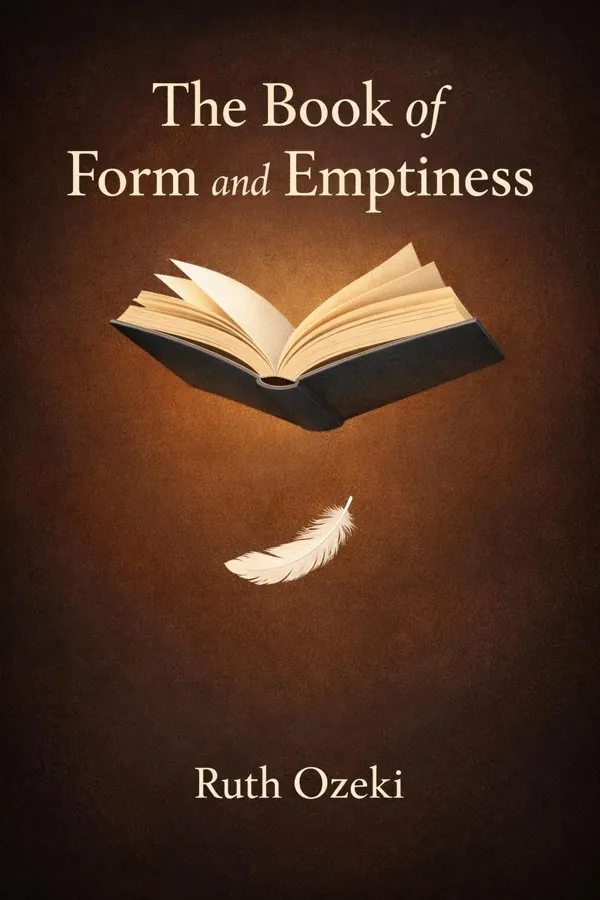
The Book of Form and Emptiness: Summary & Key Insights
by Ruth Ozeki
 10 min9 chaptersAudio available
Key Takeaways from The Book of Form and Emptiness
Sometimes loss does not arrive as silence; it arrives as unbearable noise.
Objects can become emotional stand-ins when people are gone.
In a culture addicted to speed and consumption, a library can feel almost revolutionary.
A book is one of the few objects that can hold both form and emptiness at once.
What if some forms of breakdown are also forms of perception?
What Is The Book of Form and Emptiness About?
The Book of Form and Emptiness by Ruth Ozeki is a bestsellers book spanning 5 pages. What if grief made the world louder instead of quieter? In Ruth Ozeki’s The Book of Form and Emptiness, that unsettling question becomes the doorway into a novel that is at once intimate family drama, philosophical meditation, and playful metafiction. After the sudden death of his jazz-musician father, thirteen-year-old Benny Oh begins hearing voices from the objects around him. At the same time, his mother, Annabelle, overwhelmed by sorrow, starts filling their home with possessions she cannot let go of. As Benny searches for refuge, he finds it in a public library, where books, silence, and attention open a different way of understanding reality. This novel matters because it transforms heavy subjects such as bereavement, mental illness, consumer culture, and isolation into a humane exploration of how people survive emotional chaos. Ozeki writes with unusual authority here: she is not only an acclaimed novelist, but also a Zen Buddhist priest whose work often examines consciousness, interdependence, and the stories people tell to live. The result is a deeply original book that asks how we listen, what we cling to, and whether emptiness might be not absence, but possibility.
This FizzRead summary covers all 9 key chapters of The Book of Form and Emptiness in approximately 10 minutes, distilling the most important ideas, arguments, and takeaways from Ruth Ozeki's work. Also available as an audio summary and Key Quotes Podcast.
The Book of Form and Emptiness
What if grief made the world louder instead of quieter? In Ruth Ozeki’s The Book of Form and Emptiness, that unsettling question becomes the doorway into a novel that is at once intimate family drama, philosophical meditation, and playful metafiction. After the sudden death of his jazz-musician father, thirteen-year-old Benny Oh begins hearing voices from the objects around him. At the same time, his mother, Annabelle, overwhelmed by sorrow, starts filling their home with possessions she cannot let go of. As Benny searches for refuge, he finds it in a public library, where books, silence, and attention open a different way of understanding reality.
This novel matters because it transforms heavy subjects such as bereavement, mental illness, consumer culture, and isolation into a humane exploration of how people survive emotional chaos. Ozeki writes with unusual authority here: she is not only an acclaimed novelist, but also a Zen Buddhist priest whose work often examines consciousness, interdependence, and the stories people tell to live. The result is a deeply original book that asks how we listen, what we cling to, and whether emptiness might be not absence, but possibility.
Who Should Read The Book of Form and Emptiness?
This book is perfect for anyone interested in bestsellers and looking to gain actionable insights in a short read. Whether you're a student, professional, or lifelong learner, the key ideas from The Book of Form and Emptiness by Ruth Ozeki will help you think differently.
- ✓Readers who enjoy bestsellers and want practical takeaways
- ✓Professionals looking to apply new ideas to their work and life
- ✓Anyone who wants the core insights of The Book of Form and Emptiness in just 10 minutes
Want the full summary?
Get instant access to this book summary and 100K+ more with Fizz Moment.
Get Free SummaryAvailable on App Store • Free to download
Key Chapters
Sometimes loss does not arrive as silence; it arrives as unbearable noise. That is the strange and powerful premise of Benny Oh’s awakening after his father dies suddenly. In the wake of grief, Benny begins hearing voices from the objects around him: sneakers complain, household items chatter, and the ordinary material world becomes animated with demand and distress. These voices are not treated simply as a fantasy device or a symptom to be neatly explained away. Instead, Ozeki uses them to show how grief can radically alter perception. When life breaks open, the familiar world no longer feels stable. Everything once ignored becomes charged with meaning.
Benny’s experience reflects a deeper truth about mourning and sensitivity. After a major loss, people often become hyperaware: sounds seem harsher, rooms feel different, and ordinary routines become emotionally loaded. Benny’s voices externalize this inner condition. They dramatize what happens when a young person can no longer filter reality in the usual way. The result is both frightening and revealing, because the voices force him to confront how crowded, demanding, and noisy modern life really is.
In practical terms, Ozeki invites readers to think about what their own “noise” might be. It may not come from speaking objects, but from notifications, obligations, clutter, and unresolved emotions. Many people discover during times of stress that what they once managed easily becomes intolerable.
The lesson is not to dismiss unusual perceptions, but to ask what they are expressing. The actionable takeaway: when your world suddenly feels too loud, pause before labeling the feeling as failure. Instead, identify what changed, what hurts, and what your heightened awareness may be trying to tell you.
Objects can become emotional stand-ins when people are gone. Annabelle, Benny’s mother, demonstrates this with painful clarity. After the death of her husband, she starts accumulating things at an alarming pace. Her shopping and hoarding are not presented as simple carelessness or greed. They are a form of grief management, a misguided attempt to fill absence with form. Each item promises comfort, continuity, or control, but instead contributes to suffocation.
Ozeki is especially insightful in showing why clutter can feel meaningful to the person who collects it. For Annabelle, possessions become proof that life is still happening. A purchase offers a temporary burst of relief. A saved object holds memory. A stack of items seems to protect against future loss. Yet over time the house becomes unlivable, and the physical environment mirrors her emotional state: congested, unresolved, and impossible to navigate clearly.
This idea reaches beyond the novel. Many readers will recognize softer versions of Annabelle’s pattern in their own lives. People keep clothes they never wear, boxes they never open, or sentimental items they never truly revisit. The issue is not material ownership itself, but the emotional burden placed on things. When possessions become substitutes for mourning, love, identity, or security, they can quietly begin to rule a household.
Ozeki asks us to notice the relationship between inner disorder and outer accumulation. Clearing a space does not solve grief, but it can make grief more visible and therefore more workable. The actionable takeaway: choose one small area of your home and ask of each object, “Am I keeping this for use, for joy, or because I’m afraid to let go?” That question can begin turning clutter back into conscious choice.
In a culture addicted to speed and consumption, a library can feel almost revolutionary. For Benny, the public library becomes more than a building full of books. It is a sanctuary, a structure of quiet attention in a world that has become overwhelming. Within its walls, the noise of objects is transformed. Books still speak, but they do so differently: not as demands, but as invitations. The library gives Benny a place where listening becomes meaningful instead of chaotic.
Ozeki presents the library as one of the novel’s most important moral and spiritual spaces. It is democratic, communal, and protective. Unlike stores, it is not built around buying. Unlike much of modern life, it rewards slowness. For a boy struggling with grief, social alienation, and psychiatric labeling, this matters immensely. The library does not require him to be normal before it offers welcome. It gives him access to stories, companionship, and contemplative space.
This idea has broad practical resonance. Libraries remain one of the few public institutions where people can exist without needing to spend money. They offer books, internet access, classes, shelter, and human contact. For young people especially, libraries can function as places of self-invention. A person who feels misunderstood at home or school may find language, perspective, and dignity there.
Ozeki also suggests that environments shape consciousness. A noisy room pulls the mind one way; a room organized around reading and reflection pulls it another. The library helps Benny build an inner life capable of surviving turmoil.
The actionable takeaway: if your mind feels fragmented, spend intentional time in a place designed for attention rather than consumption. A library, reading room, or quiet communal space can become more than an escape; it can become a method of repair.
A book is one of the few objects that can hold both form and emptiness at once. It is materially present, yet full of invisible voices, meanings, and worlds. Ozeki plays brilliantly with this paradox by making the book itself feel alive. In Benny’s life, books do not merely entertain him; they accompany him, interpret him, and help him survive. Reading becomes less about information and more about relationship.
This is one of the novel’s most moving claims: stories are a way human beings remain available to one another across loneliness, death, and distance. Benny is isolated by his grief and by experiences others struggle to understand. But books offer him company without intrusion. They do not demand immediate performance. They let him think at his own pace. In that sense, reading becomes a deeply ethical act, one that trains empathy and attention.
Ozeki also asks readers to see narrative itself as a living force. The stories we consume and tell ourselves influence what seems possible. If your life story becomes “I am broken,” your choices narrow. If it becomes “I am in the middle of a difficult chapter,” the future reopens. This is not denial; it is narrative framing with consequences.
In everyday life, many people already use books this way, even if unconsciously. A memoir can make private pain feel shared. A novel can help someone imagine forgiveness. A poem can name a feeling that had no language before.
The actionable takeaway: choose one book not for productivity, but for companionship. Read with the question, “What voice do I need in my life right now?” Treat reading not as consumption, but as conversation.
What if some forms of breakdown are also forms of perception? The Book of Form and Emptiness does not romanticize suffering, but it refuses simplistic categories of sane and insane. Benny’s voices create fear, social difficulty, and genuine danger, yet the novel also asks whether his sensitivity reveals truths the rest of society has numbed itself against. Ozeki explores the gray area where mental distress, spiritual awareness, trauma response, and social nonconformity overlap.
This tension is central to the book’s emotional power. Benny is subject to adults and institutions that want explanation, diagnosis, and management. Some of that intervention is necessary; he needs care and protection. But Ozeki shows how systems can flatten a person’s experience when they focus only on correction. Benny is not just a problem to be solved. He is a consciousness trying to make sense of an overwhelming world.
The same is true in real life. Mental health language can be clarifying and lifesaving, but it can also become reductive when it ignores context. A teenager’s distress may involve bereavement, overstimulation, family instability, and loneliness, not merely a clinical label. The novel encourages readers to hold complexity: someone can need treatment and also deserve to have the meaning of their experience honored.
This idea has practical application in how we respond to ourselves and others. Instead of asking only, “How do we stop this behavior?” we can also ask, “What pain, perception, or unmet need is this expressing?” That shift can lead to more compassionate care.
The actionable takeaway: when confronted with unusual or difficult behavior, resist instant judgment. Pair concern with curiosity. Seek support, but also make space for the possibility that distress may contain information worth listening to.
Much of modern life is organized to keep us wanting. Ozeki connects Benny’s auditory overwhelm and Annabelle’s hoarding to a wider critique of consumer culture, where objects are constantly marketed as solutions to emotional discomfort. In such a world, things are not just things. They become promises: buy this and you will feel safer, newer, more admired, less lonely. But the promises multiply faster than they can ever be fulfilled.
The novel exposes the psychic cost of that arrangement. When every object arrives with emotional pressure attached, the world becomes crowded with unprocessed demand. Annabelle’s home fills with purchases that were supposed to soothe grief but instead deepen entrapment. Benny, meanwhile, hears the clamor more literally, as if the material world itself is protesting its overproduction and overconsumption. This gives Ozeki’s social criticism an imaginative edge. She is not only saying that people own too much. She is saying that our relationship to things has become spiritually and psychologically distorted.
Readers can apply this insight immediately. Think about impulse buying after a bad day, or the way online shopping creates a brief sense of control. The package arrives, there is a momentary lift, and then the underlying feeling remains. Many homes become archives of attempted self-repair.
Ozeki does not demand asceticism. The point is not to reject all possessions, but to notice when consumption is being asked to do the work of connection, mourning, or meaning. Awareness alone can interrupt the cycle.
The actionable takeaway: before buying something nonessential, ask, “What feeling am I hoping this object will change?” If the answer is emotional rather than practical, address the feeling first and delay the purchase.
One of the novel’s deepest insights is that emptiness is not the same as absence. Drawing on Buddhist thought without turning the story into a lecture, Ozeki explores emptiness as openness, interdependence, and the lack of fixed essence. This matters because both Benny and Annabelle initially treat emptiness as something terrifying. His father’s death leaves a hole. Their home and family identity feel unstable. The instinctive response is to fill the gap or flee it.
But the book slowly suggests another possibility: emptiness may be what allows transformation. A room must have empty space to be livable. A page must have openness to hold words. A person must accept uncertainty to grow into someone new. Clinging too hard to fixed forms, whether possessions, roles, or explanations, can create suffering because life is inherently changing.
This concept can sound abstract, but Ozeki grounds it in everyday experience. Anyone who has cleaned out a room, left a job, ended a relationship, or sat quietly after a loss knows the discomfort of open space. Yet those spaces often become the conditions for clarity. We fear the vacuum because we do not control what comes next. The novel teaches that not every gap needs immediate filling.
For readers, this is both philosophical and practical. Instead of seeing emptiness as failure, we can begin to see it as capacity. Silence can hold attention. Uncertainty can hold possibility. Grief can hold love.
The actionable takeaway: when you encounter an empty space in your schedule, home, or emotional life, resist rushing to fill it. Spend a few moments asking what that openness might make possible before deciding what should come next.
People in pain often need witness before they need advice. Throughout the novel, Benny and Annabelle suffer not only from grief and disorder, but from forms of misattunement. Others judge, dismiss, label, or try to control them without fully seeing them. Ozeki repeatedly suggests that healing begins with attention: careful listening, patient presence, and respect for complexity.
This is why the book feels so humane even when its events are painful. It does not offer easy redemption through a single cure or revelation. Instead, it honors small acts of care: someone making space, someone listening without panic, someone recognizing the humanity beneath bizarre behavior. Compassion here is not sentimental. It is disciplined perception. To care well, one must resist the urge to simplify another person’s experience for one’s own comfort.
This insight applies powerfully in ordinary relationships. When a friend is overwhelmed, many people leap to solutions because uncertainty is uncomfortable. Yet practical fixes can feel invalidating if they come before understanding. The same is true in families, schools, and workplaces. Attention communicates dignity. It says: your experience is real enough to be met, not merely managed.
Ozeki also implies that self-compassion works similarly. People often try to correct their own pain through productivity, distraction, or self-criticism. But internal healing may begin with naming what is true and staying present long enough to understand it.
The actionable takeaway: in your next difficult conversation, delay advice. First reflect back what you hear, ask one clarifying question, and let silence do some work. Often the most healing response is not a fix, but a form of steady attention.
We survive chaos by finding forms that can hold it. At its heart, The Book of Form and Emptiness is a novel about storytelling itself: who tells the story, how a life becomes narratable, and why narrative can make suffering more bearable without reducing it. Benny’s world is fragmented by grief, noise, and instability. Story does not erase those realities, but it gives them contour. Once experience can be witnessed, spoken, or written, it is no longer only a blur of pain.
Ozeki’s metafictional playfulness reinforces this idea. She reminds readers that books are constructed objects, forms shaped around formless life. Yet that constructedness is not a weakness; it is a gift. Human beings need frames, rituals, and language to metabolize what happens to them. Funerals, diaries, conversations, therapy, and literature all serve this purpose. They do not change the facts of loss, but they change how loss lives within us.
This is why the novel can feel so consoling despite its sadness. It suggests that meaning is not always discovered fully formed. Often it is made gradually through the telling. A person may not understand their life while living it, but in recounting it, patterns emerge. Pain begins to belong somewhere.
The practical application is direct. When life feels shapeless, create a container. Write what happened. Tell the story to someone trustworthy. Organize one confusing experience into a beginning, middle, and present moment. You may not reach a conclusion, but you may recover coherence.
The actionable takeaway: take ten minutes to write about one difficult experience as a story rather than a complaint. Focus on what changed, what was lost, and what you are learning now. Narrative can be a first act of healing.
All Chapters in The Book of Form and Emptiness
About the Author
Ruth Ozeki is an American-Canadian novelist, filmmaker, and Zen Buddhist priest whose work is celebrated for its originality, compassion, and intellectual depth. Born in the United States and connected to both North American and Japanese cultural traditions, she often writes about identity, ecology, food, time, consciousness, and the ethical power of storytelling. Before establishing herself as a novelist, she worked in film and media, experiences that contributed to her vivid narrative style and structural experimentation. Her best-known books include My Year of Meats, All Over Creation, and A Tale for the Time Being, which was shortlisted for the Booker Prize. Ozeki’s Buddhist practice deeply informs her fiction, giving it a distinctive ability to explore suffering, impermanence, and interdependence without losing warmth, humor, or emotional accessibility.
Get This Summary in Your Preferred Format
Read or listen to the The Book of Form and Emptiness summary by Ruth Ozeki anytime, anywhere. FizzRead offers multiple formats so you can learn on your terms — all free.
Available formats: App · Audio · PDF · EPUB — All included free with FizzRead
Download The Book of Form and Emptiness PDF and EPUB Summary
Key Quotes from The Book of Form and Emptiness
“Sometimes loss does not arrive as silence; it arrives as unbearable noise.”
“Objects can become emotional stand-ins when people are gone.”
“In a culture addicted to speed and consumption, a library can feel almost revolutionary.”
“A book is one of the few objects that can hold both form and emptiness at once.”
“What if some forms of breakdown are also forms of perception?”
Frequently Asked Questions about The Book of Form and Emptiness
The Book of Form and Emptiness by Ruth Ozeki is a bestsellers book that explores key ideas across 9 chapters. What if grief made the world louder instead of quieter? In Ruth Ozeki’s The Book of Form and Emptiness, that unsettling question becomes the doorway into a novel that is at once intimate family drama, philosophical meditation, and playful metafiction. After the sudden death of his jazz-musician father, thirteen-year-old Benny Oh begins hearing voices from the objects around him. At the same time, his mother, Annabelle, overwhelmed by sorrow, starts filling their home with possessions she cannot let go of. As Benny searches for refuge, he finds it in a public library, where books, silence, and attention open a different way of understanding reality. This novel matters because it transforms heavy subjects such as bereavement, mental illness, consumer culture, and isolation into a humane exploration of how people survive emotional chaos. Ozeki writes with unusual authority here: she is not only an acclaimed novelist, but also a Zen Buddhist priest whose work often examines consciousness, interdependence, and the stories people tell to live. The result is a deeply original book that asks how we listen, what we cling to, and whether emptiness might be not absence, but possibility.
More by Ruth Ozeki


You Might Also Like

The Godfather
Mario Puzo
10 min
The Handmaid's Tale
Margaret Atwood
10 min
The Hunger Games
Suzanne Collins
10 min
The Nightingale
Kristin Hannah
10 min
The Seven Husbands of Evelyn Hugo
Taylor Jenkins Reid
10 min
Backwater Justice
Fern Michaels
10 minBrowse by Category
Ready to read The Book of Form and Emptiness?
Get the full summary and 100K+ more books with Fizz Moment.