
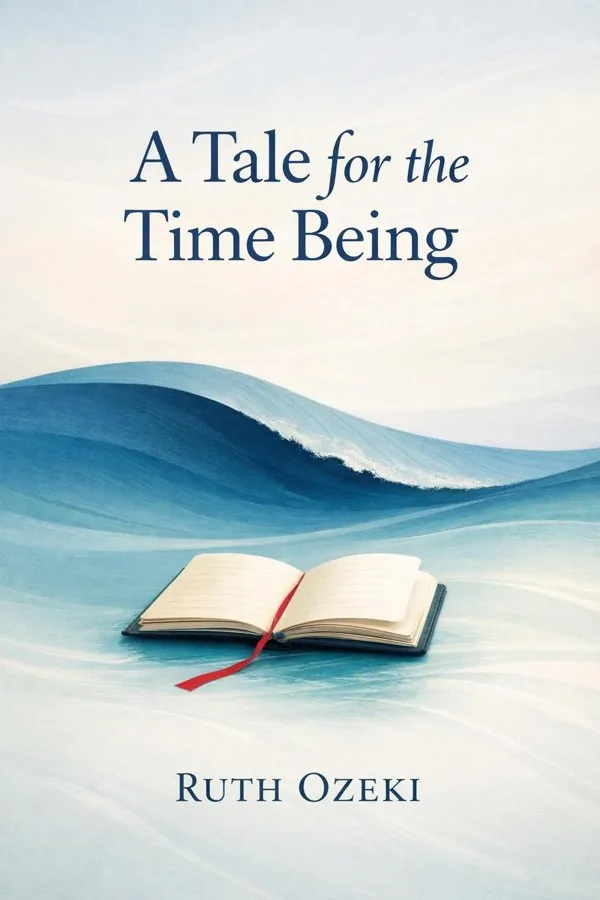
A Tale for the Time Being: Summary & Key Insights
by Ruth Ozeki
 10 min9 chaptersAudio available
Key Takeaways from A Tale for the Time Being
Sometimes the most important stories enter our lives as accidents.
Loneliness is rarely loud at first; it often arrives as a slow distortion of time.
When the world becomes unbearable, survival may begin not with escape but with attention.
To read deeply is to risk becoming changed by what you read.
We often think of time as something we move through, but Ozeki suggests that time may also move through us.
What Is A Tale for the Time Being About?
A Tale for the Time Being by Ruth Ozeki is a bestsellers book spanning 5 pages. A Tale for the Time Being is a luminous, genre-defying novel about how one life can reach across oceans, generations, and even time itself to transform another. Ruth Ozeki begins with a striking premise: on a remote island in British Columbia, a writer named Ruth discovers a lunchbox washed ashore, containing the diary of Nao, a troubled Japanese teenager in Tokyo. As Ruth reads, two narratives begin to intertwine—Nao’s intimate, urgent account of bullying, loneliness, family despair, and her great-grandmother Jiko’s Zen wisdom, and Ruth’s own effort to understand whether the girl who wrote these pages is still alive. What unfolds is part literary mystery, part meditation on consciousness, and part deeply humane portrait of suffering and resilience. The novel matters because it asks rare, unsettling questions: How do stories shape reality? What does it mean to be present in time? And how are strangers bound to one another through attention and compassion? Ozeki, a celebrated novelist, filmmaker, and Zen Buddhist priest, brings unusual authority to these themes, blending emotional depth, philosophical insight, and cultural nuance into a work that lingers long after the final page.
This FizzRead summary covers all 9 key chapters of A Tale for the Time Being in approximately 10 minutes, distilling the most important ideas, arguments, and takeaways from Ruth Ozeki's work. Also available as an audio summary and Key Quotes Podcast.
A Tale for the Time Being
A Tale for the Time Being is a luminous, genre-defying novel about how one life can reach across oceans, generations, and even time itself to transform another. Ruth Ozeki begins with a striking premise: on a remote island in British Columbia, a writer named Ruth discovers a lunchbox washed ashore, containing the diary of Nao, a troubled Japanese teenager in Tokyo. As Ruth reads, two narratives begin to intertwine—Nao’s intimate, urgent account of bullying, loneliness, family despair, and her great-grandmother Jiko’s Zen wisdom, and Ruth’s own effort to understand whether the girl who wrote these pages is still alive. What unfolds is part literary mystery, part meditation on consciousness, and part deeply humane portrait of suffering and resilience. The novel matters because it asks rare, unsettling questions: How do stories shape reality? What does it mean to be present in time? And how are strangers bound to one another through attention and compassion? Ozeki, a celebrated novelist, filmmaker, and Zen Buddhist priest, brings unusual authority to these themes, blending emotional depth, philosophical insight, and cultural nuance into a work that lingers long after the final page.
Who Should Read A Tale for the Time Being?
This book is perfect for anyone interested in bestsellers and looking to gain actionable insights in a short read. Whether you're a student, professional, or lifelong learner, the key ideas from A Tale for the Time Being by Ruth Ozeki will help you think differently.
- ✓Readers who enjoy bestsellers and want practical takeaways
- ✓Professionals looking to apply new ideas to their work and life
- ✓Anyone who wants the core insights of A Tale for the Time Being in just 10 minutes
Want the full summary?
Get instant access to this book summary and 100K+ more with Fizz Moment.
Get Free SummaryAvailable on App Store • Free to download
Key Chapters
Sometimes the most important stories enter our lives as accidents. That is the animating mystery at the start of A Tale for the Time Being, when Ruth, living a quiet life on a remote island in British Columbia, discovers a Hello Kitty lunchbox washed ashore. Inside are a diary, old letters, and fragments that seem to have survived disaster, perhaps even the 2011 tsunami. What begins as curiosity quickly becomes an ethical encounter: if another person’s private words arrive in your hands, what do you owe them?
This opening does more than launch the plot. It establishes one of the novel’s deepest ideas: reading is not passive consumption but relationship. Ruth is not merely decoding Nao’s diary; she is entering the emotional weather of a stranger’s life. The sea, often imagined as a barrier between worlds, becomes a medium of connection. Debris becomes testimony. A found object becomes a living voice.
In practical terms, the novel invites readers to think about how often meaning arrives indirectly. An old letter, a voicemail, a social media post, or a chance conversation can alter our understanding of another person. We tend to assume that connection depends on immediacy, but Ozeki shows that distance can heighten attention. Ruth’s slowness—her reading, pausing, researching, doubting—turns discovery into care.
The washed-ashore diary also frames a larger question about our own lives: what traces are we leaving behind, intentionally or not? Every message, note, and memory may someday become part of someone else’s effort to understand us.
Actionable takeaway: Treat the stories and artifacts that come into your life with reverence; they may be invitations not just to know, but to care.
Loneliness is rarely loud at first; it often arrives as a slow distortion of time. Through Nao’s diary, Ozeki gives us the inner life of a teenager who feels stranded inside her own existence. Nao has returned to Tokyo after years in California, where her family once lived with relative stability. Her father’s unemployment and depression uproot them, and in Japan she becomes a returnee—culturally Japanese, yet treated as alien. At school she is bullied with relentless cruelty, while at home she witnesses her father’s despair and suicidal ideation. Time, for Nao, becomes oppressive: school days stretch into dread, the future narrows, and the present feels unbearable.
This section of the novel captures adolescence with unusual precision. Nao is witty, intelligent, and self-aware, but those qualities do not protect her from social exclusion. Ozeki refuses sentimental simplifications. Bullying is not portrayed as a single conflict to be solved, but as a system of humiliation that reshapes identity. Family stress compounds it. When a parent loses hope, a child often begins to carry emotional burdens far beyond her years.
Readers can apply this insight well beyond the novel. In real life, distress often hides behind sarcasm, withdrawal, or apparent defiance. A student who stops participating, a colleague who grows erratic, or a friend who jokes darkly may not be difficult; they may be overwhelmed. Nao’s diary is compelling because it allows us to see what public behavior conceals.
Ozeki also shows that naming suffering matters. Writing becomes one way for Nao to hold herself together when her environment is trying to erase her.
Actionable takeaway: When someone seems unreachable, look beneath the behavior and make room for the untold pressure shaping their days.
When the world becomes unbearable, survival may begin not with escape but with attention. One of the novel’s most restorative threads centers on Jiko, Nao’s 104-year-old great-grandmother, a Zen Buddhist nun whose presence offers an alternative rhythm to the frantic pain of modern life. At Jiko’s temple, Nao encounters something she has nearly lost: spaciousness. Jiko does not erase suffering with platitudes. Instead, she teaches Nao how to sit with mind, body, memory, and grief without immediately fleeing them.
These scenes are central to the novel’s emotional architecture. Jiko embodies wisdom, but not in a distant or abstract way. Her teachings emerge through meals, stories, silence, humor, and disciplined practice. Zen here is not exotic decoration; it is a method of being present to impermanence. Nao learns that identity is not fixed, that thoughts are not commands, and that even pain can be observed without total surrender to it.
Ozeki’s portrayal has practical power because it translates philosophy into lived habit. Many readers know the language of mindfulness, but the novel shows what it can mean under real strain. For someone in emotional turmoil, meditation may not produce instant peace. It may simply create one small gap between feeling and action—and that gap can be life-preserving. Jiko’s influence also reminds us of the value of intergenerational relationships. Wisdom often arrives from those who have endured enough life to recognize which crises are survivable.
In everyday terms, this might look like taking ten quiet minutes before reacting, building rituals that anchor your day, or seeking out elders, teachers, or communities that cultivate steadiness rather than urgency.
Actionable takeaway: Create a practice of stillness, however modest, that helps you observe your pain without letting it define your next action.
To read deeply is to risk becoming changed by what you read. As Ruth immerses herself in Nao’s diary, she does not remain a detached observer. She begins researching names, places, historical references, and possible clues about Nao’s fate. Yet the more she investigates, the more the boundary between fact and imagination begins to blur. Dreams intrude. Coincidences intensify. Ruth’s reading becomes participatory, almost metaphysical, as if attention itself might influence what is possible.
This part of the novel explores a subtle but profound idea: narrative is not only a record of reality; it can also reshape the reader’s sense of reality. Ruth becomes emotionally responsible for Nao, despite distance in geography and time. Her husband Oliver, grounded and skeptical, offers a counterbalance, but even he is drawn into the uncertainty. Ozeki uses this tension to ask whether stories are discovered, created, or co-created by those who tell and receive them.
The practical application is easy to overlook but deeply relevant. We are all interpreters, constantly piecing together incomplete information from emails, conversations, memories, and media. The danger lies in either overclaiming certainty or dismissing intuition entirely. Ruth models a better approach: investigate carefully, but remain open to mystery. She cross-checks facts, yet she also honors emotional truth.
This has value in modern life, especially in an age of fragmented information. Whether you are trying to understand a family history, a personal conflict, or your own past, the goal is not perfect control over meaning. It is a disciplined humility that combines curiosity, evidence, and imagination.
Actionable takeaway: When facing uncertainty, research what you can, question your assumptions, and leave room for truths that logic alone cannot fully capture.
We often think of time as something we move through, but Ozeki suggests that time may also move through us. One of the novel’s most memorable achievements is the way it bends conventional chronology. Nao writes from one point in history; Ruth reads from another. Yet the emotional immediacy of the diary collapses that distance. Past events feel present. Present anxieties reshape the past. Through dreams, quantum ideas, and narrative structure, Ozeki turns time from backdrop into subject.
The title phrase, “time being,” captures this beautifully. It points both to a person existing in time and to the fleeting nature of all existence. Nao is a time being. Ruth is a time being. So is every reader. This insight is philosophical, but it lands with emotional force because the novel shows how memory, anticipation, and attention create our lived experience. We do not merely inhabit the clock; we inhabit stories about what has happened and what might happen next.
This perspective can be applied in everyday life. Many people live either trapped by past injury or consumed by future fear. Ozeki does not deny those pressures, but she encourages a different orientation: the present is not a thin, disposable instant between regret and worry. It is the only place where care, reading, listening, forgiveness, and change can occur.
Even small habits can reflect this. Writing a daily journal, walking without your phone, or giving undivided attention in conversation can restore a sense of lived time rather than rushed time. Ozeki’s novel asks readers to consider presence not as a slogan, but as an ethical stance.
Actionable takeaway: Reclaim one part of your day from distraction and inhabit it fully; attention is how we honor our brief life in time.
A stranger’s story can become a form of rescue. At its heart, A Tale for the Time Being is about the power of narrative to cross barriers that seem absolute: nation, language, generation, loneliness, and even death. Nao writes because she needs witness. Ruth reads because she cannot turn away. Between them, a bridge forms—not through direct conversation, but through sustained attention. This is one of Ozeki’s most generous claims: stories do not merely entertain us; they create conditions for empathy that ordinary social life often fails to provide.
The bridge matters because both women are in states of uncertainty. Nao fears she may disappear into suffering. Ruth feels adrift in her own life, creatively and emotionally. The diary becomes transformative for both. For Nao, writing affirms that her life is worth narrating. For Ruth, reading rekindles urgency, responsibility, and wonder. The relationship is asymmetrical, but it is real.
In practical life, we see this whenever memoir, fiction, or testimony helps us recognize experiences outside our own. A person who has never endured migration may understand displacement through narrative. Someone untouched by depression may begin to grasp its texture through a carefully rendered voice. Stories do not replace action, but they often make meaningful action possible by humanizing what was abstract.
Ozeki also reminds us that listening is an art. Ruth does not consume Nao’s diary quickly. She rereads, reflects, researches, and questions herself. That kind of reading resembles how we should listen to actual people—especially when they are vulnerable.
Actionable takeaway: Read and listen in ways that enlarge your capacity for empathy; understanding often begins by giving another person’s voice your full attention.
No life begins on a blank page. As Nao tells her story, Ozeki gradually reveals the historical and familial forces that live inside the present. Most notably, the novel reaches back to Nao’s great-uncle Haruki #1, a kamikaze pilot during World War II, whose letters and fate expose the moral injuries passed across generations. The family’s contemporary pain—depression, silence, shame, pressure, and fragmentation—does not emerge from nowhere. It is entangled with war, nationalism, expectation, and unresolved grief.
This broadens the novel from a personal coming-of-age story into a meditation on inherited trauma. Ozeki shows that history is not over simply because it is no longer headline news. It lingers in family stories, omissions, emotional habits, and self-concepts. Nao’s father, overwhelmed by economic failure and despair, becomes one more link in a chain of suffering that includes larger social and historical wounds. Yet the book is careful not to reduce individuals to victims of history. Awareness creates the possibility of interruption.
This has real-world relevance. Many people experience patterns in their families—avoidance, rage, perfectionism, secrecy, emotional distance—without understanding their origins. Exploring those histories can be clarifying. You may not be able to undo what previous generations endured, but you can begin to recognize what has been transmitted unconsciously.
Practically, this might mean asking elders about family history, noticing repeated beliefs about success or failure, or seeking therapeutic or reflective practices that help separate inherited fear from present reality. Ozeki suggests that compassion deepens when we see behavior in historical context.
Actionable takeaway: Examine the stories your family carries, because naming inherited patterns is often the first step toward not repeating them.
Identity feels solid until the world stops recognizing it. Nao’s experience as a cultural in-between figure reveals how fragile the self can become when community, language, and status shift. In California, she belonged one way; in Tokyo, she is marked as different. Her father, once a successful tech worker, loses not only income but a coherent sense of who he is. Ruth, too, grapples with identity—as writer, wife, neighbor, and interpreter of another life. Across the novel, identity is shown not as a fixed core but as something relational, contingent, and constantly negotiated.
Ozeki’s insight is especially relevant in a globalized world where migration, career disruption, and digital life repeatedly unsettle who we think we are. We often build identity around external confirmations: job titles, social acceptance, national belonging, productivity, or fluency in a cultural code. When those fall away, a person can feel unreal. That is part of what makes Nao’s diary so poignant. Writing becomes a means of self-assembly. She narrates herself in order not to vanish.
The novel does not offer a simplistic solution such as “just be yourself.” Instead, it suggests that identity becomes more livable when rooted in attention rather than performance. Jiko’s teachings reinforce this by pointing toward awareness deeper than social labels. The self still hurts, longs, and changes—but it need not depend entirely on external validation.
In daily life, this may mean noticing where your self-worth is overly tied to roles that can disappear. It may also mean cultivating practices—journaling, reflection, creative work, spiritual discipline, honest friendship—that help you know yourself beyond your current circumstances.
Actionable takeaway: Build parts of your identity on values and awareness, not only on roles or approval, so change does not erase your sense of self.
Compassion in this novel is not sentiment; it is disciplined attention to another being’s reality. Ozeki repeatedly shows that care begins when someone resists the urge to look away. Ruth keeps reading. Jiko keeps listening. Even the structure of the novel asks readers to linger with discomfort rather than rushing toward resolution. In a culture shaped by speed, distraction, and emotional self-protection, that is a radical proposition.
What makes this idea powerful is that compassion does not require omnipotence. Ruth cannot easily save Nao. Jiko cannot erase history. Nao cannot fix her father’s suffering. Yet each act of attention matters. Ozeki suggests that ethical life often consists not in grand solutions but in the willingness to witness, respond, and remain present. Compassion, then, is not only feeling for someone; it is making space for their existence to matter.
This has strong practical implications. Many people avoid others’ pain because they fear saying the wrong thing or being unable to help. But often what is needed first is not expertise; it is presence. A sincere check-in, patient listening, remembering details, or following up after a difficult conversation can be more meaningful than polished advice. Ruth’s reading models this beautifully: she does not know enough, but she stays engaged.
The novel also implies that compassion should extend inward. Nao’s harsh self-judgments and her father’s despair show how destructive internal cruelty can be. Practices of self-compassion—without self-indulgence—create room for endurance and change.
Actionable takeaway: Practice compassion as sustained attention—toward others and yourself—because people are often transformed first by being truly seen.
All Chapters in A Tale for the Time Being
About the Author
Ruth Ozeki is a Canadian-American novelist, filmmaker, and Zen Buddhist priest whose work is celebrated for its blend of emotional intimacy, intellectual range, and cross-cultural insight. Born in the United States to a Japanese mother and an American father, she often explores questions of identity, belonging, memory, and the meeting of Eastern and Western perspectives. Before gaining prominence as a novelist, she worked in documentary film, a background that informs the vivid, layered texture of her fiction. Her major works include My Year of Meats, All Over Creation, A Tale for the Time Being, and The Book of Form and Emptiness. Ozeki’s Buddhist practice also shapes her writing, particularly her interest in time, consciousness, and compassion. She is widely admired for creating stories that are both philosophically searching and deeply humane.
Get This Summary in Your Preferred Format
Read or listen to the A Tale for the Time Being summary by Ruth Ozeki anytime, anywhere. FizzRead offers multiple formats so you can learn on your terms — all free.
Available formats: App · Audio · PDF · EPUB — All included free with FizzRead
Download A Tale for the Time Being PDF and EPUB Summary
Key Quotes from A Tale for the Time Being
“Sometimes the most important stories enter our lives as accidents.”
“Loneliness is rarely loud at first; it often arrives as a slow distortion of time.”
“When the world becomes unbearable, survival may begin not with escape but with attention.”
“To read deeply is to risk becoming changed by what you read.”
“We often think of time as something we move through, but Ozeki suggests that time may also move through us.”
Frequently Asked Questions about A Tale for the Time Being
A Tale for the Time Being by Ruth Ozeki is a bestsellers book that explores key ideas across 9 chapters. A Tale for the Time Being is a luminous, genre-defying novel about how one life can reach across oceans, generations, and even time itself to transform another. Ruth Ozeki begins with a striking premise: on a remote island in British Columbia, a writer named Ruth discovers a lunchbox washed ashore, containing the diary of Nao, a troubled Japanese teenager in Tokyo. As Ruth reads, two narratives begin to intertwine—Nao’s intimate, urgent account of bullying, loneliness, family despair, and her great-grandmother Jiko’s Zen wisdom, and Ruth’s own effort to understand whether the girl who wrote these pages is still alive. What unfolds is part literary mystery, part meditation on consciousness, and part deeply humane portrait of suffering and resilience. The novel matters because it asks rare, unsettling questions: How do stories shape reality? What does it mean to be present in time? And how are strangers bound to one another through attention and compassion? Ozeki, a celebrated novelist, filmmaker, and Zen Buddhist priest, brings unusual authority to these themes, blending emotional depth, philosophical insight, and cultural nuance into a work that lingers long after the final page.
More by Ruth Ozeki


You Might Also Like

The Godfather
Mario Puzo
10 min
The Handmaid's Tale
Margaret Atwood
10 min
The Hunger Games
Suzanne Collins
10 min
The Nightingale
Kristin Hannah
10 min
The Seven Husbands of Evelyn Hugo
Taylor Jenkins Reid
10 min
Backwater Justice
Fern Michaels
10 minBrowse by Category
Ready to read A Tale for the Time Being?
Get the full summary and 100K+ more books with Fizz Moment.