
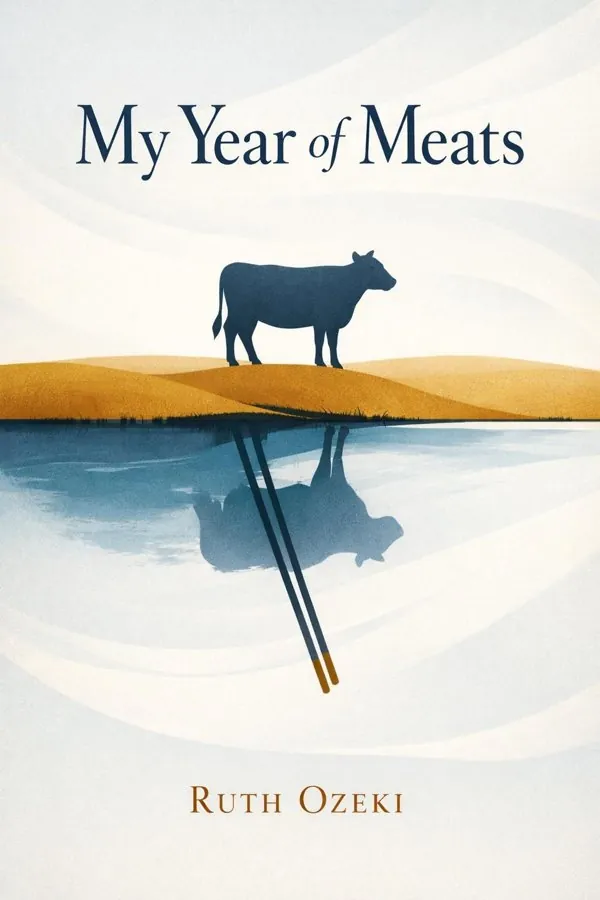
My Year of Meats: Summary & Key Insights
by Ruth Ozeki
 10 min3 chaptersAudio available
What Is My Year of Meats About?
My Year of Meats by Ruth Ozeki is a bestsellers book spanning 3 pages. My Year of Meats is a satirical and poignant novel that follows Jane Takagi-Little, a Japanese American documentary filmmaker hired to produce a Japanese television show promoting American beef. As she travels across the United States filming the lives of various women, Jane uncovers unsettling truths about the meat industry, cultural identity, and the portrayal of women in media. The story intertwines her journey with that of Akiko, a Japanese housewife whose life is transformed by watching the show, exploring themes of globalization, gender, and authenticity.
This FizzRead summary covers all 3 key chapters of My Year of Meats in approximately 10 minutes, distilling the most important ideas, arguments, and takeaways from Ruth Ozeki's work. Also available as an audio summary and Key Quotes Podcast.
My Year of Meats
My Year of Meats is a satirical and poignant novel that follows Jane Takagi-Little, a Japanese American documentary filmmaker hired to produce a Japanese television show promoting American beef. As she travels across the United States filming the lives of various women, Jane uncovers unsettling truths about the meat industry, cultural identity, and the portrayal of women in media. The story intertwines her journey with that of Akiko, a Japanese housewife whose life is transformed by watching the show, exploring themes of globalization, gender, and authenticity.
Who Should Read My Year of Meats?
This book is perfect for anyone interested in bestsellers and looking to gain actionable insights in a short read. Whether you're a student, professional, or lifelong learner, the key ideas from My Year of Meats by Ruth Ozeki will help you think differently.
- ✓Readers who enjoy bestsellers and want practical takeaways
- ✓Professionals looking to apply new ideas to their work and life
- ✓Anyone who wants the core insights of My Year of Meats in just 10 minutes
Want the full summary?
Get instant access to this book summary and 100K+ more with Fizz Moment.
Get Free SummaryAvailable on App Store • Free to download
Key Chapters
When Jane Takagi-Little first accepts the job to produce *My American Wife!*, she believes she’s landed a dream gig—an opportunity to travel across America, tell stories of ordinary people, and share them with audiences abroad. The concept is charmingly simple: each week, a wholesome American wife presents her family, her home, and her favorite beef recipe to a Japanese audience. The show’s subtle purpose, however, is less innocent: it is a marketing campaign conceived by the American meat industry, aimed at exporting both its product and its ideal of family life.
From the very beginning, Jane feels the discomfort of contradiction. As a Japanese American woman, she straddles two worlds—the one she’s meant to represent and the one she’s paid to sell. She wants to document truth, but the production demands something else entirely: a sanitized, consumer-friendly fiction. Her sponsors expect white, middle-class, heteronormative families whose happiness seems unquestionable and whose kitchens gleam under studio lights. Yet the real women Jane meets tell stories that resist such simplification. Some are mixed-race couples dealing with subtle bigotry; others are single mothers or working-class families whose lives bear little resemblance to the “perfect wife” archetype demanded by Tokyo executives.
Through this work, Jane begins to see how media can act as both mirror and mask. It reflects culture selectively, editing away the messiness of lived experience. The camera’s eye becomes a weapon and a shield—a way to shape perception and control desire. Her episodes gradually drift away from the corporate ideal, featuring people whose humanity refuses containment. She films a Black mother raising mixed-race children, an interracial lesbian couple, and women who speak with their own voices rather than reciting a script. Each time, the network executives recoil; they see controversy where Jane sees truth.
The deeper Jane delves into the process, the more she realizes how closely this manipulation parallels the treatment of the meat itself. Both are processed, packaged, and sold as commodities stripped of their origins. The cheerful domestic scenes of “My American Wife!” conceal systems of labor and suffering—just as the pristine steak on the plate hides a chain of exploitation stretching from slaughterhouses to stockyards. What began as a job for Jane transforms into a moral battleground: can she tell stories that matter in an industry built to silence them?
Across the Pacific, in a small Tokyo apartment, Akiko Ueno dutifully watches *My American Wife!* every week at her husband’s request. Her husband, John (“Joichi”) Ueno, works as an advertising executive for the same beef campaign that employs Jane. To him, Akiko is both consumer and marketing tool—someone who must embody the show’s idealized Japanese housewife. Each episode becomes an instruction manual for her life: how to cook, how to smile, how to please a man. Under his control, she is denied autonomy over her body, her diet, and her dreams.
At first, Akiko complies, though her body begins to reject the meat-heavy meals. The hormones in the beef upset her system, a quiet metaphor for how foreign values and global products can infiltrate local lives with invisible consequences. Her thin frame and health problems become symbolic of an identity consumed from within. Yet as she watches Jane’s increasingly subversive episodes—those that feature independent and diverse women—something begins to shift. Akiko glimpses alternatives to her oppression: lives shaped by curiosity, compassion, and self-determination.
This awakening is subtle but radical. The more Akiko absorbs, the more she resists. She begins to map her hunger—not for meat, but for freedom. In her diary, she records secret doubts and forbidden desires. Food, once a medium of control, becomes an act of rebellion. She stops eating the dishes prepared for her husband, refuses the beef he demands, and begins reclaiming her body. When she discovers she is pregnant, this rebellion becomes urgent; she resolves to protect the life within her from the forces that have suffocated her own.
Eventually, her defiance takes physical and symbolic form. She gathers the courage to leave her husband, stepping into uncertainty but finally owning her story. Through her, the novel explores how global systems of advertising and commerce penetrate domestic intimacy, turning love into consumption and nourishment into manipulation. But Akiko also reveals the possibility of renewal—the human capacity to rediscover authenticity through pain. Her journey, though born of oppression, becomes a quiet revolution against all forces that dictate what a woman should be, eat, or feel.
+ 1 more chapters — available in the FizzRead app
All Chapters in My Year of Meats
About the Author
Ruth Ozeki is a Japanese American novelist, filmmaker, and Zen Buddhist priest. Her works often explore themes of identity, culture, and environmental ethics. Ozeki’s debut novel, My Year of Meats (1998), received critical acclaim for its sharp social commentary and cross-cultural insight. She has since written several award-winning novels, including A Tale for the Time Being and The Book of Form and Emptiness.
Get This Summary in Your Preferred Format
Read or listen to the My Year of Meats summary by Ruth Ozeki anytime, anywhere. FizzRead offers multiple formats so you can learn on your terms — all free.
Available formats: App · Audio · PDF · EPUB — All included free with FizzRead
Download My Year of Meats PDF and EPUB Summary
Key Quotes from My Year of Meats
“When Jane Takagi-Little first accepts the job to produce *My American Wife!”
“Across the Pacific, in a small Tokyo apartment, Akiko Ueno dutifully watches *My American Wife!”
Frequently Asked Questions about My Year of Meats
My Year of Meats by Ruth Ozeki is a bestsellers book that explores key ideas across 3 chapters. My Year of Meats is a satirical and poignant novel that follows Jane Takagi-Little, a Japanese American documentary filmmaker hired to produce a Japanese television show promoting American beef. As she travels across the United States filming the lives of various women, Jane uncovers unsettling truths about the meat industry, cultural identity, and the portrayal of women in media. The story intertwines her journey with that of Akiko, a Japanese housewife whose life is transformed by watching the show, exploring themes of globalization, gender, and authenticity.
More by Ruth Ozeki


You Might Also Like

The Godfather
Mario Puzo
10 min
The Handmaid's Tale
Margaret Atwood
10 min
The Hunger Games
Suzanne Collins
10 min
The Nightingale
Kristin Hannah
10 min
The Seven Husbands of Evelyn Hugo
Taylor Jenkins Reid
10 min
Backwater Justice
Fern Michaels
10 minBrowse by Category
Ready to read My Year of Meats?
Get the full summary and 100K+ more books with Fizz Moment.