
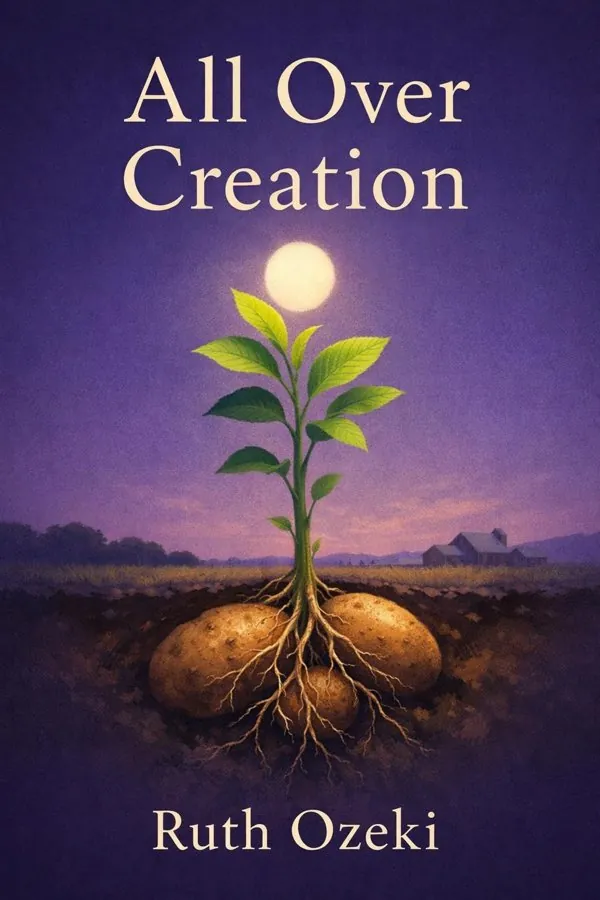
All Over Creation: Summary & Key Insights
by Ruth Ozeki
 10 min9 chaptersAudio available
Key Takeaways from All Over Creation
Families often become the first battleground where national tensions play out in miniature.
Reinvention can look like freedom while quietly functioning as escape.
The politics of food are never just about food.
Nothing truly grows in soil poisoned by resentment.
Identity is less like a fixed label and more like a plant adapting to shifting conditions.
What Is All Over Creation About?
All Over Creation by Ruth Ozeki is a bestsellers book spanning 4 pages. All Over Creation is a richly layered novel that begins as a family homecoming story and expands into a searching examination of identity, ecology, food politics, and belonging. At its center is Yumi Fuller, the rebellious Japanese American daughter of Idaho potato farmers, who returns to her hometown after years of absence, carrying with her the weight of old wounds, unresolved family conflict, and an uncertain sense of self. What she finds is not only a fractured family but also a community caught in the crosscurrents of global agribusiness, environmental protest, and changing ideas about the land. Ruth Ozeki uses this intimate domestic drama to explore urgent public questions: Who controls the food we eat? What do we owe the soil, our ancestors, and future generations? And how do people begin again after years of estrangement? Ozeki is especially well positioned to tell this story because her fiction consistently bridges the personal and the political, blending sharp social observation, humor, and moral seriousness. The result is a novel that feels both timely and humane, making large debates about biotechnology and sustainability deeply personal and emotionally resonant.
This FizzRead summary covers all 9 key chapters of All Over Creation in approximately 10 minutes, distilling the most important ideas, arguments, and takeaways from Ruth Ozeki's work. Also available as an audio summary and Key Quotes Podcast.
All Over Creation
All Over Creation is a richly layered novel that begins as a family homecoming story and expands into a searching examination of identity, ecology, food politics, and belonging. At its center is Yumi Fuller, the rebellious Japanese American daughter of Idaho potato farmers, who returns to her hometown after years of absence, carrying with her the weight of old wounds, unresolved family conflict, and an uncertain sense of self. What she finds is not only a fractured family but also a community caught in the crosscurrents of global agribusiness, environmental protest, and changing ideas about the land. Ruth Ozeki uses this intimate domestic drama to explore urgent public questions: Who controls the food we eat? What do we owe the soil, our ancestors, and future generations? And how do people begin again after years of estrangement? Ozeki is especially well positioned to tell this story because her fiction consistently bridges the personal and the political, blending sharp social observation, humor, and moral seriousness. The result is a novel that feels both timely and humane, making large debates about biotechnology and sustainability deeply personal and emotionally resonant.
Who Should Read All Over Creation?
This book is perfect for anyone interested in bestsellers and looking to gain actionable insights in a short read. Whether you're a student, professional, or lifelong learner, the key ideas from All Over Creation by Ruth Ozeki will help you think differently.
- ✓Readers who enjoy bestsellers and want practical takeaways
- ✓Professionals looking to apply new ideas to their work and life
- ✓Anyone who wants the core insights of All Over Creation in just 10 minutes
Want the full summary?
Get instant access to this book summary and 100K+ more with Fizz Moment.
Get Free SummaryAvailable on App Store • Free to download
Key Chapters
Families often become the first battleground where national tensions play out in miniature. In All Over Creation, the Fuller farm in Idaho is more than a backdrop; it is a living archive of sacrifice, migration, discipline, and disappointment. Lloyd and Momoko Fuller, Japanese American potato farmers shaped by hardship and endurance, represent a generation that understands survival through labor, restraint, and loyalty to the land. Their daughter Yumi, by contrast, embodies rebellion, sexual independence, and the refusal to accept inherited scripts. Her youthful departure from home leaves behind not just distance but a wound that time has not healed.
Ozeki turns this family divide into a portrait of postwar America, where children of immigrants often inherit both the benefits and burdens of their parents’ struggle. The farm symbolizes continuity, but it also reveals the pressure of expectation. Lloyd wants stewardship, stability, and legacy. Yumi experiences those same values as control, judgment, and suffocation. Neither side is wholly right or wrong, which is precisely what makes the conflict feel real.
This dynamic appears in many families beyond the novel. Parents may view sacrifice as love, while children may interpret it as emotional debt. A family business, a hometown, or a cultural tradition can be a source of pride for one generation and a source of entrapment for another. Ozeki shows that conflict often arises not from lack of love but from incompatible ways of expressing it.
The practical lesson is to look beneath family arguments for the deeper values driving them. When disagreements recur, ask what each person is trying to protect: dignity, freedom, continuity, or belonging. Actionable takeaway: when dealing with generational conflict, stop debating only the surface issue and name the underlying fear or hope each side is carrying.
Reinvention can look like freedom while quietly functioning as escape. When Yumi reappears after years away, her life in Hawaii suggests mobility, adaptability, and self-invention. She has built a life far from Idaho’s rigid expectations, and on the surface she seems to have done what many people dream of doing: leave the past behind and become someone new. Yet Ozeki presents reinvention as emotionally complicated. Yumi’s distance from home has not erased her old shame, grief, or confusion; it has merely scattered them across a different landscape.
Her life in Hawaii reflects the tension between creating a self and losing one. She is capable, resilient, and improvisational, but also unmoored. She has relationships, children, and routines, yet she remains partially disconnected from her own history. Ozeki refuses the simple narrative that departure equals liberation. Instead, she suggests that unresolved memories travel with us, shaping our choices even when we believe we have outrun them.
This idea has wide relevance. Many people relocate, change careers, or reinvent their public identities in hopes of escaping earlier pain. Sometimes the change is necessary and healthy. But without reflection, reinvention can become avoidance. A person who leaves a controlling family, a failed marriage, or a humiliating community may still find the same emotional patterns resurfacing elsewhere.
The novel’s power lies in showing that genuine renewal does not come from erasing the past but from re-entering it with greater honesty. Yumi’s return is difficult precisely because it requires contact with the parts of herself she tried to abandon.
Actionable takeaway: if you are seeking a fresh start, pair external change with inner reckoning. Ask not only where you want to go next, but what unfinished story you may still be carrying there.
The politics of food are never just about food. One of the novel’s central achievements is its ability to dramatize the struggle over genetically modified crops and corporate agriculture without reducing the story to a lecture. Through activist characters and local conflict, Ozeki brings into view a larger system in which patents, monoculture, and profit reshape farming communities from the ground up. The title All Over Creation itself suggests both ecological abundance and contested reproduction: what grows, who controls it, and what kind of future is being planted.
The activists in the novel challenge the spread of genetically modified potatoes and the broader logic of agribusiness. Their resistance is messy, idealistic, sometimes naive, but deeply necessary. Ozeki does not romanticize activism as pure or easy. Instead, she shows how protest emerges from moral alarm: concern for biodiversity, farmer autonomy, consumer transparency, and the long-term health of ecosystems. The Fuller farm becomes one site in a global argument over whether seeds should remain part of a common inheritance or become commodified property.
Readers can connect this to contemporary debates over food labeling, pesticide use, seed ownership, and industrial supply chains. Many consumers now ask where food comes from, how it was produced, and who benefits economically. Small gardeners saving heirloom seeds, parents choosing local produce, and communities supporting independent farmers are all participating, in different ways, in the same ethical conversation Ozeki stages in the novel.
What makes this theme memorable is that Ozeki links systems to daily life. The future of agriculture is not abstract when it affects family farms, local economies, and the taste and diversity of what ends up on our plates.
Actionable takeaway: pay closer attention to the food system around you. Start with one concrete habit, such as reading labels, buying from a local grower, or learning how seed ownership affects what farmers can plant.
Nothing truly grows in soil poisoned by resentment. In its later movements, All Over Creation becomes a novel about forgiveness, not as sentimental closure but as a difficult form of regeneration. Yumi’s return home reopens old injuries involving family shame, abandonment, desire, and misunderstanding. Yet Ozeki resists neat redemption. Forgiveness here is not forgetting the past or declaring everyone innocent. It is the slow willingness to release the grip of grievance so that life can continue.
Lloyd, Momoko, and Yumi each carry different versions of pain. Some hurts are spoken, others are buried in silence. The novel asks whether people can inherit damage without endlessly transmitting it. This question matters not only for families but also for communities and nations. Intergenerational wounds, especially in immigrant and minority families, are often sustained by what remains unsaid. Ozeki shows that repair begins when people risk honesty, vulnerability, and mutual recognition.
Regeneration also operates metaphorically through seeds, gardens, and cultivation. The land can be exhausted, but it can also recover if treated differently. Relationships follow a similar logic. Renewal does not happen because time passes; it happens because care changes. A practical parallel might be a family estrangement softened by one sincere conversation, or a long-standing resentment interrupted by curiosity rather than accusation.
The novel suggests that forgiveness is active work. It may involve listening to an elder’s perspective without surrendering your own, acknowledging harm without turning identity into injury, or allowing another person to change. Ozeki’s insight is that legacy is not just what we receive but what we choose to pass on.
Actionable takeaway: identify one relationship shaped by old grievance and take a small restorative step, such as asking one honest question, offering one specific acknowledgment, or ending one habitual blame pattern.
Identity is less like a fixed label and more like a plant adapting to shifting conditions. Ozeki portrays Yumi as Japanese American, daughter, mother, lover, exile, and returnee, never allowing any single category to define her completely. This fluidity is essential to the novel’s emotional intelligence. Rather than treating identity as a stable inheritance, All Over Creation shows how selfhood is shaped by memory, geography, race, family expectations, gender, and choice.
Yumi’s experience reflects a broader tension felt by many people who live between cultures or across social worlds. Home can feel both intimate and alien. One can belong to a place historically and still feel estranged from it emotionally. Ozeki is especially attentive to how racialized identity intersects with local life in rural America. The Fuller family’s presence complicates assumptions about who counts as native to a place and whose labor built it.
At the same time, the novel avoids turning identity into a simple political statement. Yumi is not a spokesperson for a demographic category; she is contradictory, flawed, and alive. That complexity matters. It reminds readers that identity shapes experience, but it does not eliminate individuality.
In practical terms, this theme speaks to anyone who has felt split between roles or pressured to perform authenticity. A first-generation professional, for instance, may feel different at home than at work. Someone who returns to a hometown after years away may discover that others still relate to an outdated version of them. Ozeki invites us to see these tensions not as failures but as signs of a life still unfolding.
Actionable takeaway: instead of forcing yourself into a single identity story, write down the different communities, histories, and roles that have shaped you. Then ask which ones still nourish you and which ones need to be redefined on your own terms.
Individual freedom can be exhilarating, but no one lives outside webs of dependence. One of the most compelling aspects of All Over Creation is its portrait of community life in a small Idaho town, where neighbors, growers, activists, relatives, and old acquaintances constantly intersect. Ozeki depicts community not as a cozy ideal but as an unruly social ecosystem full of gossip, memory, obligation, conflict, and unexpected care.
Yumi’s return reminds us that communities preserve stories long after individuals try to outgrow them. In such places, the past is social property. This can feel invasive, especially when someone wants privacy or reinvention. Yet the same communal density that constrains also sustains. People notice when someone is struggling. Local knowledge circulates. Shared spaces become sites of friction but also solidarity.
The activist presence in the novel further complicates the idea of community by bringing outsiders into local concerns. Their values may align with environmental protection, but they do not always understand the lived realities of farming families. Ozeki uses these tensions to ask an important question: how do communities change without erasing the people already rooted there?
This has practical relevance in many settings, from school districts to neighborhoods facing development or workplaces undergoing reform. Good intentions are not enough; durable change requires listening across difference. Community survives when people can disagree without denying one another’s stake in the shared world.
Ozeki’s insight is that belonging is rarely comfortable. It asks us to be accountable to people who know our history and challenge our self-image. But it also offers the possibility of mutual aid and shared purpose.
Actionable takeaway: strengthen one real-world community by contributing in a tangible way, such as attending a local meeting, supporting a neighborhood initiative, or listening carefully to those whose daily realities differ from your own.
Some of the most effective social criticism arrives with a smile rather than a sermon. Ozeki’s novel deals with painful topics such as family estrangement, environmental degradation, cultural dislocation, and corporate power, yet it remains lively and often funny. This tonal flexibility is not decorative; it is strategic. Humor creates room for complexity. It makes characters more human, softens defensiveness in readers, and reveals the absurdity of systems people might otherwise accept as normal.
In All Over Creation, comedy often emerges from clashing personalities, generational misunderstandings, activist theatrics, and the sheer unpredictability of human behavior. These moments prevent the novel from becoming grimly didactic. More importantly, they mirror real life. Even in moments of crisis, people miscommunicate, improvise, and laugh. Humor becomes a way of surviving contradiction.
This matters because social critique can easily lose its audience when it becomes too rigid or self-righteous. Ozeki understands that persuasion often depends on emotional openness. A reader who laughs is a reader who remains engaged long enough to think more deeply. The same principle applies beyond literature. Teachers, leaders, and advocates often communicate difficult truths more effectively when they combine seriousness with humility and wit.
For example, conversations about climate change, food ethics, or family conflict can shut down if framed only in terms of guilt. Humor does not trivialize the issue; it can make hard conversations possible by reducing shame and inviting participation.
Ozeki’s style demonstrates that moral urgency and playfulness are not opposites. They can work together to make an argument more memorable and more humane.
Actionable takeaway: when addressing a serious issue, try introducing one note of warmth, irony, or self-awareness. It can lower defenses and create a more honest space for reflection and change.
Land remembers what people do to it, even when people prefer to forget. Throughout All Over Creation, the Idaho farm functions as a moral landscape that records generations of cultivation, exploitation, hope, and damage. Ozeki treats the soil not as passive property but as a living medium shaped by choices about technology, economics, and care. The condition of the land reflects the condition of the relationships surrounding it.
This ecological perspective deepens the novel’s central conflicts. Farming is never merely an economic activity here; it is an ethical one. Decisions about seeds, chemicals, yield, and efficiency reveal broader values. Is land a resource to maximize, a heritage to protect, or a partner in mutual survival? The novel refuses simplistic answers, because farmers often face pressures that make harmful choices understandable even when they are troubling.
This theme speaks powerfully to modern readers living at a distance from agriculture. We often experience environmental harm abstractly, through headlines or statistics. Ozeki restores concreteness. Soil depletion, monoculture, and corporate influence are not separate from family life; they shape local economies, health, and cultural memory. The landscape around us is a record of what we reward.
In everyday life, the same principle applies on a smaller scale. A garden flourishes or declines according to repeated habits. A neighborhood changes according to zoning, investment, and neglect. Even digital environments reflect the incentives built into them. Human systems leave traces.
By linking ecological reality to moral attention, Ozeki encourages readers to think relationally. What we take from a place and what we give back are never unrelated.
Actionable takeaway: choose one place you rely on, such as a yard, park, community garden, or local watershed, and learn one concrete way your habits affect it. Then adopt one practice that contributes to its long-term health.
Returning home often exposes the parts of ourselves that adulthood has only partially resolved. In All Over Creation, Yumi’s homecoming is not nostalgic restoration but a confrontation with the self she once was and the selves others still project onto her. Ozeki uses the familiar literary pattern of return to show that places can preserve emotional time. A childhood home, a parent’s voice, or a local landscape can reactivate old roles with startling force.
What makes this theme so compelling is that Yumi does not simply revisit the past; she collides with it. The woman she has become cannot fully fit into the expectations waiting for her in Idaho, yet neither can she remain untouched by them. This is the paradox of homecoming: it confirms change while revealing continuity. We discover both how far we have traveled and what still has power over us.
Many readers will recognize this experience. Visiting family can revive adolescent defensiveness. Returning to a hometown can trigger old insecurities or loyalties. Re-encountering people who knew us early in life may feel grounding or destabilizing. Ozeki suggests that these moments are opportunities, not just discomforts. They expose unfinished inner work that daily busyness often conceals.
The novel also implies that growth is relational. We do not mature only by setting goals or acquiring independence; we mature by revising how we inhabit old stories. Homecoming becomes meaningful when it allows a different response to familiar pain.
In practical terms, this might mean noticing when an old family dynamic reappears and choosing not to perform your usual role. It might mean revisiting a place with enough compassion to understand your younger self more fully.
Actionable takeaway: the next time you re-enter an old environment, pay attention to which version of yourself it activates. Name that pattern in real time and choose one response that reflects who you are now, not only who you were then.
All Chapters in All Over Creation
About the Author
Ruth Ozeki is an American-Canadian novelist, filmmaker, and Zen Buddhist priest celebrated for fiction that brings together intimate human stories and large contemporary issues. Educated at Smith College, where she studied English literature and Asian studies, she has developed a distinctive literary voice marked by wit, compassion, and intellectual range. Her novels often explore food systems, environmental ethics, media culture, identity, and the porous boundary between the personal and the political. In addition to All Over Creation, she is widely known for My Year of Meats, The Face: A Time Code, and A Tale for the Time Being, the latter of which received major international acclaim. Ozeki’s work stands out for its ability to make complex social questions feel immediate, emotionally resonant, and deeply human.
Get This Summary in Your Preferred Format
Read or listen to the All Over Creation summary by Ruth Ozeki anytime, anywhere. FizzRead offers multiple formats so you can learn on your terms — all free.
Available formats: App · Audio · PDF · EPUB — All included free with FizzRead
Download All Over Creation PDF and EPUB Summary
Key Quotes from All Over Creation
“Families often become the first battleground where national tensions play out in miniature.”
“Reinvention can look like freedom while quietly functioning as escape.”
“The politics of food are never just about food.”
“Nothing truly grows in soil poisoned by resentment.”
“Identity is less like a fixed label and more like a plant adapting to shifting conditions.”
Frequently Asked Questions about All Over Creation
All Over Creation by Ruth Ozeki is a bestsellers book that explores key ideas across 9 chapters. All Over Creation is a richly layered novel that begins as a family homecoming story and expands into a searching examination of identity, ecology, food politics, and belonging. At its center is Yumi Fuller, the rebellious Japanese American daughter of Idaho potato farmers, who returns to her hometown after years of absence, carrying with her the weight of old wounds, unresolved family conflict, and an uncertain sense of self. What she finds is not only a fractured family but also a community caught in the crosscurrents of global agribusiness, environmental protest, and changing ideas about the land. Ruth Ozeki uses this intimate domestic drama to explore urgent public questions: Who controls the food we eat? What do we owe the soil, our ancestors, and future generations? And how do people begin again after years of estrangement? Ozeki is especially well positioned to tell this story because her fiction consistently bridges the personal and the political, blending sharp social observation, humor, and moral seriousness. The result is a novel that feels both timely and humane, making large debates about biotechnology and sustainability deeply personal and emotionally resonant.
More by Ruth Ozeki
You Might Also Like

The Godfather
Mario Puzo
10 min
The Handmaid's Tale
Margaret Atwood
10 min
The Hunger Games
Suzanne Collins
10 min
The Nightingale
Kristin Hannah
10 min
The Seven Husbands of Evelyn Hugo
Taylor Jenkins Reid
10 min
Backwater Justice
Fern Michaels
10 minBrowse by Category
Ready to read All Over Creation?
Get the full summary and 100K+ more books with Fizz Moment.