
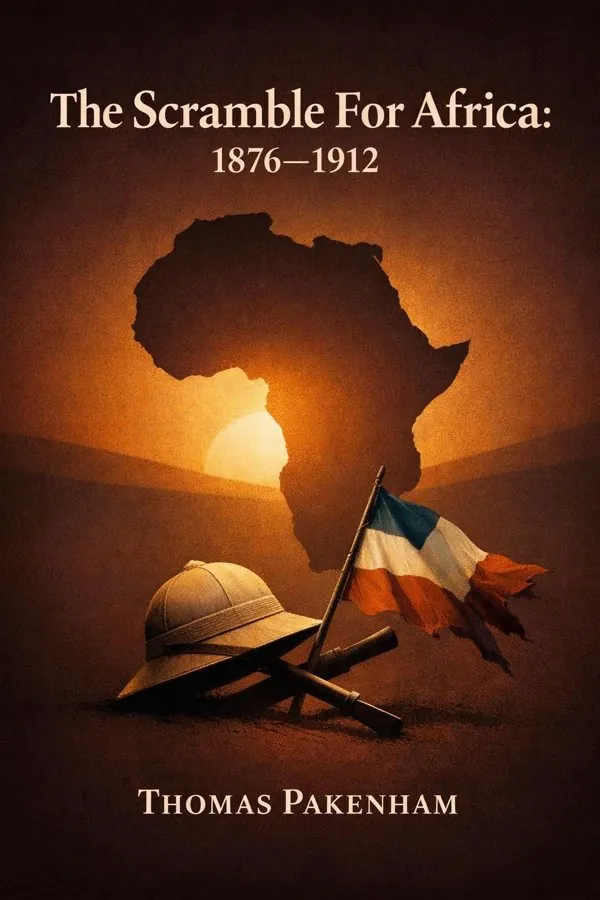
The Scramble For Africa: 1876–1912: The White Man's Conquest Of The Dark Continent From 1876 To 1912: Summary & Key Insights
 10 min12 chapters
What Is The Scramble For Africa: 1876–1912: The White Man's Conquest Of The Dark Continent From 1876 To 1912 About?
The Scramble For Africa: 1876–1912: The White Man's Conquest Of The Dark Continent From 1876 To 1912 by Thomas Pakenham is a world_history book spanning 12 pages. A comprehensive historical account of the European powers' conquest and colonization of Africa between 1876 and 1912. Pakenham meticulously chronicles the political, military, and economic forces that drove the partition of Africa, exploring the ambitions of explorers, imperialists, and statesmen who shaped the continent’s fate.
This FizzRead summary covers all 12 key chapters of The Scramble For Africa: 1876–1912: The White Man's Conquest Of The Dark Continent From 1876 To 1912 in approximately 10 minutes, distilling the most important ideas, arguments, and takeaways from Thomas Pakenham's work.
The Scramble For Africa: 1876–1912: The White Man's Conquest Of The Dark Continent From 1876 To 1912
A comprehensive historical account of the European powers' conquest and colonization of Africa between 1876 and 1912. Pakenham meticulously chronicles the political, military, and economic forces that drove the partition of Africa, exploring the ambitions of explorers, imperialists, and statesmen who shaped the continent’s fate.
Who Should Read The Scramble For Africa: 1876–1912: The White Man's Conquest Of The Dark Continent From 1876 To 1912?
This book is perfect for anyone interested in world_history and looking to gain actionable insights in a short read. Whether you're a student, professional, or lifelong learner, the key ideas from The Scramble For Africa: 1876–1912: The White Man's Conquest Of The Dark Continent From 1876 To 1912 by Thomas Pakenham will help you think differently.
- ✓Readers who enjoy world_history and want practical takeaways
- ✓Professionals looking to apply new ideas to their work and life
- ✓Anyone who wants the core insights of The Scramble For Africa: 1876–1912: The White Man's Conquest Of The Dark Continent From 1876 To 1912 in just 10 minutes
Want the full summary?
Get instant access to this book summary and 100K+ more with Fizz Moment.
Get Free SummaryAvailable on App Store • Free to download
Key Chapters
The story begins with the explorers — the men who, long before the armies and administrators, carried European ambitions deep into the heart of Africa. David Livingstone embodied the Victorian faith in discovery and moral mission. His wanderings across Central and Southern Africa inspired a generation of Englishmen who believed that exploration could open the continent to commerce and Christianity. Yet it was Henry Morton Stanley, aggressive where Livingstone was gentle, who truly bridged the age of curiosity and the age of conquest. When Stanley 'found' Livingstone in Ujiji in 1871, their meeting symbolized a passing of the torch from the missionary traveler to the professional imperial agent.
Stanley’s later journeys, financed by King Leopold II of Belgium, would map out the Congo Basin and mark the beginning of a systematic European intrusion. What had been blank spaces on European maps turned into clearly defined river networks and resource claims. Behind these expeditions lay a growing conviction that Africa was a field of opportunity — for commerce, for faith, and for national prestige. Each discovery, each mapped river, intensified the belief that whoever arrived first could stake legitimate claim. By 1876, when Leopold convened his Geographical Conference in Brussels, Africa had become no longer a mystery to be admired from afar but a territory to be possessed.
Leopold II of Belgium stands as one of the most audacious and morally complex figures in this saga. Publicly, he presented himself as a philanthropist, a patron of science, and a champion of civilization. Privately, he schemed to carve out a personal empire at the heart of Africa. Using the front of the International African Association, he hired Stanley to secure treaties with local chiefs in the vast Congo region — agreements that were meaningless to the Africans but legally convenient to Europeans.
By 1885, Leopold had achieved what no other European monarch dared attempt: he became the sole proprietor of a territory nearly 80 times the size of Belgium — the so-called Congo Free State. But 'free' it was not. Under the guise of humanitarian progress, the Congo became a brutal system of forced labor and terror, driven by the global demand for rubber. Villages were burned, hostages were taken, hands were severed as punishment for failing to meet quotas. And yet, thanks to Leopold’s propaganda machine, the world saw him as a benefactor until international outrage began to break through. Missionaries, journalists, and a few brave diplomats exposed the horror, transforming the Congo from a celebrated experiment into one of history’s most infamous colonial scandals.
+ 10 more chapters — available in the FizzRead app
All Chapters in The Scramble For Africa: 1876–1912: The White Man's Conquest Of The Dark Continent From 1876 To 1912
About the Author
Thomas Pakenham is a British historian and author known for his works on imperial history and African colonization. His detailed research and narrative style have made him a respected figure in historical writing, with other notable works including 'The Boer War' and 'The Mountains of the Moon'.
Get This Summary in Your Preferred Format
Read or listen to the The Scramble For Africa: 1876–1912: The White Man's Conquest Of The Dark Continent From 1876 To 1912 summary by Thomas Pakenham anytime, anywhere. FizzRead offers multiple formats so you can learn on your terms — all free.
Available formats: App · Audio · PDF · EPUB — All included free with FizzRead
Download The Scramble For Africa: 1876–1912: The White Man's Conquest Of The Dark Continent From 1876 To 1912 PDF and EPUB Summary
Key Quotes from The Scramble For Africa: 1876–1912: The White Man's Conquest Of The Dark Continent From 1876 To 1912
“The story begins with the explorers — the men who, long before the armies and administrators, carried European ambitions deep into the heart of Africa.”
“Leopold II of Belgium stands as one of the most audacious and morally complex figures in this saga.”
Frequently Asked Questions about The Scramble For Africa: 1876–1912: The White Man's Conquest Of The Dark Continent From 1876 To 1912
The Scramble For Africa: 1876–1912: The White Man's Conquest Of The Dark Continent From 1876 To 1912 by Thomas Pakenham is a world_history book that explores key ideas across 12 chapters. A comprehensive historical account of the European powers' conquest and colonization of Africa between 1876 and 1912. Pakenham meticulously chronicles the political, military, and economic forces that drove the partition of Africa, exploring the ambitions of explorers, imperialists, and statesmen who shaped the continent’s fate.
More by Thomas Pakenham
You Might Also Like
The Age of Capital
Eric Hobsbawm
10 min
The Gulag Archipelago
Aleksandr Solzhenitsyn
10 min
Jerusalem: The Biography
Simon Sebag Montefiore
10 min
The Anglo-Saxons
James Campbell
10 min
The Boer War
Thomas Pakenham
10 min
The Industrial Revolutionaries: The Making of the Modern World 1776–1914
Gavin Weightman
10 minBrowse by Category
Ready to read The Scramble For Africa: 1876–1912: The White Man's Conquest Of The Dark Continent From 1876 To 1912?
Get the full summary and 100K+ more books with Fizz Moment.