
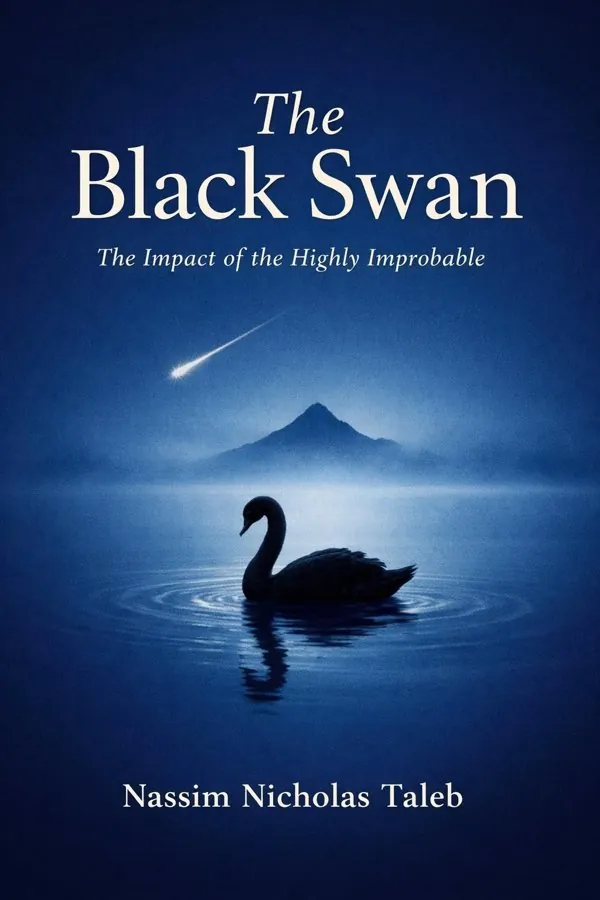
The Black Swan: The Impact of the Highly Improbable: Summary & Key Insights
 10 min5 chaptersAudio available
What Is The Black Swan: The Impact of the Highly Improbable About?
The Black Swan: The Impact of the Highly Improbable by Nassim Nicholas Taleb is a economics book spanning 5 pages. The Black Swan explores the profound impact of rare and unpredictable events—so-called 'Black Swans'—that lie outside the realm of regular expectations. Taleb argues that these events shape history, science, finance, and technology far more than we realize, yet humans are wired to rationalize them after the fact. The book challenges conventional thinking about risk, probability, and knowledge, urging readers to embrace uncertainty and develop resilience in an unpredictable world.
This FizzRead summary covers all 5 key chapters of The Black Swan: The Impact of the Highly Improbable in approximately 10 minutes, distilling the most important ideas, arguments, and takeaways from Nassim Nicholas Taleb's work. Also available as an audio summary and Key Quotes Podcast.
The Black Swan: The Impact of the Highly Improbable
The Black Swan explores the profound impact of rare and unpredictable events—so-called 'Black Swans'—that lie outside the realm of regular expectations. Taleb argues that these events shape history, science, finance, and technology far more than we realize, yet humans are wired to rationalize them after the fact. The book challenges conventional thinking about risk, probability, and knowledge, urging readers to embrace uncertainty and develop resilience in an unpredictable world.
Who Should Read The Black Swan: The Impact of the Highly Improbable?
This book is perfect for anyone interested in economics and looking to gain actionable insights in a short read. Whether you're a student, professional, or lifelong learner, the key ideas from The Black Swan: The Impact of the Highly Improbable by Nassim Nicholas Taleb will help you think differently.
- ✓Readers who enjoy economics and want practical takeaways
- ✓Professionals looking to apply new ideas to their work and life
- ✓Anyone who wants the core insights of The Black Swan: The Impact of the Highly Improbable in just 10 minutes
Want the full summary?
Get instant access to this book summary and 100K+ more with Fizz Moment.
Get Free SummaryAvailable on App Store • Free to download
Key Chapters
Let me first make clear what a Black Swan is—and what it is not. A Black Swan is an event that fulfills three criteria: it is an outlier, lying outside the realm of expectations; it carries an extreme impact; and, most insidiously, after it occurs, we concoct explanations for it to make it appear predictable. This pattern of blindness and retrospective rationalization is one of humanity’s most dangerous cognitive habits. Before the discovery of black swans in Australia, Europeans assumed all swans were white. All it took was a single bird to upend centuries of belief. The metaphor captures how fragile our knowledge really is.
The central problem is not that we fail to predict rare events, but that we fail to recognize how ignorant we are of the process that generates them. Our minds are built to simplify, to draw neat lines through messy data, and to comfort themselves with narratives that make the world seem legible. We live under the tyranny of what I call the narrative fallacy: our compulsion to weave stories post hoc, turning randomness into causality to make ourselves feel in control. A war breaks out, and historians invent ‘causes’ that make it seem inevitable. A company skyrockets, and analysts retrospectively discover its ‘strategy’. In truth, most of these turning points were accidental, complex, and unknowable in advance.
When you start to see the world through the lens of Black Swans, you become aware of just how fragile your projections are. What you call trends are merely illusions of stability—thin veils over a volatile reality. The future is not Gaussian; it does not fall neatly within the tidy bounds of probabilities derived from history. Life happens under a regime of uncertainty where the unimaginable is always waiting to explode into the imaginable. That realization is the first step toward intellectual liberation.
We humans suffer from a chronic inability to handle randomness. Psychologically, we are built to detect patterns, to impose order even when there is none. This bias, hardwired through evolution, once helped us survive in environments where recognizing patterns in nature meant life or death. But when transported into the abstract realms of finance, history, and science, it betrays us. We end up mistaking noise for signal and, worse, constructing explanations for chance occurrences. This tendency, the narrative fallacy, becomes the foundation of collective illusion.
We are storytellers first and analysts second. When something monumental happens—a market crash, a surprise election, a breakthrough invention—we rush to connect the dots retroactively. This backward storytelling is seductive because it eliminates ambiguity. It feels better to believe we ‘know’ why something happened than to confront the uncomfortable truth that it was sheer luck, or the product of forces we don’t and can’t understand. I have seen traders lose millions yet tell themselves intricate tales about ‘market behavior’ to preserve their ego. Even scientists, supposed high priests of uncertainty, often submit to this fallacy—framing their findings in comforting narratives of gradual progress when in reality science lurches forward through rare discoveries and paradigm shifts.
The greatest damage from the narrative fallacy is not epistemic—it’s practical. It keeps us from building robust systems. If we think we understand the cause of success or failure, we build policies, investments, and strategies based on faulty assumptions. Then the next Black Swan comes and wipes the board clean. The cure, paradoxically, is not knowledge but humility: to accept that our stories are crutches, not compasses, and that the world resists our attempts at neat explanation.
+ 3 more chapters — available in the FizzRead app
All Chapters in The Black Swan: The Impact of the Highly Improbable
About the Author
Nassim Nicholas Taleb is a Lebanese-American scholar, statistician, and former trader known for his work on probability, uncertainty, and risk. He is the author of the multi-volume series 'Incerto', which includes 'Fooled by Randomness', 'The Black Swan', 'Antifragile', and others. Taleb’s work bridges philosophy, mathematics, and practical decision-making under uncertainty.
Get This Summary in Your Preferred Format
Read or listen to the The Black Swan: The Impact of the Highly Improbable summary by Nassim Nicholas Taleb anytime, anywhere. FizzRead offers multiple formats so you can learn on your terms — all free.
Available formats: App · Audio · PDF · EPUB — All included free with FizzRead
Download The Black Swan: The Impact of the Highly Improbable PDF and EPUB Summary
Key Quotes from The Black Swan: The Impact of the Highly Improbable
“Let me first make clear what a Black Swan is—and what it is not.”
“We humans suffer from a chronic inability to handle randomness.”
Frequently Asked Questions about The Black Swan: The Impact of the Highly Improbable
The Black Swan: The Impact of the Highly Improbable by Nassim Nicholas Taleb is a economics book that explores key ideas across 5 chapters. The Black Swan explores the profound impact of rare and unpredictable events—so-called 'Black Swans'—that lie outside the realm of regular expectations. Taleb argues that these events shape history, science, finance, and technology far more than we realize, yet humans are wired to rationalize them after the fact. The book challenges conventional thinking about risk, probability, and knowledge, urging readers to embrace uncertainty and develop resilience in an unpredictable world.
More by Nassim Nicholas Taleb
Fooled by Randomness: The Hidden Role of Chance in Life and in the Markets
Nassim Nicholas Taleb
10 min
Skin in the Game: Hidden Asymmetries in Daily Life
Nassim Nicholas Taleb
10 min
Antifragile: Things That Gain from Disorder
Nassim Nicholas Taleb
10 min
The Barbell Strategy
Nassim Nicholas Taleb
10 minYou Might Also Like
Business Adventures
John Brooks
10 min
Nudge
Richard H. Thaler, Cass R. Sunstein
10 min
The Hitchhiker"s Guide to the Galaxy
Douglas Adams
10 minThe Muqaddimah
Ibn Khaldun
10 minThe Outsiders
William N. Thorndike
10 min
A Little History of Economics
Niall Kishtainy
10 minBrowse by Category
Ready to read The Black Swan: The Impact of the Highly Improbable?
Get the full summary and 100K+ more books with Fizz Moment.