
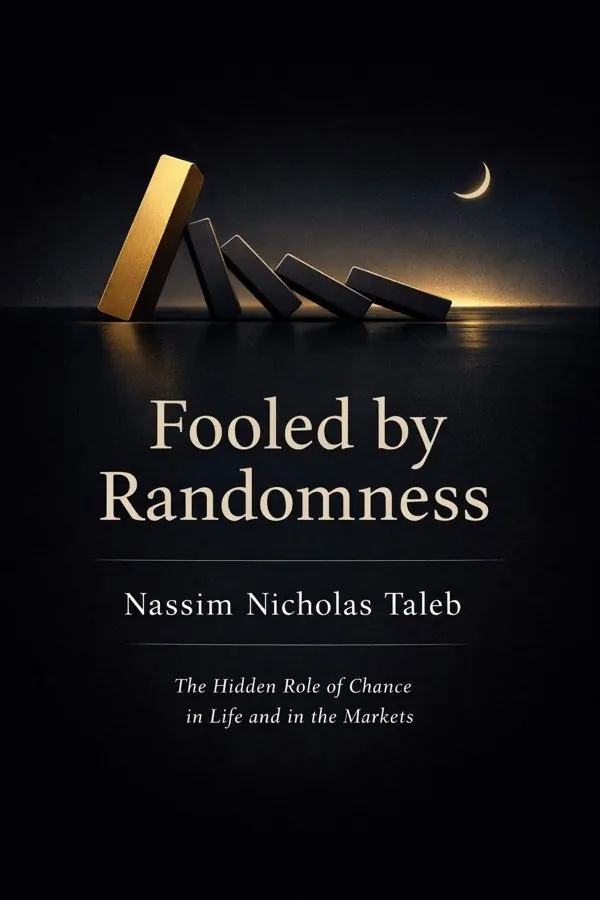
Fooled by Randomness: The Hidden Role of Chance in Life and in the Markets: Summary & Key Insights
 10 min8 chaptersAudio available
Key Takeaways from Fooled by Randomness: The Hidden Role of Chance in Life and in the Markets
A striking truth sits at the center of Taleb’s argument: in many fields, the winners we celebrate may simply be the survivors of chance.
One of the mind’s favorite tricks is turning randomness into narrative.
The people and strategies we can see are not the full picture; they are only the survivors.
Taleb argues that human beings are not naturally equipped to reason well about probability.
People do not experience randomness as detached statisticians.
What Is Fooled by Randomness: The Hidden Role of Chance in Life and in the Markets About?
Fooled by Randomness: The Hidden Role of Chance in Life and in the Markets by Nassim Nicholas Taleb is a economics book. Why do some people look like geniuses in business, investing, or life—only to fail spectacularly later? Nassim Nicholas Taleb’s Fooled by Randomness argues that we consistently confuse luck with skill, especially in environments dominated by uncertainty. The book explores how chance shapes outcomes far more than most people admit, and how human psychology pushes us to invent neat stories after the fact. In markets, careers, and everyday decision-making, we often praise winners without asking whether their success was repeatable or simply the product of favorable randomness. Taleb writes with unusual authority. A former trader and risk thinker, he understands both the mathematics of probability and the real-world behavior of people under pressure. This dual perspective makes the book especially powerful: it is not a dry statistics lesson, but a practical guide to seeing through illusion. Fooled by Randomness matters because modern life rewards visible results, not necessarily sound processes. Taleb teaches readers to think more skeptically about success, failure, forecasts, and expertise. The result is a sharper way to judge performance, manage risk, and avoid being misled by lucky streaks disguised as talent.
This FizzRead summary covers all 8 key chapters of Fooled by Randomness: The Hidden Role of Chance in Life and in the Markets in approximately 10 minutes, distilling the most important ideas, arguments, and takeaways from Nassim Nicholas Taleb's work. Also available as an audio summary and Key Quotes Podcast.
Fooled by Randomness: The Hidden Role of Chance in Life and in the Markets
Why do some people look like geniuses in business, investing, or life—only to fail spectacularly later? Nassim Nicholas Taleb’s Fooled by Randomness argues that we consistently confuse luck with skill, especially in environments dominated by uncertainty. The book explores how chance shapes outcomes far more than most people admit, and how human psychology pushes us to invent neat stories after the fact. In markets, careers, and everyday decision-making, we often praise winners without asking whether their success was repeatable or simply the product of favorable randomness.
Taleb writes with unusual authority. A former trader and risk thinker, he understands both the mathematics of probability and the real-world behavior of people under pressure. This dual perspective makes the book especially powerful: it is not a dry statistics lesson, but a practical guide to seeing through illusion. Fooled by Randomness matters because modern life rewards visible results, not necessarily sound processes. Taleb teaches readers to think more skeptically about success, failure, forecasts, and expertise. The result is a sharper way to judge performance, manage risk, and avoid being misled by lucky streaks disguised as talent.
Who Should Read Fooled by Randomness: The Hidden Role of Chance in Life and in the Markets?
This book is perfect for anyone interested in economics and looking to gain actionable insights in a short read. Whether you're a student, professional, or lifelong learner, the key ideas from Fooled by Randomness: The Hidden Role of Chance in Life and in the Markets by Nassim Nicholas Taleb will help you think differently.
- ✓Readers who enjoy economics and want practical takeaways
- ✓Professionals looking to apply new ideas to their work and life
- ✓Anyone who wants the core insights of Fooled by Randomness: The Hidden Role of Chance in Life and in the Markets in just 10 minutes
Want the full summary?
Get instant access to this book summary and 100K+ more with Fizz Moment.
Get Free SummaryAvailable on App Store • Free to download
Key Chapters
A striking truth sits at the center of Taleb’s argument: in many fields, the winners we celebrate may simply be the survivors of chance. When outcomes are uncertain and the number of participants is large, some people will inevitably appear brilliant even if they are merely lucky. We then build stories around their success, assigning intelligence, discipline, or insight to results that randomness could have produced.
Taleb is especially interested in markets, where short-term gains are often mistaken for evidence of expertise. Imagine a thousand traders taking different risks. By pure probability, a few will produce outstanding returns over several years. Observers may praise their strategy, invite them onto television, or hand them more capital. Yet their track record may say less about superior judgment than about favorable luck during a specific period. The danger is not only that outsiders are fooled, but that the winners begin to fool themselves.
This idea applies beyond finance. A startup founder may credit vision for success in a market that happened to shift at the right time. An executive may be promoted during an economic boom and later treated as uniquely gifted. In each case, the visible result overshadows the invisible role of chance.
Taleb’s deeper point is that outcomes alone are weak evidence of quality. A good decision can lead to a bad result, and a bad decision can lead to a good result. If we judge everything only by what happened, we reward luck and punish sound thinking.
Actionable takeaway: evaluate processes, not just outcomes. When judging success—your own or others’—ask what role chance may have played and whether the method would still make sense across many repetitions.
One of the mind’s favorite tricks is turning randomness into narrative. After an event happens, we feel compelled to explain it with a clean, satisfying story. Taleb shows that this habit makes uncertainty seem more understandable than it really is. We look backward, connect a few facts, and convince ourselves that the outcome was predictable all along.
This retrospective storytelling creates an illusion of knowledge. If a stock market rises, commentators explain the rally with interest rates, policy shifts, consumer confidence, or innovation. If it falls, they quickly produce a different but equally confident explanation. The problem is not that these factors are irrelevant, but that the certainty of the narrative often exceeds the evidence. The explanation comes after the move, not before it.
In everyday life, the same pattern appears constantly. A job candidate gets hired, and people attribute the success to confidence, communication style, or timing. A company collapses, and everyone identifies the “obvious” warning signs that were supposedly visible all along. Yet before the outcome, reality was far more ambiguous.
Taleb warns that stories are emotionally comforting but intellectually dangerous. They compress complexity into a form the brain likes, while hiding the many other possible paths events could have taken. This habit encourages overconfidence, because if we believe we understand the past too neatly, we also believe we can forecast the future more accurately than we actually can.
A healthier approach is to tolerate unexplained variation. Not every event has a clear reason. Not every success or failure contains a moral lesson.
Actionable takeaway: when you hear a polished explanation of a surprising event, pause and ask: would this person have confidently predicted it in advance, or are they simply narrating randomness after it happened?
The people and strategies we can see are not the full picture; they are only the survivors. Taleb emphasizes that this creates a serious distortion in how we learn from success. We focus on those who made it through and ignore those who followed similar paths but disappeared. As a result, we overestimate the quality of risky strategies and underestimate how many failures were quietly erased from view.
Consider investing. A fund manager who posts exceptional returns for several years may attract admiration and capital. But for every visible winner, there may have been dozens of managers using similar methods who blew up and vanished. Because the failed cases are no longer discussed, the survivor looks more talented than he may really be. The same logic applies to entrepreneurship, publishing, entertainment, and careers generally. We hear from the startup founder who became a billionaire, not from the hundreds who were equally passionate and disciplined but ran out of cash.
Survivorship bias can make dangerous behavior look wise. If only the lucky risk-takers remain visible, then risk itself may appear more rewarding than it truly is. This is one reason people imitate glamorous success stories without understanding the hidden graveyard behind them.
Taleb pushes readers to ask not just “Who succeeded?” but also “Who tried and failed?” Missing data matters. The absence of the dead can produce false confidence among the living.
To think more clearly, compare observed winners to the broader distribution of attempts. In business, this may mean studying failure rates. In personal decisions, it may mean resisting career advice built entirely on exceptional outcomes.
Actionable takeaway: before copying a successful person or strategy, look for the invisible comparison group—the people who did the same thing and did not survive long enough to tell the story.
Taleb argues that human beings are not naturally equipped to reason well about probability. We evolved to respond to vivid events, social signals, and immediate threats—not to subtle statistical patterns. As a result, we routinely misjudge risk. We fear dramatic but rare events, ignore slow-building dangers, and draw strong conclusions from tiny samples.
This weakness becomes especially costly in environments like finance, where small probabilities and large consequences matter. A trader may collect steady profits for years by selling insurance-like risks, believing the strategy is safe because losses have not yet appeared. But the absence of past disaster is not proof of security; it may simply mean the unlikely event has not happened yet. Taleb wants readers to distinguish between what is frequent and what is possible.
The same mistake appears in daily life. Someone may assume a shortcut is safe because they have done it many times without incident. A company may underprepare for a cyberattack because it has not yet suffered one. Families may ignore the need for emergency savings because job loss has never happened before. In each case, people confuse a limited personal history with a complete picture of risk.
Another mental trap is emotional asymmetry. We treat a 1% chance of catastrophic ruin differently from a 1% chance of a small inconvenience, yet we often discuss both under the broad label of “low probability.” Taleb reminds us that the size of the downside matters as much as the odds.
To cope with our statistical blind spots, we need habits, not intuition: scenario thinking, margin of safety, and humility about what we do not know.
Actionable takeaway: whenever a risk seems negligible, ask two questions: how bad would the outcome be if it occurred, and am I mistaking a lack of past experience for a genuinely low probability?
People do not experience randomness as detached statisticians. They experience it emotionally, and those emotions often overpower logic. Taleb shows how gains, losses, envy, stress, and social comparison alter our judgment, especially in markets. A person may understand probability in theory yet make terrible decisions in practice because uncertainty feels unbearable.
Markets provide a perfect example. A trader who has built a sound long-term strategy may abandon it after a short streak of losses, not because the strategy is broken, but because the psychological pain becomes too intense. Another trader may double down after wins, not from analysis but from euphoria and a growing sense of invincibility. In both cases, feelings—not evidence—drive action.
Taleb also notes that modern life magnifies emotional noise. Constant price updates, financial news, and social comparison push people to react to every fluctuation. If you check your portfolio every hour, randomness feels meaningful. Small changes become sources of pride or panic, even when they have no relevance to long-term goals. The more frequently we observe noisy outcomes, the more stress we create and the more likely we are to interfere destructively.
This applies beyond investing. Professionals who receive constant feedback can become trapped in mood-driven decision loops. A salesperson may feel brilliant after a lucky month and incompetent after an unlucky one. A founder may interpret normal volatility as proof of success or failure. Emotional overreaction narrows perspective.
Taleb’s lesson is not to suppress all feeling, but to design systems that reduce unnecessary exposure to noise. Fewer observations can produce better decisions.
Actionable takeaway: create distance between yourself and short-term fluctuations. Check noisy metrics less often, define decision rules in advance, and judge performance over longer horizons than your emotions prefer.
Taleb repeatedly returns to a practical truth that many ambitious people ignore: you can recover from many small missed opportunities, but not from ruin. This asymmetry should shape how we make decisions under uncertainty. A strategy that works most of the time can still be foolish if its occasional failure is catastrophic.
In markets, some investors earn regular income by taking hidden tail risks. They look successful for long stretches because losses are rare. But when the bad event arrives, it wipes out years of gains in one blow. Taleb is skeptical of any method that produces smooth rewards while quietly accumulating exposure to disaster. He prefers approaches that may look modest in ordinary times but preserve survival under extreme conditions.
The principle extends to business and personal life. A company can afford many small experiments, but not a level of debt that makes one downturn fatal. A household can endure minor inconveniences, but not the absence of savings when income disappears. A professional can try many projects, but should avoid commitments that create irreversible damage from one mistake.
This is why Taleb values optionality and resilience. If downside is limited and upside remains open, uncertainty becomes less threatening and sometimes even favorable. But if one bad draw ends the game, probability no longer matters in the same way. Survival must come first.
People often admire aggressiveness because the benefits are visible. Prudence is less glamorous because the disaster it avoids never appears on stage. Yet over a lifetime, avoiding ruin is often more important than maximizing every possible win.
Actionable takeaway: identify the scenarios that could permanently damage you—financially, professionally, or personally—and structure your decisions so that no single random shock can knock you out of the game.
Few things are more misleading than success that arrives during a favorable streak. Taleb explains that repeated good outcomes, especially in random environments, can convince people they possess deep skill when they may simply have enjoyed temporary luck. This overconfidence becomes dangerous because it encourages larger bets, weaker skepticism, and contempt for caution.
A trader who wins for several years may gradually increase leverage, certain that the market is confirming his intelligence. An entrepreneur who benefited from timing and momentum may begin to believe every future idea will work. A manager praised during a boom may interpret favorable conditions as proof of personal superiority. In each case, past outcomes create an inflated self-image.
The psychological trap is powerful because social reinforcement amplifies it. Media attention, promotions, money, and admiration all reward recent success. Very few people are told, “You may just be lucky.” Instead, they are encouraged to transform a limited track record into a full identity. Once that identity hardens, admitting uncertainty feels like weakness.
Taleb wants readers to remain suspicious of their own winning streaks. Confidence is useful, but certainty is often a luxury afforded by luck. One of the surest signs that randomness is being ignored is when someone starts explaining success as inevitable and failure as something that only happens to lesser people.
A more intelligent response to good fortune is gratitude mixed with discipline. If outcomes have been favorable, reduce fragility rather than raise exposure. Treat success as a reason to build safeguards, not as permission to become reckless.
Actionable takeaway: after a period of strong results, conduct a “luck audit.” Ask what external conditions helped you, what could easily have gone differently, and whether your current confidence is justified by process rather than recent outcomes.
Taleb’s broader philosophical contribution is a call for humility about what we know. The world is more uncertain, more complex, and more shaped by unseen forces than our models and narratives suggest. Recognizing this is not intellectual defeat; it is the beginning of better judgment.
Epistemic humility means accepting that prediction has limits. It means separating what is measurable from what only appears measurable. In markets, experts often speak with precision about future returns, macroeconomic paths, or company prospects, but their confidence frequently exceeds reality. Taleb is skeptical of elegant forecasts unsupported by robust evidence. He prefers awareness of ignorance over fake certainty.
This humility has practical benefits. It encourages diversification, because you admit you may be wrong. It encourages skepticism toward experts with polished explanations and no skin in the game. It encourages preparation instead of prediction. Rather than trying to know exactly what will happen, you focus on building systems that can withstand many possibilities.
In ordinary life, epistemic humility improves decision-making too. It makes people less dogmatic in arguments, less impressed by credentials alone, and more attentive to incentives and hidden assumptions. It also reduces the emotional burden of needing to be right all the time. You can act decisively while still acknowledging uncertainty.
Taleb’s message is ultimately liberating. If the world is partly random, then not every setback is a personal verdict, and not every success is proof of mastery. What matters is developing robust habits in the face of what cannot be fully controlled.
Actionable takeaway: replace the question “What do I know for sure?” with “What am I missing, and how can I make decisions that still hold up if I’m wrong?”
All Chapters in Fooled by Randomness: The Hidden Role of Chance in Life and in the Markets
About the Author
Nassim Nicholas Taleb is a Lebanese-American essayist, scholar, former derivatives trader, and one of the most influential modern thinkers on risk and uncertainty. After working for years in finance, particularly in options trading, he turned to writing about probability, randomness, and the hidden weaknesses in expert forecasting. Taleb is best known for a series of books exploring uncertainty and complex systems, including Fooled by Randomness, The Black Swan, Antifragile, and Skin in the Game. His work blends mathematics, philosophy, economics, and real-world observation, often with a sharp and skeptical style. Across his writing, Taleb challenges conventional ideas about success, prediction, and control, urging readers to build robustness in a world shaped by volatility and surprise.
Get This Summary in Your Preferred Format
Read or listen to the Fooled by Randomness: The Hidden Role of Chance in Life and in the Markets summary by Nassim Nicholas Taleb anytime, anywhere. FizzRead offers multiple formats so you can learn on your terms — all free.
Available formats: App · Audio · PDF · EPUB — All included free with FizzRead
Download Fooled by Randomness: The Hidden Role of Chance in Life and in the Markets PDF and EPUB Summary
Key Quotes from Fooled by Randomness: The Hidden Role of Chance in Life and in the Markets
“A striking truth sits at the center of Taleb’s argument: in many fields, the winners we celebrate may simply be the survivors of chance.”
“One of the mind’s favorite tricks is turning randomness into narrative.”
“The people and strategies we can see are not the full picture; they are only the survivors.”
“Taleb argues that human beings are not naturally equipped to reason well about probability.”
“People do not experience randomness as detached statisticians.”
Frequently Asked Questions about Fooled by Randomness: The Hidden Role of Chance in Life and in the Markets
Fooled by Randomness: The Hidden Role of Chance in Life and in the Markets by Nassim Nicholas Taleb is a economics book that explores key ideas across 8 chapters. Why do some people look like geniuses in business, investing, or life—only to fail spectacularly later? Nassim Nicholas Taleb’s Fooled by Randomness argues that we consistently confuse luck with skill, especially in environments dominated by uncertainty. The book explores how chance shapes outcomes far more than most people admit, and how human psychology pushes us to invent neat stories after the fact. In markets, careers, and everyday decision-making, we often praise winners without asking whether their success was repeatable or simply the product of favorable randomness. Taleb writes with unusual authority. A former trader and risk thinker, he understands both the mathematics of probability and the real-world behavior of people under pressure. This dual perspective makes the book especially powerful: it is not a dry statistics lesson, but a practical guide to seeing through illusion. Fooled by Randomness matters because modern life rewards visible results, not necessarily sound processes. Taleb teaches readers to think more skeptically about success, failure, forecasts, and expertise. The result is a sharper way to judge performance, manage risk, and avoid being misled by lucky streaks disguised as talent.
More by Nassim Nicholas Taleb
Skin in the Game: Hidden Asymmetries in Daily Life
Nassim Nicholas Taleb
10 min
Antifragile: Things That Gain from Disorder
Nassim Nicholas Taleb
10 min
The Barbell Strategy
Nassim Nicholas Taleb
10 min
The Black Swan: The Impact of the Highly Improbable
Nassim Nicholas Taleb
10 minYou Might Also Like
Business Adventures
John Brooks
10 min
Nudge
Richard H. Thaler, Cass R. Sunstein
10 min
The Hitchhiker"s Guide to the Galaxy
Douglas Adams
10 minThe Muqaddimah
Ibn Khaldun
10 minThe Outsiders
William N. Thorndike
10 min
A Little History of Economics
Niall Kishtainy
10 minBrowse by Category
Ready to read Fooled by Randomness: The Hidden Role of Chance in Life and in the Markets?
Get the full summary and 100K+ more books with Fizz Moment.