
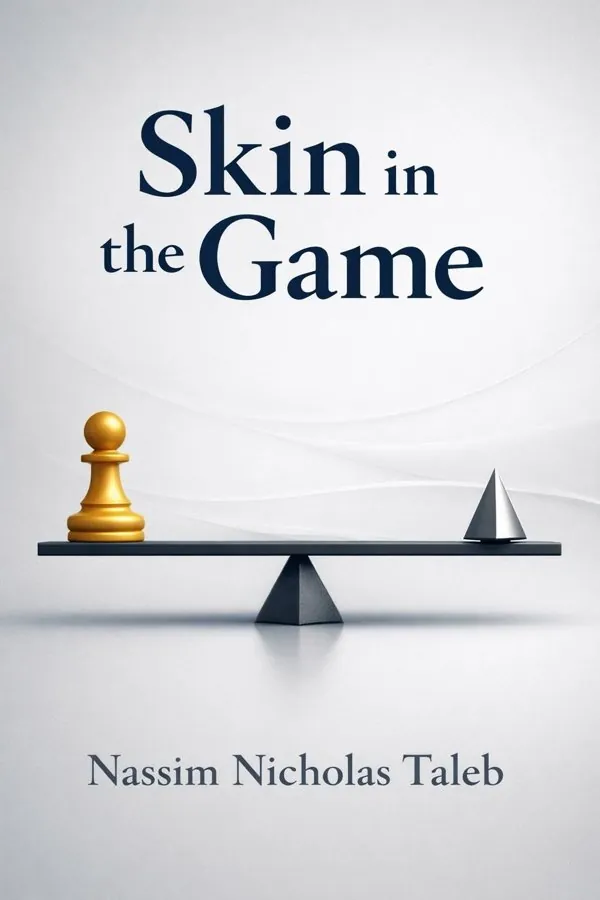
Skin in the Game: Hidden Asymmetries in Daily Life: Summary & Key Insights
 10 min9 chaptersAudio available
Key Takeaways from Skin in the Game: Hidden Asymmetries in Daily Life
The most dangerous people are often not those who take risks, but those who impose risks on others while staying personally protected.
Long before spreadsheets and probability models, human societies understood something essential: justice requires that people be exposed to the consequences of their actions.
People who live only in theories often mistake elegant explanations for reality.
Large groups are often steered not by majorities, but by small minorities that care more, insist more, and refuse compromise.
Improvement often comes less from adding the right things than from removing the wrong ones.
What Is Skin in the Game: Hidden Asymmetries in Daily Life About?
Skin in the Game: Hidden Asymmetries in Daily Life by Nassim Nicholas Taleb is a economics book spanning 7 pages. Skin in the Game is Nassim Nicholas Taleb’s sharp, provocative argument that no system can be just, stable, or intelligent when people make decisions without bearing the consequences. Across politics, business, finance, ethics, and everyday life, Taleb examines what happens when risk is transferred downward while rewards flow upward. His central claim is simple but powerful: credibility, fairness, and real knowledge emerge only when those who act also share in the downside. This matters because modern life is full of hidden asymmetries. Experts give advice they do not have to live by. Bureaucrats impose policies they will never personally suffer from. Corporate executives take upside from risky bets while others absorb the losses. Taleb shows that these arrangements are not just unfair; they also make society fragile. Taleb writes with unusual authority. A former options trader, statistician, and philosopher of uncertainty, he has spent decades studying randomness, incentives, and systemic risk. In this book, he blends ancient moral wisdom with modern economic insight to show that “skin in the game” is not a slogan. It is the missing foundation of ethics, competence, and survival in an unpredictable world.
This FizzRead summary covers all 9 key chapters of Skin in the Game: Hidden Asymmetries in Daily Life in approximately 10 minutes, distilling the most important ideas, arguments, and takeaways from Nassim Nicholas Taleb's work. Also available as an audio summary and Key Quotes Podcast.
Skin in the Game: Hidden Asymmetries in Daily Life
Skin in the Game is Nassim Nicholas Taleb’s sharp, provocative argument that no system can be just, stable, or intelligent when people make decisions without bearing the consequences. Across politics, business, finance, ethics, and everyday life, Taleb examines what happens when risk is transferred downward while rewards flow upward. His central claim is simple but powerful: credibility, fairness, and real knowledge emerge only when those who act also share in the downside.
This matters because modern life is full of hidden asymmetries. Experts give advice they do not have to live by. Bureaucrats impose policies they will never personally suffer from. Corporate executives take upside from risky bets while others absorb the losses. Taleb shows that these arrangements are not just unfair; they also make society fragile.
Taleb writes with unusual authority. A former options trader, statistician, and philosopher of uncertainty, he has spent decades studying randomness, incentives, and systemic risk. In this book, he blends ancient moral wisdom with modern economic insight to show that “skin in the game” is not a slogan. It is the missing foundation of ethics, competence, and survival in an unpredictable world.
Who Should Read Skin in the Game: Hidden Asymmetries in Daily Life?
This book is perfect for anyone interested in economics and looking to gain actionable insights in a short read. Whether you're a student, professional, or lifelong learner, the key ideas from Skin in the Game: Hidden Asymmetries in Daily Life by Nassim Nicholas Taleb will help you think differently.
- ✓Readers who enjoy economics and want practical takeaways
- ✓Professionals looking to apply new ideas to their work and life
- ✓Anyone who wants the core insights of Skin in the Game: Hidden Asymmetries in Daily Life in just 10 minutes
Want the full summary?
Get instant access to this book summary and 100K+ more with Fizz Moment.
Get Free SummaryAvailable on App Store • Free to download
Key Chapters
The most dangerous people are often not those who take risks, but those who impose risks on others while staying personally protected. Taleb calls this asymmetry, and he sees it everywhere. In politics, leaders can support disastrous wars or reckless policies and still keep their prestige, pensions, and public platforms. In finance, traders and executives may collect bonuses during good years but shift losses to shareholders, taxpayers, or employees when things collapse. In everyday life, advisors, consultants, and pundits often speak confidently because they do not personally pay for being wrong.
Taleb’s point is not merely moral; it is practical. Systems break when incentives become detached from consequences. If a builder knows he will live in the house he constructs, he will care more about structural integrity. If a doctor faces reputational and legal consequences for poor judgment, diligence rises. If investors place their own money behind their views, their opinions become more informative than those of commentators who only talk.
This idea explains why some institutions become fragile. People overproduce risk when they do not absorb the downside. They chase short-term gains, hide tail risks, and pretend uncertainty can be mastered. The result is a world in which polished narratives replace accountability.
In personal life, Taleb’s lesson is just as relevant. Before trusting advice, ask whether the person giving it has something meaningful to lose. Before delegating authority, check whether the decision-maker shares in the consequences. A reliable rule is simple: never fully trust anyone who benefits from success but is insulated from failure. Actionable takeaway: evaluate people, policies, and organizations by incentive symmetry, not by titles, credentials, or appearances.
People who live only in theories often mistake elegant explanations for reality. Taleb is especially critical of what he calls the intellectual yet idiot: the educated, articulate expert whose ideas sound impressive but collapse when exposed to the messy world. The core problem is not intelligence. It is detachment. When someone can theorize without paying for mistakes, bad ideas multiply.
Taleb draws a sharp line between knowledge gained through exposure and knowledge gained through abstraction alone. The trader who has lost money, the entrepreneur who has met payroll, the surgeon who has handled complications, and the craftsperson who must satisfy customers all learn from real-world feedback. Their understanding is constrained by consequences. By contrast, policy experts, management consultants, and media commentators can often remain influential despite repeated failures because their errors are hidden, delayed, or shifted onto others.
This does not mean theory is useless. Taleb’s point is that theory must be disciplined by reality. Models become dangerous when treated as substitutes for lived experience. This is especially true in complex systems like economies, public health, or social order, where unintended effects are common. Overconfident intervention by detached experts can produce larger harms than imperfect local knowledge.
For readers, this idea is highly practical. In hiring, trust the person who has done the thing over the person who merely explains it. In investing, prefer operators with capital at risk over forecasters with no downside. In learning, mix books with practice. Read about negotiation, then negotiate. Study health, then examine what actually improves your energy, sleep, and resilience.
Actionable takeaway: seek advice from people whose knowledge has been tested by consequences, and pressure-test abstract ideas against real-world experience before relying on them.
Large groups are often steered not by majorities, but by small minorities that care more, insist more, and refuse compromise. Taleb shows that in many domains, an intensely committed minority can reshape the behavior of a much larger population. This happens because systems adapt to the most inflexible participant when accommodating that participant is easier than resisting them.
A classic example is food standards. If a small but uncompromising minority insists on kosher, halal, allergen-free, or non-GMO options, producers may adopt those standards broadly because maintaining one unified supply chain is more efficient than running separate systems. The majority did not vote for change, but the minority’s asymmetric commitment altered the market. Similar dynamics appear in politics, corporate cultures, social norms, and digital platforms.
Taleb’s broader lesson is that influence is not evenly distributed. People who are willing to bear inconvenience for their principles often have outsized effects. This can be positive when the minority promotes quality, safety, or moral clarity. It can be negative when rigid ideologues capture institutions because everyone else is too apathetic to resist.
For individuals and organizations, this insight explains why passivity loses. If you care weakly about an outcome while someone else cares intensely, they may set the terms. In a workplace, a small group with strong standards can improve product quality. In communities, consistent local actors can shape school, zoning, or civic decisions more than larger but disengaged populations.
Actionable takeaway: identify where asymmetric commitment operates in your environment. If a principle truly matters to you, be willing to endure some cost for it; determined minorities often shape the rules everyone else ends up living under.
Improvement often comes less from adding the right things than from removing the wrong ones. Taleb calls this via negativa: a path of progress through subtraction. Instead of assuming that more intervention, more features, more policies, or more advice automatically create better outcomes, he argues that many systems become stronger when harmful elements are taken away.
This idea fits naturally with skin in the game. Additive interventions are tempting because they create visible activity and allow experts to claim credit. Yet the downside of many additions is hidden. New regulations create bureaucracy, new financial products create complexity, and new medical interventions can introduce side effects. By contrast, subtraction is quieter but often safer: remove debt, remove conflicts of interest, remove unnecessary stressors, remove fragile dependencies.
Taleb links this to the broader nature of complex systems. The body, markets, and traditions often know more than planners think. Constant tampering can make them brittle. Much of what passes for optimization is actually overengineering. This applies to health, where reducing processed foods, sleep deprivation, and sedentary habits may matter more than chasing supplements. It applies to productivity, where eliminating distractions may outperform adding elaborate systems. It applies to business, where cutting hidden incentives for reckless behavior can improve culture faster than a new values campaign.
The beauty of via negativa is that it is robust under uncertainty. When you do not fully know what helps, you can often identify what clearly harms. Subtraction reduces exposure to known sources of fragility without requiring perfect foresight.
Actionable takeaway: before adding a new strategy, tool, or policy, ask what harmful or unnecessary element you can remove first. In uncertain systems, subtraction is often the safest form of improvement.
Taleb rejects the idea that freedom means acting without limits. Real freedom, in his view, comes with responsibility and exposure. A society is healthier when people are free to make choices and also required to bear the outcomes of those choices. This combination disciplines behavior, filters bad decisions, and preserves dignity. Without consequences, freedom degenerates into moral hazard.
He is particularly wary of systems in which powerful actors are shielded from downside while ordinary people remain fully exposed. That arrangement creates resentment and destroys legitimacy. If elites enjoy the gains of risk-taking but socialize the losses, then markets are no longer true markets and political systems are no longer truly accountable. Taleb therefore sees skin in the game as the moral logic that connects liberty with fairness.
This principle also clarifies the difference between entrepreneurship and rent-seeking. An entrepreneur who invests time, money, reputation, and effort while facing possible failure embodies productive freedom. A bureaucrat or executive who can impose costs on others without personal loss does not. One creates through exposure; the other extracts through insulation.
In everyday life, the same rule applies. If you want independence in your career, you must accept uncertainty. If you want the freedom to voice strong opinions, you should be prepared to stand by them under scrutiny. If you want to lead, you should share sacrifice with those affected by your decisions. Rights and burdens are healthier when they travel together.
Actionable takeaway: wherever you seek more freedom, ask what consequences you are willing to carry. Durable liberty is not freedom from risk; it is freedom joined to responsibility.
Not everything old is wise, but what has survived for a long time often contains information that no individual fully understands. Taleb argues that traditions, customs, and inherited norms deserve more respect than modern intellectual culture usually gives them. Their value often lies not in explicit justification, but in the fact that they endured repeated exposure to reality.
This is a key theme in the Incerto worldview: time is a stress test. Ideas, habits, institutions, and practices that survive generations may embody hidden forms of antifragility. They have been filtered through trial, error, and selection. By contrast, recently invented systems often look efficient but may hide fragilities that only appear under stress. Tradition is therefore not simply nostalgia. It is a repository of practices that persisted because they did not kill the people who used them.
Taleb does not say traditions are sacred or beyond criticism. Rather, he warns against replacing them casually with top-down designs created by experts who lack skin in the game. A family ritual, local building style, dietary practice, legal norm, or code of conduct may encode practical knowledge that is invisible to abstract reasoning. When reformers sweep such things away in the name of rationalization, they may destroy resilience they did not know existed.
In modern life, this suggests humility. Before dismissing an old practice as irrational, ask what function it served. Why did communities maintain it? What risks did it reduce? What social bonds did it reinforce? Sometimes the logic is clearer after observing long-term effects, not before.
Actionable takeaway: treat durable traditions as hypotheses that have already passed many real-world tests. Question them when necessary, but do so carefully and with respect for the information embedded in survival.
In a world overflowing with opinions, the most valuable signal is not confidence but exposure. Taleb repeatedly returns to the idea that a person becomes credible when they are personally vulnerable to being wrong. Skin in the game turns speech into commitment. It separates cheap talk from costly belief.
This principle helps explain why some voices deserve more attention than others. A venture capitalist investing personal capital reveals more than a trend forecaster on television. A founder who ties reputation and livelihood to a product reveals more than a consultant delivering a presentation. A local official who uses the same public services as constituents has stronger incentives than one insulated by privilege. Exposure forces honesty because reality pushes back.
Taleb’s insight is especially important in the age of social media and endless commentary. Platforms reward certainty, outrage, and cleverness, but they rarely require accountability. This creates an ecosystem of low-cost opinions detached from outcomes. The danger is not just misinformation; it is the erosion of standards for whom we trust.
In practical life, credibility screening can improve decisions. If you are evaluating financial advice, ask whether the advisor invests under the same strategy. If you are considering a health recommendation, ask whether the expert follows it personally and has experience with its tradeoffs. If you are listening to a manager, ask whether they share the downside of their directives.
Actionable takeaway: whenever possible, rank advice by the giver’s exposure to consequences. Prefer fewer opinions from accountable people over many opinions from spectators with nothing at stake.
Progress rarely comes from committees insulated from failure. It usually comes from individuals and small groups willing to take real risks in pursuit of something new. Taleb argues that society advances because some people voluntarily expose themselves to uncertainty, loss, criticism, and ruin. These risk bearers create the discoveries, businesses, technologies, and cultural shifts that others later benefit from.
This does not mean all risk-taking is admirable. Taleb distinguishes productive risk from transferred risk. The entrepreneur who may lose savings, reputation, and years of effort while building a useful product is taking a meaningful, socially valuable risk. The executive who receives upside from aggressive financial bets while expecting a bailout is not. One internalizes the downside; the other externalizes it.
Taleb’s perspective also restores dignity to trial and error. Real innovation is messy and often comes with failure. But systems improve when failures are local, bounded, and borne by those who choose them. This creates learning without systemic collapse. By contrast, centralized risk imposed on millions can be catastrophic because those designing it often escape the damage.
For readers, this idea can reshape how success is viewed. The person who has failed honestly while attempting difficult things may deserve more respect than the polished observer who has never been tested. In organizations, leaders should reward responsible experimentation while preventing employees from hiding downside in others’ budgets, reputations, or careers.
Actionable takeaway: support and learn from people who take bounded, voluntary risks and bear their own downside. They are often the true engines of adaptation, discovery, and long-term progress.
All Chapters in Skin in the Game: Hidden Asymmetries in Daily Life
About the Author
Nassim Nicholas Taleb is a Lebanese-American scholar, essayist, former options trader, and risk analyst known for his work on uncertainty, probability, and fragility. Before becoming a full-time writer and thinker, he spent years in finance, where he specialized in derivatives and learned firsthand how markets behave under stress. That practical background shapes much of his writing, which often challenges academic theory and expert overconfidence. Taleb is the author of the Incerto series, including Fooled by Randomness, The Black Swan, Antifragile, and Skin in the Game. His ideas have influenced fields ranging from economics and investing to decision-making and public policy. He is especially known for exploring how people misunderstand rare events, hide risk, and create fragile systems through misplaced confidence.
Get This Summary in Your Preferred Format
Read or listen to the Skin in the Game: Hidden Asymmetries in Daily Life summary by Nassim Nicholas Taleb anytime, anywhere. FizzRead offers multiple formats so you can learn on your terms — all free.
Available formats: App · Audio · PDF · EPUB — All included free with FizzRead
Download Skin in the Game: Hidden Asymmetries in Daily Life PDF and EPUB Summary
Key Quotes from Skin in the Game: Hidden Asymmetries in Daily Life
“The most dangerous people are often not those who take risks, but those who impose risks on others while staying personally protected.”
“Long before spreadsheets and probability models, human societies understood something essential: justice requires that people be exposed to the consequences of their actions.”
“People who live only in theories often mistake elegant explanations for reality.”
“Large groups are often steered not by majorities, but by small minorities that care more, insist more, and refuse compromise.”
“Improvement often comes less from adding the right things than from removing the wrong ones.”
Frequently Asked Questions about Skin in the Game: Hidden Asymmetries in Daily Life
Skin in the Game: Hidden Asymmetries in Daily Life by Nassim Nicholas Taleb is a economics book that explores key ideas across 9 chapters. Skin in the Game is Nassim Nicholas Taleb’s sharp, provocative argument that no system can be just, stable, or intelligent when people make decisions without bearing the consequences. Across politics, business, finance, ethics, and everyday life, Taleb examines what happens when risk is transferred downward while rewards flow upward. His central claim is simple but powerful: credibility, fairness, and real knowledge emerge only when those who act also share in the downside. This matters because modern life is full of hidden asymmetries. Experts give advice they do not have to live by. Bureaucrats impose policies they will never personally suffer from. Corporate executives take upside from risky bets while others absorb the losses. Taleb shows that these arrangements are not just unfair; they also make society fragile. Taleb writes with unusual authority. A former options trader, statistician, and philosopher of uncertainty, he has spent decades studying randomness, incentives, and systemic risk. In this book, he blends ancient moral wisdom with modern economic insight to show that “skin in the game” is not a slogan. It is the missing foundation of ethics, competence, and survival in an unpredictable world.
More by Nassim Nicholas Taleb
Fooled by Randomness: The Hidden Role of Chance in Life and in the Markets
Nassim Nicholas Taleb
10 min
Antifragile: Things That Gain from Disorder
Nassim Nicholas Taleb
10 min
The Barbell Strategy
Nassim Nicholas Taleb
10 min
The Black Swan: The Impact of the Highly Improbable
Nassim Nicholas Taleb
10 minYou Might Also Like
Business Adventures
John Brooks
10 min
Nudge
Richard H. Thaler, Cass R. Sunstein
10 min
The Hitchhiker"s Guide to the Galaxy
Douglas Adams
10 minThe Muqaddimah
Ibn Khaldun
10 minThe Outsiders
William N. Thorndike
10 min
A Little History of Economics
Niall Kishtainy
10 minBrowse by Category
Ready to read Skin in the Game: Hidden Asymmetries in Daily Life?
Get the full summary and 100K+ more books with Fizz Moment.