
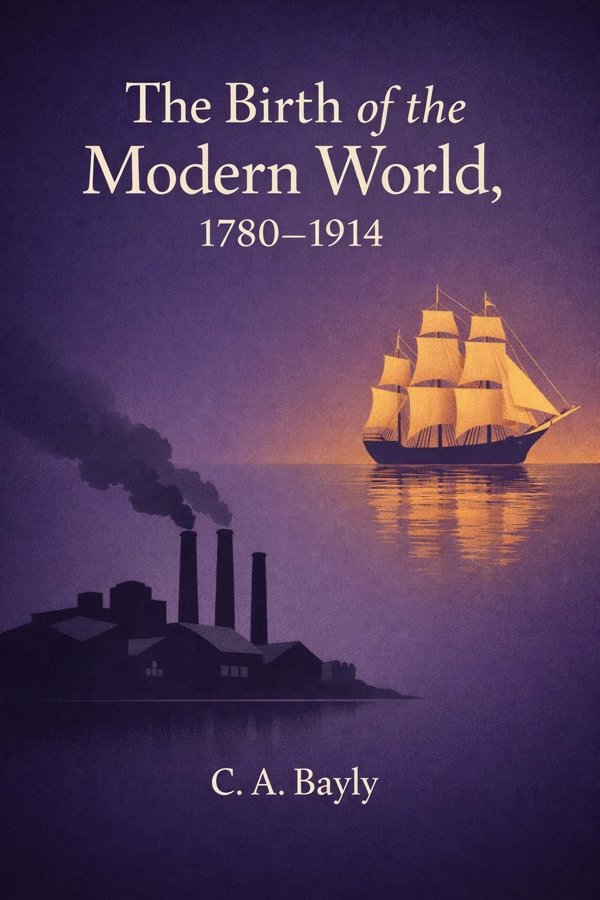
The Birth of the Modern World, 1780–1914: Global Connections and Comparisons: Summary & Key Insights
by C. A. Bayly
 10 min10 chaptersAudio available
Key Takeaways from The Birth of the Modern World, 1780–1914: Global Connections and Comparisons
A revolution in one place rarely stays there for long.
Factories may symbolize modernity, but Bayly insists that industrialization was never just a story about Britain’s mills and machines.
Modern globalization did not emerge from peaceful exchange alone; it was often organized through empire.
Modernity did not simply secularize the world.
The modern state did not emerge only in Europe, and it did not grow in a straight line toward liberal freedom.
What Is The Birth of the Modern World, 1780–1914: Global Connections and Comparisons About?
The Birth of the Modern World, 1780–1914: Global Connections and Comparisons by C. A. Bayly is a world_history book spanning 10 pages. C. A. Bayly’s The Birth of the Modern World, 1780–1914 is a sweeping reinterpretation of how modernity emerged across the globe. Rather than telling a familiar story in which Europe invents the modern age and the rest of the world merely reacts, Bayly shows that the period from the late eighteenth century to the eve of the First World War was shaped by deep connections among Asia, Africa, Europe, and the Americas. Revolutions, industrial growth, imperial conquest, migration, religious reform, state-building, and new communications did not happen in isolation. They formed a worldwide process in which societies borrowed, resisted, adapted, and transformed one another. What makes this book matter is its scale and its argument. Bayly asks readers to see the modern world not as a one-way export from the West, but as the product of comparison, contact, and conflict. This changes how we understand nationalism, capitalism, empire, and globalization itself. Bayly was one of the most respected historians of global and imperial history, and his authority shows in the book’s command of regions, sources, and debates. The result is an ambitious, influential history that reshapes how we think about the nineteenth century and the making of our world.
This FizzRead summary covers all 10 key chapters of The Birth of the Modern World, 1780–1914: Global Connections and Comparisons in approximately 10 minutes, distilling the most important ideas, arguments, and takeaways from C. A. Bayly's work. Also available as an audio summary and Key Quotes Podcast.
The Birth of the Modern World, 1780–1914: Global Connections and Comparisons
C. A. Bayly’s The Birth of the Modern World, 1780–1914 is a sweeping reinterpretation of how modernity emerged across the globe. Rather than telling a familiar story in which Europe invents the modern age and the rest of the world merely reacts, Bayly shows that the period from the late eighteenth century to the eve of the First World War was shaped by deep connections among Asia, Africa, Europe, and the Americas. Revolutions, industrial growth, imperial conquest, migration, religious reform, state-building, and new communications did not happen in isolation. They formed a worldwide process in which societies borrowed, resisted, adapted, and transformed one another.
What makes this book matter is its scale and its argument. Bayly asks readers to see the modern world not as a one-way export from the West, but as the product of comparison, contact, and conflict. This changes how we understand nationalism, capitalism, empire, and globalization itself. Bayly was one of the most respected historians of global and imperial history, and his authority shows in the book’s command of regions, sources, and debates. The result is an ambitious, influential history that reshapes how we think about the nineteenth century and the making of our world.
Who Should Read The Birth of the Modern World, 1780–1914: Global Connections and Comparisons?
This book is perfect for anyone interested in world_history and looking to gain actionable insights in a short read. Whether you're a student, professional, or lifelong learner, the key ideas from The Birth of the Modern World, 1780–1914: Global Connections and Comparisons by C. A. Bayly will help you think differently.
- ✓Readers who enjoy world_history and want practical takeaways
- ✓Professionals looking to apply new ideas to their work and life
- ✓Anyone who wants the core insights of The Birth of the Modern World, 1780–1914: Global Connections and Comparisons in just 10 minutes
Want the full summary?
Get instant access to this book summary and 100K+ more with Fizz Moment.
Get Free SummaryAvailable on App Store • Free to download
Key Chapters
A revolution in one place rarely stays there for long. Bayly’s account of the years from roughly 1780 to 1820 shows that the American, French, Haitian, and Latin American revolutions were not isolated national events but linked episodes in a broader transformation of political thought. Ideas about rights, citizenship, sovereignty, liberty, and representation traveled across oceans through pamphlets, soldiers, merchants, religious networks, and imperial administrations. Even where revolutions did not succeed, rulers and subjects had to grapple with new expectations about legitimate power.
Bayly’s crucial insight is that these revolutions did not simply spread European ideals outward. They were shaped by colonial tensions, slave resistance, indigenous politics, and imperial rivalries. Haiti, for example, exposed the contradiction between universal liberty and racial slavery. Spanish America showed how colonial elites and local populations adapted the language of rights to their own circumstances. The result was a new global political vocabulary that connected distant struggles while producing different local outcomes.
This matters because it shifts our understanding of modern politics. Concepts we now take for granted, such as constitutionalism or national self-rule, emerged through conflict across the Atlantic world and beyond. Similar dynamics still shape modern protest movements today: ideas cross borders quickly, but they are always reinterpreted by local actors.
A practical way to apply Bayly’s insight is to stop treating political change as purely domestic. When studying a revolution, election crisis, or mass protest, ask what global conversations helped shape it. Actionable takeaway: analyze major political events through both local causes and transnational influences to better understand how modern political language is formed.
Factories may symbolize modernity, but Bayly insists that industrialization was never just a story about Britain’s mills and machines. It depended on worldwide trade, imperial extraction, agricultural change, labor migration, and financial networks that tied together Europe, India, China, Africa, and the Americas. Cotton from the American South and India, silver flows, plantation profits, and Asian markets all helped make industrial growth possible. The Industrial Revolution was therefore not merely a national breakthrough; it was built on global interdependence.
Bayly also shows that industrialization had uneven consequences. Some regions gained capital, infrastructure, and new industries, while others were pushed into subordinate roles as suppliers of raw materials or consumers of manufactured goods. Indian textile production, for instance, suffered under competition from British machine-made goods, while ports, railways, and telegraph systems expanded in ways that often served imperial interests more than local development. Industrialization therefore brought both growth and distortion, innovation and dependency.
This wider perspective helps explain why economic modernization produced such different outcomes across the world. It also speaks to the present. Today’s supply chains, outsourcing systems, and unequal development patterns echo nineteenth-century structures, though in new forms. The smartphone, like the steam engine before it, depends on resources, labor, transport, and markets spread across continents.
A useful application is to think beyond inventions and focus on systems. Technology changes history not by itself, but through networks of labor, capital, and power. Actionable takeaway: when evaluating economic progress, trace who supplies the raw materials, who does the labor, who captures the profits, and who bears the social costs.
Modern globalization did not emerge from peaceful exchange alone; it was often organized through empire. Bayly argues that imperial expansion in the nineteenth century linked distant territories through conquest, trade, law, infrastructure, and military force. European empires expanded dramatically, but they also relied on cooperation from local elites, intermediaries, soldiers, and merchants. Empire was not just domination from above. It was a layered system of negotiation, coercion, adaptation, and resistance.
One of Bayly’s major contributions is to show that empire was both integrating and disruptive. Railways, ports, legal systems, and schools connected colonies more tightly to global markets and imperial capitals. At the same time, these same institutions reorganized local economies, weakened older authorities, redrew ethnic and political boundaries, and intensified inequalities. British rule in India, French expansion in North Africa, and settler colonial projects in places like Australia and South Africa all created forms of connection that were inseparable from violence and dispossession.
Empire also helped circulate ideas. Colonized peoples learned imperial languages, studied in metropolitan institutions, served in armies, and used those experiences to critique imperial rule itself. Anti-colonial nationalism often grew inside imperial systems before turning against them.
This is highly relevant today because many current borders, trade routes, legal structures, and geopolitical tensions were shaped by imperial history. Understanding empire explains why global integration has so often been unequal.
A practical application is to question narratives that celebrate infrastructure or free trade without examining the power behind them. Connections can enrich lives, but they can also entrench domination. Actionable takeaway: whenever you see a story of global integration, ask who designed the system, who benefited most, and who paid the price.
Modernity did not simply secularize the world. Bayly challenges the assumption that as states modernized and science advanced, religion faded into irrelevance. Instead, the nineteenth century witnessed vigorous religious renewal, reform, competition, and missionary expansion across multiple traditions. Islam, Hinduism, Buddhism, Christianity, and other faiths were reshaped by print culture, education, urbanization, and imperial encounters. Religion remained one of the most powerful languages through which people interpreted change.
Bayly shows that religious communities did not merely resist modernity; they actively participated in making it. Reformers standardized doctrine, founded schools, created new associations, and used print media to define collective identities. Protestant missionaries expanded literacy and education while also helping spread imperial assumptions. Muslim reformers debated how to reconcile faith with political decline and technological change. Hindu and Buddhist movements rearticulated tradition in forms that were often more organized, textual, and public than before. In many regions, religious revival became tied to nationalism, social reform, or anti-colonial sentiment.
This matters because it corrects a common misunderstanding. The modern world was not built only by secular states, industrialists, and scientists. It was also shaped by believers, clerics, reform movements, and sacred institutions. Even now, religion continues to shape politics, identity, education, and social conflict across the globe.
A practical way to use Bayly’s insight is to avoid framing religion and modernity as opposites. In many cases, religious movements modernize by changing organization, communication, and public engagement. Actionable takeaway: when analyzing social or political change, include religion as an active force rather than treating it as a leftover from the premodern past.
The modern state did not emerge only in Europe, and it did not grow in a straight line toward liberal freedom. Bayly shows that between 1780 and 1914, governments across the world became more ambitious in taxation, policing, census-taking, military organization, education, and legal regulation. States increasingly sought to classify populations, map territory, manage commerce, and shape public behavior. This expansion happened in empires, monarchies, republics, and colonial regimes alike.
What is striking in Bayly’s account is how state-building drew on both local traditions and global pressures. Military competition, imperial rivalry, trade demands, and revolutionary fear pushed rulers to centralize authority. In places as different as Meiji Japan, Ottoman territories, British India, and Latin American republics, governments tried to create stronger bureaucracies and more disciplined citizens. Yet these efforts did not erase older loyalties. Kinship groups, local notables, religious authorities, and regional identities continued to mediate state power.
Bayly’s analysis helps explain why modernization often meant deeper surveillance and control as much as freedom or efficiency. Census categories could harden ethnic divisions. Schooling could spread literacy while also enforcing nationalism. Legal reform could provide order while extending coercive authority. In this sense, the modern state was both productive and dangerous.
This idea remains deeply relevant in an era of digital governance, biometric identification, and data collection. The tools are newer, but the ambition to see, classify, and manage populations is not.
Actionable takeaway: when judging state reform, look beyond promises of order or progress and ask how new administrative tools affect liberty, identity, and the balance between public good and official power.
Modern history is also a history of speed. Bayly highlights how print, postal systems, newspapers, railways, steamships, and the telegraph transformed the scale and pace of connection during the nineteenth century. Information that once took months to circulate could suddenly travel in days or even hours. This altered commerce, diplomacy, warfare, religion, science, and everyday consciousness. People became more aware of events happening far beyond their immediate locality, and that awareness changed how they imagined themselves and the world.
These communication systems did more than spread facts. They created publics. Newspapers linked readers into shared debates; official reports allowed states to coordinate more effectively; missionaries and reformers built transnational communities; and financial markets reacted more quickly to distant events. Standardized time, regular mail routes, and expanded literacy made society more synchronized. A trader in Bombay, a bureaucrat in Cairo, and a reformer in Buenos Aires could each be drawn into overlapping global conversations.
Yet Bayly also reminds us that access to these networks was uneven. Literacy, infrastructure, censorship, and cost shaped who could participate. Information revolutions often empower some groups while excluding others. The telegraph strengthened both commerce and imperial command. Print could spread reformist ideas, but also racial stereotypes and nationalist hostility.
The parallel with today’s internet age is obvious. Faster communication expands opportunity, but it can also deepen inequality and intensify political conflict. The medium changes; the underlying dynamics remain familiar.
Actionable takeaway: treat communication technologies not as neutral tools but as systems that redistribute power, shape collective identity, and determine whose voices become visible in public life.
Modernity changed not only governments and economies but the texture of everyday social life. Bayly explains how industrialization, urban growth, commercial expansion, migration, and new forms of education disrupted older social hierarchies and produced new classes and social identities. Aristocracies did not disappear, but they had to adapt. Merchants, professionals, bureaucrats, industrialists, wage laborers, and urban middle classes became more visible and politically important. Across the world, people increasingly understood themselves in relation to work, status, education, and economic opportunity.
Bayly’s global perspective is especially helpful here. Class formation did not follow a single European script. In some regions, new elites emerged from old landholding or administrative classes. Elsewhere, merchants, colonial intermediaries, or educated professionals became the carriers of reform and nationalism. Urban workers might develop class consciousness, but they could also organize around religion, ethnicity, caste, or locality. Social transformation was therefore real, but never uniform.
The book also suggests that social change brought aspiration and anxiety in equal measure. Expanding schools and print culture widened horizons. Migration offered mobility. But city life could be precarious, labor was often exploitative, and older safety nets weakened. Debates about poverty, public health, women’s roles, labor discipline, and moral order became central to political life because social upheaval was impossible to ignore.
This helps explain why modern societies remain obsessed with inequality, merit, and belonging. Economic change always creates new winners and new insecurities.
Actionable takeaway: when analyzing social conflict, avoid reducing it to income alone. Look at how work, education, gender, family structure, migration, and cultural status combine to create new identities and tensions.
Nations often present themselves as ancient, natural communities, but Bayly shows that nationalism was largely a modern construction. During the nineteenth century, elites, reformers, soldiers, teachers, journalists, and state officials worked to define who belonged to a nation and what symbols, memories, and institutions would hold that nation together. Shared language, history, schooling, military service, newspapers, and rituals all helped produce national consciousness. National identity was made through institutions as much as through sentiment.
Bayly’s comparative approach is important because nationalism emerged in very different settings: post-revolutionary republics, old empires, settler colonies, and colonized societies. In Europe, nationalism could support state consolidation or revolutionary challenge. In colonized regions, it often developed as a response to imperial domination, borrowing some of the same administrative and political tools used by empires. Nationalism therefore had a double character: it could promise liberation while also excluding minorities, hardening boundaries, and justifying violence.
This idea is especially useful for modern readers because nationalism remains one of the strongest forces in global politics. Public debates over flags, immigration, curriculum, language, and historical memory all reveal that nations are constantly being redefined. Bayly helps us see that national identity is neither timeless nor inevitable. It is a political project.
A practical application is to pay attention to the institutions that make belonging feel natural: schools, maps, media, holidays, censuses, and museums. These shape identity more than abstract slogans do. Actionable takeaway: when confronted with nationalist claims, ask who is constructing the story of the nation, which groups it includes, and which histories it leaves out.
History is often written from the perspective of expanding power, but Bayly insists that resistance was equally central to the making of the modern world. Imperial conquest, capitalist transformation, state centralization, and missionary intrusion all generated opposition from peasants, workers, tribal confederations, religious leaders, enslaved people, and emerging nationalist movements. These responses were not marginal reactions. They influenced policies, altered institutions, and forced empires and states to adapt.
Bayly does not romanticize resistance. Some movements defended local autonomy; others sought restoration rather than reform. Some were inspired by religion, others by class grievances or ethnic solidarities. The 1857 uprising in India, anti-colonial revolts in Africa, peasant disturbances, labor unrest, and millenarian movements all show that people did not passively accept the remaking of their worlds. Even when they failed militarily, they exposed the limits of imperial power and kept alternative political possibilities alive.
The key lesson is that modernity was never simply imposed from above. It was contested at every stage. Resistance shaped how empires governed, how states justified themselves, and how later nationalist and social movements framed their claims. Many twentieth-century struggles for independence, labor rights, and social justice built on these earlier traditions of opposition.
This remains relevant whenever governments or corporations describe change as inevitable. Bayly reminds us that what appears unstoppable is often the outcome of struggle.
Actionable takeaway: in any story of modernization, look for the people who resisted, negotiated, or redirected change; understanding their role reveals not only what happened, but what other futures were once possible.
The world on the eve of the First World War was more connected than ever before, but those connections carried danger as well as opportunity. Bayly’s closing vision of the period emphasizes that by 1914 global interdependence had become unmistakable. Markets, migration routes, imperial systems, communication networks, and political ideologies linked societies across continents. Cities depended on distant food supplies and raw materials. Financial shocks could travel quickly. Political crises in one region could reverberate globally.
Yet this growing integration did not create harmony. In fact, it often intensified rivalry. Industrial competition, imperial expansion, racial thinking, nationalist passion, and military buildup developed alongside global exchange. The same railways and telegraphs that connected the world also made war mobilization more efficient. The same empires that moved goods and people also deepened resentment and resistance. Bayly therefore presents modern globalization as fundamentally ambivalent: it enlarged human horizons while embedding inequality and instability into the world system.
This insight is perhaps the most enduring in the book. Our own age is similarly marked by interdependence without trust, speed without fairness, and connection without unity. Pandemics, climate change, supply chain disruptions, and geopolitical conflict all reveal how tightly linked the world remains.
Bayly’s history helps readers understand that globalization is not new, and that its benefits cannot be separated from structures of power. Actionable takeaway: when thinking about global problems today, resist purely national explanations and examine the historical networks that make distant events immediately consequential.
All Chapters in The Birth of the Modern World, 1780–1914: Global Connections and Comparisons
About the Author
C. A. Bayly (1945–2015) was one of the most influential historians of modern global and imperial history. A longtime professor at the University of Cambridge, he was widely admired for combining deep regional knowledge, especially of India and the British Empire, with large comparative arguments about world history. Bayly helped reshape the field by challenging Eurocentric narratives and showing how Asia, Africa, and the colonial world were active participants in the making of modernity. His scholarship explored empire, nationalism, information networks, religious change, and the growth of the modern state. Known for both intellectual breadth and analytical precision, Bayly left a lasting mark on how historians understand the interconnected development of the modern world.
Get This Summary in Your Preferred Format
Read or listen to the The Birth of the Modern World, 1780–1914: Global Connections and Comparisons summary by C. A. Bayly anytime, anywhere. FizzRead offers multiple formats so you can learn on your terms — all free.
Available formats: App · Audio · PDF · EPUB — All included free with FizzRead
Download The Birth of the Modern World, 1780–1914: Global Connections and Comparisons PDF and EPUB Summary
Key Quotes from The Birth of the Modern World, 1780–1914: Global Connections and Comparisons
“A revolution in one place rarely stays there for long.”
“Factories may symbolize modernity, but Bayly insists that industrialization was never just a story about Britain’s mills and machines.”
“Modern globalization did not emerge from peaceful exchange alone; it was often organized through empire.”
“Modernity did not simply secularize the world.”
“The modern state did not emerge only in Europe, and it did not grow in a straight line toward liberal freedom.”
Frequently Asked Questions about The Birth of the Modern World, 1780–1914: Global Connections and Comparisons
The Birth of the Modern World, 1780–1914: Global Connections and Comparisons by C. A. Bayly is a world_history book that explores key ideas across 10 chapters. C. A. Bayly’s The Birth of the Modern World, 1780–1914 is a sweeping reinterpretation of how modernity emerged across the globe. Rather than telling a familiar story in which Europe invents the modern age and the rest of the world merely reacts, Bayly shows that the period from the late eighteenth century to the eve of the First World War was shaped by deep connections among Asia, Africa, Europe, and the Americas. Revolutions, industrial growth, imperial conquest, migration, religious reform, state-building, and new communications did not happen in isolation. They formed a worldwide process in which societies borrowed, resisted, adapted, and transformed one another. What makes this book matter is its scale and its argument. Bayly asks readers to see the modern world not as a one-way export from the West, but as the product of comparison, contact, and conflict. This changes how we understand nationalism, capitalism, empire, and globalization itself. Bayly was one of the most respected historians of global and imperial history, and his authority shows in the book’s command of regions, sources, and debates. The result is an ambitious, influential history that reshapes how we think about the nineteenth century and the making of our world.
You Might Also Like
The Age of Capital
Eric Hobsbawm
10 min
The Gulag Archipelago
Aleksandr Solzhenitsyn
10 min
Jerusalem: The Biography
Simon Sebag Montefiore
10 min
The Anglo-Saxons
James Campbell
10 min
The Boer War
Thomas Pakenham
10 min
The Industrial Revolutionaries: The Making of the Modern World 1776–1914
Gavin Weightman
10 minBrowse by Category
Ready to read The Birth of the Modern World, 1780–1914: Global Connections and Comparisons?
Get the full summary and 100K+ more books with Fizz Moment.