
C. A. Bayly Books
C. A.
Known for: The Birth of the Modern World, 1780–1914: Global Connections and Comparisons
Books by C. A. Bayly
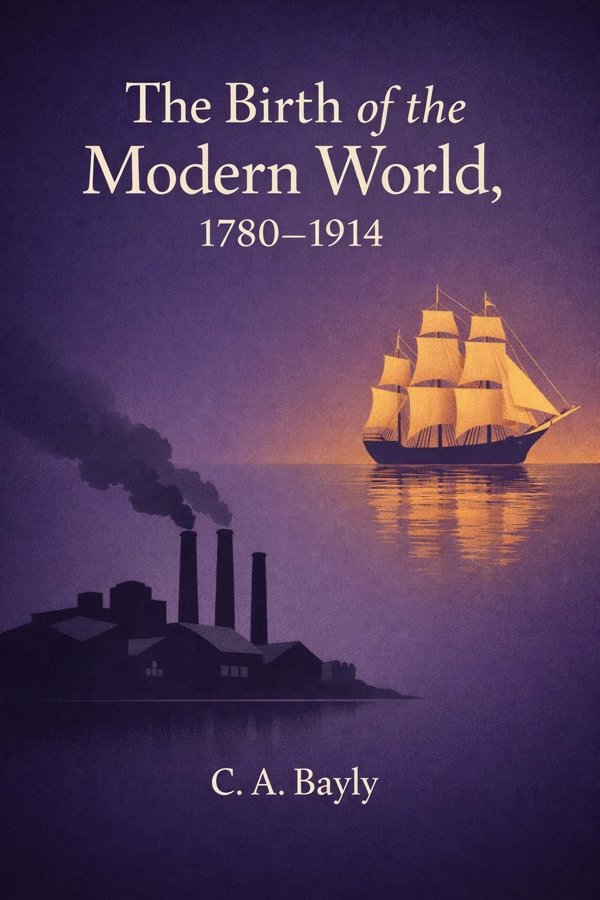
The Birth of the Modern World, 1780–1914: Global Connections and Comparisons
C. A. Bayly’s The Birth of the Modern World, 1780–1914 is a sweeping reinterpretation of how modernity emerged across the globe. Rather than telling a familiar story in which Europe invents the modern age and the rest of the world merely reacts, Bayly shows that the period from the late eighteenth century to the eve of the First World War was shaped by deep connections among Asia, Africa, Europe, and the Americas. Revolutions, industrial growth, imperial conquest, migration, religious reform, state-building, and new communications did not happen in isolation. They formed a worldwide process in which societies borrowed, resisted, adapted, and transformed one another. What makes this book matter is its scale and its argument. Bayly asks readers to see the modern world not as a one-way export from the West, but as the product of comparison, contact, and conflict. This changes how we understand nationalism, capitalism, empire, and globalization itself. Bayly was one of the most respected historians of global and imperial history, and his authority shows in the book’s command of regions, sources, and debates. The result is an ambitious, influential history that reshapes how we think about the nineteenth century and the making of our world.
Read SummaryKey Insights from C. A. Bayly
Revolutions Created a Global Political Language
A revolution in one place rarely stays there for long. Bayly’s account of the years from roughly 1780 to 1820 shows that the American, French, Haitian, and Latin American revolutions were not isolated national events but linked episodes in a broader transformation of political thought. Ideas about r...
From The Birth of the Modern World, 1780–1914: Global Connections and Comparisons
Industrialization Was a Global Process
Factories may symbolize modernity, but Bayly insists that industrialization was never just a story about Britain’s mills and machines. It depended on worldwide trade, imperial extraction, agricultural change, labor migration, and financial networks that tied together Europe, India, China, Africa, an...
From The Birth of the Modern World, 1780–1914: Global Connections and Comparisons
Empire Bound the World Together
Modern globalization did not emerge from peaceful exchange alone; it was often organized through empire. Bayly argues that imperial expansion in the nineteenth century linked distant territories through conquest, trade, law, infrastructure, and military force. European empires expanded dramatically,...
From The Birth of the Modern World, 1780–1914: Global Connections and Comparisons
Religion Remained Central to Modernity
Modernity did not simply secularize the world. Bayly challenges the assumption that as states modernized and science advanced, religion faded into irrelevance. Instead, the nineteenth century witnessed vigorous religious renewal, reform, competition, and missionary expansion across multiple traditio...
From The Birth of the Modern World, 1780–1914: Global Connections and Comparisons
States Grew Stronger and More Intrusive
The modern state did not emerge only in Europe, and it did not grow in a straight line toward liberal freedom. Bayly shows that between 1780 and 1914, governments across the world became more ambitious in taxation, policing, census-taking, military organization, education, and legal regulation. Stat...
From The Birth of the Modern World, 1780–1914: Global Connections and Comparisons
Information Networks Remade Human Possibilities
Modern history is also a history of speed. Bayly highlights how print, postal systems, newspapers, railways, steamships, and the telegraph transformed the scale and pace of connection during the nineteenth century. Information that once took months to circulate could suddenly travel in days or even ...
From The Birth of the Modern World, 1780–1914: Global Connections and Comparisons
About C. A. Bayly
C. A. Bayly (1945–2015) was a British historian and professor at the University of Cambridge, renowned for his contributions to global and imperial history. His scholarship focused on the comparative study of empires, nationalism, and the interconnected development of societies in the modern era.


Frequently Asked Questions
C. A.
Read C. A. Bayly's books in 15 minutes
Get AI-powered summaries with key insights from 1 book by C. A. Bayly.