
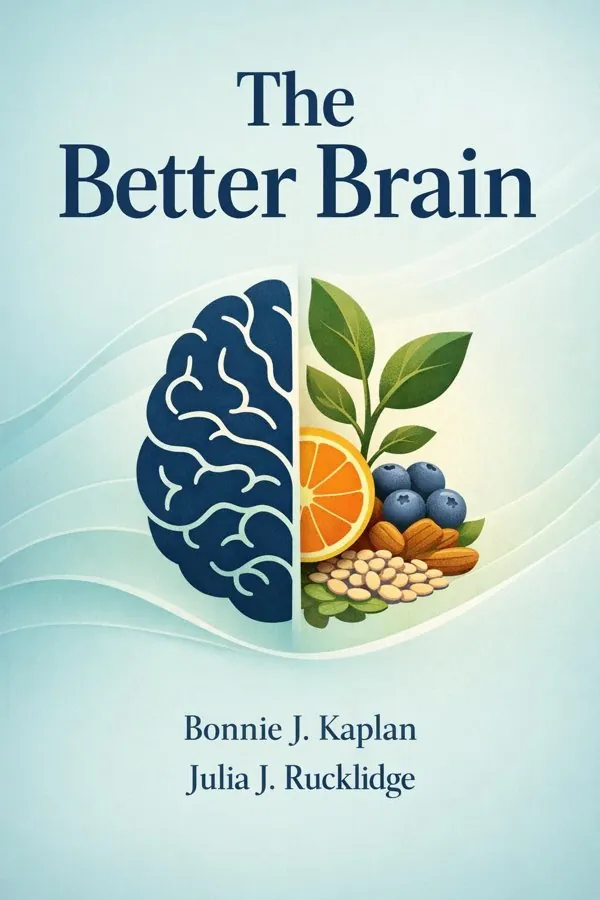
The Better Brain: Overcome Anxiety, Combat Depression, and Reduce ADHD and Stress with Nutrition: Summary & Key Insights
by Bonnie J. Kaplan, Julia J. Rucklidge
 10 min5 chaptersAudio available
What Is The Better Brain: Overcome Anxiety, Combat Depression, and Reduce ADHD and Stress with Nutrition About?
The Better Brain: Overcome Anxiety, Combat Depression, and Reduce ADHD and Stress with Nutrition by Bonnie J. Kaplan, Julia J. Rucklidge is a mental_health book spanning 5 pages. The Better Brain presents scientific evidence showing how nutrition profoundly affects mental health. Drawing on decades of research, Kaplan and Rucklidge explain how micronutrients can help alleviate anxiety, depression, ADHD, and stress. The book offers practical dietary guidance and case studies demonstrating how nutrient-rich foods can improve emotional well-being and cognitive performance.
This FizzRead summary covers all 5 key chapters of The Better Brain: Overcome Anxiety, Combat Depression, and Reduce ADHD and Stress with Nutrition in approximately 10 minutes, distilling the most important ideas, arguments, and takeaways from Bonnie J. Kaplan, Julia J. Rucklidge's work. Also available as an audio summary and Key Quotes Podcast.
The Better Brain: Overcome Anxiety, Combat Depression, and Reduce ADHD and Stress with Nutrition
The Better Brain presents scientific evidence showing how nutrition profoundly affects mental health. Drawing on decades of research, Kaplan and Rucklidge explain how micronutrients can help alleviate anxiety, depression, ADHD, and stress. The book offers practical dietary guidance and case studies demonstrating how nutrient-rich foods can improve emotional well-being and cognitive performance.
Who Should Read The Better Brain: Overcome Anxiety, Combat Depression, and Reduce ADHD and Stress with Nutrition?
This book is perfect for anyone interested in mental_health and looking to gain actionable insights in a short read. Whether you're a student, professional, or lifelong learner, the key ideas from The Better Brain: Overcome Anxiety, Combat Depression, and Reduce ADHD and Stress with Nutrition by Bonnie J. Kaplan, Julia J. Rucklidge will help you think differently.
- ✓Readers who enjoy mental_health and want practical takeaways
- ✓Professionals looking to apply new ideas to their work and life
- ✓Anyone who wants the core insights of The Better Brain: Overcome Anxiety, Combat Depression, and Reduce ADHD and Stress with Nutrition in just 10 minutes
Want the full summary?
Get instant access to this book summary and 100K+ more with Fizz Moment.
Get Free SummaryAvailable on App Store • Free to download
Key Chapters
Our journey into the science began with a profound paradox. While our generation has unprecedented access to food, mental disorders are rising at an alarming rate. The connection between these two realities lies in micronutrients—the vitamins and minerals that are quietly orchestrating the symphony of brain activity. Modern diets, dominated by refined carbohydrates and processed foods, lack these key nutrients, leaving the brain literally undernourished.
When we began studying this in the 1990s, the idea that nutrition could influence mental health was considered fringe. We now have hundreds of peer-reviewed studies showing that deficiencies in nutrients like B vitamins, magnesium, zinc, and trace minerals correlate with higher rates of anxiety and mood disorders. In randomized controlled trials, people with ADHD, depression, and stress-related conditions who received broad-spectrum micronutrient formulas experienced significant improvements in concentration, calmness, and resilience. The biological rationale is clear: neurotransmitter synthesis, neural plasticity, and the regulation of inflammation all depend on an adequate supply of micronutrients. Without them, the brain’s signals misfire.
In this section, we explain how every thought has a nutritional dimension. The act of paying attention, for example, requires precise signaling between neurons mediated by dopamine. That’s not possible without the enzymes that depend on vitamin C, iron, and copper. To repair mood after stress, your brain uses B vitamins and zinc to balance the methylation pathways that regulate serotonin. Through this lens, mental resilience is not just psychological stamina—it’s a reflection of biochemical sufficiency. Once that foundation is restored, therapy and medication work better too, because the brain finally has the raw materials it needs to function optimally.
The modern diet has drifted far from the nutritional landscape our ancestors thrived on. Where once food teemed with micronutrients, now it’s stripped bare. We eat refined grains, sugar-laden beverages, and foods preserved to prioritize shelf life over nourishment. This imbalance has consequences beyond the waistline—it erodes our mental stability.
When Julia and I reviewed decades of epidemiological data, a consistent pattern appeared: societies that transitioned to Western eating habits experienced sharp rises in depression, ADHD, and other mental health conditions. Ultra-processed foods, though calorically dense, are nutritionally hollow. They flood the body with energy but starve the brain of its essential cofactors, leading to a cycle of mood swings, fatigue, and cognitive fog. A population may look well-fed but is biochemically starving.
We break down how industrialized agriculture and food manufacturing have played roles in this epidemic. The mineral content of soil has plummeted over the last century. Crops are bred for yield, not nutrient density. Added sugars displace whole foods in children’s diets. The result? Even mild deficiencies that seem irrelevant for physical health can wreak havoc on mental processes dependent on those same nutrients. Recognizing this pattern allows us to see mental illness not solely as a matter of neurotransmitters or genes, but as a predictable consequence of chronic undernutrition in a metabolically demanding organ.
+ 3 more chapters — available in the FizzRead app
All Chapters in The Better Brain: Overcome Anxiety, Combat Depression, and Reduce ADHD and Stress with Nutrition
About the Authors
Bonnie J. Kaplan, PhD, is a research psychologist and professor emerita at the University of Calgary, known for her pioneering work on nutrition and mental health. Julia J. Rucklidge, PhD, is a clinical psychologist and professor at the University of Canterbury in New Zealand, specializing in the role of nutrition in mental resilience and psychological disorders.
Get This Summary in Your Preferred Format
Read or listen to the The Better Brain: Overcome Anxiety, Combat Depression, and Reduce ADHD and Stress with Nutrition summary by Bonnie J. Kaplan, Julia J. Rucklidge anytime, anywhere. FizzRead offers multiple formats so you can learn on your terms — all free.
Available formats: App · Audio · PDF · EPUB — All included free with FizzRead
Download The Better Brain: Overcome Anxiety, Combat Depression, and Reduce ADHD and Stress with Nutrition PDF and EPUB Summary
Key Quotes from The Better Brain: Overcome Anxiety, Combat Depression, and Reduce ADHD and Stress with Nutrition
“Our journey into the science began with a profound paradox.”
“The modern diet has drifted far from the nutritional landscape our ancestors thrived on.”
Frequently Asked Questions about The Better Brain: Overcome Anxiety, Combat Depression, and Reduce ADHD and Stress with Nutrition
The Better Brain: Overcome Anxiety, Combat Depression, and Reduce ADHD and Stress with Nutrition by Bonnie J. Kaplan, Julia J. Rucklidge is a mental_health book that explores key ideas across 5 chapters. The Better Brain presents scientific evidence showing how nutrition profoundly affects mental health. Drawing on decades of research, Kaplan and Rucklidge explain how micronutrients can help alleviate anxiety, depression, ADHD, and stress. The book offers practical dietary guidance and case studies demonstrating how nutrient-rich foods can improve emotional well-being and cognitive performance.
You Might Also Like

Big Feelings: How to Be Okay When Things Are Not Okay
Liz Fosslien, Mollie West Duffy
10 min
Creative Arts Therapies Handbook: Art, Music and Dance Therapy Practices for Wellbeing
Susan I. Buchalter
10 min
Emotional First Aid: Healing Rejection, Guilt, Failure, and Other Everyday Hurts
Guy Winch
10 min
Lost Connections: Why You're Depressed and How to Find Hope
Johann Hari
10 min
No Time to Panic: How to Stop Worrying and Embrace Life
Matt Gutman
10 min
Overcoming Mobbing: A Recovery Guide for Workplace Aggression and Bullying
Maureen Duffy, Len Sperry
10 minBrowse by Category
Ready to read The Better Brain: Overcome Anxiety, Combat Depression, and Reduce ADHD and Stress with Nutrition?
Get the full summary and 100K+ more books with Fizz Moment.