
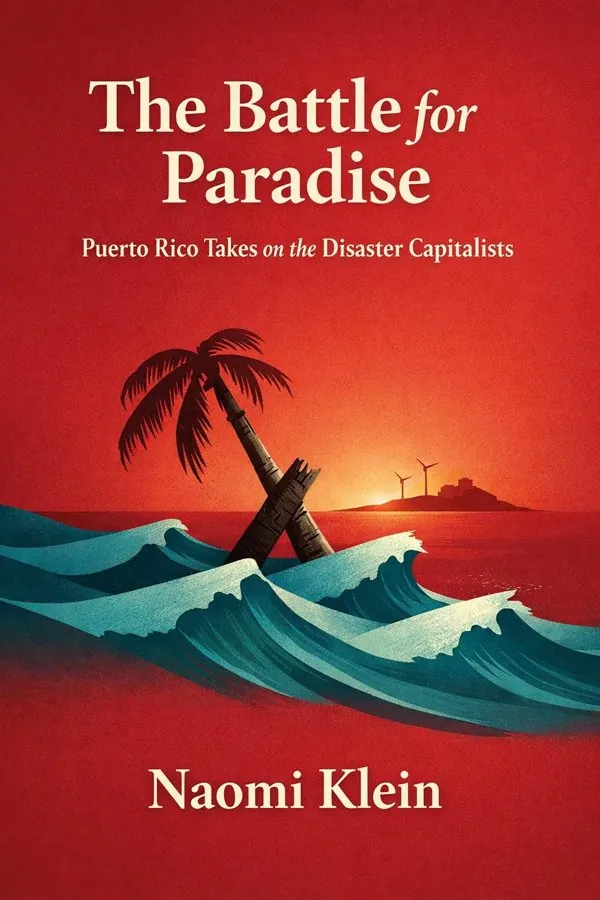
The Battle for Paradise: Puerto Rico Takes on the Disaster Capitalists: Summary & Key Insights
by Naomi Klein
 10 min9 chaptersAudio available
Key Takeaways from The Battle for Paradise: Puerto Rico Takes on the Disaster Capitalists
A disaster rarely starts on the day the winds arrive.
The most revealing moments in a society often come when its systems fail under pressure.
When people are disoriented, exhausted, and desperate, powerful interests often move with remarkable speed.
One of the most dangerous ideas after a catastrophe is that devastation creates a blank slate.
In many disasters, the most immediate form of rescue does not come from distant institutions but from neighbors.
What Is The Battle for Paradise: Puerto Rico Takes on the Disaster Capitalists About?
The Battle for Paradise: Puerto Rico Takes on the Disaster Capitalists by Naomi Klein is a politics book spanning 9 pages. In The Battle for Paradise, Naomi Klein turns her attention to Puerto Rico in the aftermath of Hurricane Maria and asks a disturbing question: when catastrophe strikes, who gets to decide what rebuilding looks like? Her answer is both urgent and unsettling. Long before the storm, Puerto Rico had been weakened by debt, austerity, and a colonial relationship with the United States that stripped the island of democratic control over its future. Maria did not create these conditions; it exposed and intensified them. Into that vacuum rushed investors, privatizers, and political actors eager to treat devastation as opportunity. Klein is uniquely qualified to tell this story. Across books such as No Logo and The Shock Doctrine, she has documented how corporate power and neoliberal policies often advance fastest during moments of public disorientation. Here, she applies that framework to Puerto Rico, while also highlighting something equally important: resistance. This is not only a book about exploitation, but about people defending land, culture, energy systems, and self-determination. The result is a compact but powerful work that shows why Puerto Rico’s struggle matters far beyond the island.
This FizzRead summary covers all 9 key chapters of The Battle for Paradise: Puerto Rico Takes on the Disaster Capitalists in approximately 10 minutes, distilling the most important ideas, arguments, and takeaways from Naomi Klein's work. Also available as an audio summary and Key Quotes Podcast.
The Battle for Paradise: Puerto Rico Takes on the Disaster Capitalists
In The Battle for Paradise, Naomi Klein turns her attention to Puerto Rico in the aftermath of Hurricane Maria and asks a disturbing question: when catastrophe strikes, who gets to decide what rebuilding looks like? Her answer is both urgent and unsettling. Long before the storm, Puerto Rico had been weakened by debt, austerity, and a colonial relationship with the United States that stripped the island of democratic control over its future. Maria did not create these conditions; it exposed and intensified them. Into that vacuum rushed investors, privatizers, and political actors eager to treat devastation as opportunity.
Klein is uniquely qualified to tell this story. Across books such as No Logo and The Shock Doctrine, she has documented how corporate power and neoliberal policies often advance fastest during moments of public disorientation. Here, she applies that framework to Puerto Rico, while also highlighting something equally important: resistance. This is not only a book about exploitation, but about people defending land, culture, energy systems, and self-determination. The result is a compact but powerful work that shows why Puerto Rico’s struggle matters far beyond the island.
Who Should Read The Battle for Paradise: Puerto Rico Takes on the Disaster Capitalists?
This book is perfect for anyone interested in politics and looking to gain actionable insights in a short read. Whether you're a student, professional, or lifelong learner, the key ideas from The Battle for Paradise: Puerto Rico Takes on the Disaster Capitalists by Naomi Klein will help you think differently.
- ✓Readers who enjoy politics and want practical takeaways
- ✓Professionals looking to apply new ideas to their work and life
- ✓Anyone who wants the core insights of The Battle for Paradise: Puerto Rico Takes on the Disaster Capitalists in just 10 minutes
Want the full summary?
Get instant access to this book summary and 100K+ more with Fizz Moment.
Get Free SummaryAvailable on App Store • Free to download
Key Chapters
A disaster rarely starts on the day the winds arrive. One of Naomi Klein’s most important arguments is that Hurricane Maria hit an island already weakened by decades of economic dependency, colonial governance, and fiscal crisis. Puerto Rico’s troubles were not simply the result of bad weather. They were built into a political and financial structure that left the island vulnerable long before the storm made landfall.
Puerto Rico had accumulated enormous debt under conditions it did not fully control. Its economy had been shaped by U.S. policies, tax changes, and external investors rather than by a development model rooted in local needs. Then came austerity. In response to the debt crisis, a federally imposed oversight board gained sweeping power over budgets and public services. Schools closed, infrastructure deteriorated, and public institutions were hollowed out. By the time Maria arrived, the power grid was fragile, hospitals were under strain, and many communities were already living with insecurity.
Klein shows that this historical context matters because it changes how we interpret what followed. The storm did not create a blank emergency. It collided with systems already designed to prioritize creditors over citizens. This pattern appears elsewhere too: when governments cut resilience spending, privatize essential services, or erode democratic accountability, natural hazards become social catastrophes.
A practical way to apply this idea is to examine any crisis by asking what made the damage so severe in the first place. Was it truly unavoidable, or did policy decisions amplify the harm? Actionable takeaway: never analyze a disaster in isolation; look for the economic and political conditions that made people so exposed.
The most revealing moments in a society often come when its systems fail under pressure. Hurricane Maria was not only a powerful storm; it was a brutal test of Puerto Rico’s infrastructure, governance, and relationship to the United States. The result was devastating. Lives were lost on a massive scale, electricity failed for months in many places, communication networks collapsed, and access to medicine, water, fuel, and basic care became dangerously limited.
Klein emphasizes that this was not merely a story of a natural event overwhelming an island. It was a story of neglect becoming visible. An aging and centralized power grid proved disastrously fragile. Emergency response was slow, uneven, and politicized. Official death estimates initially understated the scale of suffering, masking the true human toll. Communities were left waiting while state systems faltered.
This is one of the book’s sharpest insights: infrastructure is political. Power lines, hospitals, roads, and public health systems are not neutral background features. They reflect choices about investment, ownership, and whose lives are treated as priorities. Maria revealed what happens when those choices have favored austerity over resilience.
You can see the broader relevance in every region facing fires, floods, heat waves, or storms. The question is not only whether a disaster may come, but whether institutions are built to protect people when it does. Resilience requires maintenance, public accountability, and social trust long before the emergency.
Actionable takeaway: treat infrastructure as a democratic issue, not a technical afterthought, and support policies that fund resilience before crisis forces the price to be paid in human lives.
When people are disoriented, exhausted, and desperate, powerful interests often move with remarkable speed. Klein uses Puerto Rico to illustrate the logic she has described elsewhere as disaster capitalism: the practice of using crisis as an opening to push through policies that would face resistance under normal circumstances. In the wake of Maria, the devastation of the island became, for some outsiders, a market opportunity.
Consultants, hedge fund figures, crypto enthusiasts, privatization advocates, and wealthy investors began promoting Puerto Rico as a site for radical economic restructuring. Public assets could be sold, schools could be remade, labor protections could be weakened, and tax incentives could be expanded for the rich. Rather than seeing recovery as a chance to strengthen public systems, these actors framed it as a chance to shrink them and profit from the transition.
Klein’s point is not that all rebuilding involves bad faith. Reconstruction is necessary, and private actors can play roles in it. The problem arises when emergency conditions are exploited to bypass democratic consent and transfer wealth, land, and decision-making power away from residents. In that model, those who suffered the crisis become spectators to a recovery designed for someone else.
This pattern is visible beyond Puerto Rico. After floods, wars, financial crashes, or pandemics, proposals often emerge that package deregulation and privatization as pragmatic necessity. A useful discipline is to ask who benefits materially from a supposedly urgent reform and whether the affected community had real power in shaping it.
Actionable takeaway: when sweeping policy changes are proposed during a crisis, slow the conversation down and ask whether they serve public recovery or private extraction.
One of the most dangerous ideas after a catastrophe is that devastation creates a blank slate. Klein shows how Puerto Rico was imagined by some investors and ideologues not as a living society with history, memory, and political claims, but as an open canvas for reinvention. This fantasy is seductive to elites because it turns suffering into permission. If a place is treated as shattered beyond repair, then almost any intervention can be presented as visionary.
In Puerto Rico, this blank-slate mindset appeared in schemes to redesign the economy for outside capital, attract enclaves of wealthy newcomers, and remake public institutions according to free-market principles. The language was often future-oriented and optimistic: innovation, entrepreneurship, disruption, smart rebuilding. But beneath that vocabulary lay a quieter assumption that local communities, traditions, and democratic desires were obstacles rather than foundations.
Klein pushes back against this framing by insisting that Puerto Rico was never empty. It had farmers, neighborhood organizers, artists, teachers, cooperatives, environmental defenders, and families with deep ties to land and place. To call it a blank slate was to erase the very people who had the strongest stake in its future.
This idea has practical relevance in urban redevelopment, post-conflict reconstruction, and climate adaptation planning. Whenever leaders describe a damaged area as if nothing worth preserving remains, it is worth asking what and whom that language erases. Good recovery begins with listening to those who stayed, not with fantasies imported from afar.
Actionable takeaway: reject any recovery narrative that treats crisis-stricken communities as empty spaces; rebuilding should start from existing people, culture, and local knowledge.
In many disasters, the most immediate form of rescue does not come from distant institutions but from neighbors. Klein highlights how, after Maria, grassroots networks, community kitchens, mutual aid groups, and local organizers stepped into the vacuum left by inadequate official response. These efforts did more than provide emergency relief. They demonstrated an alternative model of social power rooted in solidarity rather than profit.
Communities distributed food, checked on the elderly, created local communication channels, organized cleanup efforts, and shared scarce resources. These actions were practical and lifesaving, but they also carried political significance. They showed that ordinary people were not passive victims waiting to be saved. They were active agents of recovery, often with a clearer understanding of needs on the ground than state agencies or outside experts.
Klein connects this to a wider principle: mutual aid is not simply charity. It can be a form of democratic practice. When people organize together under pressure, they build relationships, confidence, and political imagination. They begin to see that recovery could be structured around care, cooperation, and local autonomy instead of privatized services and top-down control.
This lesson applies anywhere communities face climate shocks or institutional failure. Neighborhood preparedness groups, local food networks, and community-led emergency plans can make the difference between resilience and abandonment. Even outside moments of crisis, investing in social ties creates practical capacity for future emergencies.
Actionable takeaway: build and support local networks before disaster strikes, because the strength of community relationships is often the first and most reliable infrastructure of survival.
Who controls electricity and land often determines who controls the future. In Puerto Rico, Klein pays close attention to struggles over the power system and territory because they reveal the deeper stakes of reconstruction. Recovery was not only about restoring what had been lost. It was about deciding whether essential systems would remain centralized, privatized, and externally controlled, or whether they could be rebuilt in ways that increased community power.
The energy question was especially revealing. Puerto Rico’s grid had been vulnerable before Maria, dependent on imported fossil fuels and managed through a fragile, centralized structure. After the storm, many reformers argued that rebuilding should prioritize decentralized renewable energy, such as community solar and microgrids. This approach was not just greener. It promised resilience, local control, and reduced dependence on distant institutions that had already failed people.
Land struggles were equally important. In the wake of disaster, distressed property can become a target for speculative buying. Coastal areas, farms, and neighborhoods risk being transformed into assets for tourism, luxury development, or tax-advantaged newcomers. Klein treats these conflicts as questions of belonging and democracy: will land remain embedded in communities, or be transferred to those with the most capital?
The practical lesson is that infrastructure and territory should not be discussed only in technical or financial terms. They shape political power, environmental sustainability, and everyday security. Citizens everywhere can ask who owns the systems they depend on and whether alternatives would increase resilience and accountability.
Actionable takeaway: support recovery models that prioritize community control of energy and land, because ownership structures determine whether rebuilding serves residents or investors.
Political resistance rarely survives on policy alone; it needs memory, identity, and imagination. Klein shows that Puerto Rico’s pushback against disaster capitalism was also a cultural awakening. Artists, musicians, writers, farmers, environmental defenders, and community leaders helped frame the struggle not only as an economic dispute but as a battle over dignity, belonging, and the meaning of home.
This matters because exploitative rebuilding projects often rely on a narrative of inevitability. They suggest that privatization, outside investment, and market-driven transformation are the only realistic path forward. Culture disrupts that logic. It reminds people that a place has values beyond profitability and that another future can be envisioned. In Puerto Rico, cultural expression helped preserve collective memory, honor grief, and strengthen resistance to being remade in someone else’s image.
Klein suggests that this reawakening has political consequences. When communities see themselves as holders of history rather than obstacles to modernization, they are more likely to demand self-determination. Cultural pride can energize fights over schools, language, land, public services, and democratic rights. It also helps counter the depopulating logic that tells people their best option is to leave.
This insight applies broadly. Social movements that last tend to connect material demands with stories, symbols, and shared identity. Campaigns about housing, climate, labor, or education become stronger when they affirm what communities love and want to protect, not only what they oppose.
Actionable takeaway: if you want political change to endure, connect policy goals to culture, memory, and the lived identity of the people most affected.
You cannot fully understand Puerto Rico’s crisis without confronting colonialism. Klein argues that the island’s vulnerability is inseparable from its political status: subject to U.S. power but denied full democratic sovereignty. This arrangement has profound consequences. Puerto Ricans live under federal authority, yet lack equal representation in the structures that shape key economic and political decisions affecting their lives.
The debt crisis, the unelected fiscal oversight board, the constraints on self-governance, and the uneven disaster response all reflect this colonial condition. Puerto Rico is often expected to absorb the burdens of U.S. policy while lacking the authority to define its own development path. Klein links this to neoliberalism: austerity and privatization become easier to impose where democratic power is already compromised.
Her critique goes beyond abstract theory. It shows that colonial relationships are not remnants of the past; they are active systems organizing debt, infrastructure, migration, labor, and public investment in the present. That is why rebuilding cannot be reduced to managerial fixes. If the political structure remains unchanged, the same patterns of extraction and imposed reform can return under new names.
For readers outside Puerto Rico, this insight offers a broader lens for understanding why some places are repeatedly exposed to crisis. When people lack meaningful control over the institutions governing land, finance, and public services, vulnerability deepens. Questions of democracy and sovereignty are therefore practical, not merely symbolic.
Actionable takeaway: when evaluating any economic crisis, ask who actually holds decision-making power, because durable recovery is impossible where political control is fundamentally unequal.
What happened in Puerto Rico is not an isolated tragedy. Klein presents the island as a warning for a century defined by climate disruption, financial volatility, and widening inequality. As disasters grow more frequent and severe, the struggle over recovery will become one of the central political battles of our time. The key question is whether crisis will be used to deepen privatization and inequality or to build more democratic, resilient, and just systems.
Puerto Rico offers a vivid preview of both paths. On one side are investors, opportunists, and policymakers who see breakdown as a chance to deregulate, acquire assets, and reengineer society from the top down. On the other are communities trying to rebuild around mutual aid, renewable energy, land defense, and public accountability. The island’s experience compresses a global conflict into a single place.
This is why the book resonates beyond Caribbean politics. Coastal cities facing sea-level rise, regions recovering from wildfire, countries hit by debt crises, and communities disrupted by pandemics all confront similar pressures. Emergency measures can entrench corporate power, but they can also open space for public reinvention. The outcome depends on organization, vigilance, and whose ideas dominate the post-crisis narrative.
For individual readers, the lesson is not to wait until disaster arrives to think politically. Support institutions that build resilience, pay attention to who profits from emergency reforms, and strengthen local democratic capacity now. Actionable takeaway: treat Puerto Rico as a case study for the future and prepare to defend just recovery wherever crisis is used as a pretext for extraction.
All Chapters in The Battle for Paradise: Puerto Rico Takes on the Disaster Capitalists
About the Author
Naomi Klein is a Canadian author, journalist, and activist whose work focuses on corporate power, neoliberal economics, climate politics, and social movements. She rose to international prominence with No Logo, a critique of branding and globalization, and later became widely known for The Shock Doctrine, which examined how governments and corporations exploit crises to push unpopular economic policies. Her book This Changes Everything further established her as a major voice linking climate change to capitalism and systemic inequality. Klein is known for combining investigative reporting, political theory, and accessible storytelling. Across her work, she consistently examines who benefits from upheaval and how ordinary people resist systems of extraction. The Battle for Paradise reflects these concerns in a focused study of Puerto Rico after Hurricane Maria.
Get This Summary in Your Preferred Format
Read or listen to the The Battle for Paradise: Puerto Rico Takes on the Disaster Capitalists summary by Naomi Klein anytime, anywhere. FizzRead offers multiple formats so you can learn on your terms — all free.
Available formats: App · Audio · PDF · EPUB — All included free with FizzRead
Download The Battle for Paradise: Puerto Rico Takes on the Disaster Capitalists PDF and EPUB Summary
Key Quotes from The Battle for Paradise: Puerto Rico Takes on the Disaster Capitalists
“A disaster rarely starts on the day the winds arrive.”
“The most revealing moments in a society often come when its systems fail under pressure.”
“When people are disoriented, exhausted, and desperate, powerful interests often move with remarkable speed.”
“One of the most dangerous ideas after a catastrophe is that devastation creates a blank slate.”
“In many disasters, the most immediate form of rescue does not come from distant institutions but from neighbors.”
Frequently Asked Questions about The Battle for Paradise: Puerto Rico Takes on the Disaster Capitalists
The Battle for Paradise: Puerto Rico Takes on the Disaster Capitalists by Naomi Klein is a politics book that explores key ideas across 9 chapters. In The Battle for Paradise, Naomi Klein turns her attention to Puerto Rico in the aftermath of Hurricane Maria and asks a disturbing question: when catastrophe strikes, who gets to decide what rebuilding looks like? Her answer is both urgent and unsettling. Long before the storm, Puerto Rico had been weakened by debt, austerity, and a colonial relationship with the United States that stripped the island of democratic control over its future. Maria did not create these conditions; it exposed and intensified them. Into that vacuum rushed investors, privatizers, and political actors eager to treat devastation as opportunity. Klein is uniquely qualified to tell this story. Across books such as No Logo and The Shock Doctrine, she has documented how corporate power and neoliberal policies often advance fastest during moments of public disorientation. Here, she applies that framework to Puerto Rico, while also highlighting something equally important: resistance. This is not only a book about exploitation, but about people defending land, culture, energy systems, and self-determination. The result is a compact but powerful work that shows why Puerto Rico’s struggle matters far beyond the island.
More by Naomi Klein

No Logo: Taking Aim at the Brand Bullies
Naomi Klein
10 min
The Shock Doctrine: The Rise of Disaster Capitalism
Naomi Klein
10 min
No Is Not Enough: Resisting Trump's Shock Politics and Winning the World We Need
Naomi Klein
10 min
Doppelganger: A Trip Into the Mirror World
Naomi Klein
10 minYou Might Also Like
Antifa: The Anti-Fascist Handbook
Mark Bray
10 min
Attack from Within: How Disinformation Is Sabotaging America
Barbara McQuade
10 min
Coercion, Capital, and European States, AD 990–1992
Charles Tilly
10 min
Digital Democracy: Concepts, Methodologies, Tools, and Applications
Various Authors
10 min
Fascism
Stanley G. Payne
10 min
Fire And Fury: Inside The Trump White House
Michael Wolff
10 minBrowse by Category
Ready to read The Battle for Paradise: Puerto Rico Takes on the Disaster Capitalists?
Get the full summary and 100K+ more books with Fizz Moment.