
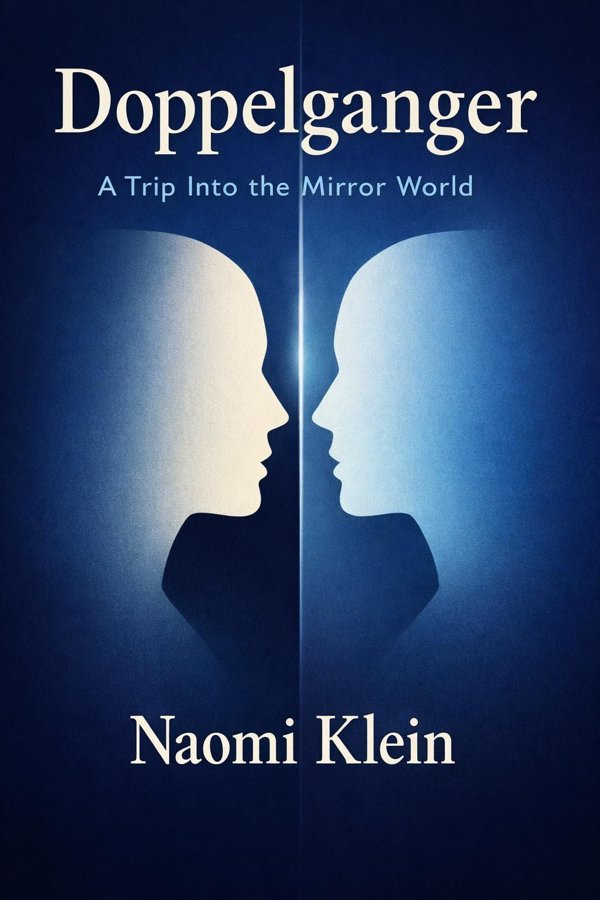
Doppelganger: A Trip Into the Mirror World: Summary & Key Insights
by Naomi Klein
 10 min9 chaptersAudio available
Key Takeaways from Doppelganger: A Trip Into the Mirror World
A double is never just a copy; it is often a distorted revelation.
Sometimes history becomes visible through an awkward coincidence.
Propaganda today rarely invents from nothing; more often, it reflects reality back in an altered form.
Modern culture encourages us to become characters in our own lives.
People rarely fall into conspiracy thinking because they are irrational from the start; more often, they are searching for order amid chaos.
What Is Doppelganger: A Trip Into the Mirror World About?
Doppelganger: A Trip Into the Mirror World by Naomi Klein is a politics book spanning 11 pages. What happens when a case of mistaken identity becomes a map of political collapse? In Doppelganger, Naomi Klein begins with an unsettling personal experience: for years, she was confused with Naomi Wolf, another prominent feminist writer whose path eventually veered into conspiracy thinking and reactionary politics. What might have remained a strange anecdote becomes, in Klein’s hands, a powerful framework for understanding a culture in which doubles, distortions, and false reflections increasingly shape public life. The book uses this personal disorientation to examine a much larger breakdown in shared reality. Blending memoir, political analysis, media criticism, and intellectual history, Klein investigates how digital platforms, pandemic anxieties, celebrity branding, and polarization have created a “mirror world” where facts are inverted, progressive language is repurposed for authoritarian ends, and emotional truth often outruns evidence. Her authority comes not only from decades of reporting on neoliberalism, disaster capitalism, and climate politics, but also from her unusual proximity to this phenomenon. Doppelganger matters because it helps readers understand why conspiracy culture feels so persuasive, why identity has become so unstable, and how we might recover a more grounded, humane political imagination.
This FizzRead summary covers all 9 key chapters of Doppelganger: A Trip Into the Mirror World in approximately 10 minutes, distilling the most important ideas, arguments, and takeaways from Naomi Klein's work. Also available as an audio summary and Key Quotes Podcast.
Doppelganger: A Trip Into the Mirror World
What happens when a case of mistaken identity becomes a map of political collapse? In Doppelganger, Naomi Klein begins with an unsettling personal experience: for years, she was confused with Naomi Wolf, another prominent feminist writer whose path eventually veered into conspiracy thinking and reactionary politics. What might have remained a strange anecdote becomes, in Klein’s hands, a powerful framework for understanding a culture in which doubles, distortions, and false reflections increasingly shape public life. The book uses this personal disorientation to examine a much larger breakdown in shared reality.
Blending memoir, political analysis, media criticism, and intellectual history, Klein investigates how digital platforms, pandemic anxieties, celebrity branding, and polarization have created a “mirror world” where facts are inverted, progressive language is repurposed for authoritarian ends, and emotional truth often outruns evidence. Her authority comes not only from decades of reporting on neoliberalism, disaster capitalism, and climate politics, but also from her unusual proximity to this phenomenon. Doppelganger matters because it helps readers understand why conspiracy culture feels so persuasive, why identity has become so unstable, and how we might recover a more grounded, humane political imagination.
Who Should Read Doppelganger: A Trip Into the Mirror World?
This book is perfect for anyone interested in politics and looking to gain actionable insights in a short read. Whether you're a student, professional, or lifelong learner, the key ideas from Doppelganger: A Trip Into the Mirror World by Naomi Klein will help you think differently.
- ✓Readers who enjoy politics and want practical takeaways
- ✓Professionals looking to apply new ideas to their work and life
- ✓Anyone who wants the core insights of Doppelganger: A Trip Into the Mirror World in just 10 minutes
Want the full summary?
Get instant access to this book summary and 100K+ more with Fizz Moment.
Get Free SummaryAvailable on App Store • Free to download
Key Chapters
A double is never just a copy; it is often a distorted revelation. Klein begins with the literary and psychological power of the doppelganger to show that doubles have long represented hidden fears, denied desires, and fractured selves. In novels and folklore, a person’s double unsettles because it suggests that identity is less stable than we like to believe. Klein extends this idea into politics: modern public life is full of doubles, imitations, and warped reflections that mimic truth while hollowing it out.
Her argument is that the doppelganger is not merely a metaphor for personal confusion. It has become a way to understand contemporary media and ideology. Political slogans are mirrored and repackaged. Anti-establishment rhetoric is adopted by billionaires and demagogues. Calls for freedom are redirected toward anti-democratic movements. What looks familiar at first glance can conceal a radical inversion of meaning.
This framework helps explain why so many people feel disoriented. They are not simply encountering lies; they are encountering counterfeit versions of authentic concerns. Real fears about medical systems, political elites, or economic precarity are absorbed into conspiracy ecosystems that offer emotionally satisfying but misleading explanations.
In everyday life, this pattern appears when social media accounts imitate credible sources, when wellness language masks extremism, or when legitimate criticism of power is redirected into paranoia. The lesson is to look beyond resemblance. Similar words do not guarantee similar values, and apparent alignment can hide opposite commitments.
Actionable takeaway: when a message feels familiar, pause and ask what has been reversed, removed, or manipulated beneath the surface similarity.
Sometimes history becomes visible through an awkward coincidence. Klein’s repeated confusion with Naomi Wolf is at first comic, then disturbing, then politically illuminating. Both were well-known feminist authors associated with critiques of power, yet over time their trajectories diverged dramatically. Wolf moved toward conspiratorial media spaces and increasingly detached claims, while Klein remained committed to structural analysis rooted in evidence and collective politics.
This mistaken identity gave Klein an unusual vantage point. She was not only watching someone else transform; she was being symbolically dragged into that transformation by strangers who merged the two Naomis into one blurred figure. The confusion exposed how public identity now operates online. We are increasingly encountered not as full people but as searchable brands, fragments, vibes, and algorithmic associations.
Klein uses this experience to show how easy it is for reputations to be flattened and recoded. The public sphere no longer rewards careful distinction. It favors speed, visual shorthand, outrage, and pattern matching. If two women share a first name, a genre, and a broad history of dissent, that can be enough for audiences to collapse meaningful differences.
This matters beyond celebrity confusion. Ordinary people also experience identity drift when they are represented through clips, labels, and online tribes. Once a public image hardens, nuance becomes difficult to recover.
A practical example is how one old tweet, one misleading headline, or one social affiliation can define someone more than years of actual work. Klein’s story becomes a cautionary tale about how easily digital culture substitutes resemblance for understanding.
Actionable takeaway: resist identity shortcuts by checking original sources, full contexts, and long-term patterns before deciding who someone is.
Propaganda today rarely invents from nothing; more often, it reflects reality back in an altered form. Klein’s concept of the “mirror world” describes a media environment where real grievances are captured and inverted. Instead of denying that institutions fail, mirror-world narratives take institutional failure as proof of vast hidden plots. Instead of rejecting inequality, they personalize blame and replace systems with villains. Instead of building solidarity, they intensify suspicion.
This is what makes mirror media compelling. It often begins where people already hurt. Distrust of pharmaceutical companies can be reasonable; distrust becomes dangerous when it slides into total epistemic collapse where no evidence can count against one’s preferred theory. Anger at elites can be justified; it becomes destructive when redirected toward fabricated enemies or marginalized groups.
Klein argues that this mirrored logic thrives on digital platforms designed to reward emotional intensity and repetition. Viral content does not need to be coherent. It only needs to feel revelatory. In this environment, the sensation of “seeing through the lie” becomes more valuable than the difficult work of analysis.
We can see this in movements that borrow left-sounding language about bodily autonomy, censorship, or corruption while steering audiences toward authoritarian politics. The rhetoric sounds rebellious, but the effects are often anti-democratic and isolating.
To navigate mirror media, readers must distinguish structural critique from conspiratorial style. Structural critique asks how systems operate and who benefits. Conspiracy style compresses complexity into hidden masterminds and secret knowledge.
Actionable takeaway: when consuming provocative media, ask whether it expands your understanding of systems or merely flatters your sense of being one of the few who “really know.”
Modern culture encourages us to become characters in our own lives. Klein reflects on the uneasy gap between lived selfhood and public persona, especially for writers and activists whose names function as brands. The online world intensifies this split. People are urged to curate identities, perform clarity, and maintain constant recognizability, even though real human beings are contradictory, evolving, and context-dependent.
In Doppelganger, this tension is not treated as a celebrity problem alone. It is a broader social condition. Platforms train everyone to package themselves into digestible signals: a stance, an aesthetic, a tribe, a set of moral cues. But once identity becomes performative and marketable, it also becomes vulnerable to capture. Others can imitate it, distort it, or weaponize it. We may even start relating to ourselves through the external image, mistaking visibility for integrity.
Klein’s insight is that this dynamic creates fertile ground for political confusion. If public life is organized around personas rather than institutions, then charisma can displace accountability. Audiences learn to follow vibes rather than arguments. The result is a culture where the question “Who seems authentic?” overtakes the harder question “What is actually true, and what collective structures are needed?”
A practical application is to rethink how we present ourselves online. Instead of feeling compelled to maintain total consistency or immediate opinion on every issue, we can protect some distance between selfhood and performance. We can value revision, uncertainty, and context.
The healthiest public sphere is one in which people are more than avatars and arguments matter more than branding.
Actionable takeaway: build habits that reduce performative pressure—speak less impulsively online, allow room for revision, and judge ideas by evidence rather than personality.
People rarely fall into conspiracy thinking because they are irrational from the start; more often, they are searching for order amid chaos. Klein treats conspiracy culture with seriousness rather than easy mockery. She shows that many people are drawn into these systems because they have experienced betrayal, precarity, humiliation, or genuine institutional abandonment. The appeal lies in receiving a total explanation, a community of believers, and a renewed sense of agency.
This is why debunking alone is often insufficient. If conspiracy narratives meet emotional and social needs, factual correction by itself may not break their hold. Klein argues that mirror-world belief systems offer belonging, purpose, and a framework that transforms confusion into certainty. They can make believers feel morally awake and specially perceptive.
The danger is that these narratives do not simply mislead; they redirect legitimate anger away from structural causes. Instead of analyzing privatized healthcare, algorithmic manipulation, or concentrated wealth, conspiracy culture personalizes everything into secret cabals and symbolic villains. This can produce endless revelation without meaningful political change.
Examples abound: wellness influencers who slide from skepticism into anti-vaccine extremism, anti-corporate frustrations converted into anti-democratic paranoia, or communities built around “research” that really means endless confirmation loops. The emotional architecture matters as much as the content.
Klein’s deeper point is compassionate but firm: people need explanations that honor their suffering without abandoning reality. That requires stronger institutions, better public communication, and more spaces for collective meaning.
Actionable takeaway: when confronting conspiracy thinking in yourself or others, address the underlying fear, loneliness, or betrayal as well as the factual claims being made.
Crises do not invent social fractures; they expose and accelerate them. For Klein, the COVID-19 pandemic became a defining test of the mirror world because it combined fear, isolation, scientific uncertainty, government inconsistency, and constant online mediation. Under those conditions, many people experienced reality as unstable and contradictory. That instability created ideal conditions for doubles, inversions, and spectacular narratives.
The pandemic sharpened a central paradox. At the very moment when societies most needed collective trust and shared responsibility, digital culture rewarded individual certainty and theatrical dissent. Public health guidance changed as evidence evolved, but in a low-trust environment that necessary revision was often interpreted as proof of deception. Meanwhile, influencers and contrarians gained attention by offering simple answers, emotional clarity, and righteous defiance.
Klein is especially interested in how some language associated with liberation and justice was repurposed during this period. Ideas about bodily autonomy, resistance to state power, and skepticism toward corporations were detached from broader social analysis and redeployed in ways that undermined public solidarity. The mirror world did not reject progressive language; it borrowed and twisted it.
This chapter has practical relevance because future emergencies will produce similar informational stress. During crises, people need not only facts but trustworthy institutions, transparent uncertainty, and community mechanisms that reduce isolation. Otherwise, the loudest narrative gains traction regardless of accuracy.
In daily life, this means paying attention to how stress affects interpretation. Anxiety makes certainty feel irresistible. Under pressure, we may mistake emotional relief for truth.
Actionable takeaway: in moments of crisis, deliberately slow your information intake, rely on accountable sources, and avoid making certainty your main criterion for credibility.
The architecture of digital life is not neutral. Klein argues that platforms do more than transmit information; they shape the kinds of identities, conflicts, and beliefs that flourish. Social media favors visibility over reflection, immediacy over depth, and engagement over accuracy. In such an environment, distortion has structural advantages. Content that provokes fear, outrage, or tribal affirmation spreads faster than careful analysis.
This helps explain why the mirror world feels so pervasive. Algorithms do not need ideological commitments to amplify confusion. They simply optimize for attention. The result is a communication system that fragments reality into monetizable micro-publics. Each group receives emotionally tuned versions of events, reinforcing the sense that other people inhabit another universe.
Klein also points to the collapse of context. A quote, image, or clip circulates independently of the larger argument it came from. Meaning becomes modular and easily repurposed. This is ideal for bad-faith actors, but it also affects ordinary users who find themselves reacting to fragments rather than wholes.
A practical example is how wellness content, political grievance, and lifestyle branding increasingly blend into the same feed, making ideological transitions feel seamless. Someone may move from yoga videos to anti-government content not through argument but through recommendation pathways built on adjacent affect.
The implication is not that technology determines beliefs in a simple way. Rather, it creates conditions in which performance, simplification, and moral sorting become normal. To resist this, users need intentional media habits that reintroduce friction and context.
Actionable takeaway: create technological boundaries—limit algorithmic feeds, seek long-form sources, and diversify where your information comes from so one platform does not become your reality engine.
When politics becomes primarily a contest of symbolic identities, it becomes easier to mirror, mimic, and manipulate. Klein shows how the cultural logic of doubling extends into movements themselves. Political actors increasingly adopt the aesthetics of their opponents, borrow emancipatory language, and present themselves as the true rebels. This creates a hall-of-mirrors effect in which everyone claims dissent, authenticity, and victimhood.
The result is identity theater: a politics organized less around material programs than around performances of who is brave enough to defy the dominant script. Because many institutions are genuinely untrustworthy, this performance can be persuasive even when attached to dangerous agendas. If rebellion itself becomes the highest good, then contradiction no longer matters much. One can denounce elites while serving elite interests, preach freedom while enabling coercion, or claim anti-authoritarianism while celebrating strongmen.
Klein contrasts this with older traditions of collective struggle that focused on labor conditions, public goods, anti-racism, climate justice, and democratic accountability. Those movements were never free of symbolism, but they were anchored in material analysis and organizing. The mirror world weakens that grounding by turning politics into a constant battle over narrative possession and personal identity.
For readers, the practical lesson is to look beyond a movement’s self-description. Ask what policies it supports, which communities it harms, how it treats evidence, and whether it builds durable solidarity or only feeds affective intensity.
This insight also applies locally. In workplaces, schools, and communities, people may signal values more than they practice them. The difference between branding and substance is a democratic issue, not just a moral one.
Actionable takeaway: evaluate political claims by material consequences and organizational behavior, not by whether they feel rebellious or aesthetically convincing.
A fractured public sphere cannot be healed by individual skepticism alone. Klein’s final contribution is constructive: if the mirror world grows from atomization, distrust, precarity, and spectacle, then reclaiming reality requires rebuilding the conditions for shared life. Facts matter, but facts travel through relationships, institutions, and social structures. A society organized around insecurity and branding will struggle to sustain a common world.
Klein does not propose a naïve return to some perfectly unified past. Shared reality has always been contested, and many official narratives have excluded or harmed people. Her point is more demanding: democratic truth requires institutions capable of accountability, public goods that reduce desperation, and cultures of solidarity that make people less vulnerable to manipulative belonging. In other words, epistemology is political.
This means confronting the systems that produce fertile ground for mirror thinking: privatization, inequality, platform monopolies, collapsing local journalism, and the transformation of every identity into a market segment. It also means recovering forms of political action rooted in mutual obligation rather than audience capture.
Practically, reclaiming reality can begin with modest but meaningful steps: supporting independent media, participating in local civic life, joining organizations that connect people across difference, and practicing slow conversation instead of reactive posting. On a personal level, it means tolerating ambiguity without surrendering to relativism.
Klein’s larger message is hopeful in a sober way. The antidote to the mirror world is not perfect certainty but renewed commitment to the messy, shared work of living together in truth.
Actionable takeaway: invest in real-world institutions and relationships that strengthen trust, because durable reality is something societies build together, not something individuals can secure alone.
All Chapters in Doppelganger: A Trip Into the Mirror World
About the Author
Naomi Klein is a Canadian author, journalist, and activist widely recognized for her incisive critiques of corporate globalization, neoliberal economics, and climate injustice. She rose to international prominence with No Logo, a foundational analysis of branding and labor exploitation, and later expanded her reputation with The Shock Doctrine and This Changes Everything. Across her work, Klein has examined how crises are used to concentrate power and reshape public life. She is known for combining investigative reporting with moral clarity and structural political analysis. In addition to her writing, she has taught and spoken extensively on climate justice, democracy, and social movements. Klein is a professor of climate justice at the University of British Columbia and remains one of the most influential progressive public intellectuals writing today.
Get This Summary in Your Preferred Format
Read or listen to the Doppelganger: A Trip Into the Mirror World summary by Naomi Klein anytime, anywhere. FizzRead offers multiple formats so you can learn on your terms — all free.
Available formats: App · Audio · PDF · EPUB — All included free with FizzRead
Download Doppelganger: A Trip Into the Mirror World PDF and EPUB Summary
Key Quotes from Doppelganger: A Trip Into the Mirror World
“A double is never just a copy; it is often a distorted revelation.”
“Sometimes history becomes visible through an awkward coincidence.”
“Propaganda today rarely invents from nothing; more often, it reflects reality back in an altered form.”
“Modern culture encourages us to become characters in our own lives.”
“People rarely fall into conspiracy thinking because they are irrational from the start; more often, they are searching for order amid chaos.”
Frequently Asked Questions about Doppelganger: A Trip Into the Mirror World
Doppelganger: A Trip Into the Mirror World by Naomi Klein is a politics book that explores key ideas across 9 chapters. What happens when a case of mistaken identity becomes a map of political collapse? In Doppelganger, Naomi Klein begins with an unsettling personal experience: for years, she was confused with Naomi Wolf, another prominent feminist writer whose path eventually veered into conspiracy thinking and reactionary politics. What might have remained a strange anecdote becomes, in Klein’s hands, a powerful framework for understanding a culture in which doubles, distortions, and false reflections increasingly shape public life. The book uses this personal disorientation to examine a much larger breakdown in shared reality. Blending memoir, political analysis, media criticism, and intellectual history, Klein investigates how digital platforms, pandemic anxieties, celebrity branding, and polarization have created a “mirror world” where facts are inverted, progressive language is repurposed for authoritarian ends, and emotional truth often outruns evidence. Her authority comes not only from decades of reporting on neoliberalism, disaster capitalism, and climate politics, but also from her unusual proximity to this phenomenon. Doppelganger matters because it helps readers understand why conspiracy culture feels so persuasive, why identity has become so unstable, and how we might recover a more grounded, humane political imagination.
More by Naomi Klein

No Logo: Taking Aim at the Brand Bullies
Naomi Klein
10 min
The Shock Doctrine: The Rise of Disaster Capitalism
Naomi Klein
10 min
No Is Not Enough: Resisting Trump's Shock Politics and Winning the World We Need
Naomi Klein
10 min
The Battle for Paradise: Puerto Rico Takes on the Disaster Capitalists
Naomi Klein
10 minYou Might Also Like

Antifa: The Anti-Fascist Handbook
Mark Bray
10 min
Attack from Within: How Disinformation Is Sabotaging America
Barbara McQuade
10 min
Coercion, Capital, and European States, AD 990–1992
Charles Tilly
10 min
Digital Democracy: Concepts, Methodologies, Tools, and Applications
Various Authors
10 min
Fascism
Stanley G. Payne
10 min
Fire And Fury: Inside The Trump White House
Michael Wolff
10 minBrowse by Category
Ready to read Doppelganger: A Trip Into the Mirror World?
Get the full summary and 100K+ more books with Fizz Moment.