
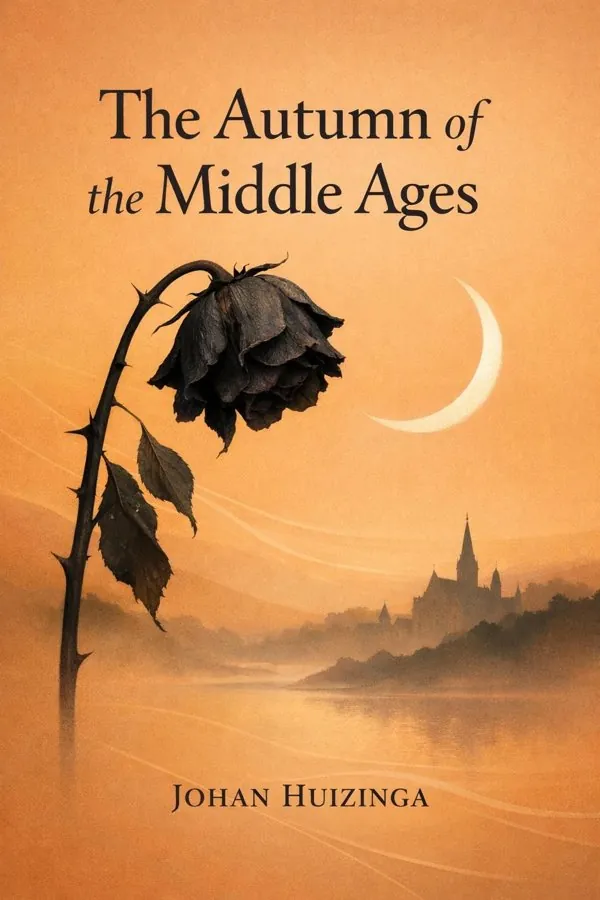
The Autumn of the Middle Ages: Summary & Key Insights
 10 min9 chaptersAudio available
Key Takeaways from The Autumn of the Middle Ages
A civilization does not decline only when its institutions weaken; it can also decline when its forms become too rigid to hold living experience.
The most admired ideals of an age may also reveal its deepest anxieties.
Feelings are never entirely private; cultures teach people how to feel, express desire, and suffer.
When life feels unstable, devotion often becomes more vivid, more emotional, and more outwardly visible.
A society’s deepest truths often appear in the images it cannot stop repeating.
What Is The Autumn of the Middle Ages About?
The Autumn of the Middle Ages by Johan Huizinga is a civilization book spanning 9 pages. The Autumn of the Middle Ages is Johan Huizinga’s brilliant exploration of the emotional, symbolic, and artistic life of fourteenth- and fifteenth-century France and the Low Countries. First published in 1919, the book challenges the simple idea that the late medieval period was merely a worn-out prelude to the Renaissance. Huizinga instead reveals a civilization of extraordinary intensity: deeply religious, fascinated by ritual, saturated with pageantry, and haunted by violence, longing, and death. His focus is not only on events or institutions, but on mentality—how people felt, imagined, and gave form to their world. What makes this book enduring is its ability to turn cultural history into a living landscape of ideas, emotions, and images. Huizinga examines chivalry, courtly love, piety, political ceremony, art, and symbolism to show how a society can appear magnificent and exhausted at the same time. Though some of his interpretations have been debated, his insight into the power of forms, symbols, and shared imagination remains foundational. For anyone interested in medieval Europe, cultural history, or the transition to modernity, this is an essential and unforgettable work.
This FizzRead summary covers all 9 key chapters of The Autumn of the Middle Ages in approximately 10 minutes, distilling the most important ideas, arguments, and takeaways from Johan Huizinga's work. Also available as an audio summary and Key Quotes Podcast.
The Autumn of the Middle Ages
The Autumn of the Middle Ages is Johan Huizinga’s brilliant exploration of the emotional, symbolic, and artistic life of fourteenth- and fifteenth-century France and the Low Countries. First published in 1919, the book challenges the simple idea that the late medieval period was merely a worn-out prelude to the Renaissance. Huizinga instead reveals a civilization of extraordinary intensity: deeply religious, fascinated by ritual, saturated with pageantry, and haunted by violence, longing, and death. His focus is not only on events or institutions, but on mentality—how people felt, imagined, and gave form to their world.
What makes this book enduring is its ability to turn cultural history into a living landscape of ideas, emotions, and images. Huizinga examines chivalry, courtly love, piety, political ceremony, art, and symbolism to show how a society can appear magnificent and exhausted at the same time. Though some of his interpretations have been debated, his insight into the power of forms, symbols, and shared imagination remains foundational. For anyone interested in medieval Europe, cultural history, or the transition to modernity, this is an essential and unforgettable work.
Who Should Read The Autumn of the Middle Ages?
This book is perfect for anyone interested in civilization and looking to gain actionable insights in a short read. Whether you're a student, professional, or lifelong learner, the key ideas from The Autumn of the Middle Ages by Johan Huizinga will help you think differently.
- ✓Readers who enjoy civilization and want practical takeaways
- ✓Professionals looking to apply new ideas to their work and life
- ✓Anyone who wants the core insights of The Autumn of the Middle Ages in just 10 minutes
Want the full summary?
Get instant access to this book summary and 100K+ more with Fizz Moment.
Get Free SummaryAvailable on App Store • Free to download
Key Chapters
A civilization does not decline only when its institutions weaken; it can also decline when its forms become too rigid to hold living experience. Huizinga’s central insight is that the late Middle Ages were marked by an excess of form. Rituals, gestures, ranks, ceremonies, and moral codes structured nearly every aspect of life. This gave society beauty, order, and emotional clarity, but it also made life theatrical and strained. People inherited patterns shaped by centuries of belief, yet those patterns increasingly felt overburdened, as if reality itself had become trapped inside inherited symbolism.
Huizinga argues that medieval society in the fourteenth and fifteenth centuries was not colorless or apathetic. On the contrary, it was overflowing with passion, spectacle, and spiritual intensity. But this intensity often appeared in fixed, stylized forms: official mourning, knightly conduct, public devotion, ceremonial justice, and elaborate etiquette. Instead of flexibility, there was repetition; instead of fresh creation, there was reenactment. The culture remained vivid, but it had become self-conscious and overripe.
A modern analogy might be a company or institution that still preserves inspiring traditions, but relies so heavily on protocol, branding, and formal language that genuine purpose becomes harder to sustain. The system still functions, even beautifully, yet it feels ceremonial rather than alive.
Huizinga’s point is not that form is bad. Form gives meaning. But when a culture can only repeat itself through inherited symbols, renewal becomes difficult. The late Middle Ages were powerful precisely because they were still emotionally committed to forms they could no longer fully revitalize.
Actionable takeaway: When evaluating any culture, organization, or tradition, ask whether its rituals still express living values—or merely preserve the memory of them.
The most admired ideals of an age may also reveal its deepest anxieties. For Huizinga, chivalry was one of the great dreams of medieval civilization: a code of courage, honor, loyalty, courtesy, and noble service. It offered a moralized image of aristocratic life and gave warfare a language of dignity. Knights were expected to defend the weak, revere women, remain faithful to lords, and embody disciplined bravery. In literature and court life, this ideal shone with irresistible glamour.
Yet Huizinga shows that by the fourteenth and fifteenth centuries, chivalry had become increasingly detached from political and military reality. Wars grew more brutal, pragmatic, and shaped by money, state power, and strategy rather than heroic combat. Nobles continued to celebrate tournaments, vows, heraldic symbolism, and knightly display, but these often functioned as compensatory theater. The code remained culturally powerful because reality no longer matched it.
This does not make chivalry meaningless. On the contrary, Huizinga treats it as a revealing fiction—an ideal that shaped behavior even when imperfectly practiced. People need stories about what power should look like. Chivalry gave the aristocracy a script for self-respect and public legitimacy. Even failed ideals matter because they show what a society wishes to believe about itself.
We can see a similar pattern today when professions uphold codes of honor—public service, academic integrity, journalistic independence, military duty—even when real conditions often compromise them. The gap between ideal and practice is not proof of hypocrisy alone; it also shows the continuing need for moral form.
Actionable takeaway: Study the ideals people praise most loudly. They often reveal not only what they value, but what they fear losing.
Feelings are never entirely private; cultures teach people how to feel, express desire, and suffer. Huizinga’s discussion of courtly love shows how the late medieval world transformed emotion into stylized practice. Love was not simply a personal bond between two individuals. It was mediated by poetry, etiquette, allegory, ritual speech, and social distance. Lovers inhabited roles shaped by convention: devotion, longing, service, restraint, jealousy, and idealization.
In this world, emotion was elevated by form. A noble lover proved sincerity through endurance, self-discipline, and symbolic gestures. Desire became dignified through indirection. Huizinga sees courtly love as part of a broader medieval tendency to clothe life in ceremony and emblem. It made passion legible and socially meaningful, especially within court culture, where rank and decorum governed behavior.
At the same time, courtly love could become artificial. Its conventions often repeated themselves so often that they hardened into literary cliché. The language of the heart risked becoming a language of performance. But Huizinga does not dismiss this as insincerity. Rehearsed forms can still carry genuine feeling. Humans often need scripts—songs, letters, anniversaries, rituals—to express emotions too large or unstable to communicate directly.
The practical relevance is clear. Even now, romance is shaped by cultural forms: social media declarations, dating norms, wedding traditions, songs, films, and shared expectations. We still perform emotion through inherited patterns, and those patterns both enrich and constrain us.
Huizinga helps us see that emotional life is historical. What feels spontaneous is often culturally organized. Understanding that can make us more reflective about our own expressions of intimacy and desire.
Actionable takeaway: Notice which emotional habits in your life are genuinely yours and which are inherited scripts that deserve rethinking.
When life feels unstable, devotion often becomes more vivid, more emotional, and more outwardly visible. Huizinga portrays late medieval Christianity as saturated with sensory and affective power. Religion was not a separate sphere of belief; it shaped time, space, art, morality, and imagination. Feast days, relics, processions, saints, sermons, visions, confession, and acts of penance made the sacred present in daily life. Faith was embodied, communal, and dramatic.
What interests Huizinga most is the heightened emotional tone of this devotion. Piety in the late Middle Ages was often passionate, visual, and intensely focused on Christ’s suffering, the Virgin’s sorrow, and the soul’s need for purification. Religious images did not merely illustrate doctrine; they invited meditation, tears, fear, and compassion. Spiritual life became increasingly detailed and affective, sometimes reaching extremes of sentiment or scrupulosity.
This intensity reflected both deep faith and cultural strain. As political insecurity, war, plague, and social tension marked the era, people sought certainty in ever more elaborate devotional forms. Yet Huizinga suggests that heightened piety could also become overgrown with external practices. The danger was not insincerity but overformalization: a multiplication of observances that risked burdening spiritual life with habit and display.
The broader lesson is that institutions under pressure often intensify symbolic and emotional expression. Whether in religion, politics, or identity, communities respond to uncertainty by making belonging more visible and more ritualized.
For modern readers, Huizinga offers a way to understand devotion not as superstition or mere doctrine, but as a lived cultural world. Belief is shaped through images, rhythms, and practices as much as through ideas.
Actionable takeaway: To understand any faith tradition, look beyond theology and study the rituals, images, and emotions through which belief becomes real.
A society’s deepest truths often appear in the images it cannot stop repeating. In the late Middle Ages, Huizinga argues, death was one of those overpowering images. It was everywhere: in sermons, art, public memory, moral teaching, and popular imagination. War, plague, famine, and high mortality made death a familiar reality, but Huizinga’s point is not simply that people died often. It is that death became symbolically central. The culture dwelled on decay, judgment, the vanity of earthly glory, and the suddenness of life’s end.
This fascination produced some of the era’s most memorable motifs: the danse macabre, tomb sculpture, memento mori, and vivid depictions of bodily corruption. Such images were not purely morbid. They functioned as moral instruction, spiritual awakening, and social equalizer. Death humbles kings and peasants alike. It exposes the fragility of worldly ambition and insists on the urgency of salvation.
Yet Huizinga also sees in this obsession a sign of cultural exhaustion. When symbolic life becomes dominated by endings, judgment, and decomposition, it suggests a civilization deeply conscious of its own vulnerability. The imagination turns repeatedly toward finality.
Modern culture may appear less openly preoccupied with death, but similar dynamics remain. Crime media, apocalyptic narratives, health anxieties, disaster coverage, and digital memorialization all show how mortality continues to shape collective consciousness. We still seek images that make death thinkable.
Huizinga’s treatment reminds us that confronting mortality is not only biological or philosophical; it is cultural. Societies teach people how to fear death, prepare for it, aestheticize it, and derive meaning from it.
Actionable takeaway: Examine how your culture talks about death, because those habits reveal what it most values, most fears, and least knows how to face.
Power rarely survives on force alone; it needs ceremony to become believable. Huizinga shows that late medieval political life was deeply theatrical. Courts, entries, feasts, heraldry, public punishments, marriages, embassies, and oaths all communicated rank and legitimacy through visible form. Princes and nobles did not merely govern; they staged authority. Political order depended on symbols that could be seen, repeated, and emotionally recognized by others.
In the fractured world of late medieval France and the Burgundian Netherlands, this mattered enormously. Rule was often unstable, contested, and personal. Institutions were less impersonal than in the modern state, so image and ritual carried heavy political weight. Magnificence signaled capacity. Ceremony reduced uncertainty. Public display transformed social hierarchy into a shared script.
Huizinga emphasizes that this was not superficial decoration added to real politics. It was politics. The forms through which power appeared shaped how power was understood and accepted. Even violence was often ritualized through judicial spectacles and formalized punishment. The political sphere, like the religious and emotional spheres, was governed by symbolic action.
This insight remains useful today. Modern politics still relies on staging: inaugurations, press conferences, campaign rallies, official language, architectural settings, dress codes, state funerals, and media optics. We often imagine ourselves beyond ceremonial politics, yet legitimacy still depends on choreography.
Huizinga helps us resist the shallow distinction between substance and symbolism. Symbolic form does not replace political reality; it organizes it. To study power seriously, we must study its performances.
Actionable takeaway: When evaluating leaders or institutions, pay attention not only to what they do, but to the rituals and images through which they ask to be believed.
Art becomes most revealing when it is treated not as ornament, but as a vessel of a culture’s deepest habits of feeling. Huizinga reads late medieval art this way. He is fascinated by its richness of detail, its love of color, its devotion to symbolic objects, and its ability to merge the sacred, the courtly, and the everyday. In painting, pageantry, literature, and decorative culture, he sees an imagination that delights in form while burdening form with meaning.
Late medieval art, especially in the Low Countries, often appears astonishingly concrete: fabrics shimmer, interiors feel inhabitable, facial expressions carry moral and spiritual charge. Yet this realism does not point toward modern secular observation alone. For Huizinga, it remains embedded in a symbolic universe. Objects signify virtues, sufferings, ranks, and sacred mysteries. The visible world is dense with references beyond itself.
This helps explain why late medieval culture can feel both sensuous and devotional, precise and allegorical. Art does not simply depict experience; it orders experience into emotionally resonant patterns. A banquet, a procession, an altarpiece, or a manuscript illumination tells us how the age wished to perceive beauty, authority, holiness, and memory.
For modern readers, the practical lesson is methodological. Works of art should be read alongside rituals, beliefs, and social norms. A beautiful object is also evidence. It reveals how a society structures perception.
The same holds today. Advertising, film, architecture, fashion, and digital design all encode social ideals. They tell us what a culture admires, fears, eroticizes, or sanctifies.
Actionable takeaway: When looking at art, ask not only whether it is beautiful, but what habits of seeing and valuing it teaches you to adopt.
A culture changes profoundly when symbols stop feeling inevitable. Huizinga argues that medieval life was built on symbolic thinking: people habitually connected visible things with moral truths, divine realities, social hierarchies, and cosmic meanings. Nature, ceremony, color, gesture, clothing, and language were interpreted through analogies and correspondences. The world seemed readable because everything could point beyond itself.
In the late Middle Ages, however, Huizinga senses strain in this symbolic order. Symbolic thinking did not vanish suddenly, but it became overloaded and less convincing. Allegory multiplied. Ceremonies grew more elaborate. Meanings accumulated without always deepening experience. The signs remained, yet their vitality weakened. This overproduction of symbolism is one mark of cultural autumn: a great style still active, but no longer renewing itself from within.
The transition toward Renaissance and early modern ways of thinking involved, among other things, a shift in how reality was approached. Observation, individual perspective, political calculation, and philological criticism began to compete with inherited systems of correspondence. The world became less uniformly symbolic and more differentiated.
This idea matters beyond medieval studies. Every era has dominant ways of making meaning. They seem natural until they begin to fray. Consider how some contemporary institutions still rely on symbolic language—national identity, corporate mission, academic prestige, celebrity branding—even when audiences no longer fully believe in the old codes.
Huizinga’s brilliance lies in showing that cultural decline is not mere disappearance. Often symbols remain highly visible precisely when belief in them is becoming unstable.
Actionable takeaway: Pay attention to symbols that feel overstated or endlessly repeated; they may signal a system trying to preserve authority it no longer effortlessly commands.
Historical periods rarely end cleanly; they dissolve by becoming something else. One of Huizinga’s most important contributions is his refusal to treat the late Middle Ages as merely a failed prelude to the Renaissance. He does describe exhaustion, rigidity, and overripe form, but he also shows extraordinary creativity, beauty, and emotional power. The culture was declining in one sense while generating new possibilities in another.
This is why the title’s seasonal metaphor matters. Autumn is not winter. It is a time of ripeness, richness, and intensified color before disappearance. Huizinga sees the fourteenth and fifteenth centuries as precisely such a moment. Medieval ideals had reached their fullest expression, but that fullness made them heavy. Chivalry, devotion, symbolism, and courtly forms had become so elaborate that they could no longer remain unchanged. Out of that saturation emerged transformations in art, politics, sensibility, and thought.
The practical value of this insight is broad. We often describe eras, institutions, or personal phases as either thriving or declining. Huizinga teaches a subtler view: maturity and fragility can coexist. A system may look most splendid at the very moment it becomes least sustainable. Apparent decadence may contain seeds of renewal.
This framework helps explain transitions in many contexts—media industries shifting formats, educational systems revising traditions, democracies renegotiating legitimacy, or individuals leaving one identity before another has fully formed. Endings are often fertile.
Huizinga invites readers to look for continuity within change and change within continuity. The modern world did not abruptly replace the medieval one; it emerged from its intensification.
Actionable takeaway: When something seems to be fading, ask not only what is ending, but what new form is being born through that very exhaustion.
All Chapters in The Autumn of the Middle Ages
About the Author
Johan Huizinga (1872–1945) was a Dutch historian, essayist, and cultural philosopher whose work helped define modern cultural history. Trained originally in linguistics and Oriental studies, he later turned to European history and became known for his ability to interpret entire civilizations through their symbols, rituals, art, and emotional life. His most famous books include The Autumn of the Middle Ages, a classic portrait of late medieval culture, and Homo Ludens, an influential study of play as a foundational element of human civilization. Huizinga’s writing stands out for its literary elegance and interpretive ambition. Rather than treating history as a sequence of events alone, he sought to recover the spirit of an age. His work remains widely read for its insight, style, and lasting impact on historical thought.
Get This Summary in Your Preferred Format
Read or listen to the The Autumn of the Middle Ages summary by Johan Huizinga anytime, anywhere. FizzRead offers multiple formats so you can learn on your terms — all free.
Available formats: App · Audio · PDF · EPUB — All included free with FizzRead
Download The Autumn of the Middle Ages PDF and EPUB Summary
Key Quotes from The Autumn of the Middle Ages
“A civilization does not decline only when its institutions weaken; it can also decline when its forms become too rigid to hold living experience.”
“The most admired ideals of an age may also reveal its deepest anxieties.”
“Feelings are never entirely private; cultures teach people how to feel, express desire, and suffer.”
“When life feels unstable, devotion often becomes more vivid, more emotional, and more outwardly visible.”
“A society’s deepest truths often appear in the images it cannot stop repeating.”
Frequently Asked Questions about The Autumn of the Middle Ages
The Autumn of the Middle Ages by Johan Huizinga is a civilization book that explores key ideas across 9 chapters. The Autumn of the Middle Ages is Johan Huizinga’s brilliant exploration of the emotional, symbolic, and artistic life of fourteenth- and fifteenth-century France and the Low Countries. First published in 1919, the book challenges the simple idea that the late medieval period was merely a worn-out prelude to the Renaissance. Huizinga instead reveals a civilization of extraordinary intensity: deeply religious, fascinated by ritual, saturated with pageantry, and haunted by violence, longing, and death. His focus is not only on events or institutions, but on mentality—how people felt, imagined, and gave form to their world. What makes this book enduring is its ability to turn cultural history into a living landscape of ideas, emotions, and images. Huizinga examines chivalry, courtly love, piety, political ceremony, art, and symbolism to show how a society can appear magnificent and exhausted at the same time. Though some of his interpretations have been debated, his insight into the power of forms, symbols, and shared imagination remains foundational. For anyone interested in medieval Europe, cultural history, or the transition to modernity, this is an essential and unforgettable work.
You Might Also Like
The Structure of Scientific Revolutions
Thomas S. Kuhn
10 min
Genius
Harold Bloom
10 min
A Cultural History of the Medieval Age
Various Editors
10 min
A History of God: The 4,000-Year Quest of Judaism, Christianity and Islam
Karen Armstrong
10 min
A History of the World in 10½ Chapters
Julian Barnes
10 min
A Short History of Progress
Ronald Wright
10 minBrowse by Category
Ready to read The Autumn of the Middle Ages?
Get the full summary and 100K+ more books with Fizz Moment.