
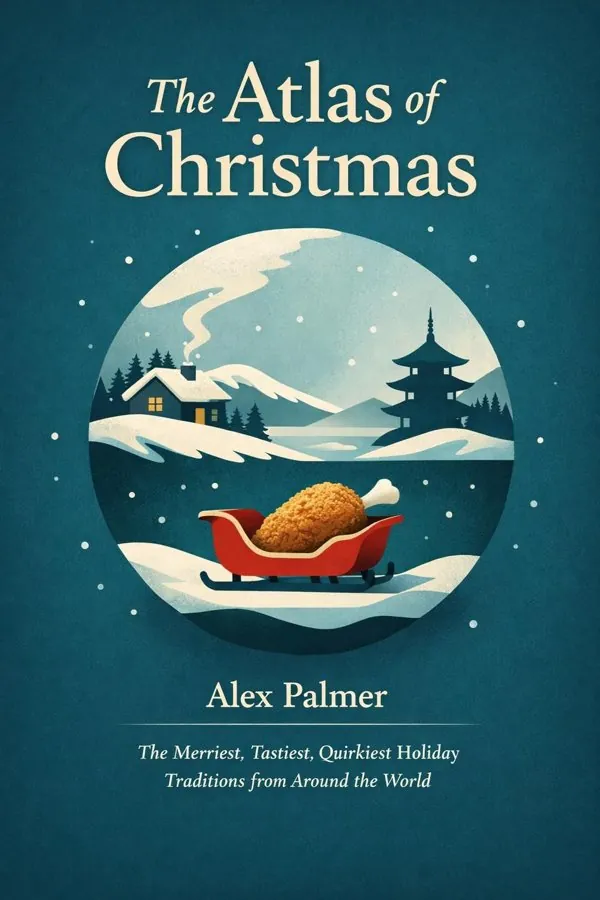
The Atlas of Christmas: The Merriest, Tastiest, Quirkiest Holiday Traditions from Around the World: Summary & Key Insights
by Alex Palmer
 10 min12 chaptersAudio available
What Is The Atlas of Christmas: The Merriest, Tastiest, Quirkiest Holiday Traditions from Around the World About?
The Atlas of Christmas: The Merriest, Tastiest, Quirkiest Holiday Traditions from Around the World by Alex Palmer is a world_history book spanning 12 pages. A festive exploration of Christmas traditions, foods, and customs from around the world, this book takes readers on a global journey through the ways people celebrate the holiday season. From Iceland’s Yule Lads to Japan’s KFC Christmas dinners, it offers a colorful and informative look at the diversity of yuletide joy.
This FizzRead summary covers all 12 key chapters of The Atlas of Christmas: The Merriest, Tastiest, Quirkiest Holiday Traditions from Around the World in approximately 10 minutes, distilling the most important ideas, arguments, and takeaways from Alex Palmer's work. Also available as an audio summary and Key Quotes Podcast.
The Atlas of Christmas: The Merriest, Tastiest, Quirkiest Holiday Traditions from Around the World
A festive exploration of Christmas traditions, foods, and customs from around the world, this book takes readers on a global journey through the ways people celebrate the holiday season. From Iceland’s Yule Lads to Japan’s KFC Christmas dinners, it offers a colorful and informative look at the diversity of yuletide joy.
Who Should Read The Atlas of Christmas: The Merriest, Tastiest, Quirkiest Holiday Traditions from Around the World?
This book is perfect for anyone interested in world_history and looking to gain actionable insights in a short read. Whether you're a student, professional, or lifelong learner, the key ideas from The Atlas of Christmas: The Merriest, Tastiest, Quirkiest Holiday Traditions from Around the World by Alex Palmer will help you think differently.
- ✓Readers who enjoy world_history and want practical takeaways
- ✓Professionals looking to apply new ideas to their work and life
- ✓Anyone who wants the core insights of The Atlas of Christmas: The Merriest, Tastiest, Quirkiest Holiday Traditions from Around the World in just 10 minutes
Want the full summary?
Get instant access to this book summary and 100K+ more with Fizz Moment.
Get Free SummaryAvailable on App Store • Free to download
Key Chapters
To understand the global diversity of Christmas, we must begin with its origins — a story that stretches deep into both religious and pre-Christian pasts. The festival as we know it was shaped from a tapestry of ancient midwinter observances. Long before Christianity adopted December 25 as the date to celebrate the birth of Jesus, civilizations marked the solstice with feasts, lights, and community gatherings. Romans held Saturnalia, a festival of gift exchange and merrymaking. Northern European peoples lit fires and brought evergreens indoors to symbolize endurance. These rituals were responses to the darkest days of the year — acts of hope asserting that warmth and light would return.
As Christianity spread, it absorbed these seasonal customs, weaving them into a narrative of divine birth and renewal. The Nativity story gave the season its spiritual foundation, but the rituals surrounding it — from caroling to gift-giving — grew from centuries of adaptation. In medieval Europe, the holiday became a complex blend of sacred observance and communal festivity. Later, as the faith expanded globally through trade and colonization, local cultures layered their own traditions onto the celebration.
When I examined sources around the world, I realized that Christmas was not imposed but reshaped everywhere it went. It became an open space for cultural imagination. In Latin America, it fused with strong Catholic processions and indigenous rhythms. In Africa, it adapted to communal singing and shared feasts. In Asia, where Christianity often remained a minority faith, it took on a secular sparkle while still evoking universal symbols of joy and generosity. This evolutionary process — a dialogue between faith and festivity, between local and global influences — explains why Christmas continues to feel both familiar and endlessly surprising wherever you are.
Understanding this history is crucial. It reminds us that Christmas has always been syncretic — a meeting point of beliefs and hopes rather than a single, fixed tradition. Its endurance lies precisely in that adaptability.
In Europe, Christmas bears the weight of ancient memory. When you wander through its customs, you meet figures who are both whimsical and terrifying. Saint Nicholas, for instance, originated as a charitable bishop in Myra, known for secret acts of generosity. His reputation spread across the continent, inspiring later interpretations like Sinterklaas in the Netherlands and Père Noël in France. Alongside his benevolent image, darker spirits emerged — reminders of winter’s wild side. Among these, none is more famous than Krampus, the horned creature of Alpine folklore who punishes the naughty while Saint Nicholas rewards the good.
Then, in Iceland, the Yule Lads appear — thirteen mischievous pranksters descended from trolls who visit children over the thirteen nights before Christmas. Each Lad has his peculiar habits: one steals candles, another slams doors. Their eccentricity reflects the unique humor and mythic storytelling of the North, where winter invites imagination as much as endurance.
When you travel across Europe through this atlas, you sense the balance between somber reflection and exuberant pleasure. The region’s architecture glows with centuries of ritual — from Germany’s Christmas markets filled with spiced wine and gingerbread to Scandinavia’s Lucia processions celebrating light in the darkness. Even the décor — evergreens, candles, ornaments — speaks of survival and hope.
For me, these stories reveal how the European heart of Christmas is emotional as well as historical. It carries the awareness of hardship, of nights that last long and cold, and counters that with an explosion of light, melody, and myth. Here, Christmas is not only about faith but about vitality. It asks people to confront the dark, transform it through laughter and generosity, and continue traditions that connect them to ancestors who did the same centuries ago.
+ 10 more chapters — available in the FizzRead app
All Chapters in The Atlas of Christmas: The Merriest, Tastiest, Quirkiest Holiday Traditions from Around the World
About the Author
Alex Palmer is an American author and journalist known for his works on history, culture, and travel. His writing has appeared in publications such as Smithsonian, National Geographic, and The New York Times.
Get This Summary in Your Preferred Format
Read or listen to the The Atlas of Christmas: The Merriest, Tastiest, Quirkiest Holiday Traditions from Around the World summary by Alex Palmer anytime, anywhere. FizzRead offers multiple formats so you can learn on your terms — all free.
Available formats: App · Audio · PDF · EPUB — All included free with FizzRead
Download The Atlas of Christmas: The Merriest, Tastiest, Quirkiest Holiday Traditions from Around the World PDF and EPUB Summary
Key Quotes from The Atlas of Christmas: The Merriest, Tastiest, Quirkiest Holiday Traditions from Around the World
“To understand the global diversity of Christmas, we must begin with its origins — a story that stretches deep into both religious and pre-Christian pasts.”
“In Europe, Christmas bears the weight of ancient memory.”
Frequently Asked Questions about The Atlas of Christmas: The Merriest, Tastiest, Quirkiest Holiday Traditions from Around the World
The Atlas of Christmas: The Merriest, Tastiest, Quirkiest Holiday Traditions from Around the World by Alex Palmer is a world_history book that explores key ideas across 12 chapters. A festive exploration of Christmas traditions, foods, and customs from around the world, this book takes readers on a global journey through the ways people celebrate the holiday season. From Iceland’s Yule Lads to Japan’s KFC Christmas dinners, it offers a colorful and informative look at the diversity of yuletide joy.
You Might Also Like
The Age of Capital
Eric Hobsbawm
10 min
The Gulag Archipelago
Aleksandr Solzhenitsyn
10 min
Jerusalem: The Biography
Simon Sebag Montefiore
10 min
The Anglo-Saxons
James Campbell
10 min
The Boer War
Thomas Pakenham
10 min
The Industrial Revolutionaries: The Making of the Modern World 1776–1914
Gavin Weightman
10 minBrowse by Category
Ready to read The Atlas of Christmas: The Merriest, Tastiest, Quirkiest Holiday Traditions from Around the World?
Get the full summary and 100K+ more books with Fizz Moment.