
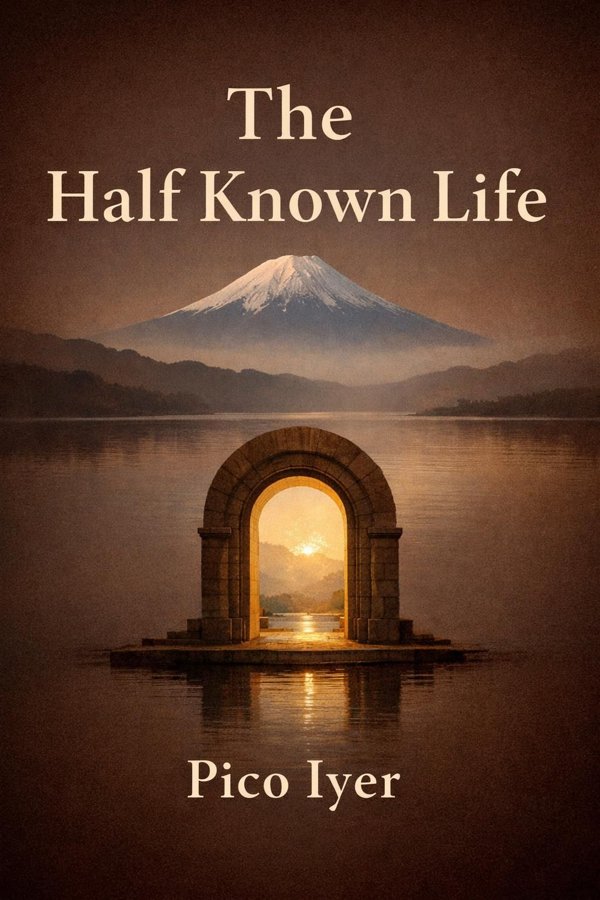
The Half Known Life: In Search of Paradise: Summary & Key Insights
by Pico Iyer
 10 min9 chaptersAudio available
Key Takeaways from The Half Known Life: In Search of Paradise
The search for paradise often says more about the seeker than the place being sought.
Some of the world’s most enchanting places are also marked by loss, tension, and historical wounds.
Every journey across the world is also a journey through the self.
For many people, paradise is closely tied to the dream of home.
A place becomes paradise not only through what it contains but through the eyes that behold it.
What Is The Half Known Life: In Search of Paradise About?
The Half Known Life: In Search of Paradise by Pico Iyer is a travel book. What if paradise is not a destination but a way of seeing? In The Half Known Life: In Search of Paradise, Pico Iyer travels through places marked by beauty, conflict, longing, and spiritual depth to examine one of humanity’s oldest desires: the search for a better world. Rather than offering a conventional travel narrative full of tips and landmarks, Iyer uses movement across the globe to explore inner landscapes—hope, exile, faith, belonging, and the tension between outer circumstances and inner peace. The book moves through locations such as Iran, North Korea, Kashmir, Jerusalem, and Sri Lanka, asking why people continue to imagine paradise even in the shadow of suffering. This book matters because it challenges modern assumptions that happiness can be bought, built, or mapped. Iyer argues that the places we idealize often reveal our deepest fears and longings, and that true paradise may lie less in perfection than in perspective. As one of the world’s most respected travel writers, known for blending memoir, philosophy, politics, and spiritual reflection, Pico Iyer brings rare authority to this subject. He writes not merely as a tourist but as a careful observer of the human condition.
This FizzRead summary covers all 9 key chapters of The Half Known Life: In Search of Paradise in approximately 10 minutes, distilling the most important ideas, arguments, and takeaways from Pico Iyer's work. Also available as an audio summary and Key Quotes Podcast.
The Half Known Life: In Search of Paradise
What if paradise is not a destination but a way of seeing? In The Half Known Life: In Search of Paradise, Pico Iyer travels through places marked by beauty, conflict, longing, and spiritual depth to examine one of humanity’s oldest desires: the search for a better world. Rather than offering a conventional travel narrative full of tips and landmarks, Iyer uses movement across the globe to explore inner landscapes—hope, exile, faith, belonging, and the tension between outer circumstances and inner peace. The book moves through locations such as Iran, North Korea, Kashmir, Jerusalem, and Sri Lanka, asking why people continue to imagine paradise even in the shadow of suffering.
This book matters because it challenges modern assumptions that happiness can be bought, built, or mapped. Iyer argues that the places we idealize often reveal our deepest fears and longings, and that true paradise may lie less in perfection than in perspective. As one of the world’s most respected travel writers, known for blending memoir, philosophy, politics, and spiritual reflection, Pico Iyer brings rare authority to this subject. He writes not merely as a tourist but as a careful observer of the human condition.
Who Should Read The Half Known Life: In Search of Paradise?
This book is perfect for anyone interested in travel and looking to gain actionable insights in a short read. Whether you're a student, professional, or lifelong learner, the key ideas from The Half Known Life: In Search of Paradise by Pico Iyer will help you think differently.
- ✓Readers who enjoy travel and want practical takeaways
- ✓Professionals looking to apply new ideas to their work and life
- ✓Anyone who wants the core insights of The Half Known Life: In Search of Paradise in just 10 minutes
Want the full summary?
Get instant access to this book summary and 100K+ more with Fizz Moment.
Get Free SummaryAvailable on App Store • Free to download
Key Chapters
The search for paradise often says more about the seeker than the place being sought. One of Pico Iyer’s central insights is that paradise is not simply a physical location with ideal weather, beauty, or safety; it is an idea shaped by memory, disappointment, faith, and desire. People imagine perfect islands, sacred cities, political utopias, or spiritual retreats because they feel some lack in ordinary life. The dream of paradise is therefore deeply revealing. It exposes what we think is missing and what we hope might finally complete us.
Iyer approaches paradise not as a travel brochure fantasy but as a human obsession. He visits places that different communities have seen as heaven, refuge, homeland, or promised land, and he shows that each ideal contains contradictions. A country may look serene while carrying hidden pain. A holy city may inspire transcendence while also breeding conflict. A quiet retreat may offer peace while forcing us to face ourselves. In this sense, paradise is never purely external. It is always entwined with expectation.
This has practical value for everyday life. Many people postpone contentment by attaching it to a future move, promotion, relationship, or lifestyle change. They assume that once they arrive somewhere better, they will finally feel whole. Iyer encourages readers to question that reflex. Before chasing a new version of paradise, ask what emotional need is driving the pursuit. Is it rest, recognition, simplicity, community, meaning, or escape?
A useful application is to examine one place or goal you idealize and write down what you believe it will give you. Then ask whether some part of that experience can be cultivated now. The actionable takeaway: when you define the longing beneath the fantasy, you gain a wiser path toward real fulfillment.
Some of the world’s most enchanting places are also marked by loss, tension, and historical wounds. Iyer repeatedly shows that beauty does not erase suffering, and suffering does not cancel beauty. This coexistence is one of the book’s most powerful lessons. We often want simple categories: paradise or hell, peace or conflict, sacred or broken. But the world resists such neat divisions. In many of the places Iyer visits, breathtaking landscapes, loving communities, and moments of grace exist alongside violence, occupation, fear, or grief.
This insight matters because it challenges sentimental thinking. It is easy to romanticize distant places, especially when viewed through tourism, media, or nostalgia. Iyer refuses that temptation. He sees paradise as inseparable from history. The Kashmir valley may appear like Eden, yet it carries political trauma. Jerusalem may be holy ground, yet holiness there is entangled with contest and sorrow. Sri Lanka may promise tropical renewal, yet memory and conflict remain present beneath the surface. Paradise, then, is never pure scenery. It is lived reality, and lived reality is layered.
There is a practical lesson here for how we understand our own lives. We often think happiness requires the absence of struggle, but Iyer suggests a deeper maturity: learning to recognize joy within imperfection. A family can be loving and difficult. A career can be meaningful and exhausting. A home can provide comfort and carry painful memories. When we stop waiting for flawless conditions, we become more capable of gratitude and resilience.
Try applying this perspective by revisiting one area of life you label too quickly—either as wonderful or hopeless. Look for the mixed truth. What goodness remains inside the difficulty? What wound exists inside the beauty? The actionable takeaway: train yourself to hold complexity, because real peace begins when you stop demanding that life be simple.
Every journey across the world is also a journey through the self. Iyer has long been admired for using travel not just to describe places but to illuminate the traveler’s mind, and this book extends that gift. The Half Known Life suggests that when we move through unfamiliar environments, we are often stripped of routine assumptions. Distance destabilizes us just enough to make hidden beliefs visible. We notice what we fear, what fascinates us, and what we project onto others. Travel becomes a mirror.
This is why Iyer’s book is more than reportage. He is not merely cataloging places associated with paradise; he is examining what these places awaken in him and in those who live there. The “half known life” is the part of existence that remains mysterious even when we believe we understand ourselves. New landscapes, political tensions, sacred rituals, or encounters with strangers can open doors into that partially hidden inner territory. In this sense, travel matters not because it gives us more stamps in a passport, but because it interrupts our habits of perception.
Even readers who rarely travel can use this insight. The point is not geographical movement alone but deliberate displacement—stepping outside comfort zones to see more clearly. This might mean visiting a neighborhood unlike your own, attending a religious service from another tradition, speaking with someone whose politics differ from yours, or spending time in silence away from digital noise. Each act can reveal assumptions you did not know you carried.
A practical exercise is to ask after any unusual experience: what did I notice first, and what does that reveal about me? Did I look for danger, beauty, familiarity, status, or belonging? The actionable takeaway: use moments of disorientation as opportunities for self-knowledge, because what unsettles you often teaches you who you are.
For many people, paradise is closely tied to the dream of home. Yet Iyer makes clear that home is not always a stable place on a map. It may be an atmosphere, a rhythm, a spiritual orientation, or a sense of being fully received. In a world shaped by migration, exile, tourism, and divided identities, the old assumption that one belongs neatly to one place no longer fits many lives. Iyer himself, with his global background and lifelong movement, is especially suited to explore this ambiguity.
The book suggests that the longing for paradise often overlaps with the longing for a true home—a place where fragmentation ends. But real belonging is rarely simple. Some people live in their ancestral homeland and still feel estranged. Others build deep roots far from where they were born. Communities may preserve traditions in exile more intensely than those who remain in the original place. Home, then, is not guaranteed by nationality or scenery. It emerges from recognition, meaning, and relationship.
This reframing is useful in modern life, where many feel displaced even without crossing borders. Remote work, frequent relocation, digital connection, and social upheaval can create subtle homelessness. Iyer’s perspective encourages us to build home intentionally. Home can be found in rituals, trusted friendships, a practice of prayer or meditation, family meals, language, music, or service. These anchors create continuity when geography cannot.
To apply this, identify three elements that make you feel most deeply at home. They may be sensory, emotional, or spiritual: morning light, a weekly call with family, a favorite prayer, cooking a certain meal, walking in nature. Protect them. The actionable takeaway: instead of waiting to discover the perfect home, consciously create the conditions of belonging wherever you are.
A place becomes paradise not only through what it contains but through the eyes that behold it. Iyer repeatedly returns to the idea that spiritual perspective can transform experience more deeply than material conditions can. This does not mean ignoring injustice or pretending hardship is pleasant. It means recognizing that inner orientation—attention, humility, reverence, patience—shapes reality in powerful ways. Two people can stand in the same city and inhabit completely different worlds depending on what they are trained to notice.
In places marked by religious devotion, pilgrimage, or monastic discipline, Iyer sees that paradise has long been understood as a condition of soul before it is a feature of landscape. Sacred traditions across cultures remind us that desire can distort perception. If we arrive somewhere expecting consumption, status, or possession, even beauty becomes thin. If we arrive with receptivity, gratitude, and stillness, ordinary moments can feel luminous. Paradise, then, is not acquired through control but approached through surrender.
This matters in practical terms because many people consume travel and leisure in a restless, distracted way. They photograph everything, compare experiences, and miss presence itself. The same happens at home. We rush through meals, conversations, sunsets, and quiet mornings while imagining that real life is elsewhere. Iyer’s work invites a spiritual discipline of attention. Paradise may appear when we stop demanding intensity and start noticing depth.
A simple application is to choose one ordinary experience each day—a walk, a cup of tea, a conversation—and engage it with complete attention. Put away devices. Observe details. Receive rather than evaluate. Over time, this practice reshapes how you inhabit the world. The actionable takeaway: cultivate an inward stillness, because the quality of your attention often determines whether life feels barren or blessed.
One of the book’s most sobering insights is that collective visions of paradise can become dangerous when they harden into ideology. Nations, movements, and regimes frequently promise a perfected society, purified identity, or redeemed future. But when paradise is defined politically in rigid terms, it can justify exclusion, denial, and control. Iyer’s travels through tense and heavily symbolic places reveal how dreams of national or religious perfection often contain hidden violence. The more absolute the vision, the less room there is for human complexity.
This theme is especially important because utopian language remains powerful in modern politics. Leaders still promise restoration, purity, greatness, security, or final solutions. These promises appeal to genuine fears and aspirations. People want safety, dignity, and belonging. Yet Iyer encourages skepticism toward any system that claims it can eliminate ambiguity altogether. Human societies are plural, wounded, and unfinished. Attempts to force paradise on earth often create fresh forms of suffering.
In everyday life, smaller versions of this pattern also appear. Organizations may chase a perfect culture and become intolerant. Families may cling to an ideal image and silence honest conversation. Individuals may impose unrealistic standards on themselves, then collapse into shame when reality fails to match the script. The desire for perfection becomes destructive when it denies vulnerability.
A practical response is to watch for language that treats complexity as betrayal. Whenever a person or institution offers a flawless vision, ask what is being excluded, simplified, or erased. In your own goals, replace perfection with integrity and adaptability. Aim to build something humane rather than idealized. The actionable takeaway: distrust any paradise that requires denial of human complexity, because healthy communities make room for imperfection, dissent, and change.
Part of what makes paradise so moving is its fragility. Iyer understands that beauty is intensified, not diminished, by the knowledge that it will pass. Landscapes change, cultures evolve, relationships end, political conditions shift, and even sacred places are vulnerable to time and conflict. Instead of responding with despair, he suggests that impermanence can sharpen love and attention. What cannot be held forever must be received more tenderly now.
This view stands against the modern impulse to preserve every experience through ownership, documentation, or control. We often act as though we could secure paradise permanently if only we had enough money, influence, or technology. But the world is dynamic. The sea rises, cities transform, memories fade, and identities evolve. Iyer does not present this as tragedy alone. He treats transience as part of the spiritual truth of travel and life. The paradise we seek may be fleeting, but that fleetingness invites reverence.
Applied personally, this idea can transform how we approach everyday blessings. A child’s dependence, a parent’s voice, a season of health, a beloved neighborhood, or a circle of friendships may not last unchanged. When we stop assuming permanence, appreciation grows. We become less possessive and more present. Rather than trying to freeze life, we participate in it with greater care.
One helpful habit is to name, at the end of each day, one beautiful thing that may not be here forever. This could be a conversation, a tree outside your window, the energy to walk, or a local café you love. Let awareness deepen gratitude rather than anxiety. The actionable takeaway: hold what you cherish lightly but attentively, because impermanence is often what turns ordinary experience into something sacred.
The title The Half Known Life points to a liberating truth: not everything meaningful can be fully understood, explained, or mastered. Iyer resists the modern demand for total clarity. In travel, politics, faith, and personal identity, he recognizes that mystery remains. Places exceed our categories. People surprise us. Sacred traditions speak in symbols rather than formulas. Our own motives remain partly hidden even to ourselves. Far from being a weakness, this uncertainty can be a source of wonder and humility.
Much contemporary life pushes in the opposite direction. We are encouraged to optimize, define, brand, and explain everything. We want immediate takes on complex conflicts, clear labels for fluid identities, and neat resolutions to spiritual questions. Iyer shows why such simplification is inadequate. Some of the deepest experiences—beauty, grief, awe, longing, devotion—are only partially knowable. Paradise itself may belong to that realm. It can be approached, glimpsed, evoked, but not fully possessed.
This idea has practical significance because many people suffer from the pressure to have complete answers. They feel anxious if they cannot explain their purpose, choose a perfect path, or resolve every contradiction. Iyer offers a gentler approach: maturity includes learning to live with unanswered questions. We do not need certainty to live meaningfully. We need openness, patience, and honesty.
To practice this, notice one unresolved area in your life and resist the urge to force a premature conclusion. Instead, ask better questions, gather richer experiences, and allow time to work. Keep a journal of what remains unclear without labeling it failure. The actionable takeaway: make peace with partial knowledge, because a meaningful life is not one without mystery but one that knows how to inhabit mystery well.
After crossing borders, histories, and spiritual landscapes, Iyer leaves readers with a subtle but transformative possibility: paradise may be less about where we go than about how deeply we attend. This does not deny the reality of injustice or the value of beautiful places. Rather, it suggests that no destination can satisfy a distracted soul. If we remain restless, acquisitive, and mentally absent, even the most celebrated locations will become ordinary or disappointing. But if we learn the art of presence, even modest settings can open into abundance.
This is the mature culmination of Iyer’s search. Paradise is not merely hidden in remote temples, conflict zones, coastlines, or sacred mountains. It can emerge in a quiet room, a conversation with a stranger, a ritual repeated over years, or a view from a window when the mind becomes still enough to receive it. Attention turns the world from backdrop into revelation. This is why the book resonates beyond travel writing. It speaks to anyone who has ever felt that life is passing by while they keep waiting for a better version to begin.
In practical terms, attention is a discipline. It requires saying no to constant distraction, comparison, and self-narration. You can build it through journaling, prayer, meditation, walking without headphones, listening without interrupting, or taking in a place without needing to capture it. Over time, such practices increase sensitivity to quiet forms of joy.
Choose one daily routine and treat it as an encounter rather than a task: your commute, lunch break, evening walk, or first ten minutes after waking. Observe it fully for one week. The actionable takeaway: stop postponing wonder, because the gates of paradise often open through sustained and grateful attention.
All Chapters in The Half Known Life: In Search of Paradise
About the Author
Pico Iyer is a celebrated essayist, novelist, and one of the most distinctive travel writers of his generation. Born in Oxford, England, to Indian parents and educated at Eton and Oxford University, he has spent much of his life moving between cultures, countries, and traditions. That global perspective shapes his writing, which often explores travel, identity, exile, spirituality, and the search for stillness in a restless world. He is the author of several acclaimed books, including Video Night in Kathmandu, The Global Soul, and The Art of Stillness. Known for his lyrical style and philosophical depth, Iyer writes less about tourism than about what movement, place, and silence reveal about the human condition. His work has appeared widely in major international publications.
Get This Summary in Your Preferred Format
Read or listen to the The Half Known Life: In Search of Paradise summary by Pico Iyer anytime, anywhere. FizzRead offers multiple formats so you can learn on your terms — all free.
Available formats: App · Audio · PDF · EPUB — All included free with FizzRead
Download The Half Known Life: In Search of Paradise PDF and EPUB Summary
Key Quotes from The Half Known Life: In Search of Paradise
“The search for paradise often says more about the seeker than the place being sought.”
“Some of the world’s most enchanting places are also marked by loss, tension, and historical wounds.”
“Every journey across the world is also a journey through the self.”
“For many people, paradise is closely tied to the dream of home.”
“A place becomes paradise not only through what it contains but through the eyes that behold it.”
Frequently Asked Questions about The Half Known Life: In Search of Paradise
The Half Known Life: In Search of Paradise by Pico Iyer is a travel book that explores key ideas across 9 chapters. What if paradise is not a destination but a way of seeing? In The Half Known Life: In Search of Paradise, Pico Iyer travels through places marked by beauty, conflict, longing, and spiritual depth to examine one of humanity’s oldest desires: the search for a better world. Rather than offering a conventional travel narrative full of tips and landmarks, Iyer uses movement across the globe to explore inner landscapes—hope, exile, faith, belonging, and the tension between outer circumstances and inner peace. The book moves through locations such as Iran, North Korea, Kashmir, Jerusalem, and Sri Lanka, asking why people continue to imagine paradise even in the shadow of suffering. This book matters because it challenges modern assumptions that happiness can be bought, built, or mapped. Iyer argues that the places we idealize often reveal our deepest fears and longings, and that true paradise may lie less in perfection than in perspective. As one of the world’s most respected travel writers, known for blending memoir, philosophy, politics, and spiritual reflection, Pico Iyer brings rare authority to this subject. He writes not merely as a tourist but as a careful observer of the human condition.
You Might Also Like

A Walk in the Woods: Rediscovering America on the Appalachian Trail
Bill Bryson
10 min
How to Travel the World on $50 a Day: Travel Cheaper, Longer, Smarter
Matt Kepnes
10 min
In Xanadu: A Quest
William Dalrymple
10 min
In a Sunburned Country
Bill Bryson
10 min
Notes From A Small Island
Bill Bryson
10 min
The Art of Travel
Alain De Botton
10 minBrowse by Category
Ready to read The Half Known Life: In Search of Paradise?
Get the full summary and 100K+ more books with Fizz Moment.