
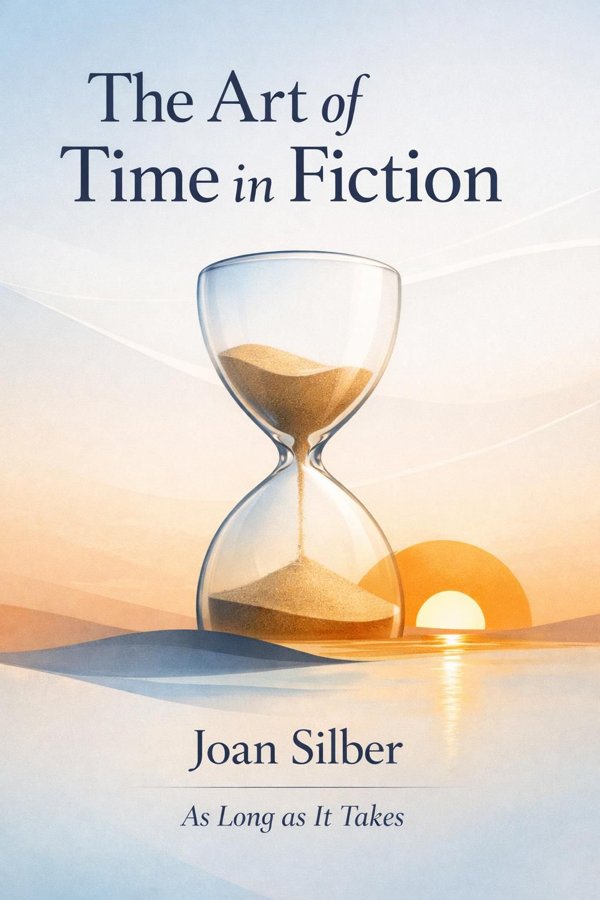
The Art of Time in Fiction: As Long as It Takes: Summary & Key Insights
by Joan Silber
 10 min7 chaptersAudio available
What Is The Art of Time in Fiction: As Long as It Takes About?
The Art of Time in Fiction: As Long as It Takes by Joan Silber is a writing book spanning 7 pages. In this concise and insightful guide, Joan Silber explores how time functions in fiction, revealing five key ways in which narrative time unfolds. Drawing on examples from writers such as F. Scott Fitzgerald, Chinua Achebe, and Arundhati Roy, Silber demonstrates how the manipulation of time shapes storytelling and deepens emotional resonance. Written in clear, accessible prose, the book serves as both a craft manual and a meditation on the art of fiction.
This FizzRead summary covers all 7 key chapters of The Art of Time in Fiction: As Long as It Takes in approximately 10 minutes, distilling the most important ideas, arguments, and takeaways from Joan Silber's work. Also available as an audio summary and Key Quotes Podcast.
The Art of Time in Fiction: As Long as It Takes
In this concise and insightful guide, Joan Silber explores how time functions in fiction, revealing five key ways in which narrative time unfolds. Drawing on examples from writers such as F. Scott Fitzgerald, Chinua Achebe, and Arundhati Roy, Silber demonstrates how the manipulation of time shapes storytelling and deepens emotional resonance. Written in clear, accessible prose, the book serves as both a craft manual and a meditation on the art of fiction.
Who Should Read The Art of Time in Fiction: As Long as It Takes?
This book is perfect for anyone interested in writing and looking to gain actionable insights in a short read. Whether you're a student, professional, or lifelong learner, the key ideas from The Art of Time in Fiction: As Long as It Takes by Joan Silber will help you think differently.
- ✓Readers who enjoy writing and want practical takeaways
- ✓Professionals looking to apply new ideas to their work and life
- ✓Anyone who wants the core insights of The Art of Time in Fiction: As Long as It Takes in just 10 minutes
Want the full summary?
Get instant access to this book summary and 100K+ more with Fizz Moment.
Get Free SummaryAvailable on App Store • Free to download
Key Chapters
Stories that stretch across years or generations challenge a writer’s control of compression and continuity. I have always been drawn to the elasticity of narrative time, how entire years can be contained in a few sentences if the pulse of emotion remains unbroken. Think of how Chinua Achebe’s 'Things Fall Apart' carries us from Okonkwo’s rise to his tragic end while maintaining an unbroken sense of fatal inevitability—that’s what ‘long time’ accomplishes when done well. The trick is not in recounting everything but in tracing the key shifts, so that the reader feels the magnitude of change without feeling stranded in summary.
Writers handle long spans by leaning on pattern and rhythm. Decades may pass through repetition of small details—a season reappears, a ritual repeats, a relationship endures or fades. I have noticed that readers respond to the feeling of duration rather than to its numerical span. A story that spans two years can feel like an eternity if its changes in heart are deeply registered; a novel spanning a century can feel light as wind if its transitions are deftly managed. Compression, then, is not the enemy of emotional truth. It is often the most faithful way to reproduce how time actually lives in memory.
Classic time belongs to the world of causality—where one event leads neatly to another. Many of us first learn storytelling through this structure, and with good reason. Chronological unfolding mimics the way we look back on lived experience: cause, consequence, revelation. Linear order grants comfort and clarity; it allows tension to build and resolution to feel earned. In such stories, time seems invisible but deeply steady, like a current beneath our feet.
I always think of F. Scott Fitzgerald’s 'The Great Gatsby' as an example—not for its glittering prose alone, but for its near-perfect temporal control. The steady forward movement of Gatsby’s doomed pursuit allows each event to carry prophetic weight. Classic time affirms moral cause and effect; it tells us that choices matter and that consequences come in order. But what interests me most is that even in linear narratives, the writer’s choice of pacing—what to linger on, what to hurry past—is a moral decision. Time in such stories is not neutral motion, but judgment rendered through rhythm.
+ 5 more chapters — available in the FizzRead app
All Chapters in The Art of Time in Fiction: As Long as It Takes
About the Author
Joan Silber is an American author known for her short stories and novels that often explore moral complexity and the passage of time. She has received numerous awards, including the PEN/Faulkner Award and the National Book Critics Circle Award. Silber teaches writing and is celebrated for her lucid prose and deep insight into human experience.
Get This Summary in Your Preferred Format
Read or listen to the The Art of Time in Fiction: As Long as It Takes summary by Joan Silber anytime, anywhere. FizzRead offers multiple formats so you can learn on your terms — all free.
Available formats: App · Audio · PDF · EPUB — All included free with FizzRead
Download The Art of Time in Fiction: As Long as It Takes PDF and EPUB Summary
Key Quotes from The Art of Time in Fiction: As Long as It Takes
“Stories that stretch across years or generations challenge a writer’s control of compression and continuity.”
“Classic time belongs to the world of causality—where one event leads neatly to another.”
Frequently Asked Questions about The Art of Time in Fiction: As Long as It Takes
The Art of Time in Fiction: As Long as It Takes by Joan Silber is a writing book that explores key ideas across 7 chapters. In this concise and insightful guide, Joan Silber explores how time functions in fiction, revealing five key ways in which narrative time unfolds. Drawing on examples from writers such as F. Scott Fitzgerald, Chinua Achebe, and Arundhati Roy, Silber demonstrates how the manipulation of time shapes storytelling and deepens emotional resonance. Written in clear, accessible prose, the book serves as both a craft manual and a meditation on the art of fiction.
You Might Also Like
The Art of Perspective
Christopher Castellani
10 min
Making a Point: The Persnickety Story of English Punctuation
David Crystal
10 min
The Elements Of Eloquence: How To Turn The Perfect English Phrase
Mark Forsyth
10 min
The Pocket Muse: Ideas and Inspirations for Writing
Monica Wood
10 min
A Little Book on Form: An Exploration into the Formal Imagination of Poetry
Robert Hass
10 min
Adventures In The Screen Trade: A Personal View Of Hollywood And Screenwriting
William Goldman
10 minBrowse by Category
Ready to read The Art of Time in Fiction: As Long as It Takes?
Get the full summary and 100K+ more books with Fizz Moment.