
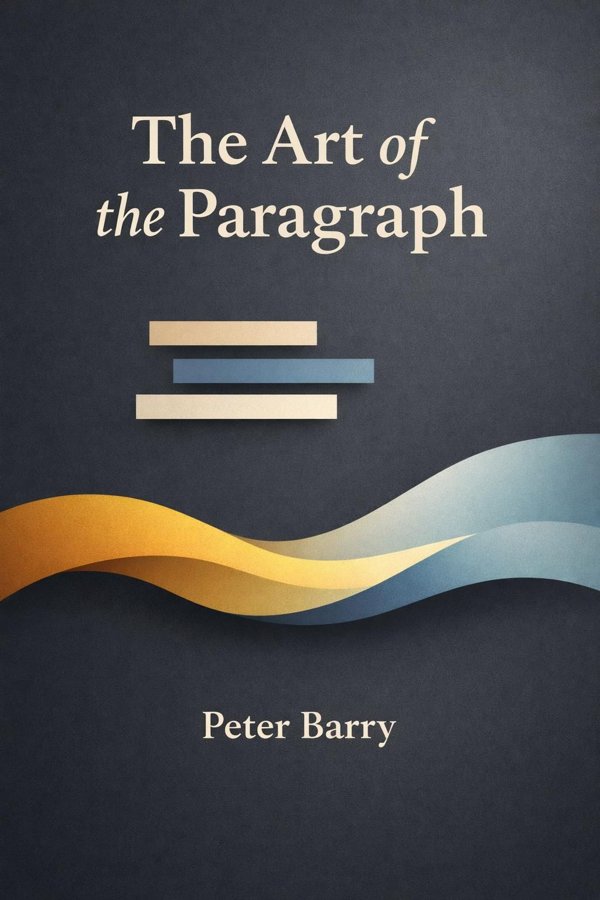
The Art of the Paragraph: Summary & Key Insights
by Peter Barry
 10 min10 chaptersAudio available
What Is The Art of the Paragraph About?
The Art of the Paragraph by Peter Barry is a writing book spanning 10 pages. This concise guide by literary scholar Peter Barry explores the craft of paragraph writing, focusing on how structure, rhythm, and coherence shape effective prose. It provides practical insights for students and writers seeking to improve clarity and flow in their writing, blending theory with examples from literature and academic writing.
This FizzRead summary covers all 10 key chapters of The Art of the Paragraph in approximately 10 minutes, distilling the most important ideas, arguments, and takeaways from Peter Barry's work. Also available as an audio summary and Key Quotes Podcast.
The Art of the Paragraph
This concise guide by literary scholar Peter Barry explores the craft of paragraph writing, focusing on how structure, rhythm, and coherence shape effective prose. It provides practical insights for students and writers seeking to improve clarity and flow in their writing, blending theory with examples from literature and academic writing.
Who Should Read The Art of the Paragraph?
This book is perfect for anyone interested in writing and looking to gain actionable insights in a short read. Whether you're a student, professional, or lifelong learner, the key ideas from The Art of the Paragraph by Peter Barry will help you think differently.
- ✓Readers who enjoy writing and want practical takeaways
- ✓Professionals looking to apply new ideas to their work and life
- ✓Anyone who wants the core insights of The Art of the Paragraph in just 10 minutes
Want the full summary?
Get instant access to this book summary and 100K+ more with Fizz Moment.
Get Free SummaryAvailable on App Store • Free to download
Key Chapters
To understand paragraphing deeply, we must first see it historically. The paragraph did not always exist in the form we know today. In classical rhetoric, speeches and treatises were organized primarily by topic and argument, not by typographical breaks. Ancient Greek and Roman writers used physical markers—such as spacing, marginal points, or verbal transitions—to signal shifts in thought. The modern concept of a visible paragraph emerged gradually with the advent of print culture, when visual layout became integral to reading comprehension.
In the eighteenth and nineteenth centuries, literary prose began to treat the paragraph as a distinct aesthetic entity. Novelists used it to manage pacing, dramatize shifts in viewpoint, and structure dialogue. Essayists, meanwhile, discovered that paragraphing could mirror the flow of reasoning itself—allowing intellectual development to unfold in visible stages. By the twentieth century, with academic writing increasingly standardized, paragraphs came to be defined by conventions of unity, coherence, and logical development. Many writers and teachers emphasized the paragraph as an instrument of discipline: one idea per unit, expressed cleanly and completely.
However, the art of paragraphing did not stop evolving. Modern writers—whether in fiction, criticism, or journalism—experiment with length, rhythm, and fragmentation to create distinctive voice. Long, flowing paragraphs may immerse us in thought; short, abrupt paragraphs can strike us like quick, revealing gestures. History teaches that form has always responded to medium and purpose. The digital age, for instance, has begun transforming paragraphs again, favoring brevity and visual clarity. Yet even within these changes, the basic principles of unity and coherence remain essential for writers seeking meaning rather than mere efficiency. The paragraph continues to adapt, reminding us that effective writing marries tradition and innovation.
The unity of a paragraph is its heartbeat. Without unity, a paragraph becomes a loose collection of sentences pulling in different directions, leaving the reader uncertain of the writer’s intention. The principle of unity insists that each paragraph should focus on a single controlling idea—a clear center around which all its sentences revolve. As I discuss in the book, this controlling idea acts like the gravitational field holding the paragraph together, ensuring that every sentence supports or extends that idea rather than distracting from it.
Unity is not achieved by repetition alone but by internal coherence. The writer must select details, examples, and reasoning that illuminate a single facet of the larger argument. In academic writing, for example, unity means that every paragraph should respond clearly to the essay’s thesis. In literary prose, unity manifests through tone and imagery, producing an emotional or thematic continuity that draws the reader inward. Achieving unity thus requires both discipline and intuition—the discipline to avoid tangents and the intuition to sense when each paragraph feels complete.
In practice, the best way to test unity is to read a paragraph aloud and ask: does every sentence feel like it belongs here? If any moment breaks the rhythm or steers away from the main idea, revision should restore balance. It is through this attentiveness that paragraphs become precise engines of thought rather than loose associations of language. Readers recognize unity instinctively; they follow the thread of reasoning with confidence. When unity reigns, paragraphs no longer merely contain ideas—they embody them, expressing conviction and focus.
+ 8 more chapters — available in the FizzRead app
All Chapters in The Art of the Paragraph
About the Author
Peter Barry is a British literary critic and professor known for his works on literary theory and writing. He has authored several influential books, including 'Beginning Theory', widely used in literary studies. His research and teaching focus on modern literary criticism and writing pedagogy.
Get This Summary in Your Preferred Format
Read or listen to the The Art of the Paragraph summary by Peter Barry anytime, anywhere. FizzRead offers multiple formats so you can learn on your terms — all free.
Available formats: App · Audio · PDF · EPUB — All included free with FizzRead
Download The Art of the Paragraph PDF and EPUB Summary
Key Quotes from The Art of the Paragraph
“To understand paragraphing deeply, we must first see it historically.”
“The unity of a paragraph is its heartbeat.”
Frequently Asked Questions about The Art of the Paragraph
The Art of the Paragraph by Peter Barry is a writing book that explores key ideas across 10 chapters. This concise guide by literary scholar Peter Barry explores the craft of paragraph writing, focusing on how structure, rhythm, and coherence shape effective prose. It provides practical insights for students and writers seeking to improve clarity and flow in their writing, blending theory with examples from literature and academic writing.
You Might Also Like
The Art of Perspective
Christopher Castellani
10 min
Making a Point: The Persnickety Story of English Punctuation
David Crystal
10 min
The Elements Of Eloquence: How To Turn The Perfect English Phrase
Mark Forsyth
10 min
The Pocket Muse: Ideas and Inspirations for Writing
Monica Wood
10 min
A Little Book on Form: An Exploration into the Formal Imagination of Poetry
Robert Hass
10 min
Adventures In The Screen Trade: A Personal View Of Hollywood And Screenwriting
William Goldman
10 minBrowse by Category
Ready to read The Art of the Paragraph?
Get the full summary and 100K+ more books with Fizz Moment.