
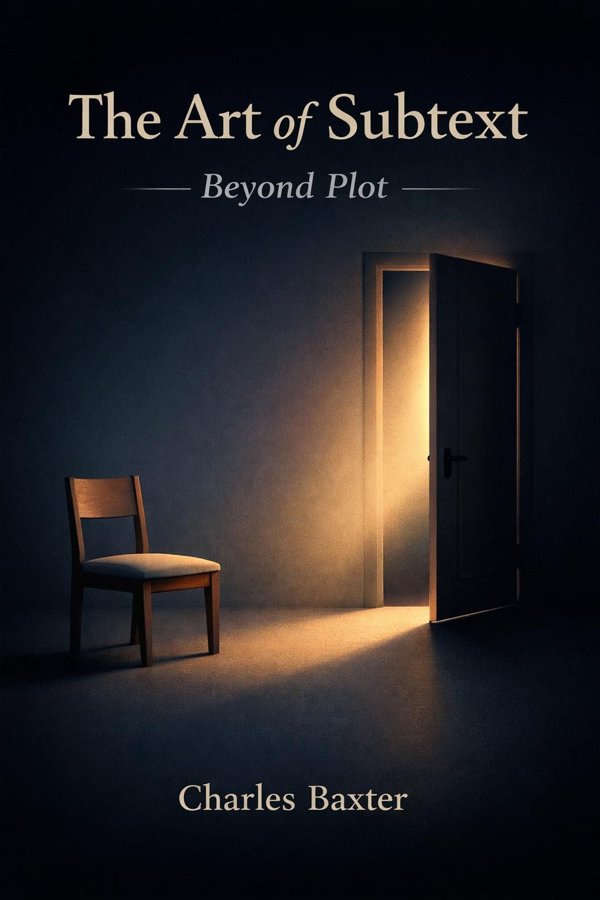
The Art of Subtext: Beyond Plot: Summary & Key Insights
 10 min11 chaptersAudio available
What Is The Art of Subtext: Beyond Plot About?
The Art of Subtext: Beyond Plot by Charles Baxter is a writing book spanning 11 pages. In this insightful work, Charles Baxter explores the subtle art of subtext in fiction—the unspoken, the implied, and the emotional undercurrents that give stories their depth. Through examples from classic and contemporary literature, Baxter examines how writers use silence, gesture, and implication to create resonance and meaning beyond the surface of plot. The book serves as both a guide and a meditation on the craft of writing, encouraging authors to trust the power of what remains unsaid.
This FizzRead summary covers all 11 key chapters of The Art of Subtext: Beyond Plot in approximately 10 minutes, distilling the most important ideas, arguments, and takeaways from Charles Baxter's work. Also available as an audio summary and Key Quotes Podcast.
The Art of Subtext: Beyond Plot
In this insightful work, Charles Baxter explores the subtle art of subtext in fiction—the unspoken, the implied, and the emotional undercurrents that give stories their depth. Through examples from classic and contemporary literature, Baxter examines how writers use silence, gesture, and implication to create resonance and meaning beyond the surface of plot. The book serves as both a guide and a meditation on the craft of writing, encouraging authors to trust the power of what remains unsaid.
Who Should Read The Art of Subtext: Beyond Plot?
This book is perfect for anyone interested in writing and looking to gain actionable insights in a short read. Whether you're a student, professional, or lifelong learner, the key ideas from The Art of Subtext: Beyond Plot by Charles Baxter will help you think differently.
- ✓Readers who enjoy writing and want practical takeaways
- ✓Professionals looking to apply new ideas to their work and life
- ✓Anyone who wants the core insights of The Art of Subtext: Beyond Plot in just 10 minutes
Want the full summary?
Get instant access to this book summary and 100K+ more with Fizz Moment.
Get Free SummaryAvailable on App Store • Free to download
Key Chapters
Every writer has faced the temptation to explain too much: to name every emotion, to clarify every motive. Yet explanation is often the enemy of mystery, and mystery is what draws the reader closer. The unspoken—those moments of omission, pause, or silence—creates space for the reader’s imagination to enter. In this space, tension builds.
In fiction, what’s left out can be more powerful than what’s included. Consider how much of real life takes place between words: the long pause before confession, the polite smile that hides resentment, the decision not to call someone. These absences are emotional landslides, and when writers respect them, they give readers a chance to *feel* rather than merely to *know*. Subtext thus emerges as the echo of what’s withheld.
In this chapter, I explore how omission serves as a narrative tool. Silence, deployed with intention, can amplify emotion. The absence of dialogue in a climactic scene can make what’s implied infinitely more forceful than direct statement. That tension, that hum of unspoken truths between characters, transforms fiction into something alive. Like music, stories depend on the pauses between notes to create resonance.
One of the clearest pathways into subtext is gesture. The body often betrays what the mind refuses to acknowledge. A character’s slight flinch, their hesitation to touch another’s hand, or the way they rearrange a napkin—all these small gestures speak volumes. Fiction that captures physical behavior with precision allows readers to decipher the emotional codes beneath. When written truthfully, gestures function as emotional handwriting.
I analyze examples where behavior becomes a stand-in for dialogue—the way a character’s repeated actions accumulate meaning. In Chekhov’s stories, for instance, movements carry emotional freight that words never could. We read the truth through motion. As writers, our task is to sharpen our powers of observation until we see not just what people do, but what their gestures conceal.
For me, a great scene functions like choreography: bodies moving in quiet revelation. The storyteller who learns to trust gesture crafts readers who can feel emotion rather than be told of it. The more deeply you attend to behavior, the richer your subtextual world becomes.
+ 9 more chapters — available in the FizzRead app
All Chapters in The Art of Subtext: Beyond Plot
About the Author
Charles Baxter is an American author and educator known for his novels, short stories, and essays on the craft of writing. Born in Minneapolis, Minnesota, he has taught at the University of Michigan and the University of Minnesota. His works often explore the complexities of human relationships and the subtleties of emotional life. Baxter is also the author of acclaimed books such as 'The Feast of Love' and 'Burning Down the House: Essays on Fiction.'
Get This Summary in Your Preferred Format
Read or listen to the The Art of Subtext: Beyond Plot summary by Charles Baxter anytime, anywhere. FizzRead offers multiple formats so you can learn on your terms — all free.
Available formats: App · Audio · PDF · EPUB — All included free with FizzRead
Download The Art of Subtext: Beyond Plot PDF and EPUB Summary
Key Quotes from The Art of Subtext: Beyond Plot
“Every writer has faced the temptation to explain too much: to name every emotion, to clarify every motive.”
“One of the clearest pathways into subtext is gesture.”
Frequently Asked Questions about The Art of Subtext: Beyond Plot
The Art of Subtext: Beyond Plot by Charles Baxter is a writing book that explores key ideas across 11 chapters. In this insightful work, Charles Baxter explores the subtle art of subtext in fiction—the unspoken, the implied, and the emotional undercurrents that give stories their depth. Through examples from classic and contemporary literature, Baxter examines how writers use silence, gesture, and implication to create resonance and meaning beyond the surface of plot. The book serves as both a guide and a meditation on the craft of writing, encouraging authors to trust the power of what remains unsaid.
You Might Also Like
The Art of Perspective
Christopher Castellani
10 min
Making a Point: The Persnickety Story of English Punctuation
David Crystal
10 min
The Elements Of Eloquence: How To Turn The Perfect English Phrase
Mark Forsyth
10 min
The Pocket Muse: Ideas and Inspirations for Writing
Monica Wood
10 min
A Little Book on Form: An Exploration into the Formal Imagination of Poetry
Robert Hass
10 min
Adventures In The Screen Trade: A Personal View Of Hollywood And Screenwriting
William Goldman
10 minBrowse by Category
Ready to read The Art of Subtext: Beyond Plot?
Get the full summary and 100K+ more books with Fizz Moment.