
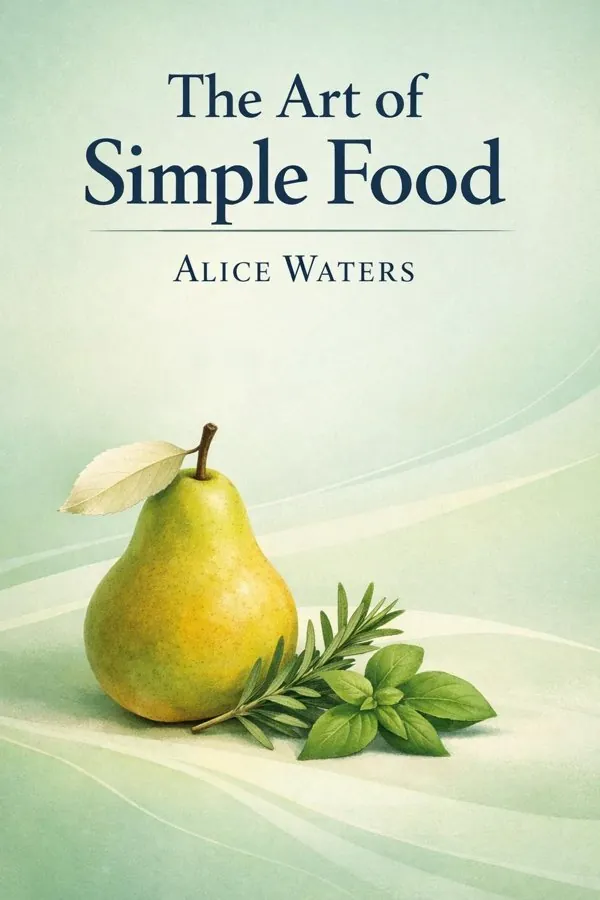
The Art of Simple Food: Notes, Lessons, and Recipes from a Delicious Revolution: Summary & Key Insights
by Alice Waters
 10 min9 chaptersAudio available
Key Takeaways from The Art of Simple Food: Notes, Lessons, and Recipes from a Delicious Revolution
Cooking becomes easier when readiness replaces guesswork.
The quality of your cooking life often depends less on owning many tools than on trusting a few good ones.
The most profound flavors are often the least manipulated.
Seasonality is not a trend in Waters’s work; it is a way of aligning cooking with reality.
A satisfying meal is not just a collection of dishes; it is a composition.
What Is The Art of Simple Food: Notes, Lessons, and Recipes from a Delicious Revolution About?
The Art of Simple Food: Notes, Lessons, and Recipes from a Delicious Revolution by Alice Waters is a nutrition book spanning 9 pages. Alice Waters’s The Art of Simple Food is more than a cookbook: it is a philosophy of eating, cooking, and living well. Built on the conviction that the best meals begin with the best ingredients, the book teaches readers how to cook with confidence by focusing on seasonality, freshness, and restraint rather than complication. Waters argues that truly memorable food does not come from technical showmanship or long ingredient lists, but from attention, care, and a deep respect for what nature provides. Drawing on decades of experience as the founder of Chez Panisse and one of the most influential voices in the farm-to-table movement, Waters offers practical instruction alongside a larger cultural vision. She explains how to stock a pantry, use essential kitchen tools, build flavor, plan simple meals, and prepare everyday dishes that honor the integrity of each ingredient. Her lessons are accessible enough for beginners yet rich enough to reshape the habits of experienced cooks. What makes this book matter is that it connects cooking to larger values: sustainability, community, pleasure, and mindfulness. It shows that simple food, made thoughtfully, can be both deeply nourishing and quietly transformative.
This FizzRead summary covers all 9 key chapters of The Art of Simple Food: Notes, Lessons, and Recipes from a Delicious Revolution in approximately 10 minutes, distilling the most important ideas, arguments, and takeaways from Alice Waters's work. Also available as an audio summary and Key Quotes Podcast.
The Art of Simple Food: Notes, Lessons, and Recipes from a Delicious Revolution
Alice Waters’s The Art of Simple Food is more than a cookbook: it is a philosophy of eating, cooking, and living well. Built on the conviction that the best meals begin with the best ingredients, the book teaches readers how to cook with confidence by focusing on seasonality, freshness, and restraint rather than complication. Waters argues that truly memorable food does not come from technical showmanship or long ingredient lists, but from attention, care, and a deep respect for what nature provides.
Drawing on decades of experience as the founder of Chez Panisse and one of the most influential voices in the farm-to-table movement, Waters offers practical instruction alongside a larger cultural vision. She explains how to stock a pantry, use essential kitchen tools, build flavor, plan simple meals, and prepare everyday dishes that honor the integrity of each ingredient. Her lessons are accessible enough for beginners yet rich enough to reshape the habits of experienced cooks.
What makes this book matter is that it connects cooking to larger values: sustainability, community, pleasure, and mindfulness. It shows that simple food, made thoughtfully, can be both deeply nourishing and quietly transformative.
Who Should Read The Art of Simple Food: Notes, Lessons, and Recipes from a Delicious Revolution?
This book is perfect for anyone interested in nutrition and looking to gain actionable insights in a short read. Whether you're a student, professional, or lifelong learner, the key ideas from The Art of Simple Food: Notes, Lessons, and Recipes from a Delicious Revolution by Alice Waters will help you think differently.
- ✓Readers who enjoy nutrition and want practical takeaways
- ✓Professionals looking to apply new ideas to their work and life
- ✓Anyone who wants the core insights of The Art of Simple Food: Notes, Lessons, and Recipes from a Delicious Revolution in just 10 minutes
Want the full summary?
Get instant access to this book summary and 100K+ more with Fizz Moment.
Get Free SummaryAvailable on App Store • Free to download
Key Chapters
Cooking becomes easier when readiness replaces guesswork. One of Alice Waters’s central lessons is that a well-stocked pantry is not merely a place to store ingredients; it is the foundation of calm, flexible, everyday cooking. When basic, high-quality staples are always within reach, you do not need to rely on complicated recipes or emergency takeout. You can respond to the day, the season, and your appetite with ease.
Waters emphasizes pantry essentials that support simple, flavorful meals: olive oil, vinegars, grains, dried beans, pasta, onions, garlic, canned tomatoes, salt, pepper, herbs, and a few dependable condiments. The value of these ingredients is not in their quantity but in their usefulness. A pot of beans can become soup, salad, or a side dish. Good olive oil and vinegar can turn raw greens into a meal. Pasta, garlic, and a handful of vegetables can become dinner in twenty minutes.
This approach also changes how people think about cooking. Instead of seeing meals as isolated projects requiring special shopping trips, Waters encourages a more continuous relationship with the kitchen. A pantry stocked with care invites improvisation. It supports confidence because it reduces friction. You stop asking, “What can I make?” and begin asking, “What sounds good today?”
In practice, this might mean keeping lentils, rice, eggs, lemons, broth, and seasonal vegetables on hand. From those alone, you can make a grain bowl, soup, frittata, or warm salad. The point is not abundance for its own sake. It is intelligent readiness.
Actionable takeaway: build a short list of 15 to 20 pantry staples you truly use, upgrade their quality, and restock them consistently so everyday meals become simpler and more spontaneous.
The quality of your cooking life often depends less on owning many tools than on trusting a few good ones. Waters treats kitchen equipment as an extension of the cook’s hands and senses. Simple food does not require a gadget-filled kitchen; it requires reliable tools that make preparation efficient, precise, and pleasurable.
She highlights the importance of a sharp knife, a cutting board with enough working space, sturdy pots, heavy-bottomed pans, wooden spoons, mixing bowls, a peeler, and measuring tools when needed. These are not luxury items in her philosophy. They are practical instruments that help preserve the integrity of ingredients. A sharp knife, for instance, does more than cut neatly. It makes vegetable preparation safer, quicker, and less destructive. A well-made pan distributes heat evenly, allowing onions to soften gently instead of scorching.
Waters also values basic technique as much as equipment. Knowing how to chop an onion evenly, wash greens thoroughly, boil pasta correctly, roast vegetables until caramelized, or taste for seasoning at the right moment creates better food than owning the latest appliance. In her world, skill grows through repetition and attentiveness, not intimidation.
This view is especially liberating for beginner cooks. It reframes cooking from something dependent on specialized knowledge into a craft that can be learned through practice. If you can handle a knife confidently, understand heat, and taste as you go, you can make excellent food from simple ingredients.
For example, roasting root vegetables requires only a knife, a pan, olive oil, salt, and proper spacing in the oven. Yet when done well, the result is deeply flavorful. The lesson is that mastery comes from working carefully with essentials, not from overcomplicating the process.
Actionable takeaway: choose three core kitchen tools to maintain well, especially a chef’s knife, a heavy pan, and a large pot, then focus on improving one foundational technique each week.
The most profound flavors are often the least manipulated. Waters insists that good cooking starts not with sauces, tricks, or heavy seasoning, but with ingredients that already possess character. If a tomato is ripe, a peach is fragrant, or a carrot is sweet from the soil, the cook’s job is not to hide or reinvent it. The cook’s job is to reveal it.
This philosophy challenges a common modern assumption that flavor must be manufactured through complexity. Waters argues instead for discernment. Learn the difference between an ingredient that is merely acceptable and one that is vibrant. Taste olive oil by itself. Smell herbs before chopping them. Notice whether lettuce tastes alive or flat. The more attuned you become to natural flavor, the less you need to do in order to make food delicious.
This does not mean seasoning is unimportant. On the contrary, salt, acid, fat, and herbs are essential tools. But they should support rather than dominate. A squeeze of lemon can sharpen green beans. A drizzle of olive oil can round out soup. Fresh basil can complete a tomato salad. Flavor in Waters’s approach is built through balance and restraint.
Practical application might be as simple as comparing two versions of the same dish. A pasta made with ordinary canned sauce may taste serviceable. The same pasta made with ripe tomatoes, garlic gently cooked in olive oil, a pinch of salt, and torn basil can feel luminous. The ingredients do more work because they have more to say.
This principle also leads to better shopping habits. You begin buying fewer items, but better ones. Quality becomes an everyday criterion, not an occasional luxury. And as your ingredients improve, your cooking naturally becomes simpler.
Actionable takeaway: for one week, choose produce and staples by smell, appearance, and seasonality first, then prepare them with as little interference as possible to train your palate to recognize real flavor.
Seasonality is not a trend in Waters’s work; it is a way of aligning cooking with reality. She believes food tastes better, nourishes more deeply, and makes more sense when it is eaten close to its natural season. Seasonal cooking encourages patience, attention, and gratitude. It asks you to stop expecting every ingredient at all times and start noticing what the moment naturally offers.
In practical terms, seasonal produce is often fresher, less expensive, and more flavorful. Strawberries in spring, tomatoes in summer, squash in autumn, and citrus in winter each arrive when conditions allow them to fully develop. Waters sees this not as limitation, but as richness. A changing menu throughout the year keeps cooking interesting and teaches cooks how to adapt.
Seasonality also fosters creativity. When asparagus appears, you might shave it raw into a salad, roast it with olive oil, or fold it into pasta. When winter greens dominate the market, soups, braises, and warm grain dishes take their place. The cook becomes responsive rather than rigid.
This mindset deepens one’s relationship to place. Shopping at a farmers’ market or reading labels more carefully can reveal what actually grows nearby and when. Over time, this awareness strengthens both taste and ethics, since buying seasonal food often supports local growers and reduces dependence on long-distance industrial supply chains.
Waters does not romanticize this process as difficult or elite. She presents it as practical common sense. A ripe peach needs almost nothing. A winter stew benefits from ingredients that naturally suit slow cooking. The season itself offers guidance if you pay attention.
Actionable takeaway: choose one season and commit to cooking around five peak ingredients from that period, using them in multiple ways until you understand their natural strengths and rhythms.
A satisfying meal is not just a collection of dishes; it is a composition. Waters teaches that building a meal well means thinking about balance, pacing, texture, color, and appetite. Even the simplest lunch or supper can feel elegant when its parts relate thoughtfully to each other.
Her approach begins with the central ingredient or occasion. If you have beautiful fish, the rest of the meal should support it, not compete with it. If a soup is hearty and rich, the salad might be crisp and acidic. If a dessert is sweet and dense, the main meal can stay lighter. This sense of proportion prevents excess and lets each component speak clearly.
Waters also encourages cooks to think about variety. A soft dish benefits from something crunchy. A warm preparation pairs well with a cool accompaniment. Richness needs brightness. For example, roast chicken with braised beans may need a sharp green salad with vinaigrette. Pasta with creamy sauce may be improved by bitter greens on the side. These choices are not decorative. They shape how the meal is experienced.
This perspective is especially useful for home cooks who want to serve more confidently without becoming elaborate. Building a meal can be as simple as combining one strong main element, one seasonal vegetable, and one contrasting side. Bread, fruit, or a modest dessert can complete the table.
Waters reminds readers that meals are also social forms. Their structure affects how people gather, linger, and share. Simplicity often creates more ease at the table because it allows the food to nourish conversation rather than interrupt it.
Actionable takeaway: when planning your next meal, choose one main dish and deliberately add only two complementary elements that contrast it in texture, temperature, or acidity.
The meals we make most often shape our lives more than the spectacular ones we rarely attempt. Waters places enormous value on everyday cooking because it is where habits are formed, taste is educated, and nourishment becomes routine. Her recipes are designed not for performance, but for repetition. They show that ordinary meals can be deeply pleasurable when made with care.
This is an important corrective to the way cooking is often presented as either drudgery or entertainment. Waters offers a third way: cooking as a daily practice of attention. A pot of soup, scrambled eggs, roasted vegetables, beans with herbs, or a simple pasta can all express intelligence and generosity. What matters is how they are made and what ingredients they begin with.
One practical benefit of this mindset is that it lowers the emotional barrier to cooking. You do not need a special occasion to roast a chicken properly or make a good vinaigrette. The reward is cumulative. The more often you cook simple meals, the more fluent and intuitive you become. Skills deepen quietly over time.
Waters’s recipes often function as templates. Once you know how to cook beans, you can change the herbs, aromatics, or finishing oil. Once you understand a vegetable soup, you can adapt it to what is available. Once you can make a basic tart or salad dressing, a wide range of meals opens up. Everyday cooking becomes less repetitive because technique gives you flexibility.
This philosophy also supports health. Meals prepared from whole ingredients tend to be more balanced, less processed, and more satisfying than convenience food. But Waters never makes this point in a punitive way. Pleasure remains central.
Actionable takeaway: pick three simple meals you enjoy enough to make regularly, learn to cook them well from memory, and use them as your weekly foundation for healthier, calmer eating.
In a book devoted to simplicity, baking might seem like a departure, yet Waters treats it as a natural extension of careful, ingredient-driven cooking. Baking teaches discipline, observation, and respect for process. While savory cooking often allows more improvisation, baking asks the cook to understand proportion, temperature, and timing with greater precision.
Waters’s approach to desserts remains consistent with her larger philosophy: let ingredients shine. A fruit tart succeeds because the fruit is ripe and the pastry is well made, not because it is overloaded with decoration. A simple cake can feel luxurious if the butter is good, the texture is tender, and the sweetness is balanced. Dessert should conclude a meal gracefully rather than overwhelm it.
There is also a practical lesson here. Baking helps cooks develop confidence in technique. Measuring accurately, creaming butter properly, folding batter gently, or knowing when pastry is truly done builds attentiveness that carries back into all forms of cooking. The cook learns to observe signs rather than merely obey instructions.
Fruit desserts are especially aligned with Waters’s values. A baked apple, plum tart, or berry crisp honors seasonality while keeping preparation approachable. Such dishes invite adaptation based on what is available and ripe. They also demonstrate that desserts do not need to be elaborate to be memorable.
For home cooks, baking can restore a sense of domestic rhythm. Making bread, cookies, or a rustic tart creates aroma, anticipation, and a feeling of abundance in the household. It is one of the most tangible ways food becomes an act of care.
Actionable takeaway: master one simple dessert built around seasonal fruit, such as a crisp or tart, and repeat it through the year with different produce to build both skill and confidence.
Every meal expresses values, whether we acknowledge it or not. Waters connects cooking to a broader moral and civic vision: how we buy, grow, and prepare food affects farmers, land, animals, workers, and local communities. Her idea of simple food is therefore not only aesthetic. It is ecological and social.
She argues that choosing local, seasonal, and sustainably grown ingredients supports systems that are healthier for both people and the planet. When consumers buy from farmers who care for soil and biodiversity, they help preserve agricultural knowledge and regional food cultures. When they rely less on heavily processed industrial food, they often reduce waste, packaging, and environmental strain.
But Waters’s vision goes beyond purchasing. She sees cooking and eating as acts that can restore relationships. Family meals create rhythm and intimacy. Farmers’ markets reconnect urban eaters to growers. School gardens teach children where food comes from and why taste matters. Sharing food made from good ingredients can be a quiet form of cultural repair.
This is why her influence extends beyond the kitchen. Waters has long advocated for edible education and a food system rooted in pleasure, responsibility, and justice. In the book, these ideals are translated into everyday practice. Buying a better egg, composting scraps, cooking from scratch, or learning the names of local farmers may seem small, but together such habits change the food culture.
Importantly, Waters frames this not as sacrifice but as enrichment. Better systems produce better flavor, and better flavor makes better habits easier to sustain. Ethics and pleasure reinforce each other.
Actionable takeaway: choose one food habit to align with your values this month, such as buying local produce, reducing packaged foods, or composting kitchen scraps, and treat it as part of your cooking practice rather than a separate virtue.
All Chapters in The Art of Simple Food: Notes, Lessons, and Recipes from a Delicious Revolution
About the Author
Alice Waters is an American chef, restaurateur, author, and food activist whose work has had a profound influence on modern food culture. She is best known as the founder of Chez Panisse in Berkeley, California, a restaurant that helped define the farm-to-table movement through its commitment to local, seasonal, and sustainably grown ingredients. Over the course of her career, Waters has championed organic agriculture, artisanal food production, and the idea that good food is both a pleasure and a public good. She is also the founder of the Edible Schoolyard Project, which promotes food education by teaching children to grow, cook, and share meals. Through her books, advocacy, and restaurant work, Waters has inspired generations of cooks to value simplicity, flavor, and responsibility.
Get This Summary in Your Preferred Format
Read or listen to the The Art of Simple Food: Notes, Lessons, and Recipes from a Delicious Revolution summary by Alice Waters anytime, anywhere. FizzRead offers multiple formats so you can learn on your terms — all free.
Available formats: App · Audio · PDF · EPUB — All included free with FizzRead
Download The Art of Simple Food: Notes, Lessons, and Recipes from a Delicious Revolution PDF and EPUB Summary
Key Quotes from The Art of Simple Food: Notes, Lessons, and Recipes from a Delicious Revolution
“Cooking becomes easier when readiness replaces guesswork.”
“The quality of your cooking life often depends less on owning many tools than on trusting a few good ones.”
“The most profound flavors are often the least manipulated.”
“Seasonality is not a trend in Waters’s work; it is a way of aligning cooking with reality.”
“A satisfying meal is not just a collection of dishes; it is a composition.”
Frequently Asked Questions about The Art of Simple Food: Notes, Lessons, and Recipes from a Delicious Revolution
The Art of Simple Food: Notes, Lessons, and Recipes from a Delicious Revolution by Alice Waters is a nutrition book that explores key ideas across 9 chapters. Alice Waters’s The Art of Simple Food is more than a cookbook: it is a philosophy of eating, cooking, and living well. Built on the conviction that the best meals begin with the best ingredients, the book teaches readers how to cook with confidence by focusing on seasonality, freshness, and restraint rather than complication. Waters argues that truly memorable food does not come from technical showmanship or long ingredient lists, but from attention, care, and a deep respect for what nature provides. Drawing on decades of experience as the founder of Chez Panisse and one of the most influential voices in the farm-to-table movement, Waters offers practical instruction alongside a larger cultural vision. She explains how to stock a pantry, use essential kitchen tools, build flavor, plan simple meals, and prepare everyday dishes that honor the integrity of each ingredient. Her lessons are accessible enough for beginners yet rich enough to reshape the habits of experienced cooks. What makes this book matter is that it connects cooking to larger values: sustainability, community, pleasure, and mindfulness. It shows that simple food, made thoughtfully, can be both deeply nourishing and quietly transformative.
You Might Also Like
Eating by the Seasons Cookbook: Seasonal Produce-Focused Recipes
Clare Foster
10 min
From Crook to Cook: Platinum Recipes from Tha Boss Dogg's Kitchen
Snoop Dogg with Ryan Ford
10 min
Juicing for Beginners: The Essential Guide to Juicing Recipes and Juicing for Weight Loss
Rockridge Press
10 min
The Food Therapist: Break Bad Habits, Eat with Intention, and Indulge Without Worry
Shira Lenchewski
10 min
The Mediterranean Diet Meal Plan: A 4-Week Meal Plan for Optimal Health and Weight Loss
Various Contributors
10 min
The Well Plated Cookbook: Simple, Wholesome Recipes for Everyday Meals
Erin Clarke
10 minBrowse by Category
Ready to read The Art of Simple Food: Notes, Lessons, and Recipes from a Delicious Revolution?
Get the full summary and 100K+ more books with Fizz Moment.